
Open Google AI Mode and search your own business — using the exact question your customer would type. “Best [your category] near [your city].” “Recommend a [your product].” This week Google confirmed AI Mode crossed 1 billion monthly users and roughly 75% of searches are now resolved without anyone clicking through to a website. If you don’t show up cited inside the AI answer, you don’t exist. This takes 90 seconds. Do it before lunch. (More on what to do about it in The Big Story below.)
Open a spreadsheet today and try ChatGPT for Sheets. OpenAI’s sidebar inside Microsoft Excel and Google Sheets is now globally available, no waitlist, works in your existing files.
Re-prompt every important AI answer you got last week with this exact sentence: “What would you change about this answer, and what did I get wrong?” Multiple studies have confirmed AI models quietly agree with you — even when you’re wrong — and will happily build elaborate logic on top of your bad assumption. The fix is one sentence. We’ve baked it into every internal SOP at LowCode Agency. Highest-leverage prompt change you’ll make this month. Costs you nothing.
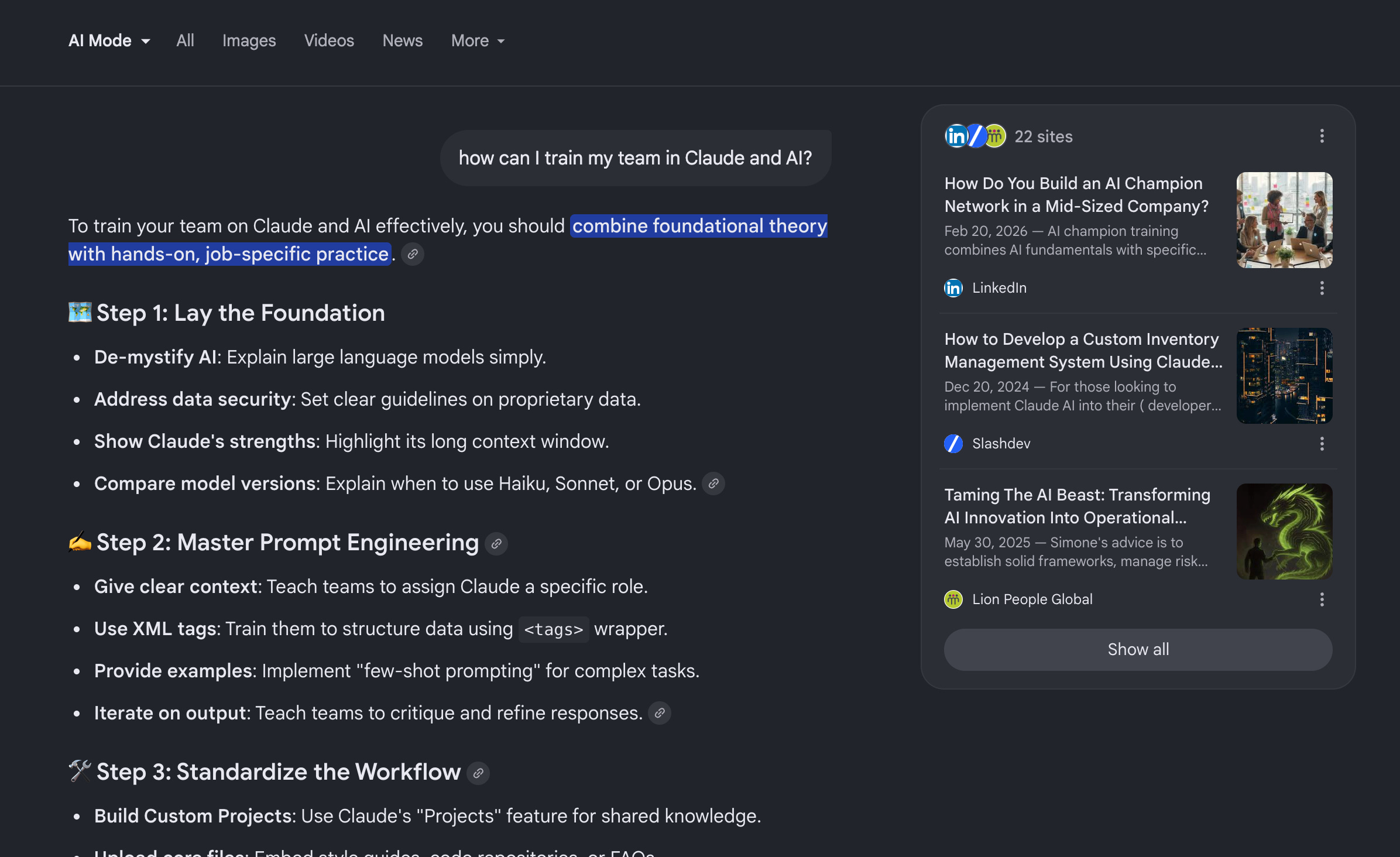
This is the single biggest structural change to the internet since Google launched in 1998 — and most business owners are sleepwalking through it.
Google rolled out the full version of AI Mode this week, built on its new Gemini 3.5 Flash model. Three numbers that should stop you cold:
1 billion monthly users of AI Mode (queries doubling every quarter)
2.5 billion monthly users seeing AI Overviews at the top of regular Google
75% of all queries are now resolved without users ever clicking a link
The new search box accepts text, images, files, video, and entire Chrome tabs as input. It generates custom layouts, interactive visuals, and mini-apps in real time inside the results page. Google is also launching “information agents” that quietly run in the background monitoring the web for you — apartment listings, product drops, market changes — and proactively surface updates without you searching.
Why you should care: Years of SEO work didn’t disappear, but the shape of getting found has permanently changed. You’re no longer trying to rank #1 on a list of links. You’re trying to be cited inside the AI answer. If your content isn’t structured for an AI model to extract, summarize, and credit you — you’re invisible. This affects every local business, every service provider, every SaaS, every e-commerce store. Nobody is exempt.
What this means for you (do this today):
Run our AI Visibility Dashboard audit (reply and I’ll send the link) — or do it manually: ask the same buying question in ChatGPT, Claude, Gemini, and Perplexity. If you’re not cited in 3 of 4, that’s your Q3 priority — not Q4.
Get your structured data tight. Schema markup, clean business info, machine-readable pricing, FAQs in plain language — this is the new “ranking signal.”
Stop writing 2,000-word blog posts to chase keywords. Start writing the answer a buyer would copy-paste. Short, opinionated, with your business named in the first 50 words.
This is exactly the playbook we run for clients now at LowCode Agency. If you want help thinking through which of your service pages should be retooled for AI extraction first, reply to this email — I’ll send you our 5-page audit template.
A startup called Liquid just shipped Co-Invest — an extension that lets you analyze markets and execute real trades directly inside ChatGPT and Claude. 500+ markets: crypto, equities, forex, prediction markets, even pre-IPO shares. Live in all 50 US states.
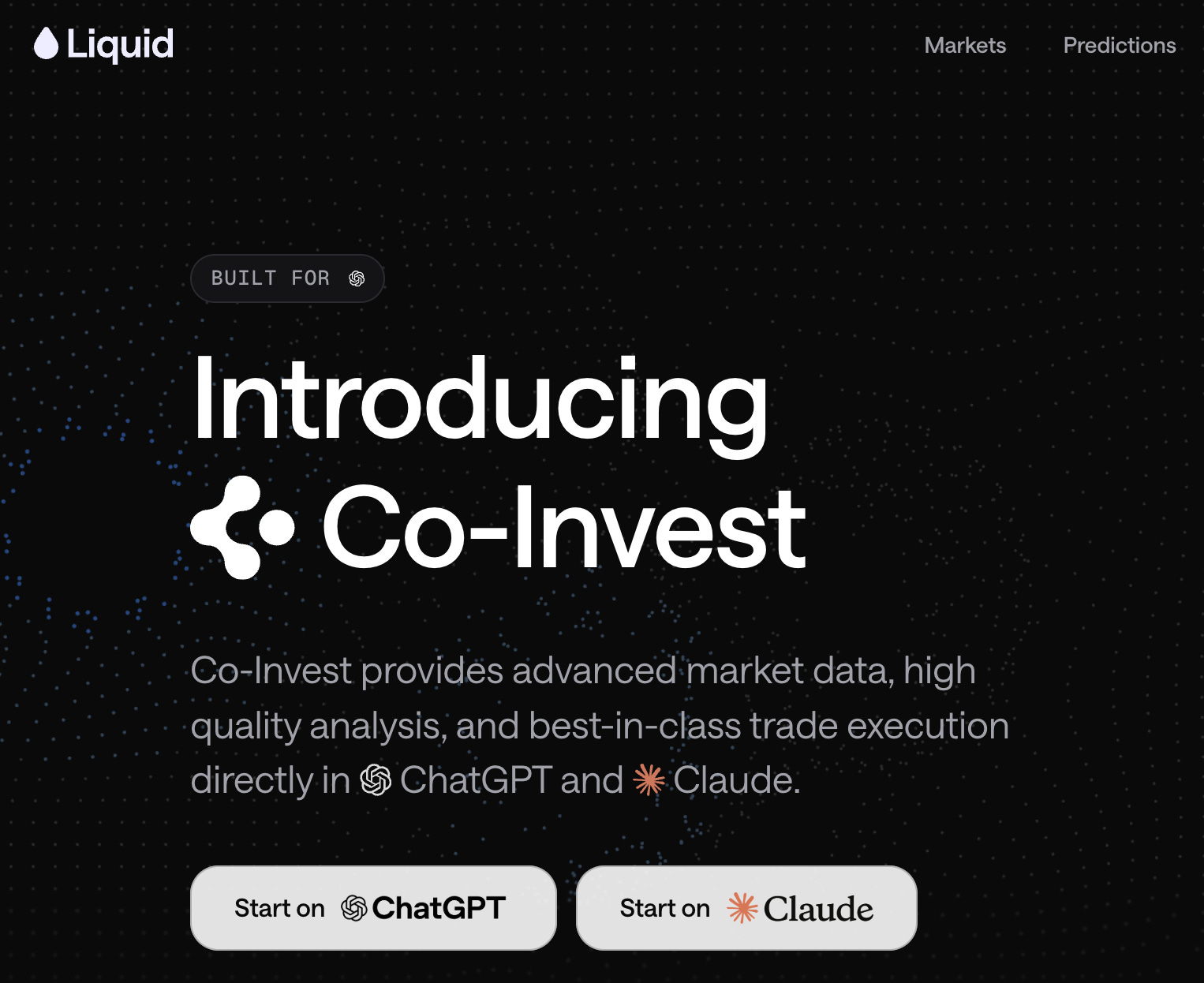
You fund the account, set stop-losses and take-profits, confirm orders — all inside a chat. No new app, no separate broker dashboard. ChatGPT becomes the trading terminal.
Why it matters for you: This is the canary, not the story. The story is: anything you currently log into a separate app to do — trading, booking travel, managing payroll, ordering inventory — is about to live inside ChatGPT or Claude. The same week, MoonPay launched crypto-in-ChatGPT and OpenAI shipped Plaid-powered personal finance tools. If you sell a SaaS or a marketplace, the “where the user starts their session” question just got terrifying. The starting point is now the chat window. Be where the chat sends them — or be invisible. (Same story as Google, different surface.)
Granite — Long-term document memory for your business. Drop in every file your team needs — contracts, SOPs, training docs, old proposals — no tagging, no folders. Then search in plain English: “what did we tell ClientX about their refund policy in Q3?” and it pulls the exact source. Try this: dump your top 50 client emails and your sales decks into it and ask “what objections have I lost deals over in the last year?” The answer will probably surprise you.
Mainframe — Turns the work your AI agents do behind the scenes into short recap videos for your team. Try this: if you’ve got an agent running overnight (research, lead enrichment, content drafting), set Mainframe to summarize what it did into a 90-second clip. This is the missing piece for “show your team what AI is actually doing” — and it’s the #1 reason teams stop trusting their AI tools (they can’t see the work).
Anthropic’s Project Glasswing found 10,000+ critical software vulnerabilities — Claude Mythos Preview autonomously identified 1,094 high/critical CVEs across major software. One bank partner used it to catch a fraudulent $1.5M wire transfer.
An AI agent got $10,000 and a public email address. Strangers showed up to talk it out of the money. — AgentMail handed an AI agent ten grand of real cash, pointed an inbox at it (freemoney@agentmail.co), and invited the internet to try to social-engineer it. Hundreds tried, some succeeded, the thing went viral.
Two weeks ago I was on stage at Anthropic’s Dallas build session demoing a system we run hourly at LowCode Agency:
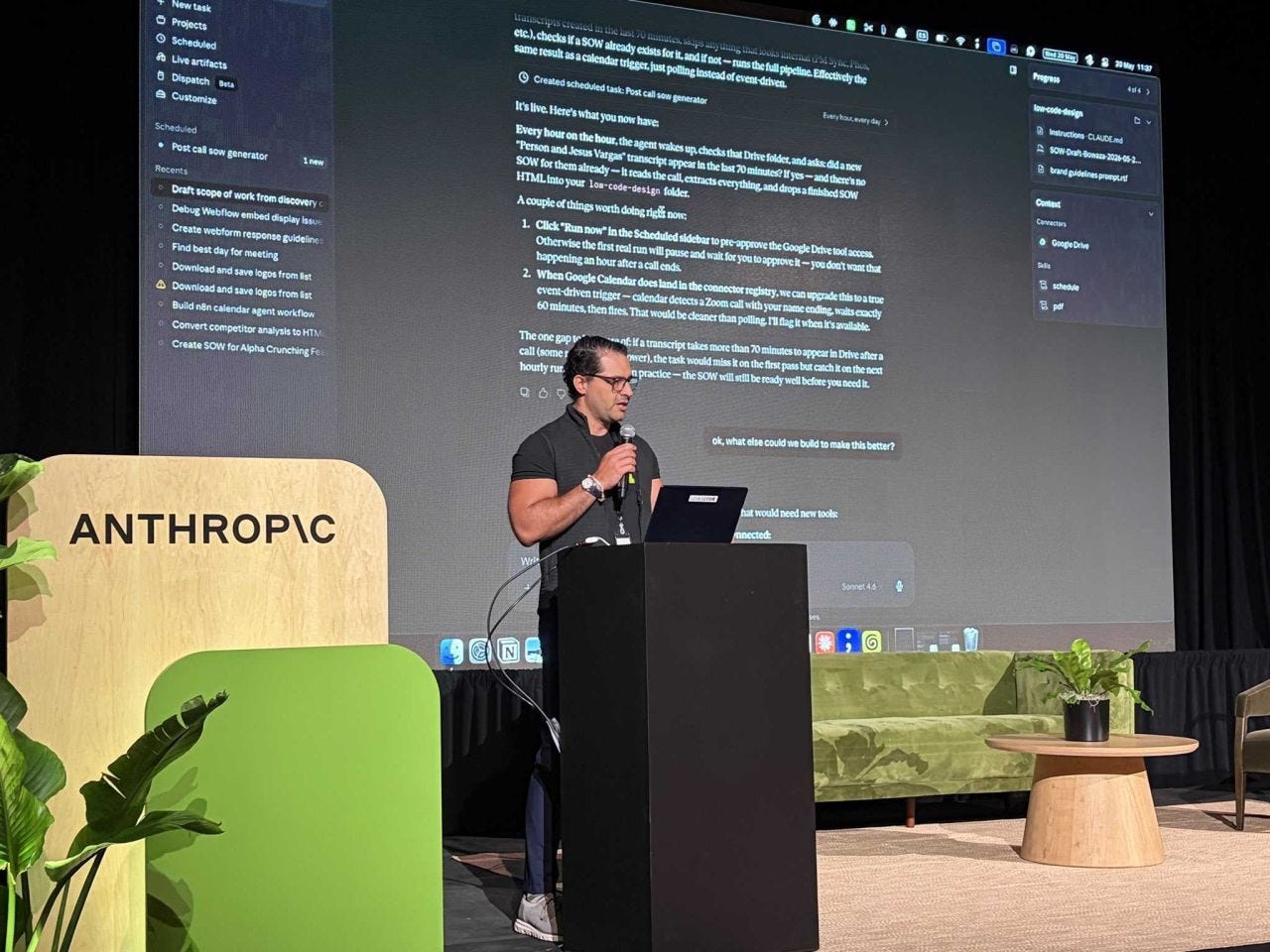
An AI agent wakes up on the hour, checks Google Drive for new client-call transcripts, drafts a finished Statement of Work, and drops it in the right folder — before anyone on the team has to ask for it.
The pitch isn’t the agent, it’s the production of it. Prototypes are easy. Hourly, reliable, doesn’t-need-babysitting production is the moat. Most “agent” demos die the second they’re handed off to a non-technical operator. Ours doesn’t, and that’s where the real margin is.
If you’ve got a workflow that works in your browser but never made it past one person’s laptop, reply to this email. That’s exactly the thing we like turning into a real agent at LowCode and at Phos AI Labs.
That’s your week in AI. Forward this to someone who keeps asking “should I be using AI?” — the answer is yes, and this newsletter is their starting point.
No posts
Comments
Nothing yet. Say the first thing.
Sign in to join the conversation.