
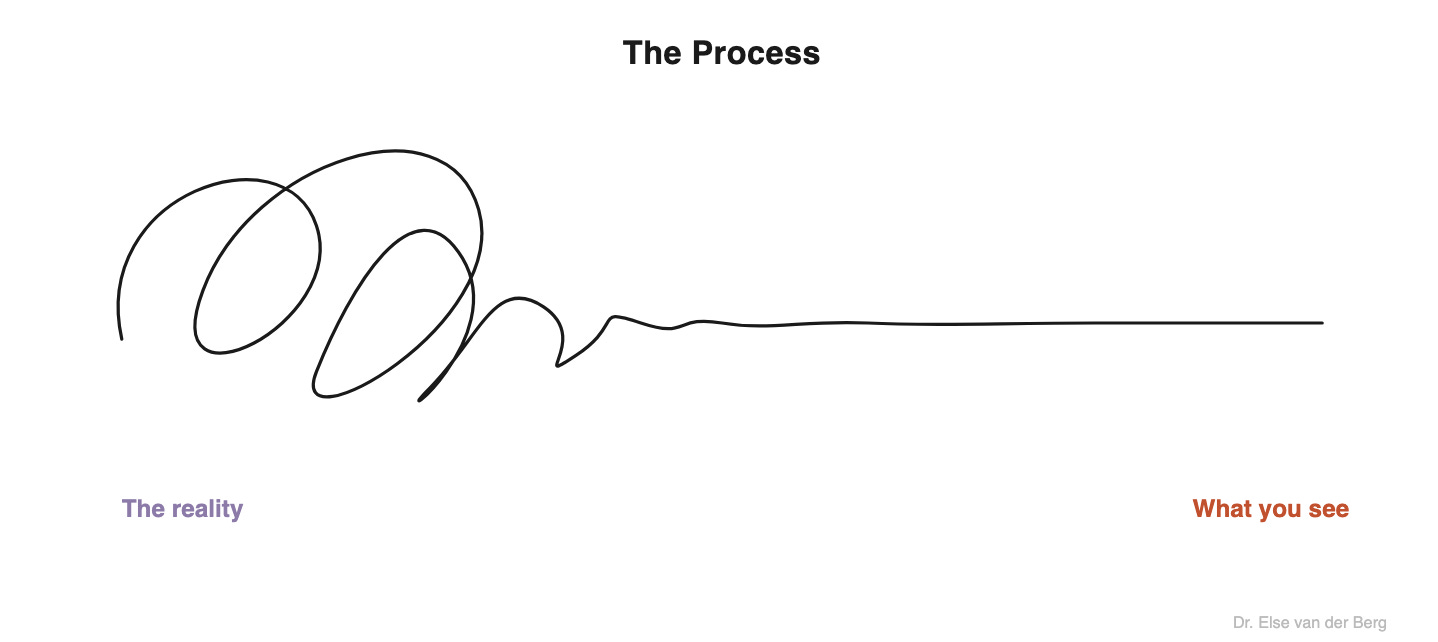
Two women came up to me recently, separately, and said roughly the same thing: “I read your articles on how you use AI - You’re so far ahead, I’ll never catch up.”
That’s the exact opposite of what I’m trying to do. I try to write concrete, step-by-step pieces specifically to make this stuff accessible. Here’s the prompt, here’s the output, here’s the file structure - go build it yourself.
But for some readers, all that detail tells them “forget it, you’re too far gone”.
So let me set the record straight.
There’s a huge difference between being a “prolific AI experimenter” and “10x effectiveness”.
I’ve vibe-coded several Python-based agents, subagents, skills, orchestrators and what have you - that I never use. I’d estimate 80% of what I’ve built with AI is stuff I tried, learned something from, and threw away.
And yes, I feel conflicted about the wastefulness of it all. I still have not reconciled my joy of (and need for) playing with AI, with the environmental and societal impact of it all.
What I can tell you, is that the things that actually made me more effective addressed the biggest bottleneck I was facing in my workflow. And like with product management, the first solution I pursued was never the best. It took lots of iteration and questioning both myself and Claude Code.
That’s a Pareto distribution most people don’t see. They see the prolific output and assume proportional effectiveness gains. But in reality, volume of experimentation and actual lift in your work have a surprisingly weak relationship.
There’s also a structural advantage people forget: this is literally my job. I work on projects where experimenting with AI in product workflows is part of the description. Most people don’t have that luxury. If your job doesn’t create space for this, you’re not “behind” - you have different constraints. And telling yourself to do it on evenings and weekends when you have a life, maybe a family, maybe just hobbies you enjoy - that’s not a real answer.
Most people have normal J-O-B-S that keep them stuck in meetings, and give them little room to experiment with AI. That means most people are where you are, not where the Substack evangelists (myself included) are.
Perhaps this can be a good starting point: Carve out 30 minutes of your workday. Tell your agent of choice (Claude Code, Claude Cowork, GPT 5.4 Codex, they’re all good) about the biggest bottleneck in your work, and just vibe with it. Time-box yourself (it’s so easy to go down the rabbit hole). You would have easily spent those 30 minutes sitting in a useless meeting or crafting a PRD that no one reads.
I have 15 years of product management experience, and I’ve built an audience on that foundation. When I write about how I use AI, readers unconsciously transfer the credibility. “She knows PM quite well, so she must know a lot about AI too.” But nobody is an expert at something this new and this fast-moving. We’re all just people trying to figure it out as we go along (although there are definitely people who score higher on the “expert” bar than I do).
I’ve spent years learning about product management. Getting good at synthesis, at connecting qualitative and quantitative data, at coaching teams through discovery. And now, someone could take all my content, feed it into a model, and build an AI coach without the human bias or memory loss.
I can totally imagine what an autonomous Product Management agent will look like.
At this point - how many of the skills I’ve been banking on for years are still valuable? Elena Verna wrote a very honest article about how she is “mourning her skillset”. It’s disorienting for all of us.
This is where I think I’m gonna be OK:
Anything that doesn’t happen on a computer screen. For product management: anything that works better in human-to-human interaction, or that requires a physical body. I recently wrote about ethnograph - spending a day (or more) at a customer’s job site. AI can’t walk into an office and observe, and it will be while before humans will be comfortable havin an unfamiliar robot wheeling around.
We haven’t been doing nearly enough of this type of research - not because we couldn’t, but because we’ve been too busy sitting behind screens. There’s enormous value in the physical, human-to-human work that most product teams have neglected for years. I personally also find it the more interesting part.
Human taste and judgment. AI has developed something that looks a lot like taste. But at least for now (maybe until forever - I honestly don’t know) We still need our own judgment. Knowing which insight to pursue, which signal to trust, which bet to make with incomplete information.
Have you touched grass today?
I’m not trying to be flippant, I mean it as possibly the most important point. I have two young children, so I spend a lot of time on playgrounds, going down slides, touching grass. It really helps.
Stepping away from it all and doing something completely different is the best way to enable your brain to handle all this new, terrifying input. What doesn’t help is staying up at night desperately trying to consume all the content and installing ALL THE SKILLS.
At the end of the day, it’s just software. Most of us are building silly stuff. B2B software to make it slightly easier to plan a project, or a B2C app to make it easier to order food, or something along those lines.
Very few of us are building the software to diagnose cancer sooner or slow down the warming of the earth.
So for most of us, none of it really matters. Did I just say that out loud?
I sometimes picture myself lying on a beach, watching a wave approach. I can either tense up, anxious about getting wet - or I can lie back and let it wash over me and see what happens.
I’m gonna go with the latter approach. Not out of confidence, but out of acceptance. Most of us are going to be fine. The work will change, for sure, but it might actually get more interesting.
(a bit random, but I recommend Noah Smith’s recent article on “salarymen”, interesting theory on HOW work will change)
No posts
Comments
Nothing yet. Say the first thing.
Sign in to join the conversation.