
At the opening match of the Football World Cup at Estadio Ciudad de México, the official price of some tickets hovered around $300. According to figures released by FIFA, certain tickets allocated to Mexican residents could be purchased for between $60 and $75. Yet interviews with fans who attended the match revealed that many had paid close to $1,000 per ticket, while resale prices in some cases tripled that amount.
The historical comparison is even more revealing. During the 1970 World Cup in Mexico, it is estimated that a Mexican worker needed roughly one day’s wages to purchase the cheapest ticket. For this World Cup, by contrast, nearly twenty-four daily minimum wages are required to obtain a comparable seat. Even before the tournament began, many media outlets were already describing it as the most expensive World Cup in history. The reasons seemed obvious: a competition spread across three countries entails transportation, accommodation, food, and ticket costs that can hardly be considered accessible for the majority of people.
FIFA itself has reinforced this logic of exclusivity. Broadcasting rights reached multimillion-dollar figures for television networks, while in countries such as Mexico, bars and restaurants were required to pay special licensing fees in order to show the matches, something that had not previously been part of the everyday experience of the tournament.
Yet the opening of the World Cup also highlighted another phenomenon that appears increasingly common in contemporary societies: the enjoyment of others’ enjoyment.
In the days surrounding the opening match, hundreds of videos began circulating online. Fans—or perhaps, more accurately, content creators—filmed themselves throughout the event. Because of legal restrictions on recording the match itself, many chose to capture only their reactions. As a result, thousands of people found themselves watching not the game, but someone else watching the game.
If attending a World Cup is already difficult for most people, attending the opening match has become a privilege reserved for celebrities, politicians, former footballers, affluent sectors of society and, increasingly, influencers invited by brands. Some of these creators justified their presence by arguing that they had worked hard to earn that privileged position. And indeed, there is nothing inherently objectionable about that. Content creators perform a particular function within the contemporary digital economy. Their work consists precisely in transforming experiences into consumable narratives.
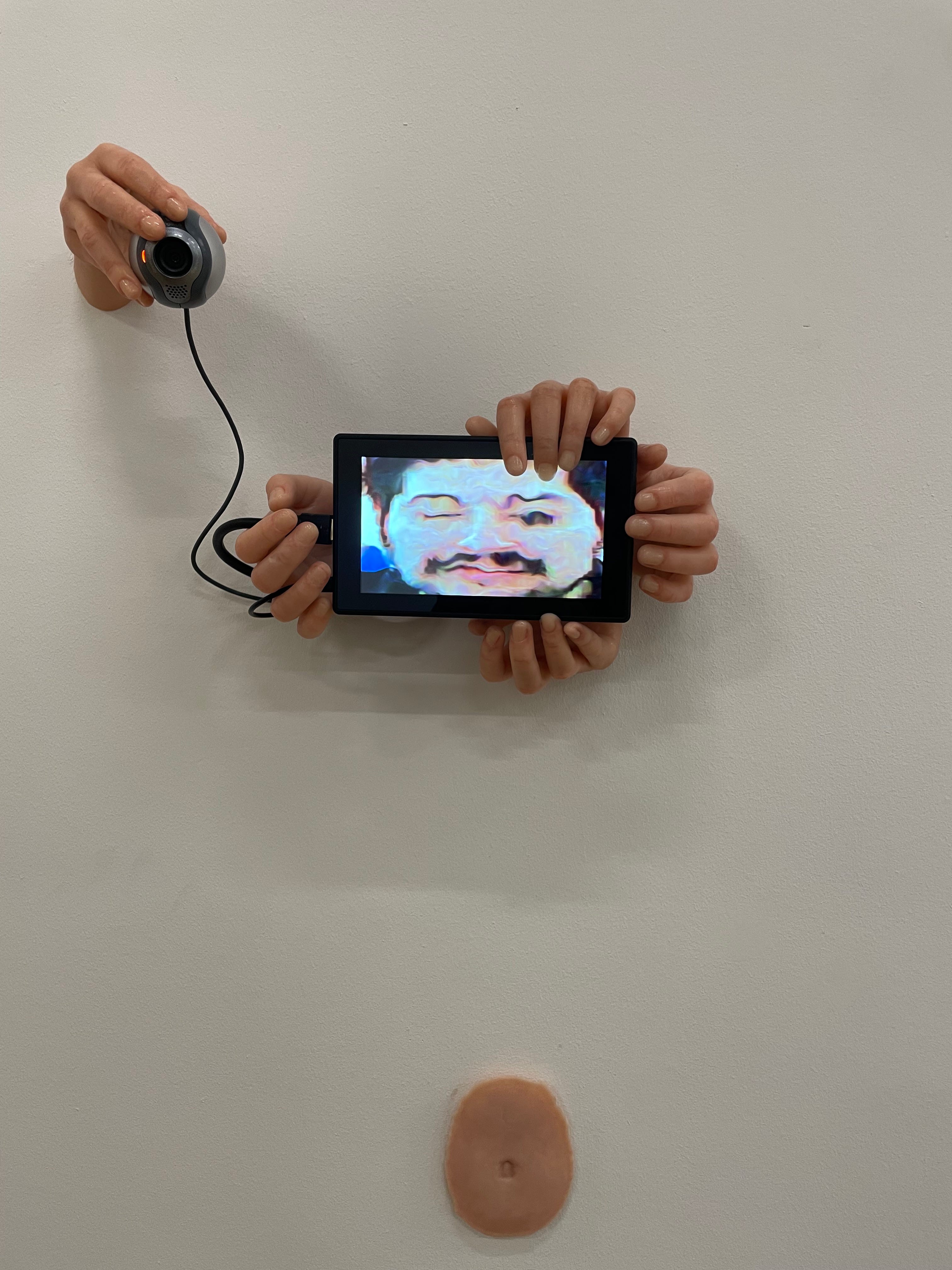
An artwork from the Stedelijk Museum's collection in 2024, in which my own face appears distorted, almost dissolving into its own image.
Nevertheless, the phenomenon raises a broader question: who has access to these kinds of events? And why does it seem that fewer and fewer people are able to experience them directly?
What was once a relatively accessible celebration for broad sectors of society appears to be gradually transforming into a premium product. Direct participation diminishes while the number of spectators watching others enjoy the experience continues to grow.
These changes are not limited to football. Something similar is happening in the world of food.
Every day, millions of people consume mukbang videos, restaurant reviews, food tours, and international travel content in which creators show what they eat, where they eat, and how viewers should feel if they ever taste those same dishes. We are no longer simply observing food; we are observing people enjoying food.
Long before social media existed, Alfred Hitchcock explored a similar idea in Rear Window. From his apartment window, the protagonist watched the lives of his neighbours while they, consciously or unconsciously, participated in this mutual game of observation. The difference today is that we are no longer watching a handful of neighbours. Through our phones, we observe thousands of fragments of other people’s lives originating from every corner of the world. The scope of what we see is limited only by the algorithm.

Hitchcock, Alfred, dir. Rear Window, 1954.
The power social media has exerted over individuals has been overwhelming. Today, people who are only slightly more visible than others shape trends regarding how we should dress, where we should travel, which cities we should visit, and which restaurants we should try. The spectator becomes dependent upon opinions whose legitimacy derives less from expertise than from follower counts and the brands that support them.
In this sense, ordinary individuals exist in a state of perpetual anaesthesia. We spend hours watching people inside football stadiums, walking through cities we dream of visiting, and tasting dishes we may never have the opportunity to try ourselves. When we awaken from this contemplative state, we return to our everyday routines: work, a generic Netflix series, and a frozen pizza bearing little resemblance to the one our favourite influencer was eating in Naples.
Yet behind these images lies a persistent message: one day you too will be able to live this experience. Anyone can get there. You simply need to work a little harder.
The promise is seductive because it transforms extraordinary experiences into seemingly attainable aspirations. At the same time, it generates impossible expectations. The pizza is no longer simply a pizza; it must be the best pizza of your life. The restaurant is no longer merely a restaurant; it must become a transformative experience.
One of the central conflicts surrounding this phenomenon is that experiences historically intended for the masses appear to be becoming increasingly inaccessible. What was once a relatively attainable experience—such as attending a World Cup match, especially for local residents—has gradually become a VIP experience designed for sponsors, invited guests, and brand representatives. Meanwhile, the masses settle for fan zones, where paradoxically one often finds more passion, excitement, and community than inside many exclusive spaces.
The same pattern can be observed in other dimensions of everyday life. Going out for dinner, attending a concert, meeting friends at a bar, or even purchasing a decent weekly grocery basket has become increasingly expensive.
Social media contributes to this process by constructing narratives aligned with commercial interests. Spectators receive carefully edited versions of reality and develop expectations regarding how a particular experience should feel.
Here it is useful to revisit an idea proposed by Jean Baudrillard. For him, simulation emerges when representation becomes more important than that which it represents. In this sense, the contemporary World Cup exists as much on social media as it does inside stadiums. The match itself becomes little more than an excuse for producing an endless stream of images, reactions, clips, memes, and posts. What generates economic and emotional value is no longer solely the sporting event itself, but everything produced around it.
It no longer matters only how Cristiano Ronaldo played or what tactical adjustments a national team made. What spectators receive are millions of filtered, edited images distributed at a speed impossible to metabolise. The event fragments into an endless succession of content.
Dublin’s gastronomic landscape is not so different.
For all the claims that food is the most democratic of the arts, this assertion seems increasingly detached from reality. There is no time to share a table, no time to cook, and often no time to sit down and enjoy a meal. Many restaurants are booked weeks in advance, and even food markets frequently require admission fees.
Food culture in Ireland appears to be shifting towards an experience represented by others. While a considerable portion of the population watches food influencers tour Dublin’s most celebrated restaurants, many others resolve their daily meals with a chicken fillet roll from Dunnes Stores or a Tayto Meal Deal.
The gastronomic city exists, but not necessarily for everyone.
What exactly are we consuming when we arrive at the newest viral pizzeria or restaurant? How is our taste constructed? Do we still possess enough confidence to form our own judgments when trying something for the first time? Or are we simply guided by the opinions of our trusted influencers?
In many ways, we arrive already conditioned. When a content creator uploads a video asking, “Is this Dublin’s best pizza?” or “The best Mexican restaurant in Ireland?”, perhaps we should become suspicious. Such titles function as lures designed to capture attention and construct anticipation. Before tasting the dish, a narrative already exists around it. Before sitting at the table, we already possess a preconceived idea of how it should taste, feel, and affect us.
Although Dublin increasingly presents itself as a cosmopolitan city full of exciting culinary possibilities, it is also true that a significant proportion of the population cannot access these spaces with the frequency social media suggests. The cost-of-living crisis, the housing crisis, and the lack of time mean that many of these experiences are more visible than accessible.
Yet perhaps the problem is not only economic. Nor is it about criticising people for having favourite restaurants. The problem emerges when gastronomic experience is reduced to a small catalogue of places validated by algorithms, brands, and influencers.
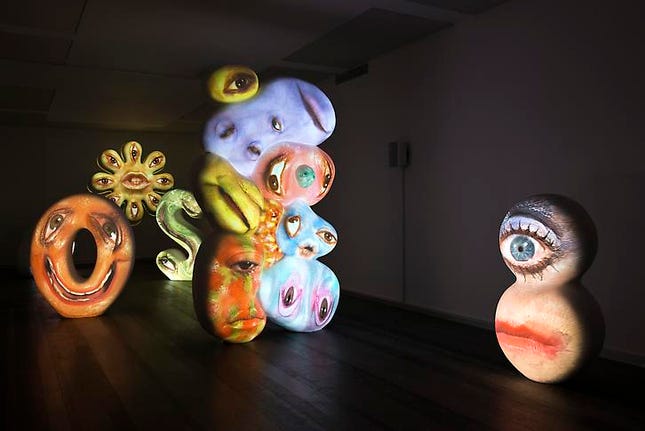
Tony Oursler, "agentic iced etcetera," installation view, 2013. PinchukArtCentre, Ukraine.
Ideally-in my crazy dreams- a person should struggle to answer the question of which restaurant is their favourite. They should be able to name twenty different places. Restaurants, cafés, street vendors, food markets, family recipes, or the meal a friend cooked for them when they were sick. Taste should be built through interpersonal experiences rather than digital recommendations alone.
Because food has never been solely about technical quality. It is also made of affection, memory, encounters, and context. A soup can be extraordinary not because of its ingredients, but because of the person who prepared it. Perhaps one of the quietest consequences of the attention economy is that it becomes increasingly difficult to think for ourselves. We become accustomed to having others speak for us, choose for us, and validate our choices. We outsource our judgment to people whose authority derives from visibility, follower counts, and sponsorships.The consequence is not merely a homogenisation of taste. It is also a gradual erosion of our capacity to be surprised.
In the end, the dilemma appears remarkably similar to the one revealed by the World Cup’s opening match. We can settle for enjoying the enjoyment of others, watching from a distance those who have access to certain experiences and adopting their perspective as our own. Or we can attempt to recover something more difficult, yet perhaps more valuable: the possibility of building a personal relationship with what we see, what we experience, and what we eat.
Because ultimately, the greatest risk is not being excluded from the trendiest restaurant or the most exclusive stadium. The greatest risk is forgetting how to think, feel, and taste for ourselves.
No posts
Comments
Nothing yet. Say the first thing.
Sign in to join the conversation.