
Last week, I went to see The Odyssey, Christopher Nolan’s much-discussed new film. Everyone will probably have their own favourite scenes or characters, but the one that stayed with me the most was when Odysseus and his crew arrive on an island and, while exploring the landscape, discover a cave filled with cheese, some of which they immediately begin to eat. To their surprise, the Cyclops Polyphemus returns with his flock of sheep, and we realise that the cave is, in fact, his home. He seals the entrance with a massive boulder, trapping Odysseus and his men inside.
Unlike in the original poem, Nolan portrays the Cyclops as a much quieter figure who, through the eyes of the Greeks, appears utterly monstrous and incomprehensible. Upon discovering the intruders inside his home, he devours two of the soldiers before eventually falling asleep. Odysseus then devises a plan to escape. During the night, the men heat a giant wooden stake in the fire and drive it into the Cyclops’ single eye. Overcome with unbearable pain, Polyphemus calls upon Poseidon to curse Odysseus and his crew throughout the long journey that lies ahead. Once they manage to escape, Odysseus cannot resist provoking him one last time. Enraged, Polyphemus chases them all the way to the shore. Odysseus and his men eventually reach their ship safely, but they remain hungry and with no clear sense of where to go next.
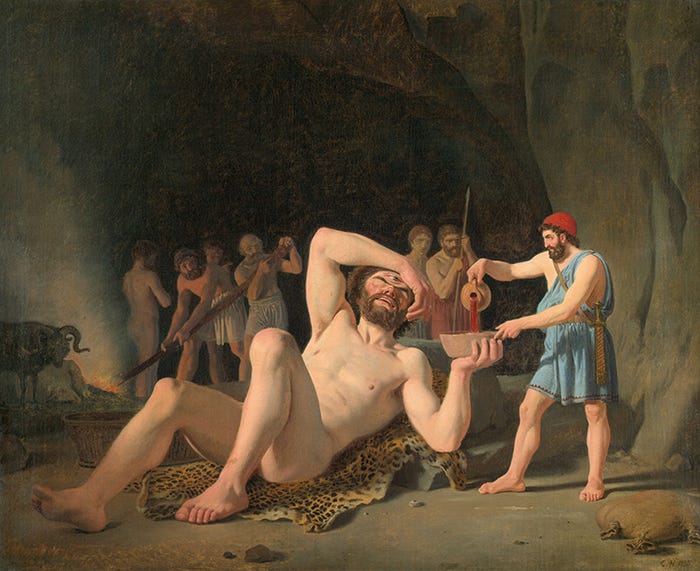
Odysseus in the Cave of Polyphemus, by Constantine Hansen, 1835
This was the scene that struck me the most because, on the one hand, it illustrates the impossibility of dialogue between the Cyclops—who, in theory, should be the host—and Odysseus and his men, who arrive as guests. Yet at the same time, the Greeks assume that the cheese belongs to them, that they will be welcomed and offered hospitality, while simultaneously taking for granted that the other is a monster, someone incapable of speech or reason. From the very beginning, the relationship is profoundly unequal. Here, the tension between hospitality and hostility emerges, becoming one of the central forces that shapes Odysseus’ entire journey back to Ithaca.
As a result, the encounter between Odysseus, his soldiers and the Cyclops becomes a failed encounter between strangers. Across the centuries, very little seems to have changed. The other continues to appear as an enemy, a threat, a stranger who must be controlled, governed and, at times, expelled or even destroyed.
There are moments when food can become a bridge between strangers, creating spaces where these tensions give way to an embrace, to an act of love through alterity. A smile, too, can soften the tension between two strangers crossing paths on the street. But it is not always enough. Our bodies have already been categorised according to the colour of our skin, our gender, our gestures and the language we speak.
In a recent article, Jennie Moran argues that hospitality is only possible when it is detached from the word industry. In her view, hospitality can flourish within a beautiful system where people from every corner of the world are able to enter unfamiliar spaces and strangers can genuinely encounter one another. Moran illustrates this through a personal experience. While sitting in the waiting room of a hospital during a particularly difficult moment, a cup of tea suddenly appeared on the table beside her. A member of staff had quietly placed it there, said nothing, and walked away a few seconds later. For Jennie, this simple gesture represented a pure act of hospitality: a form of love that expects nothing in return, a selfless act, a temporary agreement grounded in silent trust between two strangers.
Today, these kinds of encounters seem increasingly rare. We walk to work or back home, passing hundreds of strangers along the way. We board buses and trains, sitting only inches away from other people, yet we choose to look down at our phones, liking the lives of strangers we will probably never meet. Perhaps this is why artists, cooks and facilitators continue creating events and spaces that attempt to bring strangers together, hoping that, even if only for a few hours, a gesture of spontaneity might emerge.
If we stop on the main street of almost any city, we find ourselves surrounded by industries constantly talking about hospitality: hotels, restaurants, Airbnb, and universities offering degrees in hospitality management. It is almost taken for granted that simply speaking about hospitality somehow guarantees its existence. Yet commercial hospitality has been designed to be regulated, standardised and consumed by customers who do not want surprises, tension or uncertainty. Hospitality becomes another commodity, appearing at the bottom of the bill as a service charge. It is also sold as an experience: wine tastings, supper clubs, pop-ups and corporate retreats. Even large technology companies allocate dedicated budgets so their employees can enjoy memorable experiences—although rarely memorable enough to encourage them to question the ethics of the companies paying for them.
This is precisely where those of us working within the cultural industries should begin questioning our own role. We create experiences that seek to stimulate the senses of those who attend, hoping that, if only for a few hours, they might awaken from the sedation of the digital age. We live in a society that possesses fewer and fewer tools for independent thought while, paradoxically, relying on technologies specifically designed to think on our behalf.
Creating an experience that genuinely facilitates meaningful encounters between strangers is no easy task. It requires creating a space where, if only briefly, people can let go of their social conventions and the masks they habitually wear. The British psychoanalyst Donald Winnicott developed the concept of the false self, a kind of mask that initially allows individuals to adapt to society, its norms and expectations. The problem arises when this adaptation becomes excessive and people begin living solely according to what others expect of them. Their spontaneity, emotions and desires become hidden behind this false self. Perhaps one of the greatest challenges of any hospitable space is to create the conditions in which people can set aside that mask, even for a few hours, and encounter one another from a more authentic place.
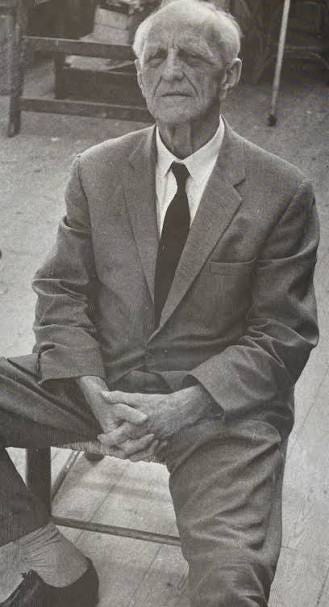
Donald Winnicott
At the same time, we live in an era in which the hospitality industry seems obsessed with measuring everything: productivity, creativity and performance. Rankings and ratings have become our primary criteria for choosing restaurants and experiences. We seek out places with the most certifications, the highest number of Michelin stars, the best Google reviews or the restaurant recommended by an influencer in a thirty-second reel. But how could we possibly quantify the spontaneous gesture of the woman who quietly placed a cup of tea beside someone who was suffering? How could we translate into stars or ratings the warmth of an act capable of holding another person’s pain as though it were an embrace? How do we measure the hospitality of a mother preparing a bowl of fideo soup and tortillas for her child without expecting anything in return?

It is said that a simple bowl of fideo soup, prepared with selfless love, can quiet the deepest anxieties and soothe the most profound sorrows of the heart
No posts
Comments
Nothing yet. Say the first thing.
Sign in to join the conversation.