
Recently, The National Party published a post on its Facebook page claiming that Irish women are under threat because of multicultural Ireland. It made me think that perhaps they are right. Perhaps we should be concerned not only about safety. Following their logic, the impact of multiculturalism would extend much further: immigrants would gradually occupy the streets, become an increasingly larger share of the population, and, inevitably, impose their customs, their culture and, of course, their food.

I am not Irish, so perhaps it is not my place to say. Still, if we follow the party’s reasoning, it seems inevitable to wonder what will happen to Irish cuisine as more immigrants continue to arrive, both legally and irregularly. More Ethiopian, Chinese, Mexican, Brazilian, Syrian and Nigerian restaurants open every year. If this trend continues, what will become of Irish food? Will the Irish continue eating as they always have, or will they inevitably find themselves surrounded by spices, tortillas and unfamiliar fermented foods?
Imagine the scenario a few years from now. The streets of Dublin will be lined with street vendors selling exotic dishes on every corner. Surely this would represent a serious threat to public health. One only has to look at Oaxaca, Mexico, where it is perfectly common to find women selling chapulines—grasshoppers. Yes, insects. Now imagine, for a moment, vendors selling insects in the heart of Dublin. What could possibly come next?
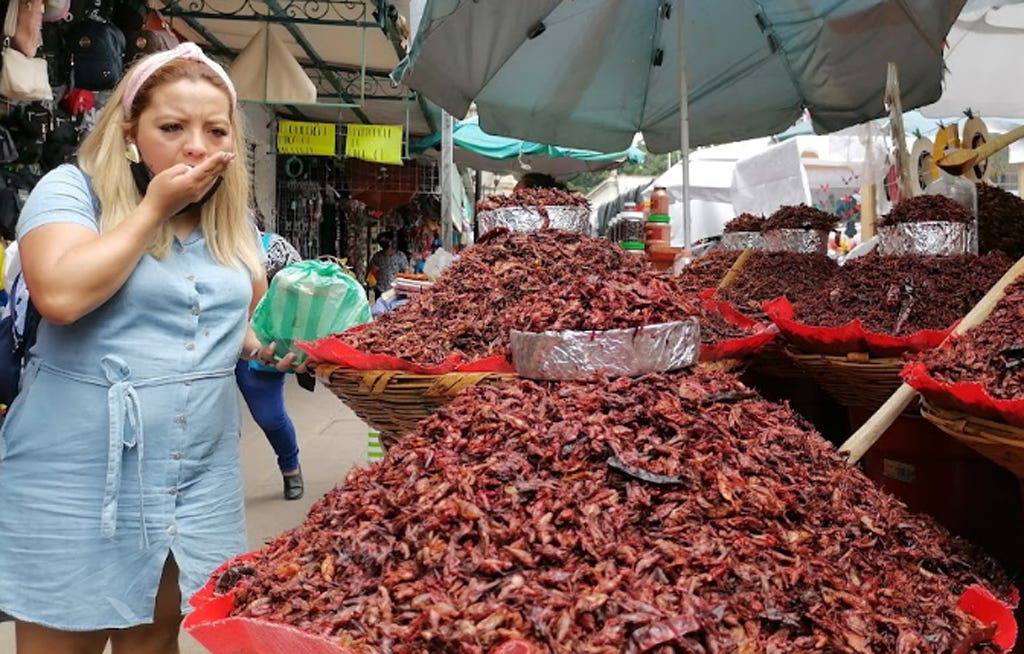
A chapulines stall outside a market in Oaxaca.
Statistics show that, since around 2015, Ireland has experienced a significant increase in immigration from what is commonly referred to as the Global South. India, Brazil, Nigeria, the Philippines, China, Pakistan, South Africa and, to a lesser extent, Mexico are among the countries whose populations have grown the most. If multiculturalism truly poses a threat to national identity, then it would seem logical to conclude that it also threatens Irish culinary identity.
But, to be fair, the National Party would probably argue that some immigrants are more welcome than others. European migrants appear to belong to an entirely different category. The French and the Italians have spent decades enriching international gastronomy without anyone questioning their presence. They represent haute cuisine, refinement and culinary culture. The problem, it would seem, begins when those arriving come from the Global South.
But this raises a question that seems worth asking in gastronomic terms: why are Escargots de Bourgogne perceived as a form of cultural enrichment, while tripe stew, a plate of beef tripe, tacos filled with beef eye or tongue, are so often relegated to the category of popular, marginal or lower-prestige cuisine?
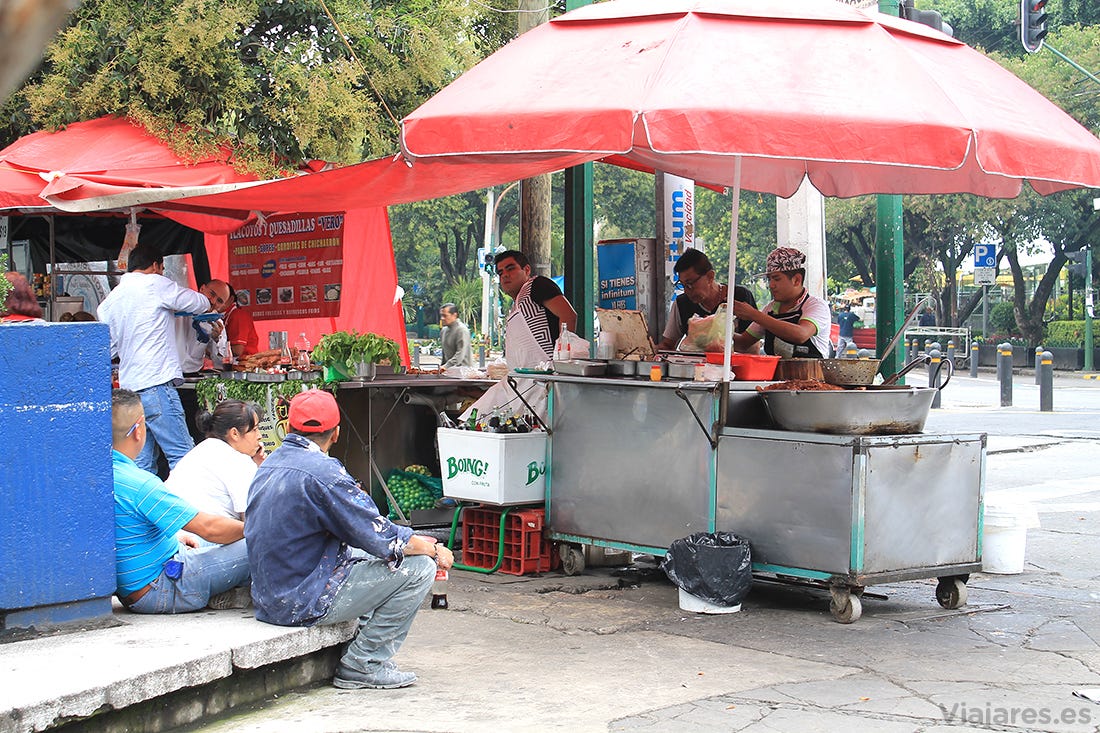
Working-class people enjoying tacos from a street vendor
In The Coloniality of Modern Taste, Zilkia Janer devotes an entire chapter, “Racializing Taste,” to dismantling this way of thinking. She challenges the idea, inherited from philosophers such as Kant and Hume, that there exists a universal faculty of taste capable of objectively distinguishing what is beautiful, refined and correct. What we commonly call “good taste,” Janer argues, is not a universal truth but rather the historical product of the Europeanisation of taste.
The culinary preferences of European elites eventually became the standard against which all other food cultures were measured. Taste ceased to be an individual experience and instead became a mechanism of cultural classification. If colonialism racialised bodies, it also racialised flavours.
European cuisines came to be described as balanced, clean, rational and sophisticated. By contrast, the cuisines of colonised peoples were portrayed as excessively spiced, primitive, irrational or even dirty. Eating with one’s hands could be interpreted as a sign of backwardness; eating with cutlery, as a mark of civilisation. A curry was “too strong”; a mole “too complex”; a taco “messy.” These were not merely gastronomic opinions but cultural judgements that legitimised a hierarchy between peoples.
In Mexico, one could also argue that immigration profoundly transformed our cuisine. During the 1920s, Lebanese immigrants who settled in Puebla introduced culinary techniques that gave rise to tacos árabes and, decades later, to the taco al pastor. In Mexicali, Chinese immigration permanently reshaped the city’s gastronomic culture. Today, it is not unusual for families to gather on weekends around fried rice, carnitas coloradas or chipotle prawns. Out of the encounter between Cantonese techniques, local ingredients and Mexican customs emerged a Chinese-Mexican cuisine that has become inseparable from the region’s culinary identity.
If we followed the National Party’s reasoning, we would have to conclude that these migrations destroyed the Mexican true identity. We would have to lament that tacos al pastor displaced a supposedly pure Mexican cuisine, or that families in Mexicali no longer eat exclusively “traditional” dishes. So why should the same not happen to the eating habits of Irish families?
This is my modest proposal: The National Party should draw up an official cookbook of patriotic foods. Every ingredient would have to be carefully audited to ensure that it would never be allowed to cross the border again. After all, if ingredients, spices and herbs continue to travel across borders, they too become agents of multiculturalism, surely a dangerous prospect for those determined to preserve an untouched and homogeneous vision of Irish tradition. Potatoes would have to disappear because of their Andean origins; tea because it came from Asia; sugar because of its colonial history; whisky, if one considers the exchanges of techniques and raw materials that made its modern production possible. Perhaps the only truly nationalist menu would be one without spices, coffee, chocolate, tomatoes, maize or, of course, potatoes.
Who is the National Party?
For readers who may not be familiar with it, the National Party is an Irish far-right political party associated with anti-immigration policies, opposition to abortion, and the promotion of remigration. It advocates a homogeneous conception of Irish national identity. Its leader, Justin Barrett, is known for promoting a traditional vision of the family and for opposing multiculturalism, a position that is reflected in the party’s public campaigns and political messaging.
Although the National Party has not yet secured significant representation in the Irish Parliament, it has gradually gained visibility through social media and public debates surrounding immigration, asylum and national identity. For this reason, it is worth paying attention to the party and its representatives—not because of their electoral success, but because they reflect broader anxieties and exclusionary forms of nationalism that have become increasingly visible within Irish public discourse. Understanding these movements is essential if we are to critically examine how racism, nationalism and anti-immigrant sentiment can become normalised within political institutions and society more broadly.
No posts
Comments
Nothing yet. Say the first thing.
Sign in to join the conversation.