
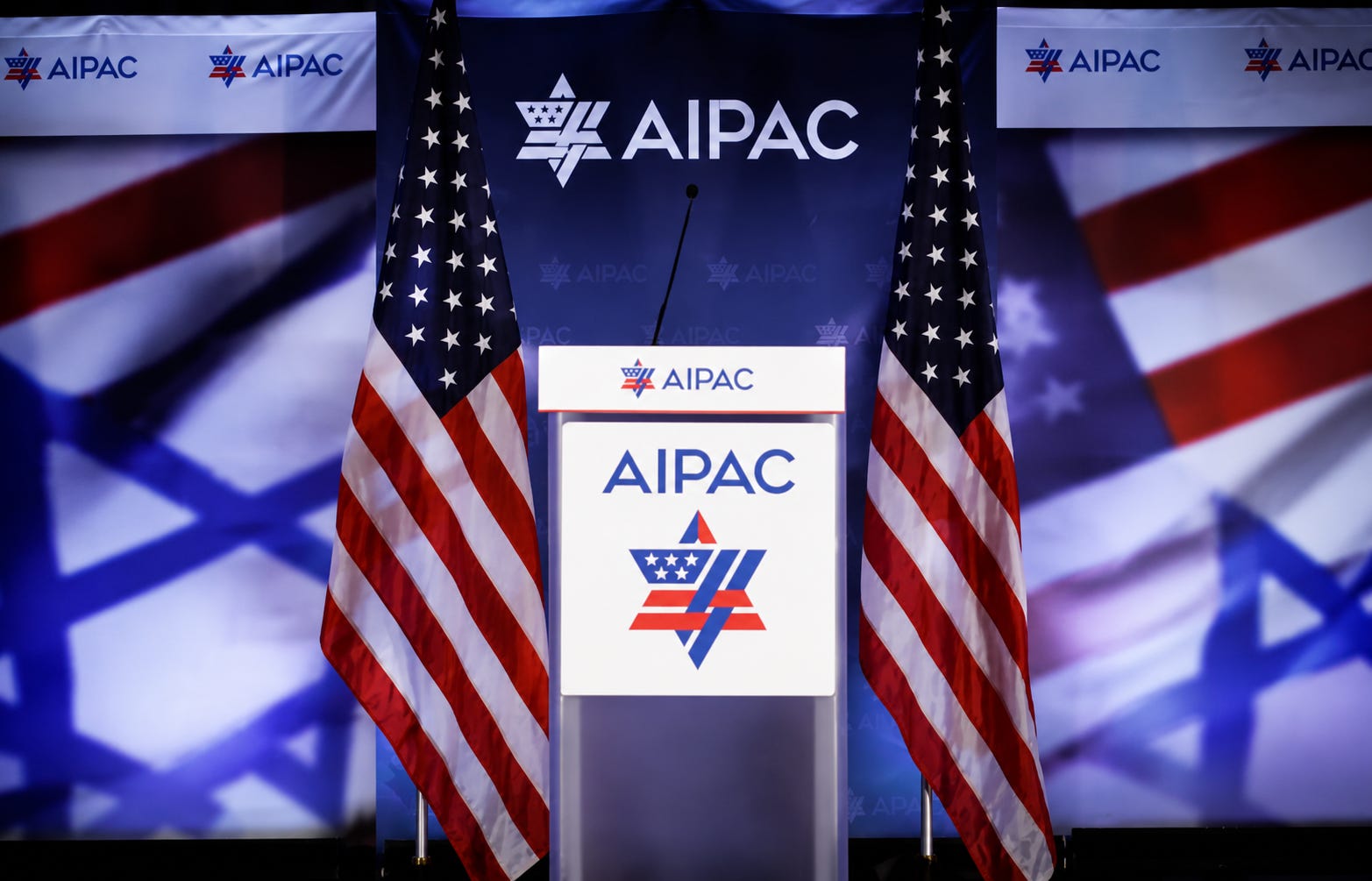
I love Wikipedia. It’s a fabulous resource. But I had a hunch that when I looked up the American Israel Public Affairs Committee, better known as AIPAC, I wasn’t going to like what I found.
Unfortunately, I was right.
According to Wikipedia, “The American Israel Public Affairs Committee is an American pro-Israel lobbying group that advocates for policies strengthening the U.S.–Israel relationship.”
The definition reads, at best, like cynical propaganda and, at worst, like a compendium of lies. But I am loath to blame solely the website or its community of contributors, because what you find there merely echoes what you hear from almost every pundit, television talking head, politician, and mainstream media journalist.
And yet, almost no one I know, Jewish or otherwise, would describe AIPAC in these terms. And that includes longtime supporters of the Jewish state and people with deep ties to Israel. The chasm between this benign public description and the much darker reality of what AIPAC has become has generated a great deal of understandable anger.
This is not a matter of semantics. It reflects a profound disconnect over what it means to support Israel, what kind of relationship the United States should have with it, and who gets to define the terms of that relationship.
Looking again at the Wikipedia definition, I think you can make a very strong case that AIPAC is neither “pro-Israel” nor primarily a “lobbying group.” And the assertion that it “advocates for policies strengthening the U.S.–Israel relationship” becomes increasingly difficult to defend when you take a clear-eyed view of how fraught that relationship is today, and the role AIPAC has played in shaping it.
If I were writing the Wikipedia entry, it would go something like this:
“AIPAC is a right-wing political organization that uses its vast financial resources to influence American electoral politics, spending enormous sums on vicious and often disingenuous campaigns against mostly Democratic candidates who refuse to submit to its ideological demands. It has aligned itself with some of the most reactionary forces in Israeli and American politics, defended the destructive Netanyahu regime, undermined democracy in both countries, and helped poison the very U.S.–Israel relationship it claims to strengthen.”
A recent investigation in The New York Times looked at the extraordinary growth in AIPAC’s super PAC spending. In 2022, the year the super PAC was founded, it spent $29 million. Already in 2026, its spending has surpassed $67 million, with millions more almost certain to come before the election cycle is over. According to The Times, no organization outside the two major political parties has spent more, including AI- and crypto-funded organizations. And almost all of that money has been poured into influencing Democratic primaries.
The most high-profile and profligate example was the recent Democratic Senate primary in Michigan, in which AIPAC spent $30 million supporting Representative Haley Stevens over her opponent, Dr. Abdul El-Sayed, the eventual winner. According to The Times, only one-third of that money was spent promoting Stevens. Two-thirds, or $20 million, went toward attacking El-Sayed through ads and voter outreach.
But what I found particularly revealing in the article was a look back at how AIPAC had helped Haley Stevens in 2022. That year, after Michigan lost a congressional seat following the 2020 census, Stevens was forced into a primary against another sitting member of Congress, Andy Levin. Levin was a former president of his synagogue and an avowed Zionist who supported Jewish self-determination. But he also spoke forcefully about Palestinian rights and supported a two-state solution. That was enough for AIPAC to throw millions of dollars behind Stevens, who defeated him.
That Levin was Jewish not only didn’t matter; in some ways, it was part of the point. In a fundraising letter, David Victor, a former president of AIPAC, called Levin “the most corrosive member of Congress to the U.S.-Israel relationship.” And that statement gives away the game. AIPAC is pro-Israel in much the same way MAGA is pro-American. It demands unquestioning loyalty to an extreme political vision and treats those who challenge it as enemies.
The Levin example is not a one-off. Earlier this year, in the Democratic primary for an open House seat in Illinois, AIPAC spent more than $5 million against Evanston Mayor Daniel Biss, who is Jewish, supports a two-state solution, and has been sharply critical of both the war in Gaza and Israel’s hard-line government.
Biss, who eventually won a crowded primary, wrote about his experience in The Nation:
I was AIPAC’s top target for two reasons. First, I refused to back their hard-line agenda. I support peace, self-determination, and justice for all—that’s why I endorsed the Block the Bombs Act and have called for the recognition of Palestinian statehood. These steps are necessary starting points if we are serious about the dignity and human rights of Palestinians.
Second, I’m the grandson of Holocaust survivors. My mother is Israeli. My extended family lives in Israel. AIPAC knew that they couldn’t dismiss me as anti-Israel or antisemitic.
AIPAC’s extreme policy agenda of unconditional military aid to Israel, even as it perpetrates an ongoing horror in Gaza, is indefensible. That’s why instead of trying to win a policy argument, they prefer to silence and marginalize their critics. But because of my own story and identity, they won’t be able to do that to me.
And that is precisely why Biss and others like him are such a problem for AIPAC. Their criticisms of Israel cannot be easily dismissed as antisemitic. They offer a different definition of what it means to be “pro-Israel,” one that is anathema to the likes of Netanyahu and his allies in AIPAC and the MAGA movement. And these critics are giving strength to a rising chorus of condemnation of many of Israel’s current policies.
Biss titled his article in The Nation, “I Was AIPAC’s Number 1 Target—and I Beat Them. Here’s How to Do It.” He showed that you can stand up to AIPAC and win, which will encourage others to do the same. And now he is poised to be in Congress arguing that the United States needs to have a very different relationship with Israel, especially under its current government, than it has had in the past.
There was even a time when most Democrats were afraid to attack AIPAC because of the power it wielded in Washington. But what Biss and others have come to understand is that the greatest threat to AIPAC is having people in positions of power within the Democratic Party whom it cannot easily paint as antisemitic or anti-Israel.
We are seeing Biss and even politicians such as Rahm Emanuel become more outspoken in their criticism of Israel. Some of that might reflect their own convictions, but it also represents where much of the Democratic Party is, including many Jews.
And this exposes the fallacy in AIPAC’s claim that it is strengthening the relationship between the United States and Israel. A durable relationship cannot depend on being silent in the face of outrageous actions.
By aligning itself with Netanyahu and the Israeli right, embracing MAGA and reactionary forces in American politics, and using enormous sums of money to try to shape Democratic politics so that candidates who challenge that alliance pay a price, AIPAC has chosen a side.
AIPAC would have you believe that all the money it is spending is about the debate over Israel. After all, that is what its avowed mission is supposed to be about. But The Times investigation analyzed 109 AIPAC-funded television and digital ads that ran between April 2022 and the end of July 2026. Of those, only six even mentioned Israel.
That is because AIPAC is not interested in a good-faith debate about what the future of Israel should be, even among people who agree that it should remain a Jewish state. It is interested in demanding a blank check for Netanyahu and his government, despite its corruption, its assault on democratic institutions, and the horrors it has inflicted in Gaza and beyond.
Part of what is so dangerous about AIPAC is that it actually plays into the antisemitic tropes it claims to be defending against. It is an enormously wealthy organization pouring vast sums of money into American elections while insisting on an extraordinarily narrow definition of what it means to be pro-Israel, one that too often gets conflated with what it means to be pro-Jewish. And it has used that power to support an Israeli government that has behaved atrociously while aligning itself with a MAGA movement in the United States whose values are antithetical to much of what American Jews believe.
And now there is Iran. For years, AIPAC worked to undercut the Obama administration’s nuclear deal with Iran, another example of its pernicious meddling in American politics. And then it acted as a cheerleader for this destructive war perpetrated by the MAGA-Netanyahu alliance, the exact alliance AIPAC insists benefits both the United States and Israel, even though the war has left both countries worse off and, by many measures, Iran calling the shots.
If you care about Israel remaining part of the international community. If you care about fighting antisemitism rather than giving it more fuel. If you care about peace and the dignity of human life. If you care about steady and responsible leadership from the United States. If you care about rooting out corruption. If you care about the corrosive influence of money in politics. If you care about good-faith dialogue and debate. Then there is only one stance to take toward AIPAC: complete and utter repudiation.
What I and many people I know believe is that to be pro-Israel is to be pro-peace, pro-accountability, and anti-Netanyahu and his Likud Party. It is to support an Israel that is more democratic and does not abuse its power. It is to believe in a two-state solution and in the rights and dignity of the Palestinian people. Not only because that is the right thing to do, but because it is the only sustainable path for Israel and the broader Middle East. And, perhaps most importantly, to be pro-Israel now, especially with its current leadership, is to stop giving the country unconditional support.
I think we are at a point already, or will be soon, where, for Democrats, aligning with AIPAC will be akin to aligning with the NRA. There was a time, in the distant past, when both organizations were considered broadly bipartisan, more focused on advancing a variety of policies than aligning themselves with one political movement. But both have evolved into active agents of the autocratic, antidemocratic, and anti-humanity forces threatening our world.
While I cheer AIPAC’s declining influence and welcome new leaders in the Democratic Party who are willing to challenge the traditional orthodoxies around America’s policy toward Israel, including many Jewish elected leaders, I also feel a deep sadness about the traumas that have gotten us to this point. In Gaza, the West Bank, and Lebanon, but also in Israel itself. That Israel is being run by such a destructive regime, one that echoes so much of what we are facing in the United States, is an unmitigated disaster.
Because while there are many reasons to be deeply critical of Israel and its current government, there is also the very present and dangerous reality that antisemitism is on the rise. Those two truths can and do coexist. And not only is AIPAC not helping. It’s making matters much, much worse.
No posts
Comments
Nothing yet. Say the first thing.
Sign in to join the conversation.