
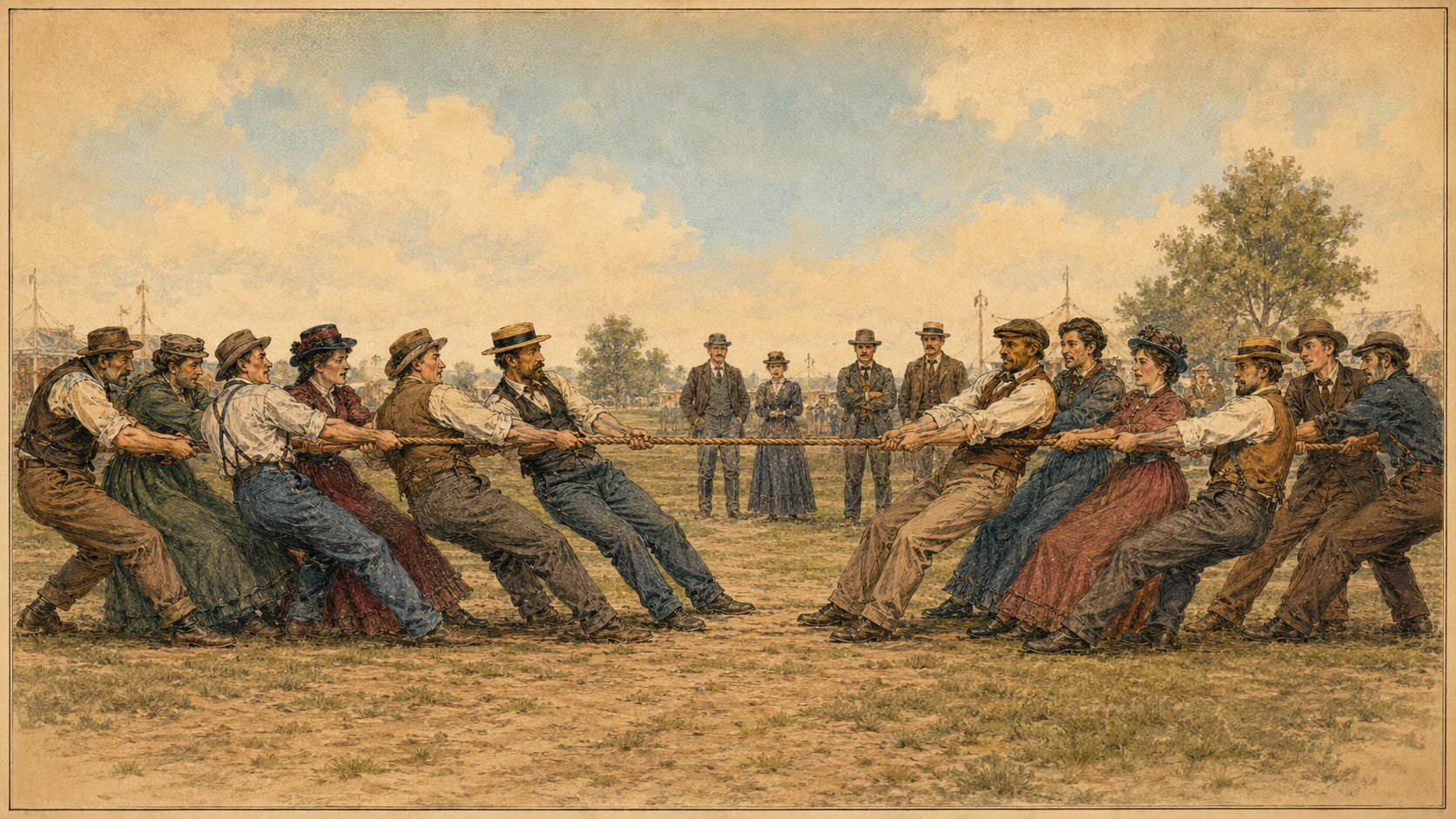
The long primary season, which is thankfully almost over, is a time of peak poppycock for pundit prognostication and parsing.
Seeking to fill airtime, column inches, and the endless expanse of bits and bytes in our digital media ecosystems, retired (forcibly or otherwise) politicians, consultants, former aides to people we no longer care about, activists, party hacks, and the coiffed hosts who egg them on fill a vacuum of reason and responsibility. They summon the hyperbolic rhetoric of military campaigns and natural disasters to pontificate about whatever they’re seeing through the peepholes the latest poll, election result, or trending outrage provides.
That most voters who actually decide elections tune these chattering chairsitters out, or more accurately don’t even know they exist, underscores how little this analysis actually does to sway elections. It’s not much of a feedback loop if the feedback you’re offering never reaches actual voters.
And yet chatter on they do in ways that sully us all, especially those inclined to consume the news. And sadly, because the narcissist in office infects all aspects of life, most of the news these days seems to swirl in the putrid soup of our polluted politics.
Unfortunately, I include myself among those who don’t have the fortitude to ignore the horserace circus entirely. But I still try to keep my exposure to a minimum, lest it seep too deeply into my subconscious.
And that’s why I am so eager to rebut all the endless talk and “reporting” about this supposed war within the Democratic Party, pitting the so-called mainstream or establishment against the so-called far left. It’s another lazy version of Democrats in Disarray, which has become as much a trope of the political press as taking the pulse of the nation from a rural diner in Indiana.
To be sure, there have been some heated primary battles between more self-identified progressive candidates and those identified with the party establishment. The recent Senate race between Abdul El-Sayed and Haley Stevens in Michigan, and the gubernatorial contest between Francesca Hong and David Crowley in Wisconsin, are two obvious examples. And if you squint hard enough, you can find others at the state and federal level.
But zoom out from a handful of high-profile primaries and the narrative of a pitched battle between binary ideological armies fails in the face of reality. You begin to realize that candidates are complex human beings who don’t spend their lives in rigid straitjackets of checklist-style political orthodoxies.
Most bring views, identities, constituencies, and political instincts that cut across multiple categories. And when you take a broad view of the Democrats running competitive races for Senate, governor, the House, and state legislatures around the country, you see candidates who look more like varied Venn diagrams than the ready-made soundbites pundits want to impose on them.
From Alaska to Maine, Georgia to Michigan, Iowa to Texas, there are complex constituencies and local concerns, different regions and different party makeups. It is a landscape in flux, in a nation at a crossroads, in an age of disruption. Tidy labels are at best misleading and at worst simplistic distortions.
Of course, there are some voters, and perhaps even some candidates, who are deeply invested in a particular issue or strongly identify with labels like Democratic Socialism, and some races genuinely do break along the lines the pundits describe. But what I see is a group of voters around the country, regardless of label, that is far more united than divided, and certainly not in disarray.
What I see is a broad coalition bound by core commitments that feel both expansive and inclusive. It is fueled by a desperation for change, rooted in a demand for justice, and eager for new leaders and ideas. It is exciting and purposeful.
We believe the current regime of corrupt autocrats is a dangerous threat to American democracy. We believe that the accumulation of wealth among MAGA-aligned oligarchs and complicit corporations is anathema to a government accountable to the people. We believe that reducing income inequality, improving the quality and affordability of education, expanding access to health care, and ensuring humane treatment of those in our communities should be fundamental priorities. We believe we need to restore the rule of law and rein in the Supreme Court. We need voting rights, LGBTQ rights, women’s rights, and civil rights. We need to counteract the scourges of racism, misogyny, antisemitism, Islamophobia, and other divisive hatreds. We want better protection of our air, water, and environment. Climate change is real. The violent insurrectionists of January 6 belong in prison. And the likes of Donald Trump must never be allowed to wield power over our nation again.
I hear echoes of almost all of this in every campaign I have seen, even if the details, emphasis, strategies, and policies may differ. And this is what a healthy party and a healthy democracy should look like: a place where arguments are tested, candidates are challenged, and voters get to decide among competing visions. We are living through a period when old assumptions are breaking down. We cannot know what will come next, but it must be very different from what we have now, and likely even a reimagining of what came before the MAGA era.
And that is what these debates within the party and its broader coalition are really about: not a civil war, but a contest over who can best lead through this period of change, with different ideas, styles, experiences, and instincts competing for the voters’ trust.
Infusing this gathering wave of change is a broad frustration with a party leadership that has been there forever and has become, in the view of many if not most Democratic voters, passive, cautious, and sclerotic. Too many of those who carry the mantle of “the establishment” seem caught up in Washington parlor games and disconnected from the energy of the electorate.
But there is another calculus hanging over this election and shaping Democratic voters. In a more normal political environment, where the Republican Party had not become an autocratic cult of personality, there might be more appetite for experimentation. If a candidate loses while trying something new, or simply proves to be a poor campaigner, there is always another election.
But with control of Congress so tight, state governments wielding enormous power over elections, and the Republican Party no longer a reliable partner in a functional democracy, voters are forced to weigh what may be the most important consideration of all: Who can actually win? The answer is often unknowable. And this is where arguments over more progressive or more mainstream candidates can have real currency.
But again, look at the candidates themselves. Hear them talk. Watch how they respond, adapt, and learn through the act of campaigning, and you see a political landscape that doesn’t fit the pundit-driven narratives being imposed upon it.
Heterodoxy is healthy, in life and in politics. Debate is essential. Generational change is necessary. Local considerations are important. And the quality of the candidate, that elusive combination of traits that forms our overall impression of a person, may be most determinative of all.
The Democrats have a lot of talented, passionate, interesting people running for office. That they bring a variety of viewpoints to our national dialogue is a strength, and one that I think most Democratic voters, as well as Independents and some Republicans, will recognize if they don’t already. It bodes well for November and for the possibility of giving this group a chance to lead the country in a new direction.
Some will fail. Some will disappoint. That’s what future elections are for. But this is a movement with energy and a desire to usher in a new era for the American experiment.
Some pundits might call that disarray. I prefer to call it democracy.
No posts
Comments
Nothing yet. Say the first thing.
Sign in to join the conversation.