
How do you speak to yourself when you most need comfort? When you are in most need of love and understanding - do you speak to yourself kindly, or cruelly?
If you’re often hard on yourself, keep reading. This piece is for you.
Through many, many years of practice and slowly learning to treat myself with more compassion, these days I am usually kind to myself. But I notice that when I am overwhelmed, when I am having a tough time and am really in need of comfort and kindness - that’s when my inner critic pops up. And it is a ferocious.
This happened to me a few days ago.
I’ve been finding the school holidays overwhelming to an extent I didn’t expect. I’m used to my son not having nursery or school for 6 weeks in July and August, but this is the first year I’ve been trying to balance sober coaching as well as a fundraising job, alongside a voluntary role, several other projects, plus life/child admin and keeping on top of housework.
Yesterday, as River and I headed to the local swimming pool, my inner critic had something to say to me. When I imagine my inner critic, I see them as a floating demon in a black cloak, hovering over my right shoulder.
It sneered at me: ‘Oh, First World problems! How pathetic that you’re finding this overwhelming. Some people have real problems you know!’
It was so cruel. I felt a stab of shame in my heart.
Then I took a deep breath. I put my hand on my heart. And as I walked along, I said (in my head) to that voice:
‘Wow, that really hurts. You think I shouldn’t be overwhelmed. I know you’re trying to help. But I am overwhelmed. That’s how I feel. This is hard for me.’
When I spoke these words, they scowled. But they had nothing else to say. I said:
‘I know you care about me. Thank you for trying to help. But I really need some love and understanding right now. So I’m going to be kind to myself.’
Then I turned to myself - to the one who was struggling, the one who was overwhelmed - and I said:
‘This is hard for you. I’m here. I love you.’
This, for me, is something that has changed my life. Relating to all parts within with love. And coming back to a deep sense of compassion for myself and however I am feeling in that moment.
Perhaps my inner critic hopes that, by minimising and dismissing my suffering, it will make my suffering go away.
Perhaps it believes that by comparing myself to others, I will be able to find a solution. If I can only figure out why that person isn’t struggling with the same thing, I can apply this to my own life and not suffer.
I see a lot of Insta-therapy (probably AI generated these days) about ‘quieting the inner critic’. But ‘quieting the inner critic’ doesn’t happen by forcing our inner critic to be quiet, it comes by doing the opposite: by listening to them. Asking them what they have to say. Showing them that we care about them.
The inner critic is a part of us that desperately wants to feel safe. They try to feel safe by making us in the wrong: they believe that if we’re in the wrong, if our suffering is caused by our mistakes, then this means we can correct them and therefore not suffer.
Sometimes, and certainly when we were younger, this tactic probably worked. If it didn’t work, the inner critic wouldn’t have formed. If it didn’t work, the inner critic wouldn’t pop up with lots to say.
But often our suffering isn’t ‘our fault’. This was the case when I was a new mum and for the first couple of years my son often woke me every hour in the night. It was a special kind of torture, being torn from sleep I was desperate for and feeding him until we both fell back to sleep.
What made it 100 times harder was the fact that my inner critic would say: ‘This is your fault! You’re doing this wrong.’ And then give me examples of friends and family who had babies who (allegedly) slept through the night, given me advice or in any way suggested that parenthood was easy if you just did X, Y and Z.
My inner critic was trying to help by finding solutions to my suffering, when all I needed was comfort, love and acceptance that being woken up ever hour by a baby is brutally hard.
Even if our suffering was caused in some way by our own error, then the best way to course-correct is not by beating ourselves up, by meeting ourselves with compassion and understanding. We might speak to ourselves in this way:
‘You made a mistake, and you’re feeling bad about that. Yes. That hurts.’
‘You wish things had been different.’
‘It’s so human to make mistakes. Everyone makes mistakes.’
‘I care about your suffering, my love. I care about your pain.’
‘I love you. I love you when you make mistakes. I’m here with you. It’s OK.’
But before we do that, we need to show our inner critic that same care and love.
The next time they pop up: notice them. That voice isn’t the whole of you - they are a part of you. You might sit still, close your eyes and put your hand on your heart for comfort.
Notice the inner critic. What are they saying? What do they look like? Are they in your body, or next to you, or - as mine does - hovering menacingly by your shoulder?
Then you can speak to them:
‘Hi. It’s you. You’ve got something important to tell me. What would you like to say?’
Let them speak. Repeat their words back. For example, if they snarl: ‘you’re such a failure!’ You can say: ‘Yes, you think that I’m a failure. You want to tell me that.’
You might just leave it at that, and see what happens. Often, I find, my inner critic looks bemused. They hadn’t expected to be listened to. They go quiet! I then might say: ‘Is there anything else you’d like to tell me?’
Maybe there is, so listen and acknowledge their words. If it feels right, you might want to tell them:
‘It hurts when you speak to me like that. I know you’re trying to help. But those words really hurt.’
This is not about arguing with it or telling it not to speak to you this way - it’s just about giving it some information that feels true. Letting it know its words hurt. Then see what it wants to do with what you’ve shared with it.
It might show you a different side. It might want to share something with you. Perhaps it’s face changes, perhaps it shrinks, perhaps it looks afraid. It might say:
‘I’m scared. I don’t want you to get things wrong. I don’t know what else to do.’
In that softening, you might notice you want to give it love, naturally. You can see that it is a scared part of you trying to be tough. You could say:
‘Yes, you’re scared. You don’t want me to get things wrong. You’re trying to help.’
Just see what happens. Be curious. This is your process and your own relationship to build with your inner critic. With all the parts of you within you that are doing their very best to help you.
Thank you so much to everyone who has given me their thoughts about group coaching with me. If you’d like to you can fill out the survey here.
A raucous time at the swimming pool with my son, where I was tasked with being a runaway sea-horse who River kept falling off and then swimming after me to catch me. He was beside himself with laughter, so much so that he swallowed a lot of water but gave me the thumbs-up while he was spluttering away. Afterwards, when we were getting changed, he looked at me and said: ‘I love you mummy.’
I saw Nick Cave and the Bad Seeds perform to a crowd of 50,000 in Brighton on Saturday. For 2.5 hours this extraordinary creative force leapt about the stage, raising his hands in incantation and led us on a journey through darkness, grief, tenderness and unbridled joy. Kylie showed up to sing Where The Wild Roses Grow with him. One of the best gigs I’ve ever been to.
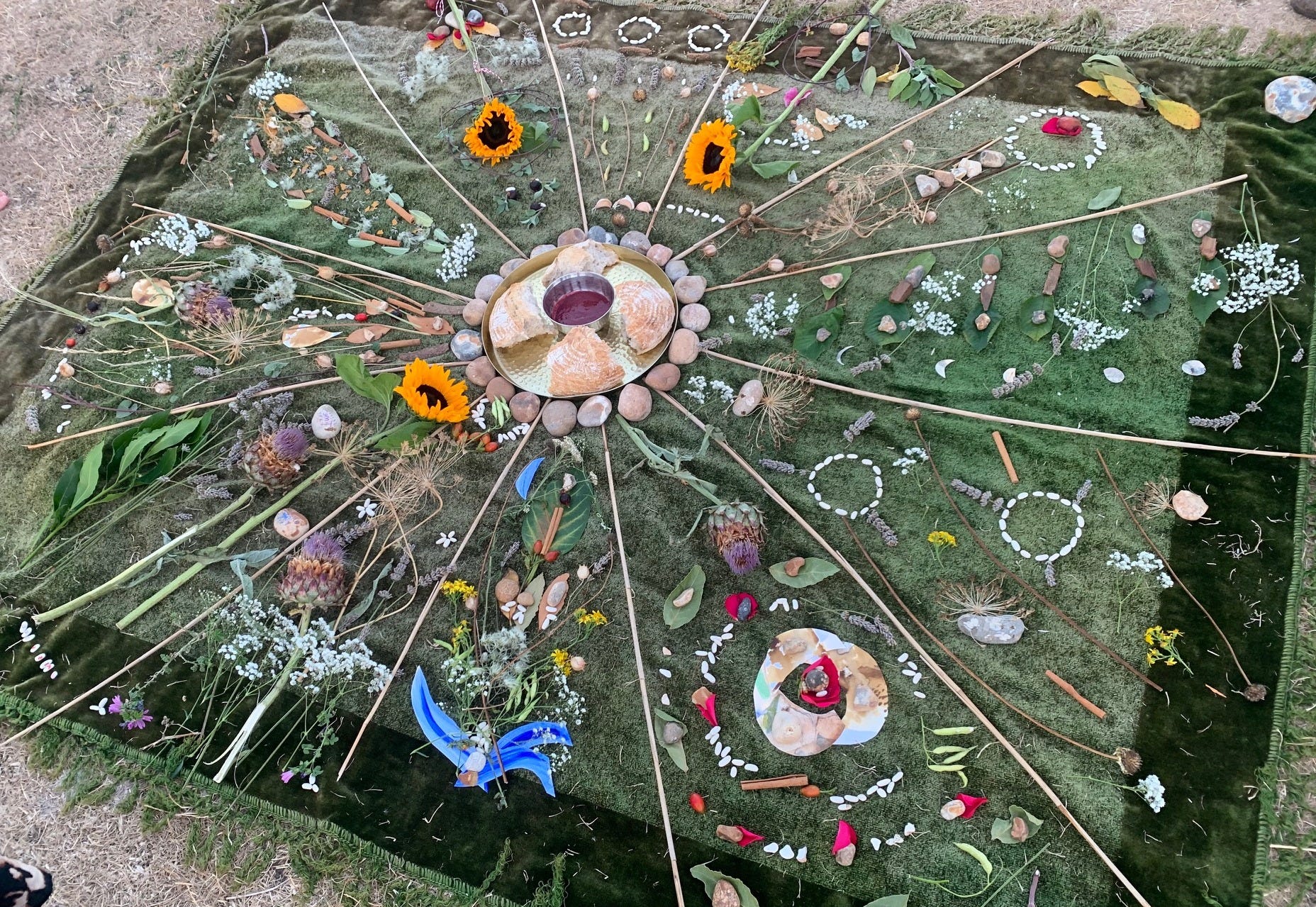
I went to a grief circle named Give it to the Water on Hove beach Tuesday night. We made a beautiful piece of artwork using dried seeds, beans, flowers and stones. I felt peaceful afterwards, and so grateful as I travelled home on the bus through the lights and bustle of Brighton and Hove. And so grateful, too, to return home to my beautiful dark, quiet town of Lewes.
I’m also grateful for the merciful, though brief, spell of light rain earlier this week. I pray for more.
Navigating sunshine and holidays without alcohol
·
Apr 3

Sunny afternoons and holidays are two of the biggest triggers for the women I support. Even if they’ve had a long period of not drinking and are loving the way they feel, the draw of ‘a cold glass of rosé in the garden’ or ‘cocktails on the beach’ is strong. The co…
Comments
Nothing yet. Say the first thing.
Sign in to join the conversation.