
In honor of Memorial Day on Monday, I’d like to thank all those men and women who have given the ultimate sacrifice in defense of the United States. May we honor your courage by serving as wise and respectful custodians of the Nation.
As promised, this is a bit longer than my usual posts, as it covers a lot of ground. The email version will get truncated, so if you want the whole thing, click on the link provided.
Early Friday, the stock market opened well in negative territory, the VIX volatility index spiked over 25%, and the dollar weakened further. In comparison, bonds and Bitcoin rose on the news that President Trump is threatening to impose 50% tariffs on the European Union within a matter of days, and warned that Apple iPhones could face at least a 25% tariff if the company doesn’t start manufacturing and assembling them in the US.
We can’t discuss the economic outlook without mentioning President Trump, as his administration has ambitious plans that aren’t likely to stop with just tariffs, so let’s face the awkward elephant in the room. To have a constructive conversation about the economy and the impact of policy, we need to set aside our political preferences and biases, and, to the best of our abilities, focus on an objective assessment. Love the politicians or hate ‘em, doesn’t matter; it is all about the specific policies. Great politicians can come up with terrible ideas and vice versa.
The first thing to consider is that the federal deficit is way too big; it cannot continue at these levels, but Congress has shown itself to be incapable of reducing spending. No congressperson wants to risk taking treats away from their constituents and risk not getting reelected. If you can’t cut spending, then you need to increase taxes, except that will also tick off your constituents. So, what can you do? Tax outside the USA, and that is how we get to tariffs.
I suspect that the tariffs are not just about “unfair trade” and bringing manufacturing back home, but also about how to reduce the deficit without cutting spending and without the risks that come with increasing income taxes. Tariffs on goods are effectively a consumption tax, but a hidden one, the cost of which is not entirely borne by the buyer and can be blamed on those bad guys over there, which is very attractive on Capitol Hill.
To be clear, there is plenty of “unfair trade” going on, and it isn’t only about tariffs. For many countries, it includes regulatory barriers that make America’s exports less competitive or effectively prohibit them. Europe is a prime example. Even Mario Draghi agrees.
“These are far more damaging for growth than any tariffs the U.S. might impose—and their harmful effects are increasing over time.” -Mario Draghi in the FT, February 14, 2025
The trade regime that has been in place for decades requires an overhaul, of that I am confident. If this is the most constructive way to go about it, and if it will result in a stronger domestic economy, is not at all clear to me right now. I have the delicious luxury of sitting back and judging the hell out of politicians with relative impunity.
Before we delve into the economic breakdown, I’d like to briefly examine the Republican reconciliation package of tax and spending changes that the House passed following a marathon overnight session. This is a starting point for bargaining with the Senate and is likely to change significantly, but it provides insight into the changes the administration wants to make.
The most significant features are the increase in the deduction cap for state and local taxes (SALT) to $40,000, along with a reduction in the value of itemized deductions, which results in some costs being cancelled out.
The cuts to Medicare are pulled forward to the end of 2026 from 2028.
Accelerating phase-outs for tax credits for climate-oriented items, such as renewable energy and EV tax credits, that came into effect with Biden’s Inflation Reduction Act. This would likely lead to the halting of meaningful amounts of factory construction, with the already built bits becoming less useful than a paperweight, leading to a wave of layoffs and bankruptcies.
The CBOE estimates that this bill would trigger the statutory Pay-As-You-Go Act of 2010, which would result in automatic sequestration, including an estimated $490 billion in Medicare cuts over the 2027-2034 period.
Now for the impact (just big picture):
The cost of extending Trump’s 2017 Tax Cuts and Jobs Act for individuals and businesses, including the new SALT cap, adds $4.0 trillion to the deficit, plus an additional +$550 billion in incremental interest payments over the next decade from not having the cuts roll off.
A reduction in the deficit of -$300 billion in other tax increases, including removing the energy tax credits.
A -$1.2 trillion in program spending cuts from Medicaid, SNAP, and some educational programs.
We can’t know today what the final form will take, so let’s move forward with what we do know now. Warning signs of slowing abound.
The most comprehensive economic monthly data point is the 85-variable Chicago Fed National Activity Index (NAI), which contracted by 0.25 in April, following a modest 0.03 increase in March. That’s moving from stagnation to contraction in just one month, and keep in mind that the March data was positively skewed from all the pre-tariff activity. Here are the highlights/lowlights - nothing looked good:
Deteriorating economic breadth.
Both Production/Income and Personal Consumption/Housing have been negative three out of the past four months.
Sales/orders/inventories shrank for the first time since the start of 2025
The employment subindex was flat.
It doesn’t look good today, and looking forward, I see a wide range of headwinds.
Tariffs, unpredictable and exceptionally high
Decline in government spending
Pressure from high levels of government debt
Demographics
Weakening Consumer
Interest Rates
I’ve already written about how the magnitude of the tariff rates is like nothing we’ve seen since at least WWII. We know from history and countless studies on the subject that the price elasticity of global exports tends to be relatively flat because they are more readily substituted.
The impact on domestic imports is illustrated on the chart below, drawn by yours truly, and I’m more stick-figure than DaVinci, so please forgive me.
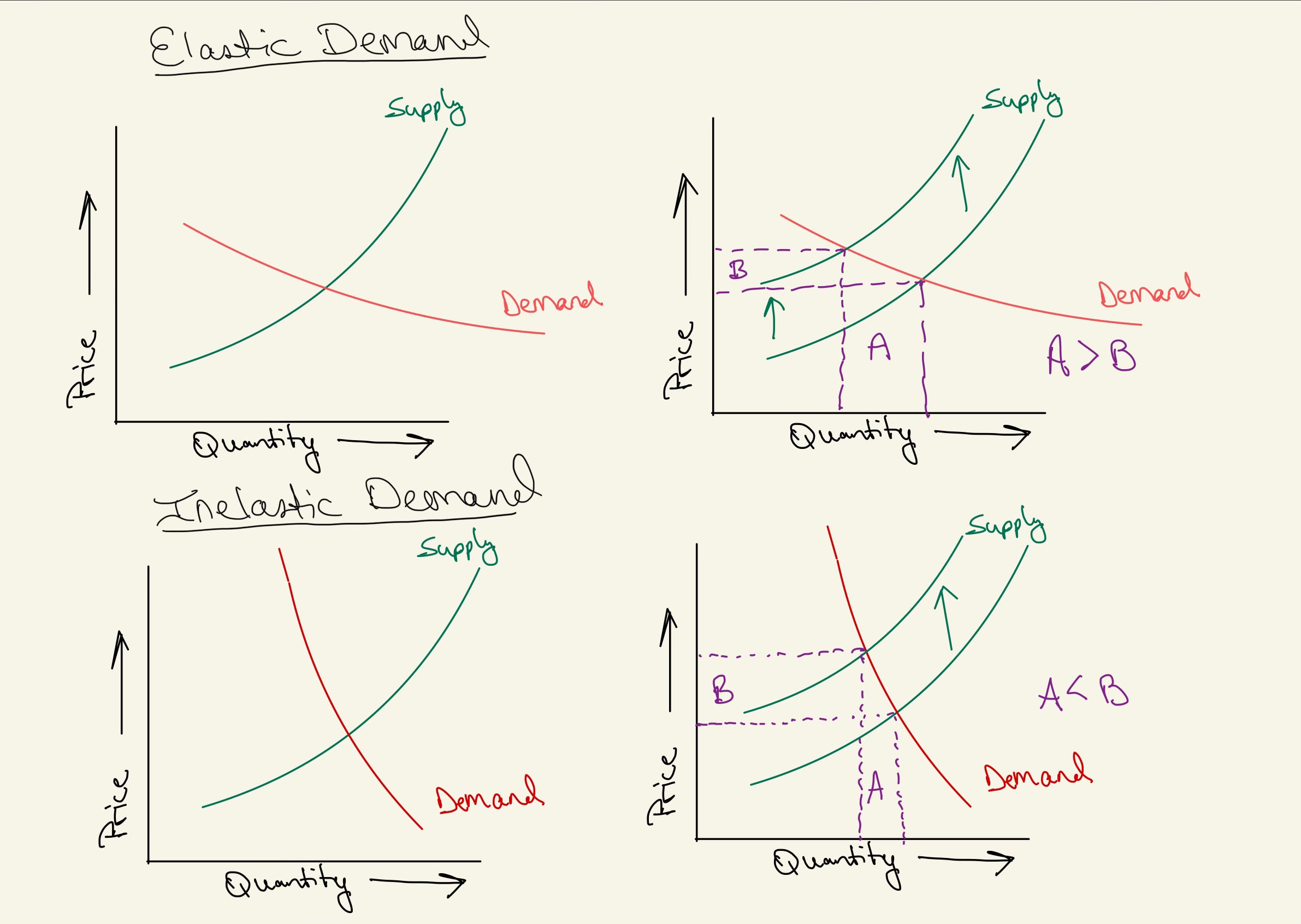
I apologize in advance for introducing math into what is otherwise a civilized discussion. With a more elastic (flatter) demand curve, the loss in total revenue represented by (A) is greater than any gains from higher prices (B).
As importers sell less, they will also require fewer inputs, which means less labor and capital. This decline in demand for inputs is coming at a time when capacity utilization rates are already depressed, as shown below. What’s more concerning is that global capacity utilization rates have fallen meaningfully recently, and that decline typically precedes a drop in the US use rate.
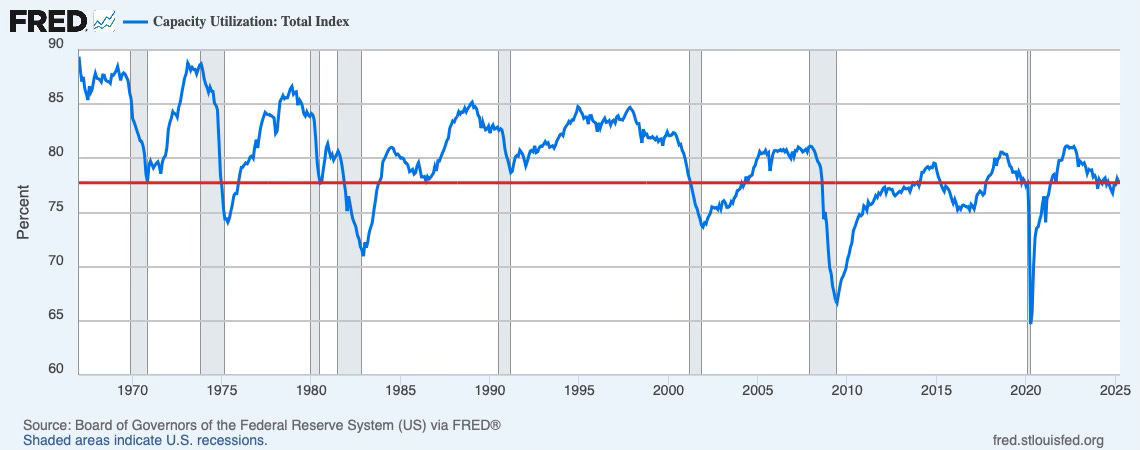
We have a decline in revenue for companies that import, which will lead to a reduction in demand for inputs at a time when utilization rates are already under pressure. But wait, there’s more fun.
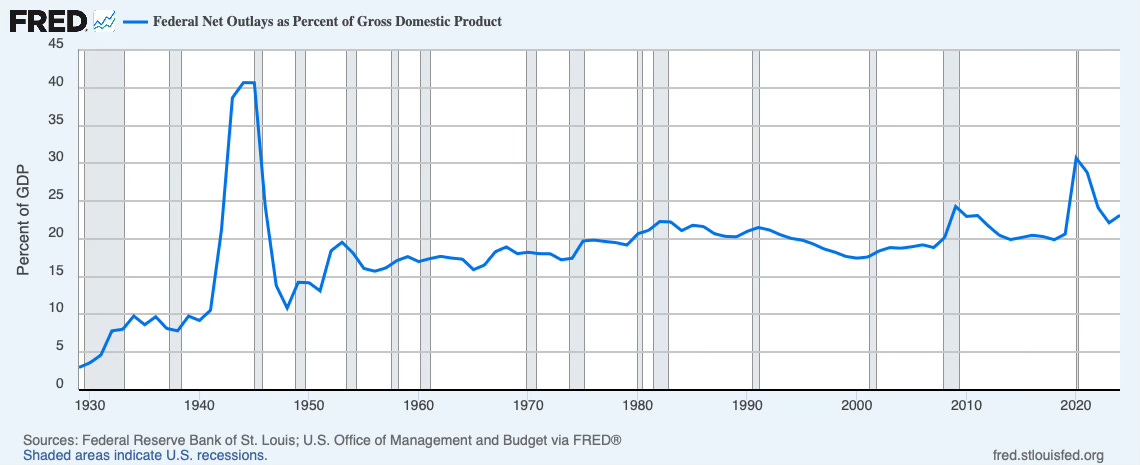
Government spending went utterly bonkers during the pandemic, as you can see on the chart below. (Source: St. Louis Fed)
Federal government spending accounted for 23.1% of the economy in 2024, having peaked at 30.7% during the worst of the pandemic. However, it remains at a level seen only three times in history: during the pandemic, the Global Financial Crisis, and WWII.
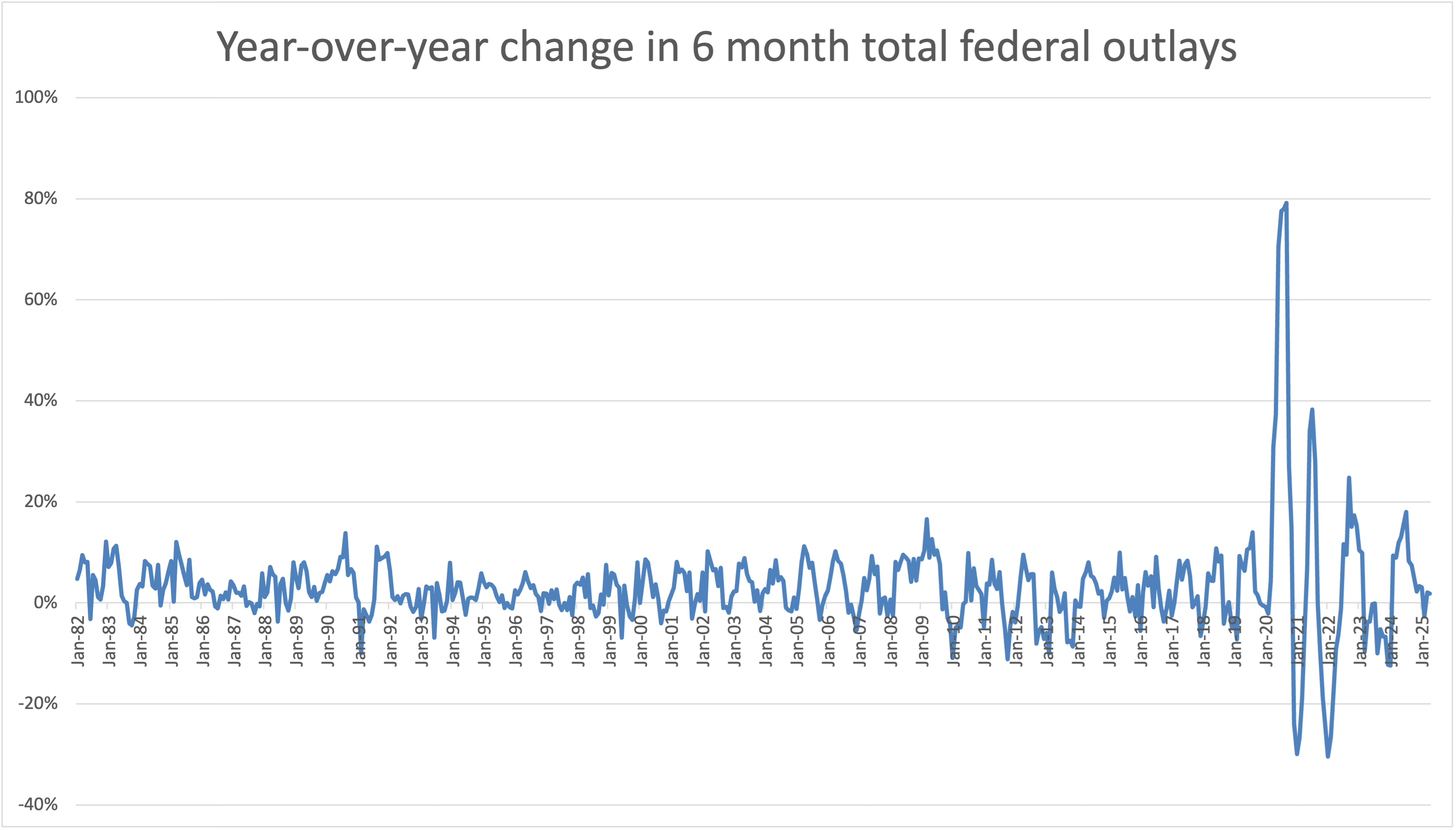
Federal spending from October 2024 through April 2025 reached $4.16 trillion versus $3.82 trillion for the same period last year, an increase of 8.9%. The full-year budget only allows for a 6.0% increase, which, doing a little of that dreaded math again, means that there is only $2.99 trillion left in the budget versus $2.93 trillion spent last fiscal year, so zero growth in government spending for the remainder of the fiscal year.
That means that nearly a quarter of the economy is expected to face zero growth for the remainder of the year.
All that spending has driven the federal debt to the highest levels on record. I’ve written earlier about the numerous studies that have found this level of debt to be a significant headwind to economic growth. In essence, there is a finite amount of funding available to an economy. Borrowing by the public sector pushes out borrowing by the private sector, which reduces growth opportunities. Furthermore, all this borrowing means a greater share of federal spending goes toward interest expenses, which does little for the economy, particularly with so many US creditors outside the country.
The current level of federal debt is 4.7% above the WWII level and 33.6% above the 90% level that Reinhart and Rogoff identified as damaging to the economy.
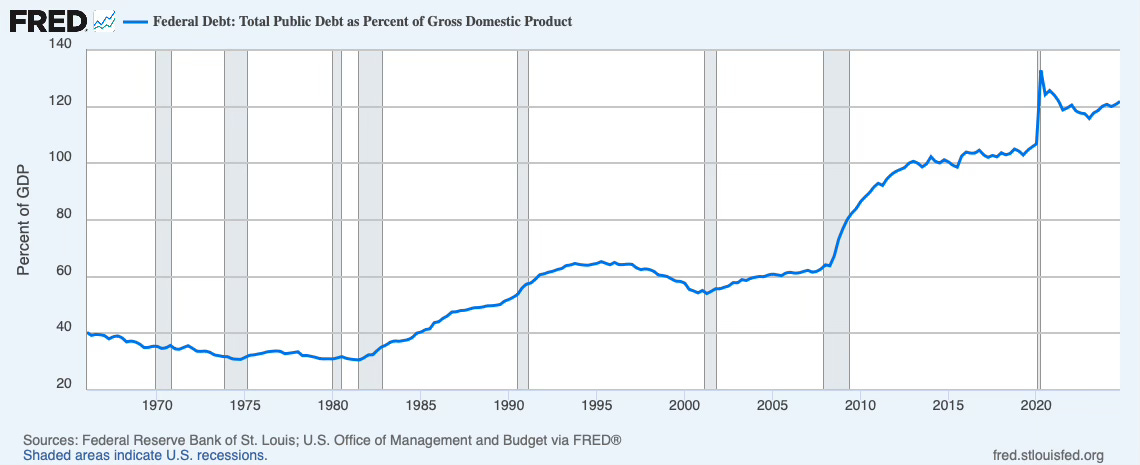
On May 16, Moody’s announced a change in its view of the U.S. Treasuries credit rating, with a downgrade from AAA to Aa1. The first downgrade of U.S. Treasury debt was by S&P on August 5, 2011, and the second was in August 2023, when Fitch issued its downgrade.
For the first time in history, all three major rating agencies have assigned the global reserve currency a rating below AAA status. The difference between now and the summer of 2011 is that only one agency had downgraded the U.S. ranking, and the Fed was sucking up assets onto its balance sheet under Bernanke like there was no tomorrow.
There was no alternative back in 2011, but today, a BB-rated bond will get you a 6% yield, 30-year Ginnie Mae coupons offer 5.6%, the long-bond offers 5%, and short-dated financial paper gets you 4.8%. How about the 4.0% free cash flow yields on the S&P 500?
Why does this matter? According to the Securities Industry and Financial Markets Association (SIFMA), the U.S. Treasury market comprises $28.6 trillion in bills, notes, bonds, TIPS, and Floating Rate Notes (FRNs), with an average daily trading volume of more than $1.1 trillion. The U.S. Treasury market is the largest securities market in the world, providing unrivaled liquidity, transparency, and stability with Treasuries commonly referred to as the “risk-free asset.” Now the risk-free rate is no longer attached to assets with the highest credit rating - not sure what to make of that.
The interest expense on the debt is now more than $1 trillion annually, having doubled over the past five years and today exceeds spending on defense and Medicare.
At least when we were spending that money on defense, we got a good deal of innovation out of it that the private sector could use.
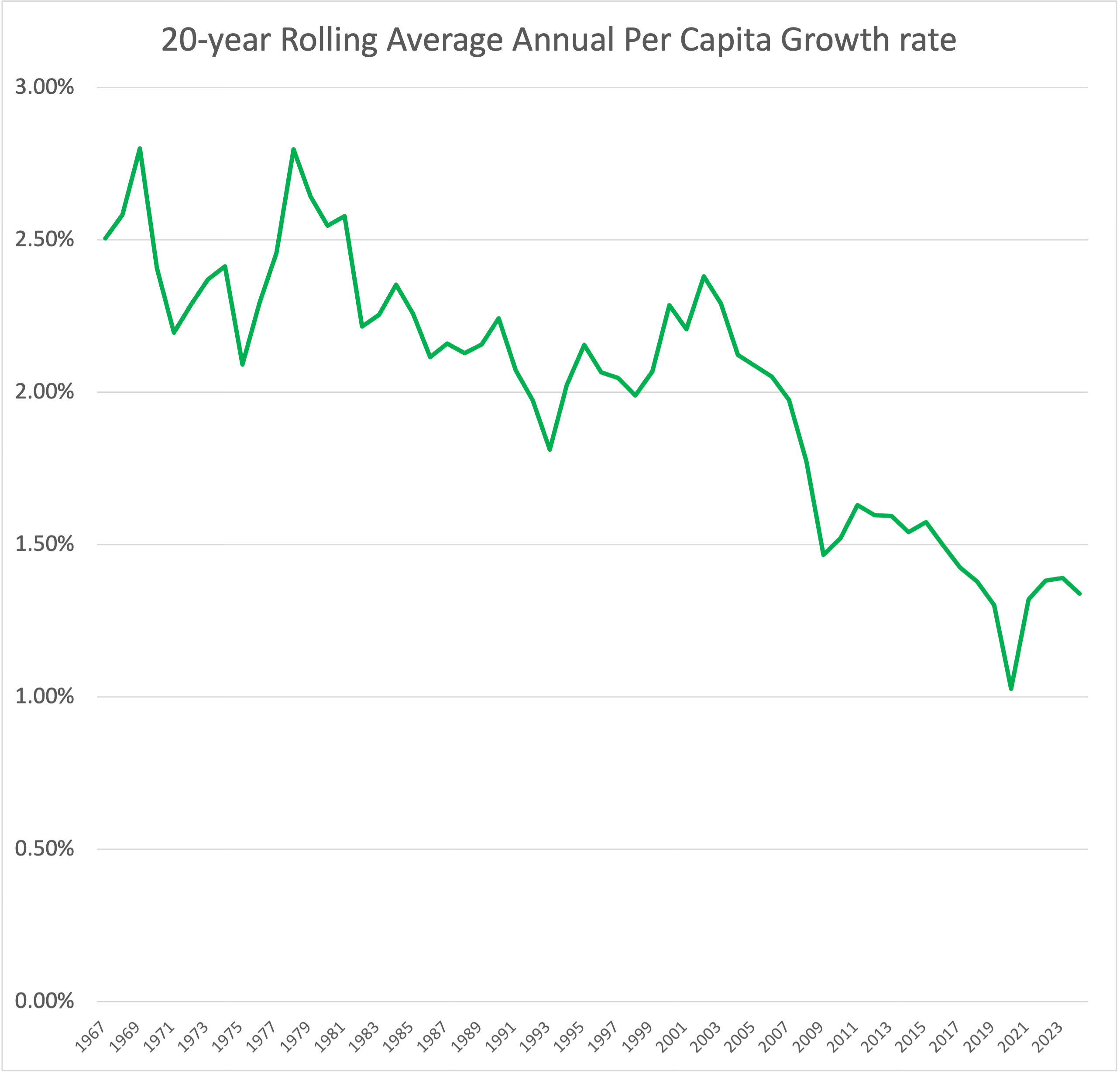
While debt continues to grow seemingly out of control, the growth in per capita GDP is falling hard. The chart below shows the consistently declining per-capita GDP growth rate (20-year rolling). As debt has gone up, growth has slowed, so that’s fun. (Source: St. Louis Fed)
Demographics are becoming such a downer that the administration has floated the idea of paying women to have babies and a medal if they give birth enough times. Would you be expected to display this medal the way you would an Olympic one?
The growth of an economy depends on the growth of productivity and the growth of the labor pool. The growth of productivity depends on innovation and capital investment, which we’ve already discussed. The growth of the labor pool depends on fertility rates and net immigration.
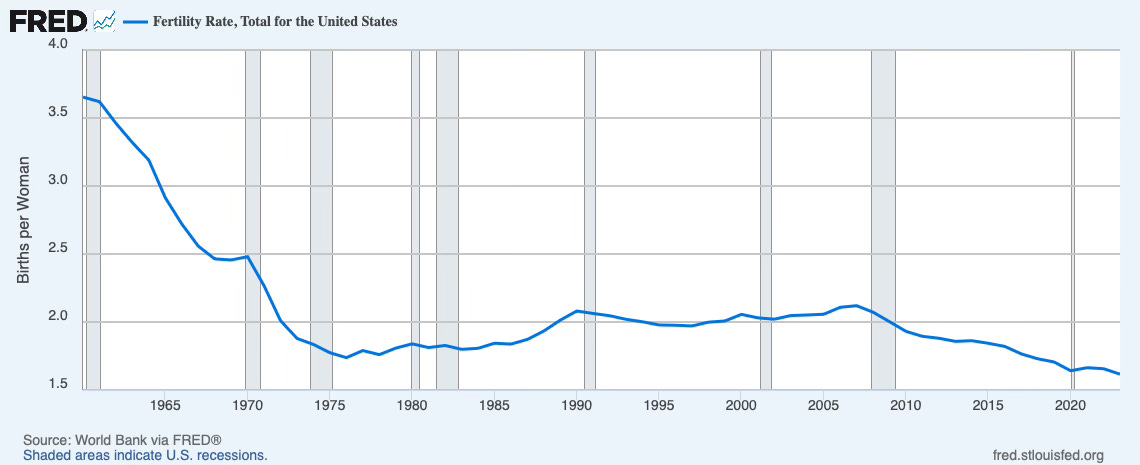
For a population to remain at its current level, excluding immigration, the “replacement” fertility rate needs to be around 2.1%. The US fertility rate dropped to 1.6% in 2023, thus the baby birthing medal.
The total population growth rate has also slowed markedly. The 5-year moving average of the annual population growth rate has fallen to 0.6%. (Source: St. Louis Fed)
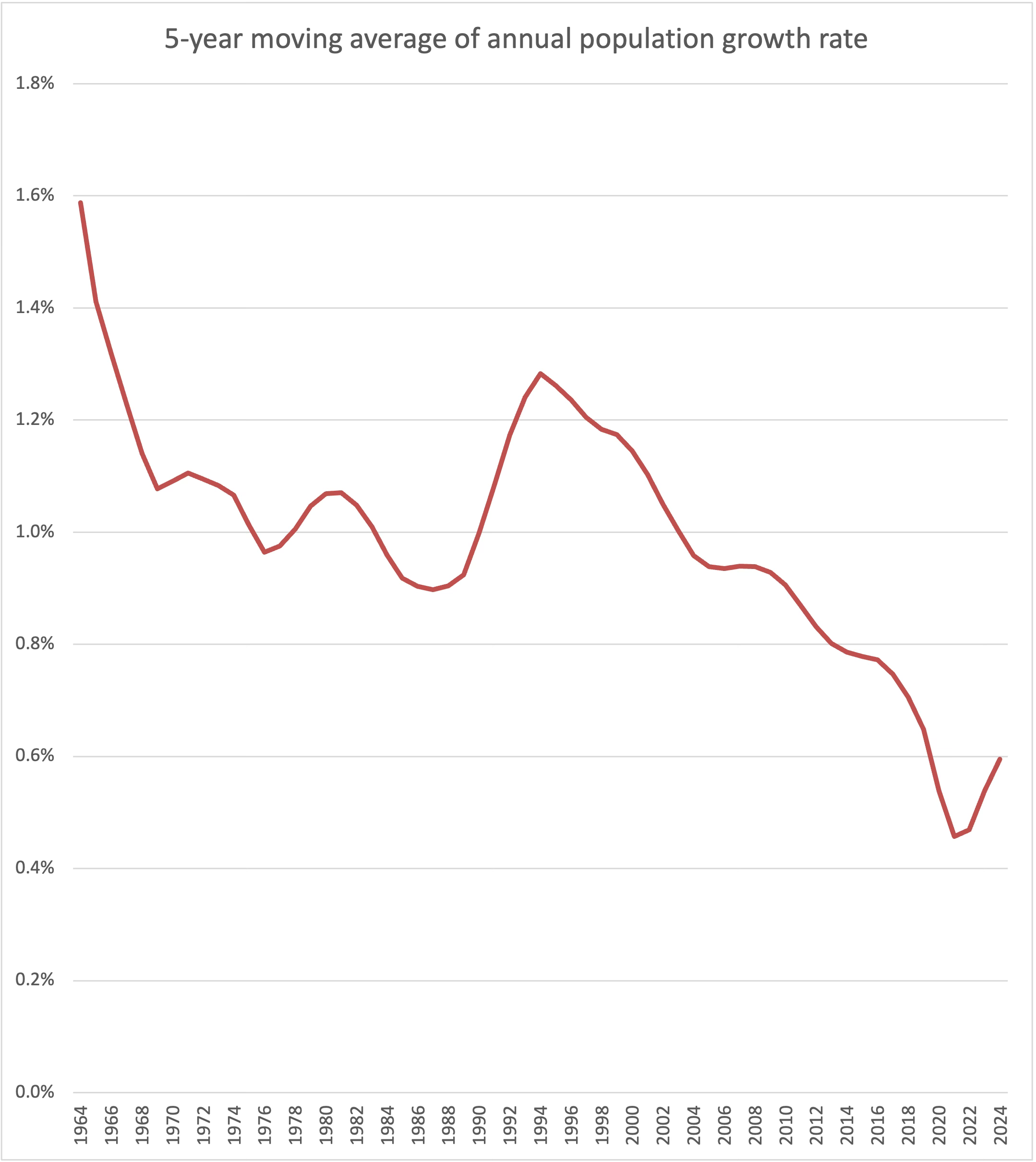
The CBO expects the population growth rate to slow to an average of 0.4% per year from 2025 to 2035, when it will slow to just 0.1%, making immigration more vital for economic growth.
Putting politics aside, the recent push to reduce immigration has a negative impact on population growth and a significantly more pronounced impact on workforce growth. In 2024, 19.2% of the workforce consisted of immigrants. Immigrants accounted for 4.7% of the population in 1970, and this percentage has risen to 15.6% today. In 2024, the labor force participation rate for foreign-born individuals was 66.5%, compared to 61.7% for native-born individuals.
→ Spending is growing faster than earnings
Over the past year, real wages and salaries have grown at a rate of less than 2% per year, yet real consumer spending has increased by 3.3% year-over-year. This increase in spending above earnings has been made possible by a decline in the savings rate from 5.2% a year ago to 3.9% today, versus the historical norm of nearly 9%. Drawing down savings is not a sustainable option.
According to a survey from Lending Tree, 44% of Americans have a side hustle, and 43% of those earning extra income are doing so to cover their living expenses. A different survey from Bankrate found that 32% of side hustlers believe they will always need that extra income to get by, while 16% want to one day turn the side hustle into their main hustle.
For most, the extra monthly income they generate isn’t much. According to Bankrate data:
When it comes to the side grind, 71% of people—and 80% of Gen Zers—make $500 or less. And 19% of overall respondents reported taking home between $501 and $2,000.
Then there are the ultimate hustlers: Nine percent of respondents said they make more than $2,000 monthly from their extra work.
→ No more Instagram-Inspired Vacations
Vacations are getting dialed back per this article in the Wall Street Journal, which points out that “Summer vacation is getting a makeover. Americans are planning to take time off this summer, but their concerns about the economy are prompting them to swap air travel and extravagant holidays for road trips and shorter vacations.”
→ Consumer Credit Getting Hit
The Swedish fintech Klarna (king of “buy now, pay later” or BNPL) announced this week that its consumer credit losses in Q1 rose 17% YoY to $136 million. More customers are struggling with the step after “buy now.” According to a recent LendingTree survey, around 25% of people using BNPL services are doing so to pay for groceries, up from 14% a year ago, and 41% of BNPL customers are struggling to repay their loans on time, versus 34% last year.
The 90-day delinquency rates on credit cards are now at a 14-year high of 12.3%, up from 10.7% a year ago, and as of the latest data (from Q4 2024), the portion of credit card borrowers making only their minimum monthly payment is now above pre-pandemic levels. Delinquency rates on credit cards and auto loans are nearing levels last seen in 2011, when the unemployment rate averaged nearly 9%.
Nearly 10 million Americans are delinquent on their student loans, and now that students have to start paying back their debt, the late-payment rate has soared from 0.6% a year ago to 7.7%.
Rising delinquency rates are spreading from apartments to hotels and offices, with the vacancy rate in the office sector reaching a record high. Auto loans, a $1.6-trillion market, have seen default rates rise to a nearly 5-year high of 5% from 4.4% a year back. The New York Fed Survey of Consumer Expectations found that around 12% of respondents in the February-April period reported that they would not be able to meet their minimum debt payment in the next three months, the highest since May 2020.
→ Housing Market Stumbling
The housing market is also flashing warning signs. The number of unsold newly-built homes has skyrocketed by +34% over the past twelve months to the highest level in nearly sixteen years. The volume of pre-existing homes for sale on the market that have yet to be sold has increased by +20% in the past year, while resale activity is down -2.0% year-over-year. Home sales are lower now than they were back in October 2008, just after the Lehman collapse and when the economy had been in a recession for 11 months. The median home sales price fell by 0.4% month-over-month and has contracted for four consecutive months —the longest losing streak in over fourteen years. As for rentals, the 7% nationwide rental vacancy rate is a new cycle high.
→ Retailers Feeling Pain
Retailers are also flashing warning signs, vacating nearly 6 million additional square feet than they occupied during the first three months of the year, making Q1 the weakest quarter for shopping-center leasing since the onset of the pandemic in 2020.
We just learned from Target that comparable year-over-year sales (in the three months to May 3rd) fell by -3.8%, reflecting both lower foot traffic and less spent per visit. Compared to Walmart, Target sales are less about groceries and more about discretionary spending. Speaking of Walmart, the retail giant is planning to cut 1,500 corporate positions.
Anecdotally, I’ve noticed a pronounced, and frankly annoying, increase in the number of emails warning me, “Don’t miss out, this is your last chance,” sales that inevitably return in the next week or so, often with even deeper discounts.
"The president wants lower rates... He and I are focused on the 10-year Treasury and what the yield of that.” - Scott Bessent.
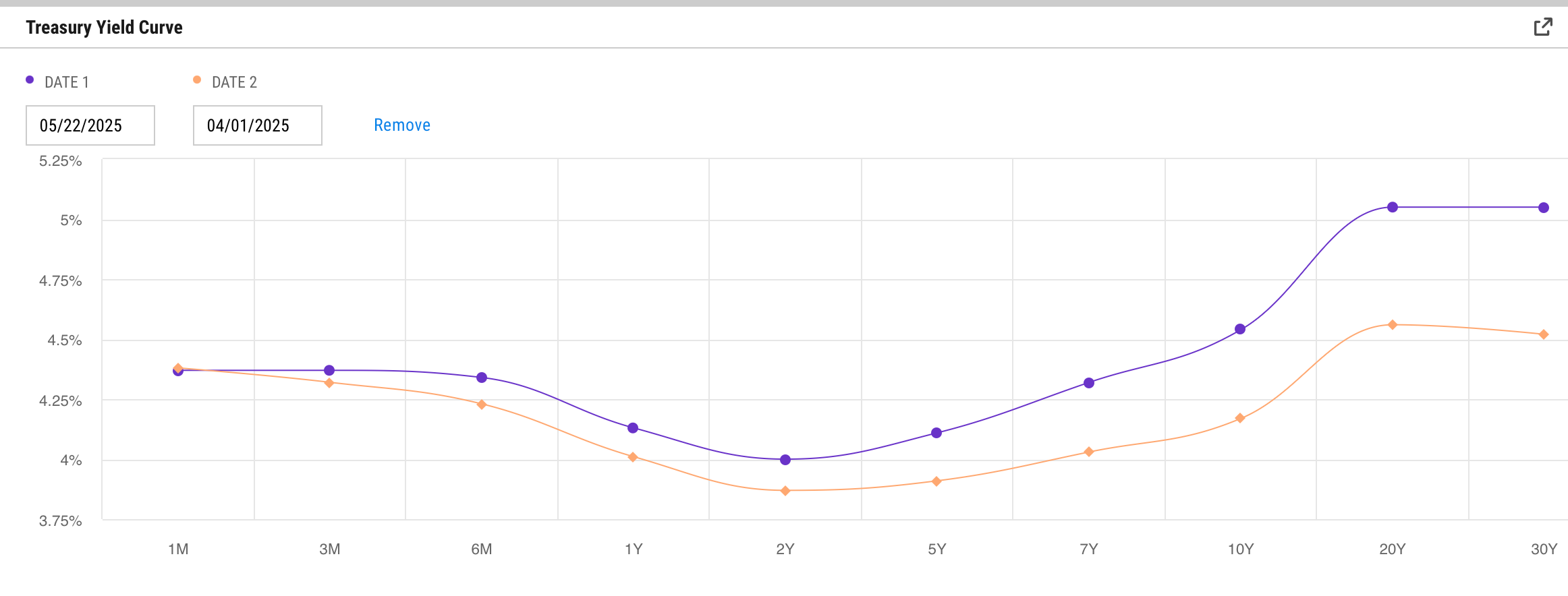
He may want it, but he isn’t getting it anytime soon. Rates across the entire yield curve are up since the start of Q2. The 10-year US Treasury yield hasn’t reached a new high for the year, but the 30-year yield broke out above resistance Wednesday then rose as high as 5.15% on Thursday. From a technical perspective, the move higher in yield is a textbook breakout, suggesting even higher rates are coming.
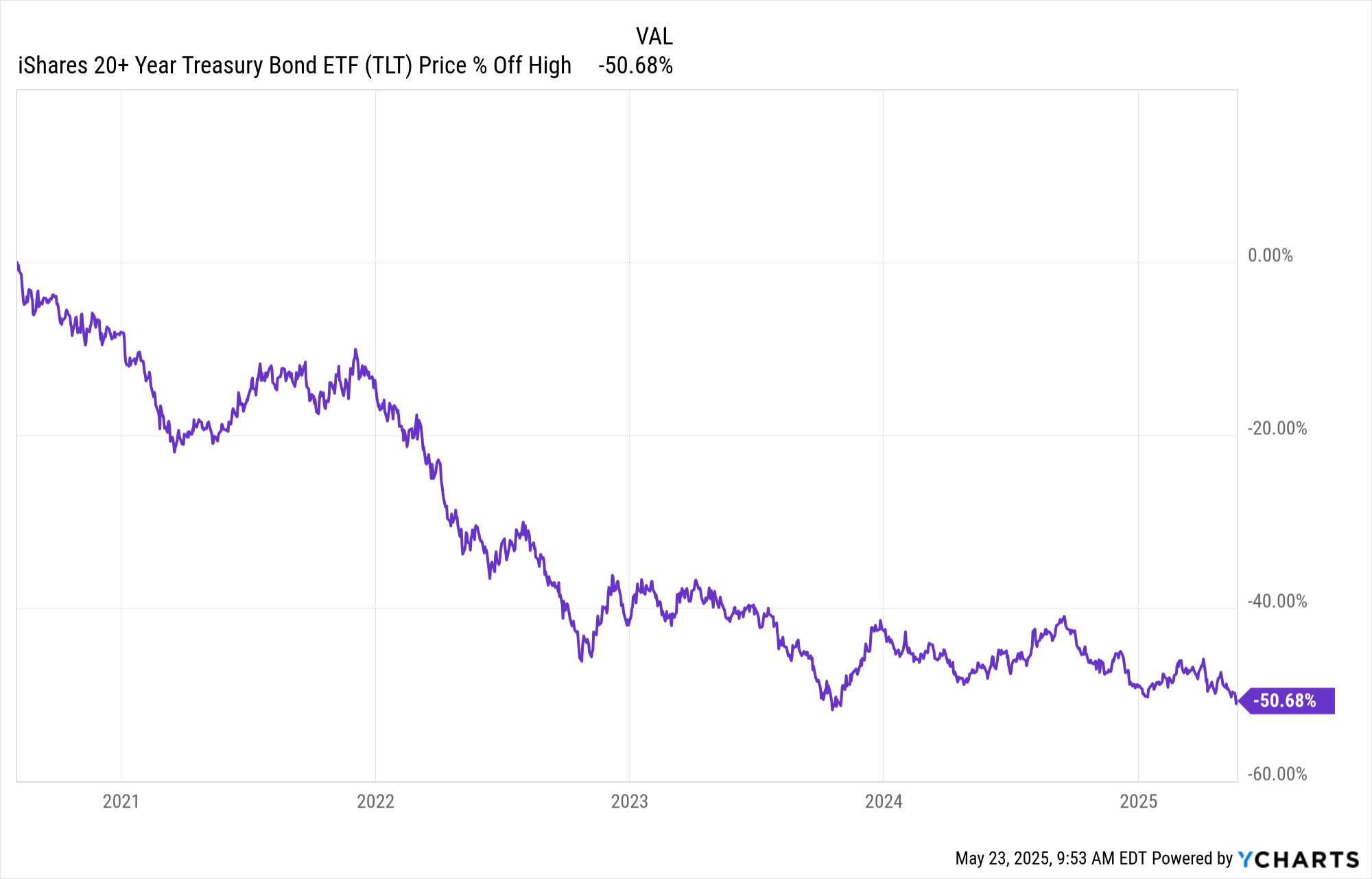
It is remarkable to consider that the long-term Treasury Bond ETF (TLT) has been halved from its August 2020 high.
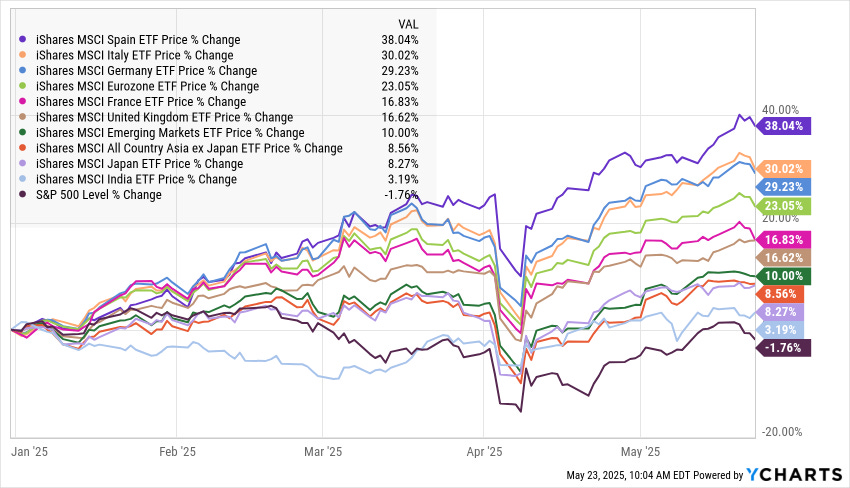
From an investor perspective, the US has been seriously unattractive after years of outperformance.
One of my biggest concerns for the US economy is the changing international perception of the country, which I am exposed to daily in my life. The US was viewed as a great place to do business thanks to its stability. The rules didn’t change often, laws were respected and enforced, as were contracts, in stark contrast to, for example, emerging economies where a change in leadership meant what initially attracted a company to do business there could be immediately thrown out the window. That kind of environment is not conducive to long-term growth because investment is just too risky.
Here are some concerning data points.
US hotel bookings made via HotelHub fell by 7.76% YoY in Q1 2025, yet bookings in other countries, including Canada (+9.9%), the UK (+7.2%), and France (3.0%), were up over the same period. Bookings for business travel from Europe to the U.S. were down 26% YoY in April, when compared to April 2024. Less business travel now means fewer deals, fewer investments, and fewer joint ventures in the years to come.
Well done! If you made it all the way through, thank you. This was a labour of love. I tried to cut it down as much as possible, but I’m an Irish lass living in Italy, so brevity is just not in my blood nor in the air I breathe.
You’ve probably got a list of things to do or that you get to do this weekend, so I’ll save you a drawn-out closing summary and just leave you with this.
The global economy and international geopolitics are experiencing another monumental shift. Arguably, quite a bit of this is a long time coming.
“450 million EU citizens should not have to depend on 340 million Americans to defend ourselves against 140 million Russians who can’t defeat 38 million Ukrainians.”
EU Defense Commissioner Andrius Kubilius and former prime minister of Lithuania.
I couldn’t agree more, it is a disservice to people on both sides of the Atlantic. China doesn’t play fair, and countries in Europe have tied up their own economies and those of anyone exporting to them in a ridiculous mountain of regulations, including. I kid you not, with pages and pages on how to ship basil. 🤦🏼♀️
Things need to change, and that is certainly what we are getting. What kind of pain we are going to feel, and if at the end of that day it was all worth it, remains to be seen. For the near term, the outlook for the US economy is not robust, and investors are doing better by navigating their portfolios elsewhere.
Signing off from Lake Como and wishing you all a wonderful, restful weekend. One that I hope is filled with the joy of being with loved ones, frequent laughs (they are good for you), and at least a few moments of awe (also great for you).
Baci

Comments
Nothing yet. Say the first thing.
Sign in to join the conversation.