
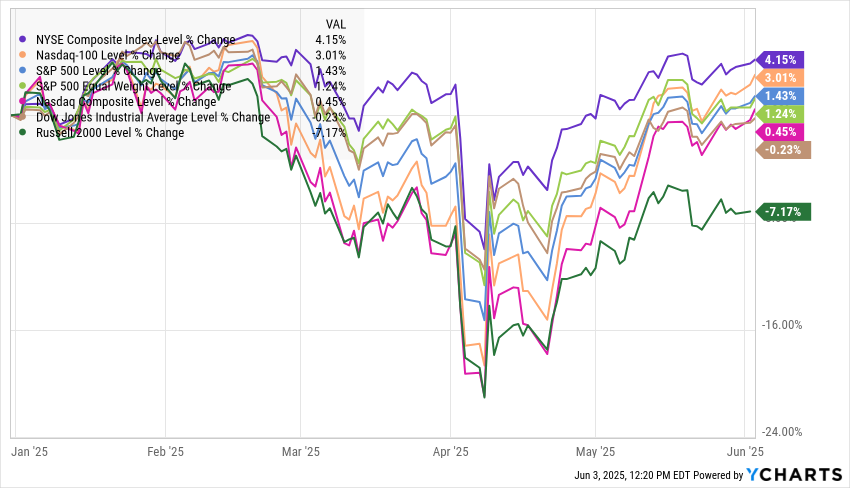
The market has rebounded significantly since the lows of April 8, despite ongoing uncertainty surrounding tariffs and a weaker outlook for both the domestic and global economies. Gains have been driven in large part by the mega caps, but even small caps have rebounded significantly.

Year to date, the Nasdaq 100 is in positive territory while the Nasdaq Composite is essentially flat, and small caps remain well in the red.
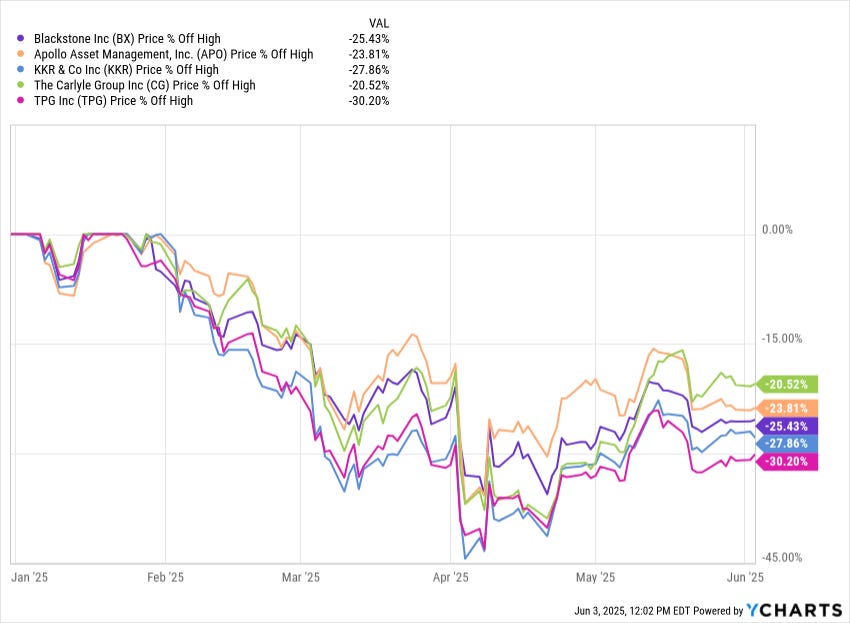
Private equity stocks have been struggling this year, recovering some of their losses from mid-April through mid-May, but they remain off their highs again, having not even approached their prior January highs.
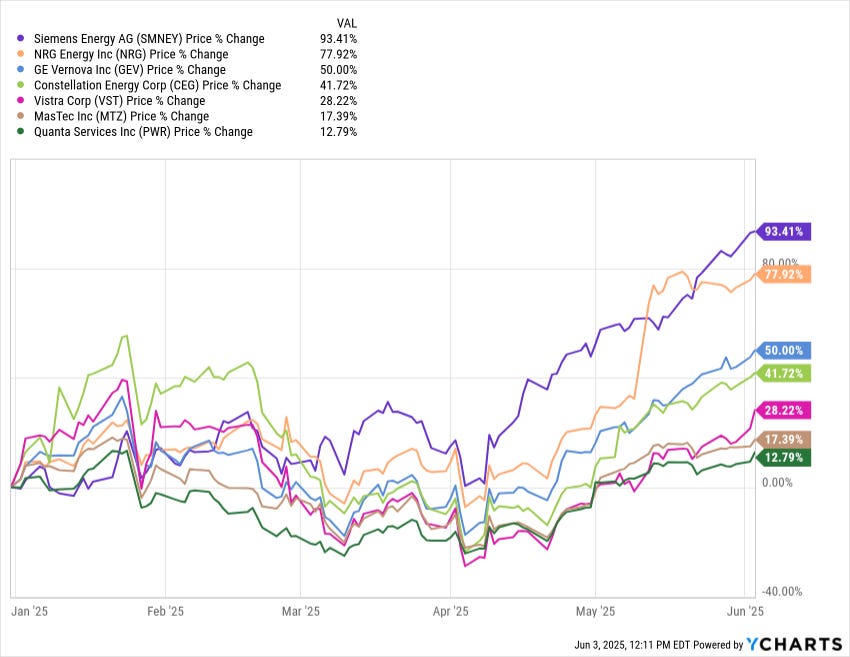
On the other end of the spectrum, stocks focused on data center contracting or power generation have exploded higher.
I keep reading articles concerning the “shock” over the May 28th ruling by the Court of International Trade that struck down the Trump administration’s tariffs under the International Emergency Economic Powers Act (IEEPA). I’m shocked that anyone is shocked. Of course, this was going to go to the courts, and of course, they would get overturned, and of course, the administration will appeal. For the near to medium term, all that has been accomplished is that uncertainty remains even greater and will continue for longer.
Keep in mind that this ruling does not affect the steel and aluminum tariffs nor the auto tariffs. Even if all the other tariffs are not replaced, which I considered a near-zero probability, the effective tariff rate will have risen to 6.5% from 2.5% in 2024, but less than the 13% before the ruling.
The reality, as I see it, is that the Trump administration is unlikely to give up and will find a way to implement the tariffs it wants. The scope may be less, and their implementation may be delayed, but if he wants them —and he desperately does —his team will find a way to get them.
I doubt that the tariffs will be resolved by year-end, and maybe not even before the end of 2026. This starts to get really interesting because then you have just two more years of the Trump administration, so what then? How do companies make decisions with the thought that whatever tariffs we end up with could be reversed by the next administration?
Just to add to the uncertainty, these on-again off-again tariffs are wreaking havoc with the economic data for imports, exports, and inventories, and these distortions are only going to continue even longer as we have uncertainty around both how counterparty nations are going to respond as well as the question of the administration’s legal authority.
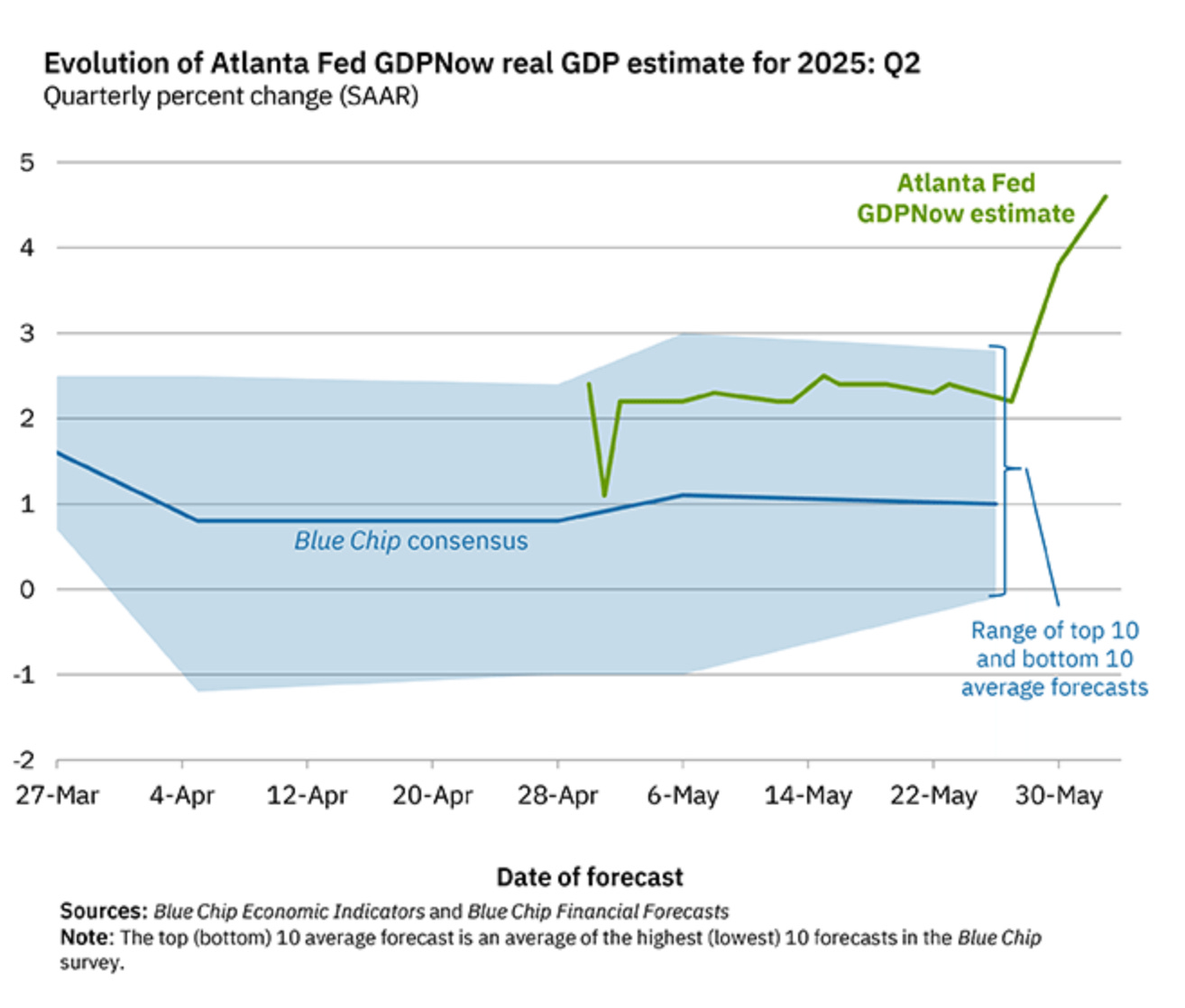
For example, the Atlanta Fed’s GDPNow forecast for Q2 GDP growth, as of June 2nd, is 4.6%, with net exports adding 1.4% versus subtracting -0.6% from GDP back at April 30th. That number is significantly higher than +3.8% last Friday and +2.2% a week ago, which has been driving the equity markets higher.
The Atlanta Fed is feeling good, but at least according to Campbell’s, the consumer isn’t. On Monday, the company’s CEO, Mick Beekhuizen, told analysts that consumers are more focused on ingredients that “can help stretch tight food budgets.” He also noted that consumers have been cooking at home at the highest levels since early 2020, which has improved sales in the company’s meal and beverage unit, but has negatively impacted sales of snacks.
While the Atlanta Fed’s math views the economy through rosier lenses, the Caixin manufacturing PMI index isn’t feeling it, having experienced its biggest drop since September 2022 last month. The index declined to 48.3 (contraction) in May from 50.4 in April, well below the consensus estimate for a 50.7 headline. To really rub in the negativity, new orders also fell to a two-year low.
Caixin echoed the data in Monday’s ISM Manufacturing PMI, which further dropped into contraction in May, falling to 48.5 from April’s 48.7 - a reading below 50 indicates contraction. The number of industries contacting rose to 7, from 6 in April, matching the number expanding, which dropped to 7 from 11 in April. The import subindex dropped to the lowest level of the year at 39.9 from April’s 47.1. The average of the imports index and the new export orders subindex has only been lower at the peak of the Global Financial Crisis recession and during the COVID shock, which suggests a smaller bounce-back for trade-related activity in the coming months.
The OECD is also feeling less optimistic. Its outlook for US growth for 2025 was nearly cut in half from its March prediction of +2.8% to +1.6%, warning that the tariffs will not only hurt US growth, but also the global economy. The outlook for 2026 was also cut down to +1.5% from +1.6%. The OECD has reduced its global real GDP growth projection for 2025 to +2.9%, down from the previous +3.3%.
The economic outlook is weaker than it was at the start of the year, but stocks continue to gain ground, which has been the standard operating procedure for a while in the equity markets. While stocks may take a hit in the near term, over time, the big story stocks that support the tech narrative will rebound, and multiples will continue to expand.
Comments
Nothing yet. Say the first thing.
Sign in to join the conversation.