
On Monday, the markets cheered the positive news regarding the China-US trade war. The S&P 500 opened the day more than 3% above Friday’s close, but weakened by midday to around the mid-2% range. An afternoon rally that rose into the close left the index up 3.3% for the day.
The price action was notable in that it bounced back and forth between some important technical levels. The intraday lows found support at the intraday highs from March 25, and the intraday high rose above the 76.4% Fibonacci retracement drawn from the February 19 high to the April low - all positives from a technical perspective.
On a less positive note, over the past 35 years, when the S&P 500 has rallied more than 3%, the average net advance/decline level is +406. Monday’s level was +316, which was the 11th weakest out of 94 trading days in the past 35 years when the S&P 500 rallied 3% or more. That means that the biggest market cap stocks drove the day’s gains.
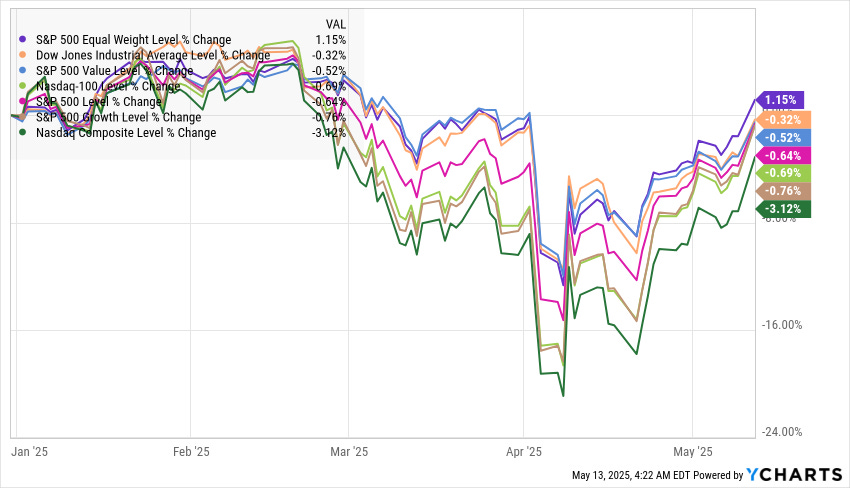
For all the intense drama that we’ve lived through so far this year - the fires in Los Angeles, trade wars, two nuclear powers getting testy once again, and Popeye’s launch of tequila-infused chicken - the markets are today little changed from the start of the year.
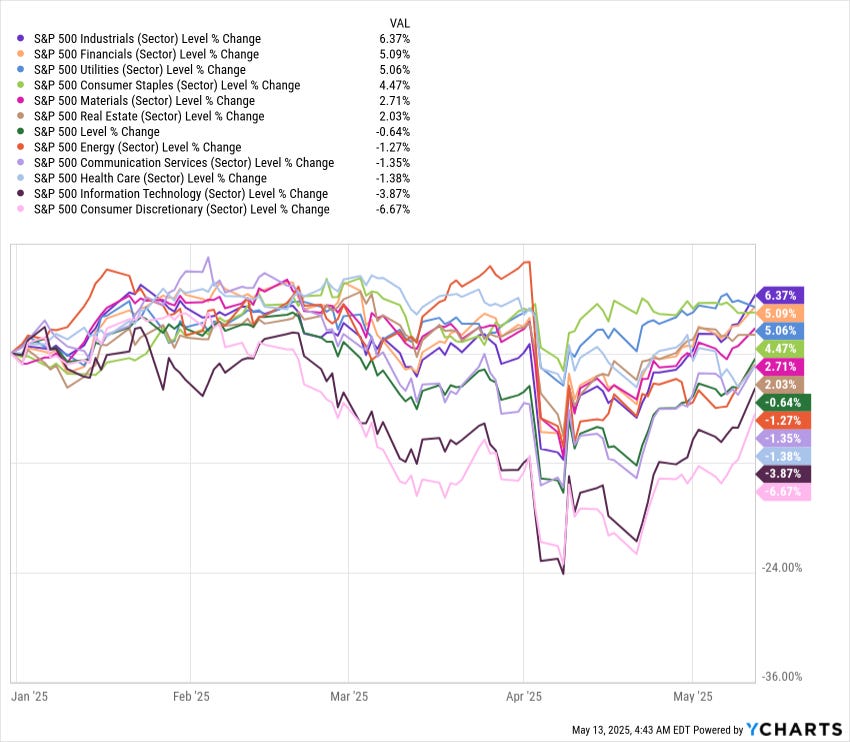
On a sector basis, the strongest performers have primarily been defensive with Consumer Discretionary the worst performer while Industrials (hello defense sector) and Utilities two of the strongest.
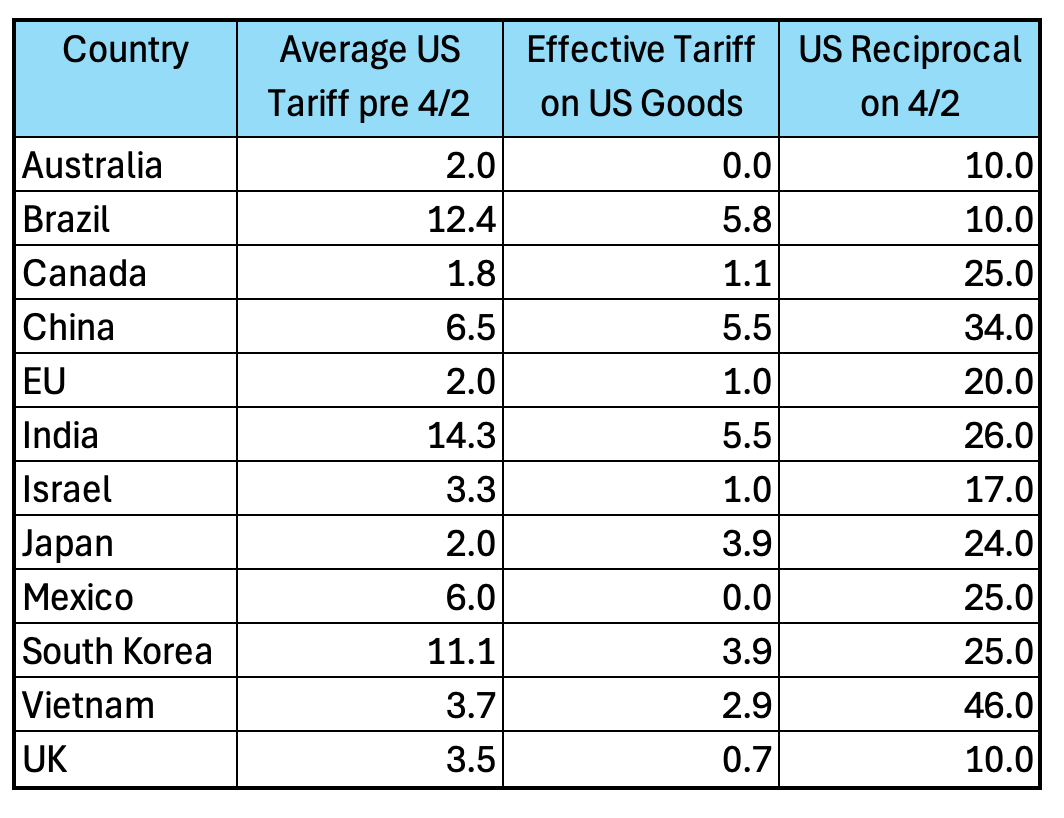
The big news on Monday was that China and the US are engaged in a 90-day pause on the brutally high tariff rates on each other’s products. The U.S. is lowering its 145% to 30%, and the Chinese side from 125% to 10%, going well beyond what investors were hoping to see. China has added “purchasing agreements” to the talks, upping the drama.
So we spiked tariffs to nosebleed levels only to then lower them, but keep them well above where they were at the start of the year, and the market cheers? Color me skeptical. The net effect of the recent temporary drop in tariffs for Chinese goods lowers the overall U.S. tariff rate to 13% from 23%, but that remains far above the 2024 level of approximately 2.5%. A 30% tariff on Chinese imports and 10% on US exports to China remain economically devastating, even if they won’t obliterate bilateral trade. This is not a recipe for lower inflation and a thriving economy in the coming year.
I’m with Ken Mahoney, CEO of Mahoney Asset Management.
“This is so exhausting. There’s no playbook on how to trade this.”
The uncomfortable reality is that at least for the near to medium-term future, the world is highly reliant on China, which we saw during the pandemic, as it is a vital player in global supply chains. It also dominates the extraction, development, and processing of rare earth minerals, which are essential for electronics, cars, solar panels, robots, and, oh yeah, missiles, which just may have the attention of the defense department.
This is why Trump was pressured to exempt Chinese smartphones, robotics, semiconductors, and other electronics from the 145% tariff almost as soon as he announced it. There is also the threat of empty store shelves, which won’t please voters, and meaningfully higher prices at a time when wallets are already thinning thanks to years of inflation. No one can say where we will be in six months, given all the moving parts and differing timelines - China’s leaders don’t face electoral pressures, so they are playing a much longer game. What I can say is that these relief rallies are built on a lot of hope, for which I don’t see a compelling basis.
What I do see is that, according to Deutsche Bank market positioning data, fund manager equity exposure in April fell to levels last seen in 2020, during the peak of the pandemic crisis. Over the past month, $24.8 billion of U.S. equity funds were redeemed, the most in two years, with 37.5% of that in just the last week. A State Street survey found that market positioning is now neutral after all that de-risking; shorts have covered, and bearishness is net zero. Investor sentiment surveys from AAII and Investors Intelligence put us back into neutral territory, so further gains are possible, but forward P/E multiple on the S&P 500 is back to 20.7x, at almost the 90th percentile historically and at the very high end of its 3-year range.
While I am fundamentally skeptical of the current market (not as a general life statement), shorting this market is seriously dicey given the highly headline-driven nature of the current climate. This environment is way too politically driven.
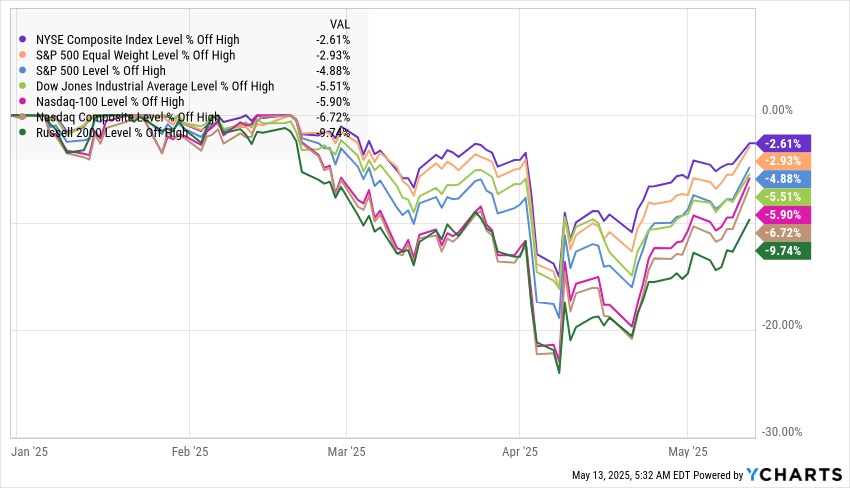
The Russell 2000 closed down nearly -10% from its 2025 high on Monday, the Nasdaq Composite is down -6.7%, and the S&P 500 is down almost -6% from the February peak. Historically speaking, the first 10% of a bear market in a fundamental recession occurs before the economic downturn takes hold, while on average, the next 20% occurs during the economic contraction.
Market participants cheered on Monday, I can’t help but remember that uncertainty among small businesses is at a record high (hat tip: Rosenberg Research).
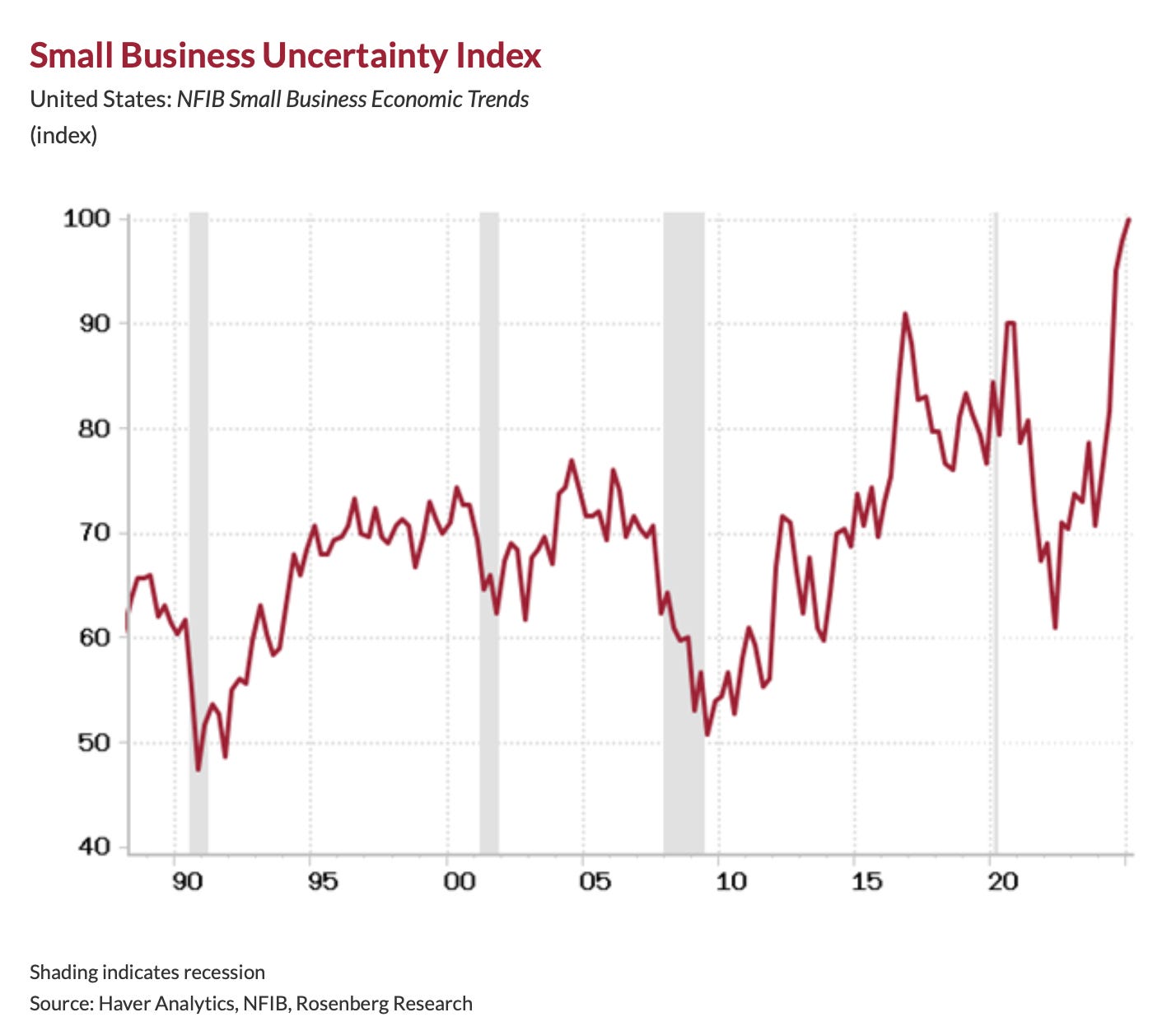
It isn’t just the little guys fretting about the instability. This earnings season, the term uncertainty was used by execs 87% of the time, versus 38% in Q4, according to the Sunday New York Times. The word “tariffs” was spoken 93% of the time, and “recession,” 30% of the time, a 10x increase from just 3% in Q4 2024.
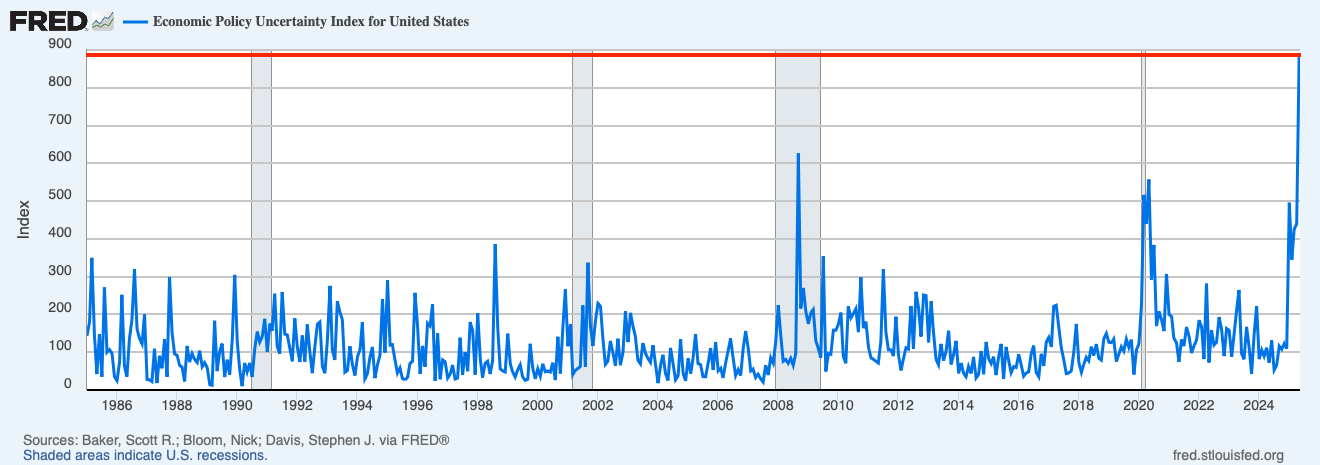
The economic policy uncertainty for the US has never been higher, not by a long shot. See that red line across the very top, at nearly 900? That’s the level of the uncertainty index now, compared to the highest ever recorded previously, which was just over 600 and occurred during the Great Financial Crisis, when the global markets came within a hair’s breadth of total collapse. The gray shaded areas are recessions. Notice what happens around spikes in uncertainty.
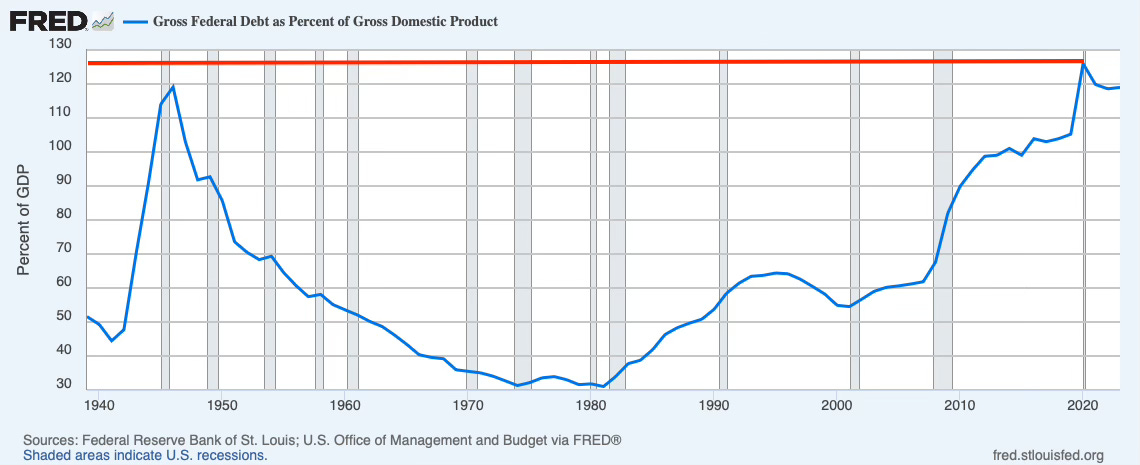
Here’s fiscal uncertainty, also that red line way the hell up above everything that has been before.

Monday afternoon, the Treasury Department updated its latest receipts and outlays figures for April. As expected, given it was tax month, receipts surged to over $850bn NSA, the second-highest monthly receipts on record behind April 2022. After seasonal adjustment, receipts were offset by higher outlays, resulting in a widening of the deficit.
Just a reminder that the US debt-to-GDP ratio remains well above levels seen in decades and has only been near these levels during WWII.
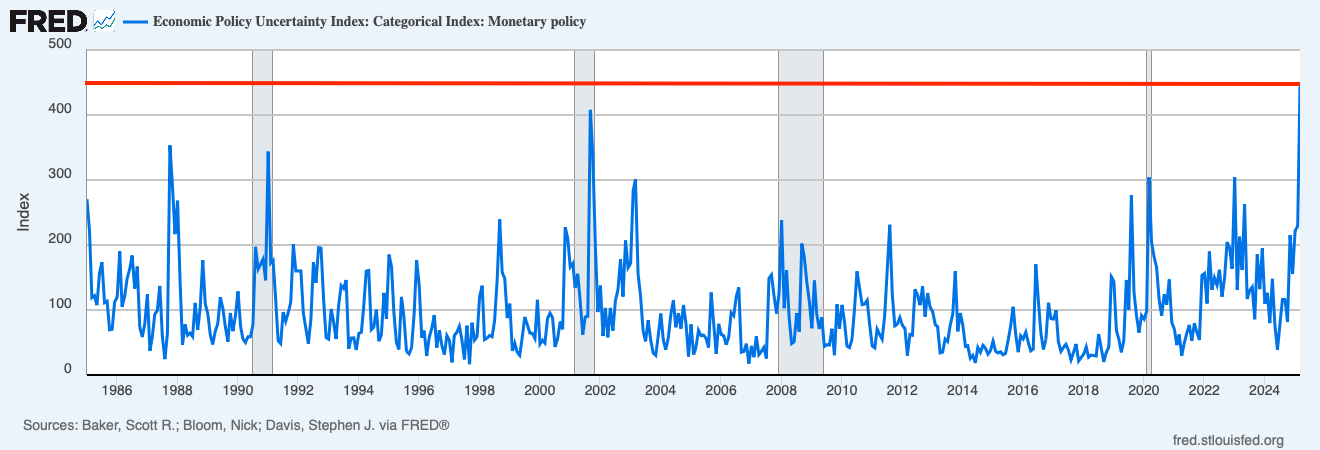
Even monetary policy uncertainty has reached new record highs.
All these tariff tantrums and, oh, just a little bit of geopolitical angst have global uncertainty at the highest level on record.
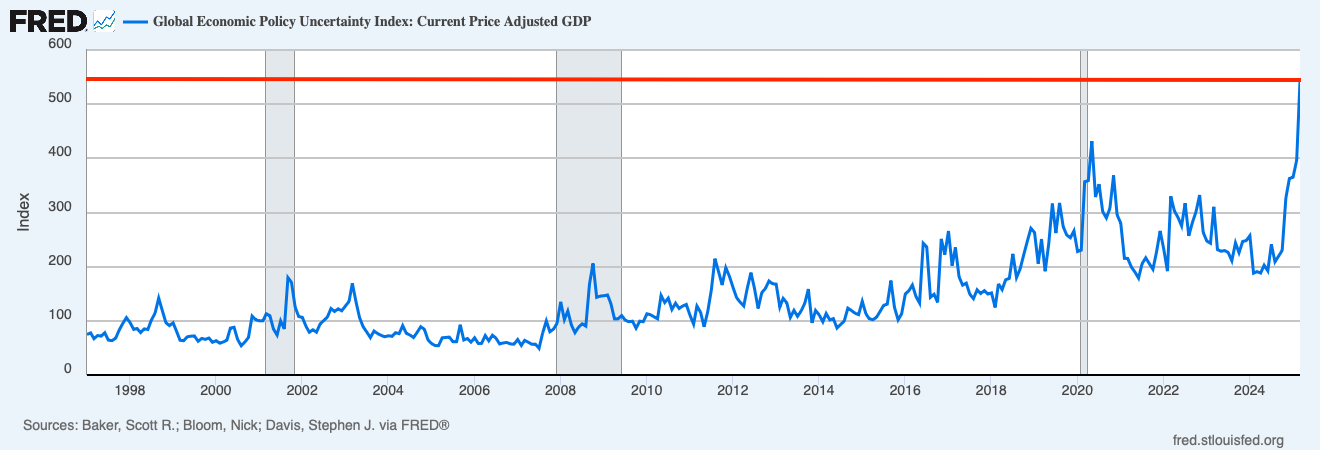
The bottom line is that market momentum is positive and political headlines have been constructive lately, but they are sitting on top of record high uncertainty that drives economic contraction, as executives put off expansion plans. You can’t short it, but this market is richly priced for such levels of uncertainty and a cloudy horizon.
Comments
Nothing yet. Say the first thing.
Sign in to join the conversation.