
Wednesday, the markets managed to close in the green, but breadth was lacking with the megacaps driving the gains, as is evidenced by the outperformance of S&P 500 Growth and the Nasdaq indices over S&P 500 Equal Weight, which closed 1.5% lower than S&P 500 Growth.
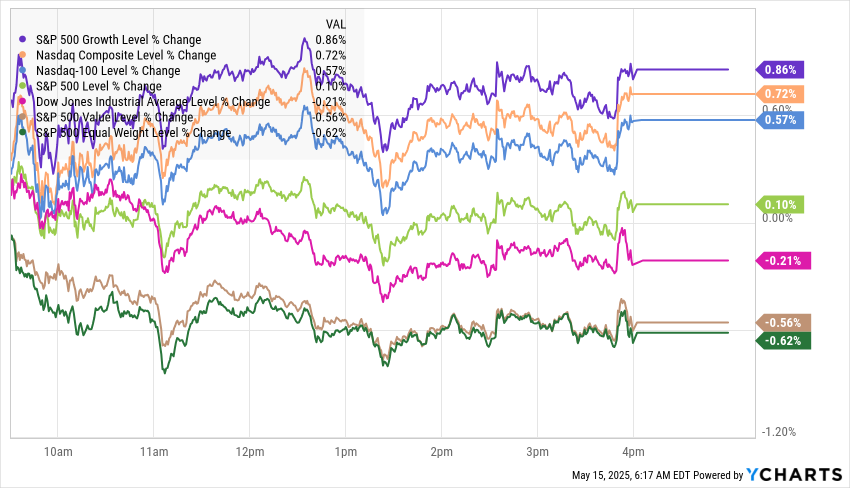
For the S&P 500, 204 more stocks fell than rose. Going back to 1990, the S&P 500 has closed in positive territory only seven other times when breadth was this bad, and five of those were in 2023 or 2024. The other two were July 2015 and February 2000. Decliners led advancers by roughly 2-to-1 on the NYSE and were close to that for the Nasdaq.
Over the past week, the Magificent 7 ETF (MAGS) has outperformed the S&P 500 ETF (SPY) by nearly eight points, the widest performance spread since June 2023.
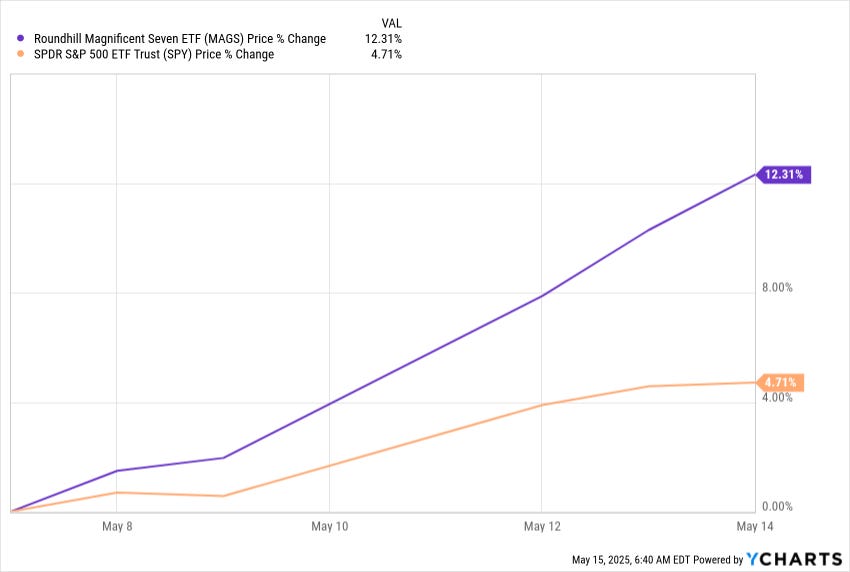
Since the market’s low on April 8, the Magnificent Seven have outperformed by nearly twelve percentage points.

In the options markets, across a range of major currencies, investors are willing to pay more for long-term US dollar downside than for long-term dollar upside. With respect to the euro, only during the peak of COVID volatility was the view on the dollar more bearish over the past 20 years. The bearish view of the US dollar is the most bearish versus the UK pound sterling and the Canadian dollar since 2009 in the aftermath of the Global Financial Crisis.
Historically, long-term returns for the US dollar are the weakest following periods when options markets were the most bearish on the US dollar. Still, for now, the dollar remains weak, while uncertainty over whether the US can remain a primary destination for global capital, driven by the tariff war, remains high.
The recent relief rally in equity and credit markets has not been mirrored in the FX market, with the DXY dollar index down again on Thursday. All the major trendlines depict a significant bear market in the U.S. dollar.
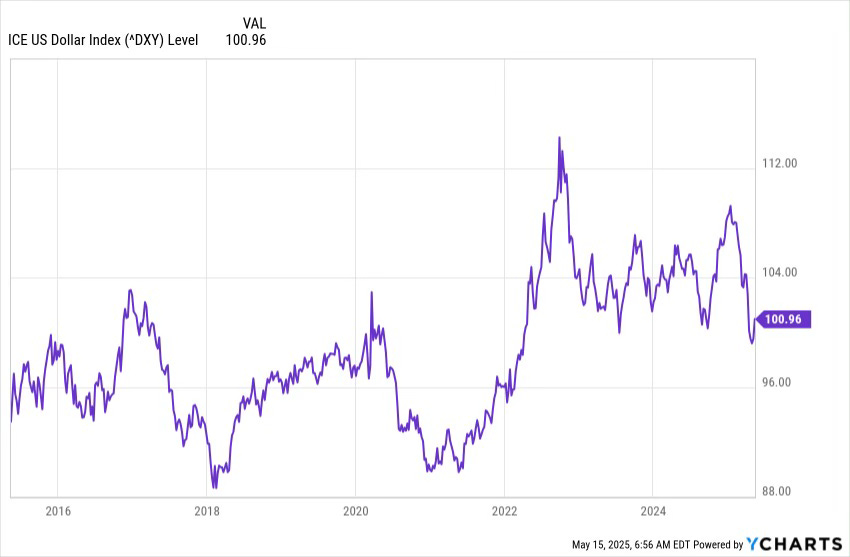
This is also particularly interesting to watch as the rise in bond yields in recent weeks has returned them to their highest levels since February, on the assumption (I’m guessing) that the 90-day holds have removed economic downside risk.
Aside from the impact of the significant shift in US trade policy, the US economy doesn’t look quite as strong as our partners. While the US economy was in contraction in Q1, industrial production in the euro area rose by 2.6% month-over-month (MoM) in March and by 3.6% year-over-year (YoY). Real GDP for the Eurozone increased by 0.3% quarter-over-quarter and by 1.2% year-over-year.
The U.K. surprised to the upside with a +0.2% MoM jump in real GDP in March. For Q1, the first release showed +0.7% sequential growth spurt and +1.3% on a YoY basis, which is bullish for the pound sterling against a weakening US dollar.
Mark Carney, Canada’s new Prime Minister, announced a suspension of most of his country’s retaliatory tariffs, leaving the effective tariff rate back around 0%. President Trump has announced that India has pledged to do the same.
Doesn’t look like Tim Cook is going to get an invitation to Mar-a-Lago anytime soon, as the President has made it clear he is not happy with Apple’s decision to move all of its production of its iPhones away from China and into India by the end of next year. Earlier this month, Cook said Apple expects to take a $900 million hit to its bottom line in the second quarter due to the tariffs.
This week, Paul Singer, the founder of the activist firm Elliot Management and major Republican donor, wrote a letter to his firm’s investors in late April titled “Bonfire of the American era?” In the letter, he argues that the Trump administration’s economic programme could negatively impact both the US dollar and foreign interest in doing business in the US. The administration’s policies, Singer wrote, risk causing “capital flight” and a “significant” decrease in the US dollar and US assets. According to the OpenSecrets website, Singer has been a significant donor to Republicans in recent years, donating $ 56 million to the party’s candidates during the last election.
On Wednesday, Walmart's Chief Financial Officer told CNBC that consumers could start to see tariff-driven price hikes as early as the end of this month. Earlier this month, AMD announced that it expects to lose $1.5 billion in revenue in 2025 because of restrictions on chip shipments to China. Other major companies citing significant impacts to their business from the tariffs include:
AMD expects to lose $1.5 billion in 2025 because of restrictions on shipments to China
Alaska Airlines pulled guidance
Ford expects a $1.5 billion hit in 2025 from tariffs
General Motors lowered forecasts for earnings
JetBlue pulled its full-year outlook
Kraft Heinz lowered its full-year outlook
Logitech withdrew its 2026 outlook
Mattel warned it may need to raise prices
PepsiCo lowered its earnings forecast for 2025
Procter & Gamble lowered sales growth projections
Rivian lowered its targets for vehicle deliveries and CapEx
Skechers pulled its full-year outlook
Southwest Airlines pulled guidance
Stellantis suspended full-year guidance
Steve Madden withdrew financial guidance in light of the tariffs
Toyota estimated $1.25 billion lost in just April and March from tariffs that will also generate a 21% drop in operating income through 2025
UPS pulled full-year guidance
But markets are back to where they were before this all started, and the CNN Fear and Greed Index is back near 1-year “greed” highs. Go figure!
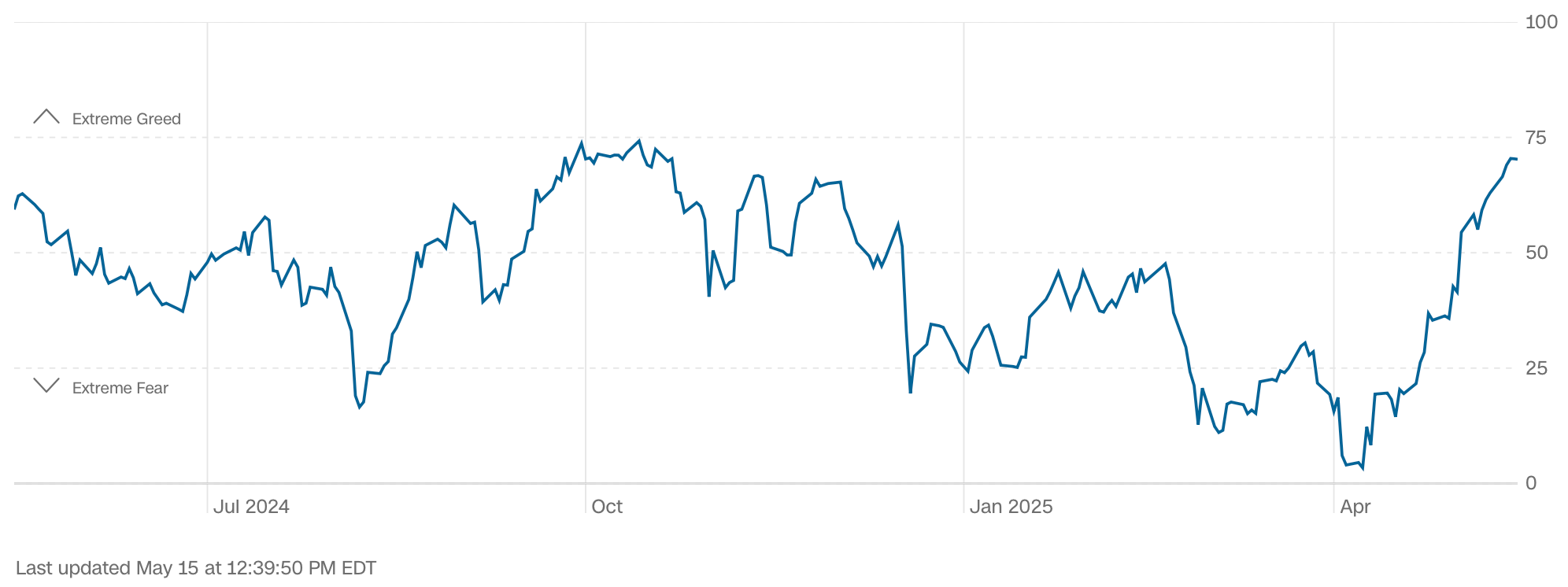
As I mentioned yesterday, I still can’t tell if this tariff issue will end up being a whole lot of drama that ends up having little impact on actual trade. It has generated enormous short-term market gains for those with inside information on the timing of announcements while leaving the rest of us exhausted.
According to Yale’s Budget Lab, the peak tariff rate of 28% has dropped to 18%, but that is still more than 7x (SEVEN TIMES!) the pre-2025 level of 2.5% and the highest since 1934. My apologies for the shouty CAPS, but damn, this is a big deal.
Investors are betting that this was mostly bark with little bite in the end. I remain skeptical that this will all go away. We can expect to see the impact of such high levels of uncertainty in the job data in the coming months, at the very least, which will put significant pressure on the administration.
Comments
Nothing yet. Say the first thing.
Sign in to join the conversation.