
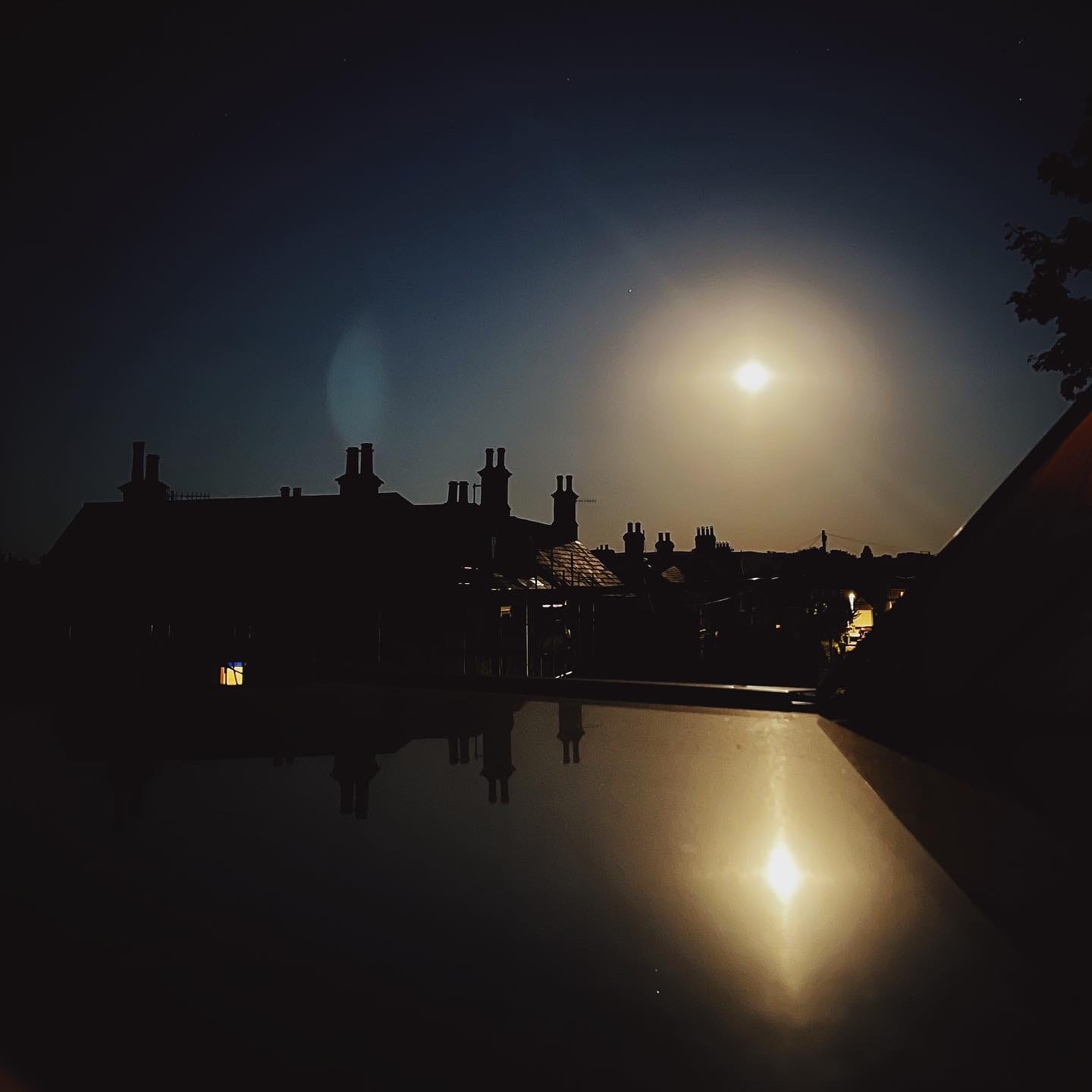
Let me tell you: I’m glad I’m not an astronaut. I have claustrophobia and the thought of being propelled into space with four other people inside a capsule the size of a parking lot gives me palpitations. But, over the last few days, when I have carried the weight of my sleeping sons across my shoulders from the car to our front door under the wash of the moon, I’ve looked up and thought: Where are they now and what can they see?
Which side of the earth is Artemis II orbiting right now? What does the little ‘glass marble’ of our planet look like today while they eat their breakfast? How do stars burn when there is no atmosphere to make them flicker? Craving the celestial silence of space for a few minutes, I wipe down the highchair of a weaning baby and blow-up balloons for our four-year-olds birthday. In the background, I play “Moon” by Sleeping At Last—the song my husband and I walked down the aisle to. Our wedding fell just one week after the 50th anniversary of Apollo 11. If you listen closely to the track, you can hear the flickers of NASA audio clips—the launch, landing, and the long journey home—scattered through the melody. The composer wrote the piece by imagining what the music for such an adventure might sound like. For us, marriage was that “great adventure,” our own voyage into the unknown. It has been years since I really listened, but this week, I keep returning to it.
I am pulled toward these reflections because astronauts occupy a vantage point I will never reach. They see what I cannot; perhaps they even feel things I never will. As a visual storyteller and photojournalist, I spend my life thinking about the relationship between the seen and the unseen. But it goes deeper than my job. It’s my faith—a belief in an invisible God made visible through a human who walked, breathed, and suffered among us. What is mysterious that has been made known? What is far that has come close? What is abstract that has become personal? (Also, maybe it’s because, I’m glad it’s not me up there, my hair floating wildly around my face without a scrunchie.)
From that small, distant vessel, we have heard words spoken from the depths of the human heart. We’ve witnessed the Commander’s grief for his late wife: “It’s a bright spot on the moon. And we would like to call it Carroll.” We’ve heard Victor Glover remind us that we aren’t here by chance: “In all of this emptiness... you have this oasis, this beautiful place that we get to exist—together.” We’ve been reminded that from 250,000 miles away, Earth doesn’t look like a map of countries defined by borders; it looks like home. One world. One story.
We’ve also seen a microphone floating around in silence, possibly in response to some remarks by a certain contraversial leader. More floating microphones please.
I’ve loved these dispatches. But one specific part of their journey haunts me: the moment the spacecraft moves behind the Moon. Radio contact vanishes. A moment of intense, unprecedented isolation begins. The mission disappears. The tether is cut. Forty minutes of complete invisibility. A communications blackout. Silence from the far side of the moon.
These scientific facts settle into my bones as feelings. I think of those 2,400 seconds of silence. I have had my share of them: those dark pauses, the lost contact, the days of hiding or sorrow. The “middle” days—between the struggle and the solution, the question and the answer. The days when God is on mute and there is nothing to do but wait. I know them well—those “Silent Saturdays” between Good Friday and Resurrection Sunday, when everyone else seems to have a testimony and I have only the void.
I once wrote about Ray Parkin, who, while a Prisoner of War, painted a watercolor of a Lantern Bug. It was his own season of lost contact, a “night of the soul” set against the horror of the Death Railway. I am still figuring out why that drawing holds such power over me. Partly, it is a testament to resilience—the way a tiny, colorful creature allowed Ray to reclaim his humanity in a place where men were treated like animals.
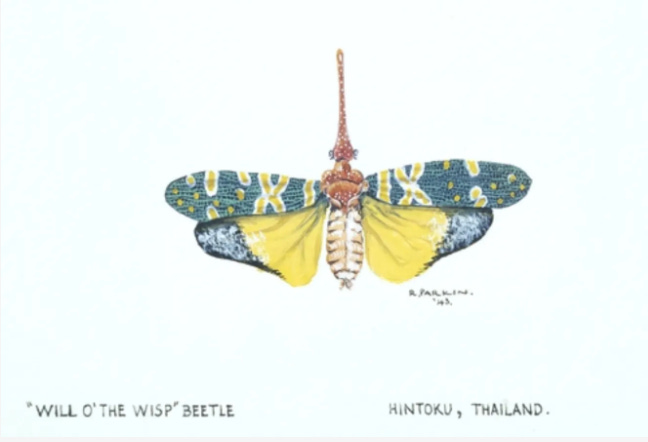
His painting is a reminder that we live within a juxtaposition of scales: colorful insects and global wars; tsunamis and wasp stings; a tiny capsule housing four heartbeats and the fractured, vast cratered shadow of the moon. Ray’s beetle has become a symbol for me. It reminds me that I can be simultaneously out of control—helpless, limited, and unremarkable—while remaining full of specificity, color, and purpose.
Small, specific, touchable, sparks of life. They are what we need to see outside of us. They are what we need to feel within us.
Maybe not that strange then, that I’ve started caring more about the vast expanse above my head now that four humans are reporting from there; in expertise, in grief, in discovery, poetry and wonder.
And, while I’m not sure my own stomach would have held it, I find it comforting knowing the astronauts were apparently eating maple creams during those forty minutes of silence on the far side of the moon; a little taste of home and a reminder of who they are on the other side.
As always, I love hearing from you. Feel free to leave feedback, comments or reflections.
Thanks for reading The Honeyeater Press ! This post is public so feel free to share it.
No posts
Comments
Nothing yet. Say the first thing.
Sign in to join the conversation.