
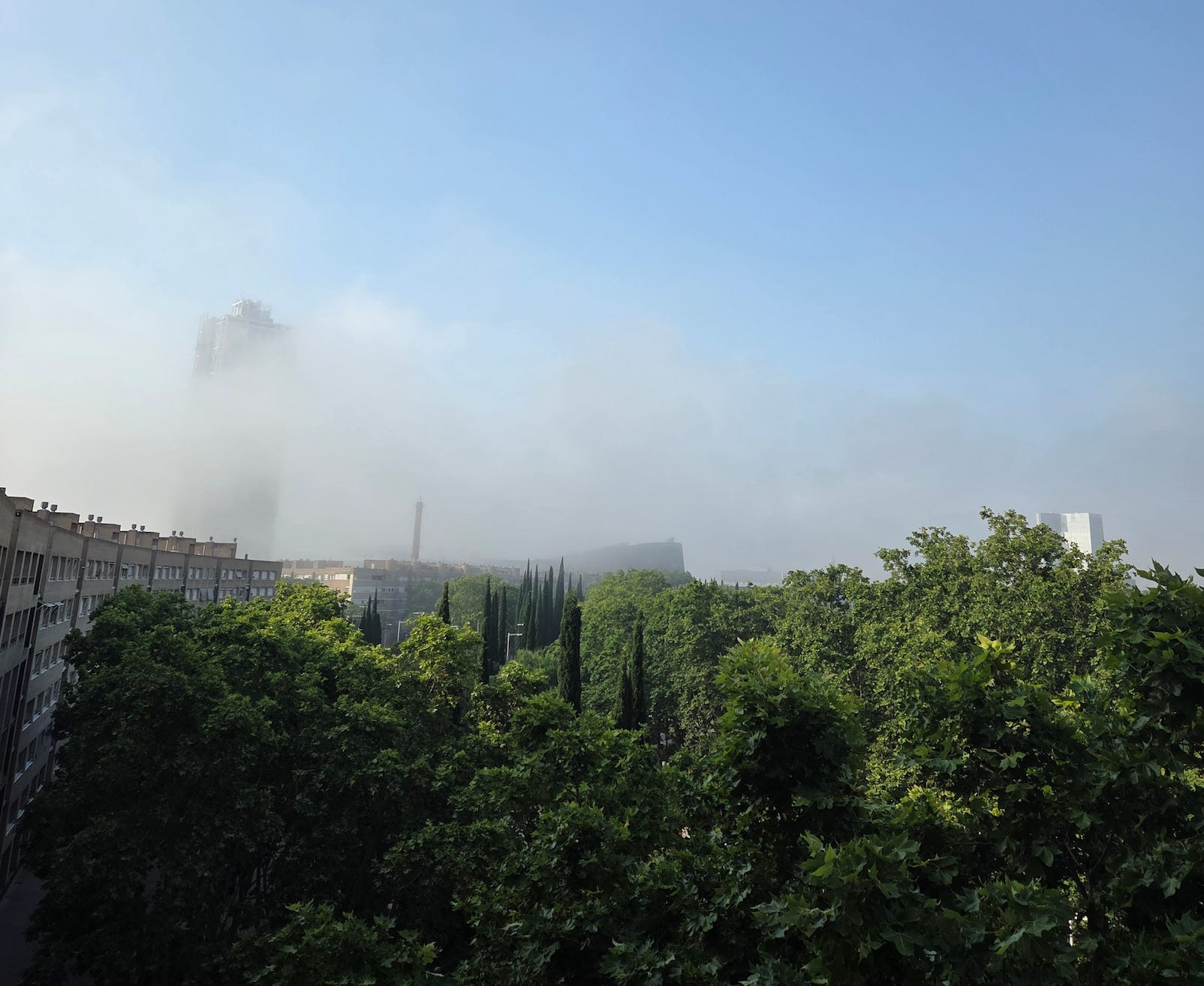
Most mornings you can find me on my balcony sipping coffee. A long standing tradition since — was it luck? serendipity? some higher power? — presented me with the most perfect Parisian apartment avec balcon1. If you’ve never lived in the French capital you might not understand how truly rare this is. I made it a point to park my butt on that balcony every single morning as a symbol of my gratitude to whoever or whatever blessed me with such a coveted find nearly 12 years into my French chapter2. The tradition is still holding six years in, even if the balcony, apartment and city have changed.
One great thing about moving to a coastal city is that you can be comfortably outside most days of the year and are greeted by sun most mornings. It’s also much more common for people to have terraces and balconies here, so mine is less of a flex at this point, but having one still feels incredibly luxurious to me.
A few days after publishing OpenLoops.02, I was sitting out there watching seagulls fly around3 and I saw a text from from one of my best friends, Ines4. She’d read my latest newsletter and wanted to know if one of the two albums I’d shared in the last one was AI generated.
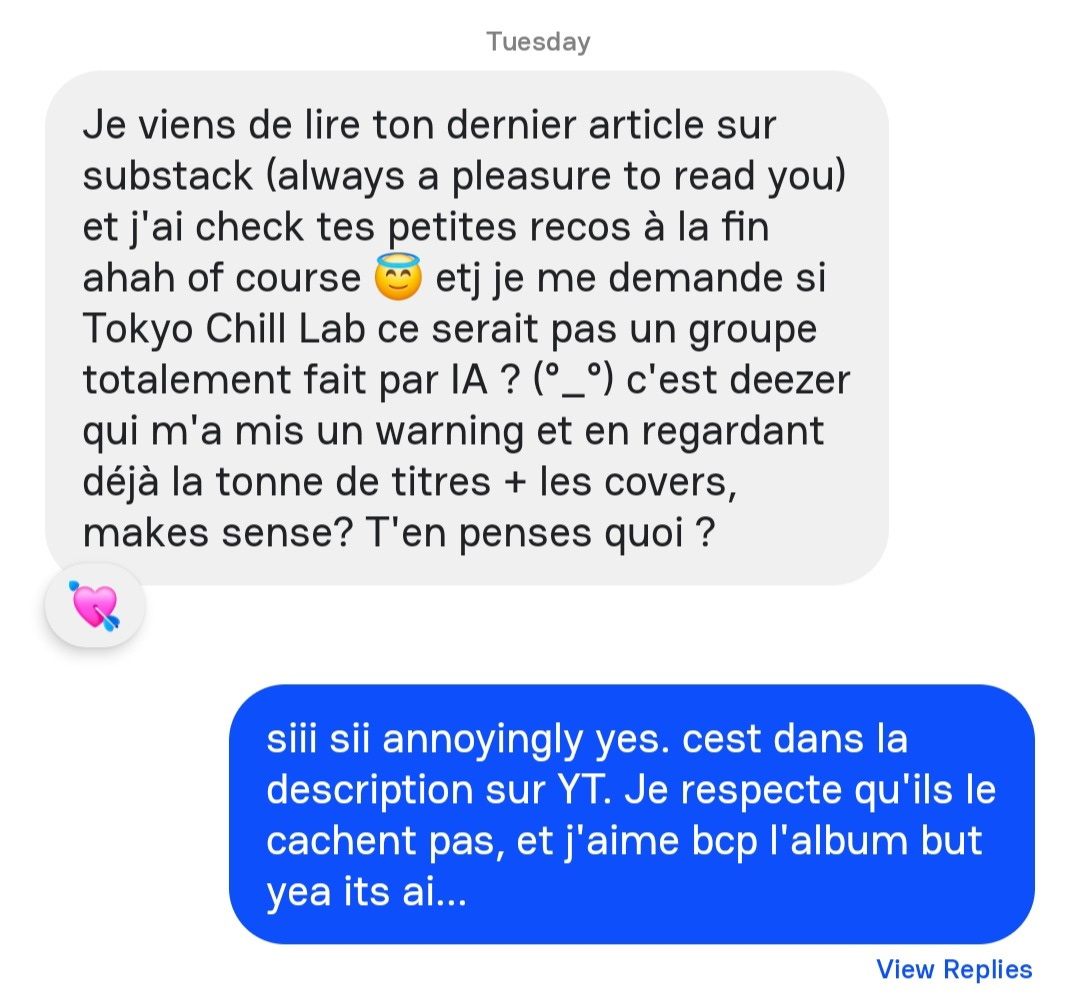

Up until now I’ve felt pretty secure in my ability to tell when AI is attempting to enter the chat. With writing I can usually spot it pretty quickly. With visuals, I can feel into it most of the time. But I hadn’t picked up on it at all in the Tokyo Chill Lab album that I’d shared last week, and that made me feel strange.
Not because I felt deceived. The artist clearly states in the Album description, (which until Ines texted me, I obviously had not read,) that the music is AI-generated. What bothered me was what it implied about my apparently very misguided confidence in hearing the AI-ness of it.
At the same time, I noticed something else, an absence of repulsion where I had definitely expected to find some. Learning that it was AI didn’t make me like the album any less. That really surprised me.
Ines and I spent the rest of this week chatting back and forth about what makes something slop, what makes something real even if AI is part of the workflow and more generally, the ethics around all of it.
From where I stand, slop goes back much farther than this AI era we’re in.
Before I started working with code, I was in the digital media space, right at the apex of web video becoming the thing. Suddenly everyone was making videos whether they wanted to or not, because eyeballs. Does anyone remember the era of YouTube agencies? I certainly wish I didn't. They'd promise creators more views, more clicks, more money, channel growth, the whole thing. Maybe this is the digital slop origin story?
The same thing happened with NFTs, specifically longform. A wave of people with zero relationship to generative art appeared out of nowhere, scraped algorithms off the internet, swapped a parameter or two, maybe added a new color palette, and got to minting. Part of me will forever side eye that wave of “artists” for the impact they had on the Creative Coding side of the Open Source community. I wouldn’t be where I am in my career without the generous and kind individuals who not only share code snippets or entire repos, but also their time and expertise with me. The scene is very different now. Code is kept more private or stashed behind a paywall. I’ve also noticed within the creative tech ecosystem, a jump away from writing code to instead using nodes. Nodes are harder to plagiarize since you can’t scrape them from the web. They’re also harder to use AI with. And to me that tracks.
AI is just the latest iteration of this dysfunctional dynamic. Annoyingly, it tends to make going for the cash grab even easier. But I’d be remiss not to point out that the people making AI generated slop would have found a way to make slop regardless. They always do. It’s not the medium’s fault. Incentive is a powerful thing and when it happens to be money, people can go numb to how their actions affect others individually and culturally at scale.
On the other side of all that slop, there are brilliant people who are genuinely curious about what this tool can do in the context of their own practice. Those are the people I’m interested in. I honestly can’t tell you with any certainty where Tokyo Chill Lab lands on that spectrum. I genuinely still enjoy the album I shared but I also acknowledge that the artist(s?) released more than 15 albums in the last year, which smells a bit like a strategy for maximizing streaming profits to me. But it’s just a guess, and like I said, it’s a spectrum.
The genuinely interesting stuff appears when people stop showing off the tool for the sake of the tool, and start using it to go somewhere they couldn’t get to before.
There are also the things that people will just never stop doing.
Writing. Making music. Telling stories to an audience, putting on a show in front of a crowd. These are things that are baked into our DNA as human beings. Tribal beings. Collaborative, creative, expressive beings.
Even if AI can do it all, and eventually do it more accurately or perfectly than any of us humans can, the pull of any piece of work of art isn’t the output. The only reason any output is truly impressive, touching, poignant... is because the audience knows how hard it is for a human being to extract that formless spark of an idea from their mind’s eye, communicate it to people, gather enough resources, and stay motivated throughout everything to make it happen. Someone imagined it, and then somehow made it real. The feat of it all, that’s not something you can automate.
The fact that we humans have even created AI is a feat. And a damn impressive one. It’s why showing off the tool for the tool’s sake is still exciting. Someone built that too.
a quote:
An alive culture replaces distraction and escapism with mindful attention, direct experience, active participation, creative expression, deep connection, genuine sharing, and lasting community (in other words, it’s a utopia!).
In an alive culture, you follow what is interesting rather than having your mind be fed for profit. In an alive culture, you listen with intent and open yourself to awe. An alive culture requires effort and vulnerability. In exchange, it offers adventure and divine sparkle in seemingly mundane moments. An alive culture is deeply human, soul-focused, and utterly unreasonable from today’s perspective.
Frederik Gieschen | The Birds and the Wasteland
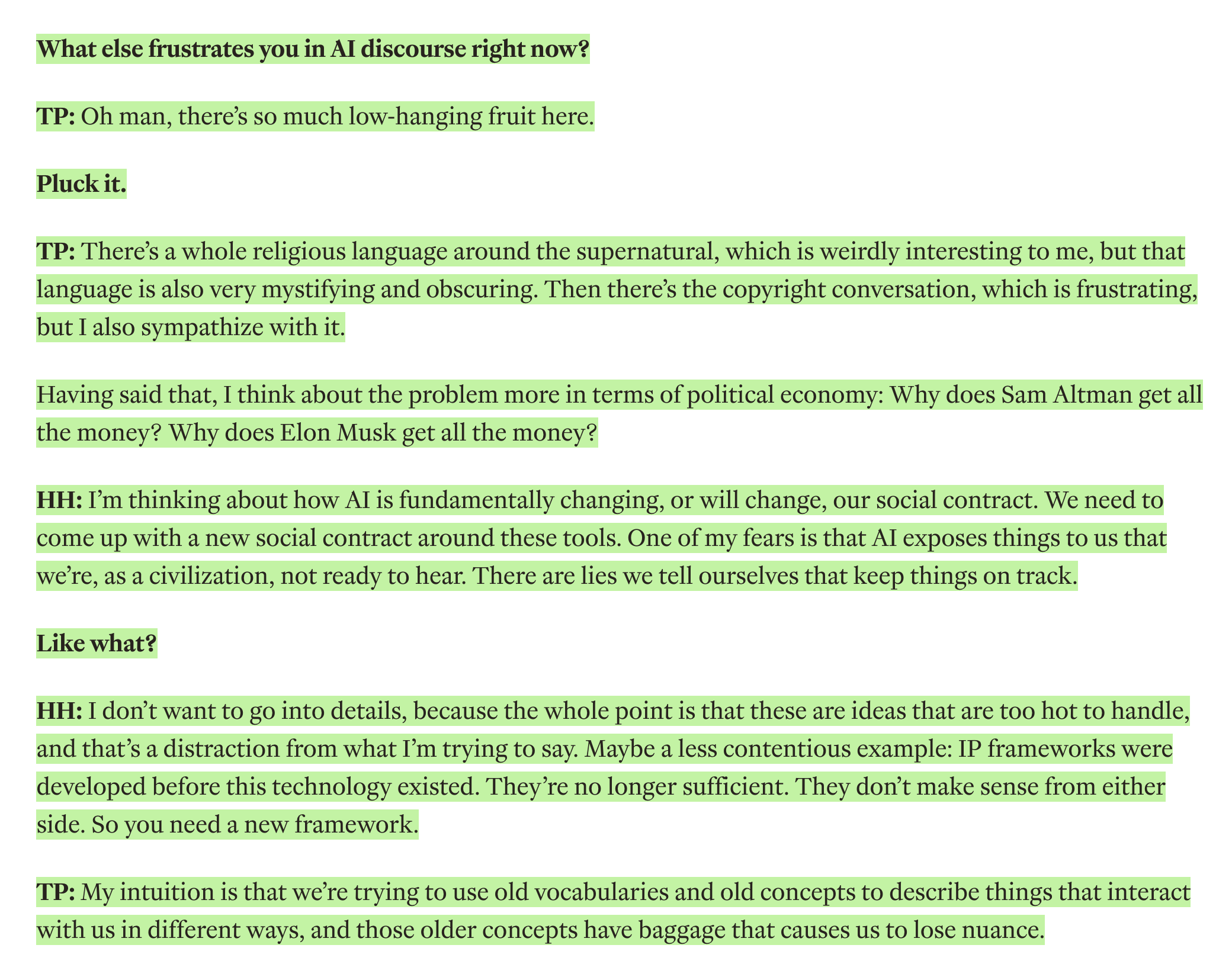
an interview
I landed on a discussion between Trevor Paglen and Holly Herndon this week. I always enjoy reading Holly’s thoughts around AI because they feel very nuanced and realistic to me.
a thought
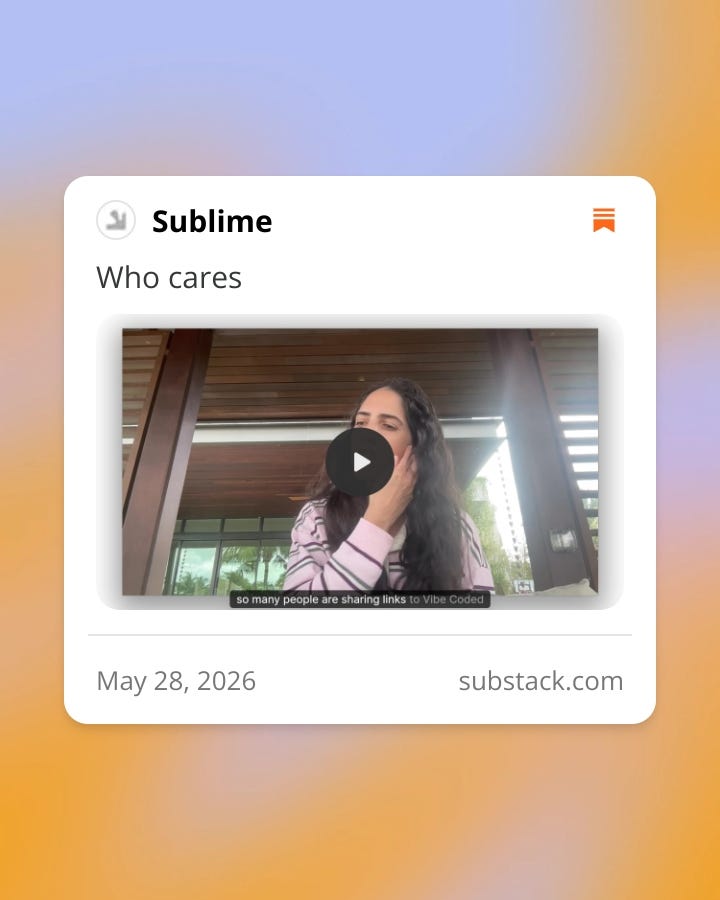
Sari from Sublime (that happiest place on the Internet) on who cares in the age of AI, or if anyone cares at all, and why.
a book:
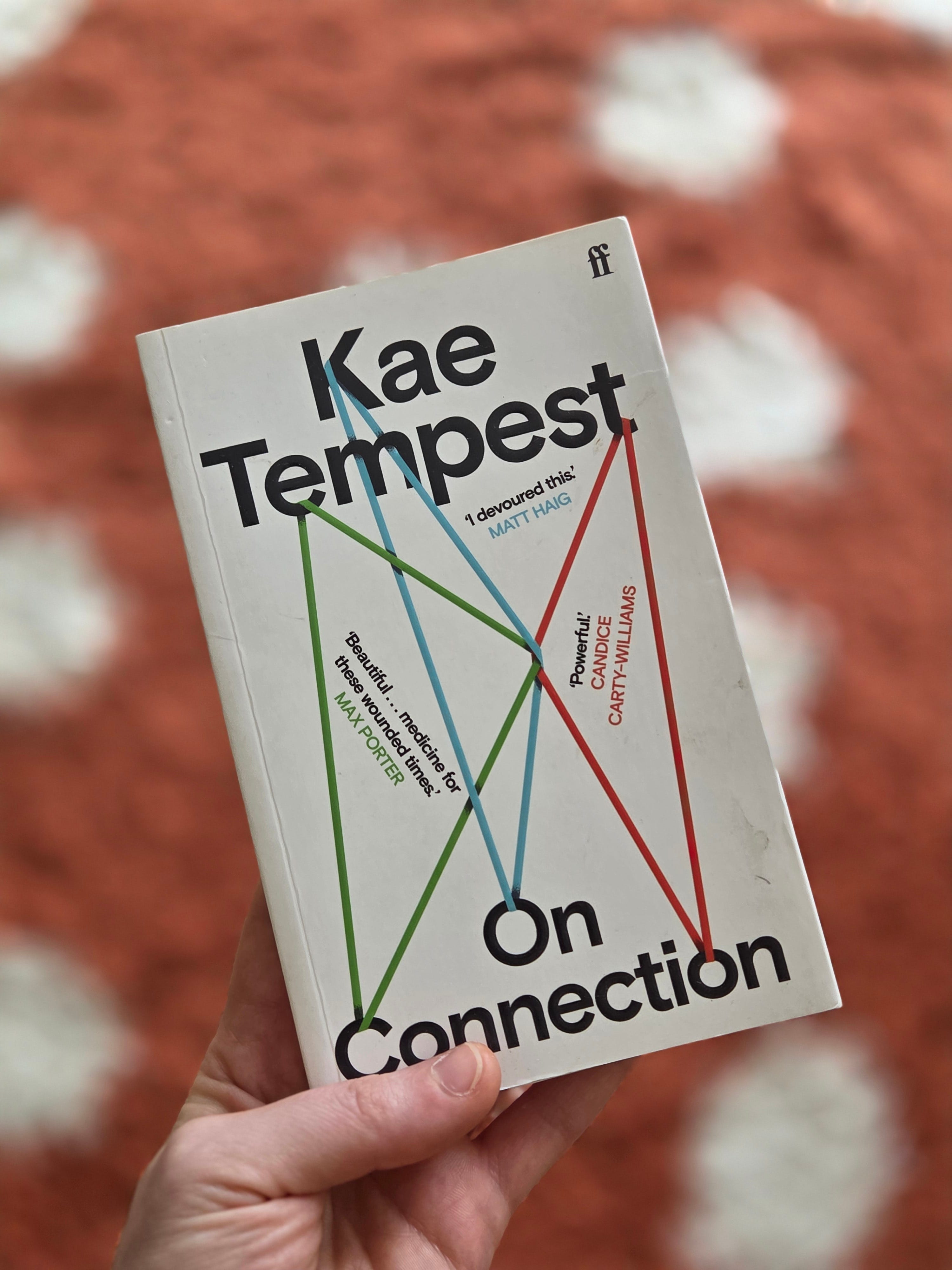
I have highlighted like 90% of this book, that’s how much I loved it. I hate endings and so I tend to drag my feet to finish books. I’ve been holding on to the last 10 pages of this one since I got back from Australia last April. I know. It’s short, it’s sweet and it’s hopeful. All things we need right now.
avec balcon is French for with balcony.
Exceptions being the many soggy, wet and rainy days Paris is known for.
One of the many perks of living by the beach is seeing an endless stream of birds gliding around at any given moment, but especially in the early hours of the morning.
Comments
Nothing yet. Say the first thing.
Sign in to join the conversation.