
If you’re reading this newsletter, chances are you’re already well acquainted with the Slow Food movement. For me, Slow Food has been an integral part of both my personal and professional life since the early 1990s. That’s why the recent passing of its founder, Carlo Petrini, feels especially significant.
I still remember hearing about the very first Salone del Gusto in 1996. It was going to be a food fair unlike any other. I can’t quite remember if I first read about it in a newspaper or received a press release in the mail (it was a long time ago!) but I knew immediately that I wanted to be there. An organization called Slow Food was bringing together food producers from all over Italy, but not just any producers. These were farmers, cheesemakers, bakers, and artisans dedicated to preserving foods that were on the verge of disappearing.
Walking through the exhibition halls was a revelation. I met people proudly cultivating a single variety of bean on the shores of Lake Trasimeno. Others were curing lardo in marble vats carved from the quarries of Carrara. Farmers from Puglia were linking strings of tomatoes, to preserve for winter exactly as generations before them had done. Nearly everything I encountered was completely new to me, despite the fact that I already considered myself fairly knowledgeable about Italian food. And if you know about these products today it is most likely thanks to this first Salone and the ones that followed every two years since then.
What Carlo Petrini understood - and what made Slow Food revolutionary - was that food is inseparable from culture. Preserving a cheese, a bean, or a loaf of bread also means preserving a landscape, a language, a way of life, and a community. Education was central to the movement, but Petrini also recognized that awareness alone wasn’t enough. Producers needed visibility, political support, and markets for their products. If no one knew about these foods, they would disappear. If no one bought them, they could not survive.
Over time, Slow Food brought this message far beyond Italy, inspiring people around the world to think differently about what they eat and why it matters.
From the very first moment I encountered Slow Food, it changed the direction of everything that followed. Recognizing the cultural significance of food, and trying to preserve and share it through writing, photography, video, and travel, has guided my work ever since. In many ways, Via Rosa would not exist without Slow Food. And Slow Food would not exist without Carlo Petrini.
Food may be the map that leads us to a destination, but it is also the key that unlocks an entire world. Using food as a compass to lead us is not only the most delicious way to travel, but also the most meaningful. When we learn about something as simple as freshly made Sicilian sheep’s milk ricotta, we are also learning about a place, a history, and a way of life that exist nowhere else. More importantly, we meet and support the people who keep these traditions alive.
That connection between food, culture, and place is the legacy Carlo Petrini gave us.
Sophie and I have wrapped up our final tour of the season. I know time flies when you’re having fun, but these last few months have sped by. Even though I’m not currently going on tours, I am busy working away, planning for the fall, tours in 2027, and even as far out as 2028!
We are so excited to be collaborating with a great group of guest hosts. Shereen Pavlides finished up a wonderful tour last week, and it looked like they had a blast! Each of our guest hosts brings their own energy and knowledge to every tour. But the tour itself is 100% Via Rosa—searching out the connections between food, culture, and community. In Puglia, Shereen was the host with our tour leader Giorgio, who led them from the alleyways of Bari to the coast of Gallipoli. Shereen truly captures the spirit of our tours in her short videos. You can see the one she made about her most recent trip here, and she just posted another one about her upcoming tour to Sicily.
Another guest host that we are super excited about is Erin Jeanne McDowell. Maybe you already follow her? Her recipes appear regularly in The New York Times, and her books are most likely on your shelf if you’ve ever baked anything at home. She is hosting our Eastern Sicily tour next spring, and of course the trip will include a lot of baking. A visit to a watermill will include a scaccia-making workshop, and guests will also visit our friend Giuseppe’s organic farm to learn how to work with the ancient grains he grows to make pasta. And the visit to the almond farm means working with freshly ground almond meal to make Sicilian almond biscotti.
Longtime Via Rosa guest host (I think she was one of the first and is now on trip number seven!) Jenny Rosenstrach is heading to Palermo & Western Sicily. Although I know her through our infinite food-world connections (and the fact that she is a friend of my sister), many of you probably know her through her award-winning website, newsletter, and books, Dinner: A Love Story. After a long career in traditional publishing, Jenny launched a blog built around a simple but powerful idea: she had been keeping a diary of what she ate for dinner since she first learned to cook. As her own family grew, that diary evolved into something much bigger. Jenny became one of the most thoughtful voices writing about family meals—not just what to cook, but why dinner matters. Her work reminds us that dinner is more than a task to check off at the end of a busy day. It’s an opportunity to gather, connect, and create memories around the table. The fact that she also develops incredibly delicious, approachable recipes explains why her books have become such bestsellers.
We love it when a guest host inspires us to look at our tours through a different lens. When Leah Koenig, author of the award-winning Portico—which explores the food traditions of Rome’s historic Jewish community—approached me about hosting a tour focused on the Jewish roots of Roman cuisine, my immediate response was: “How about Sicily instead?” Not only does Rome not need any more tourists, but Sicily offers an even richer opportunity to explore the intersection of food, history, and culture. Jewish communities lived on the island for centuries before their expulsion in 1492, and their influence remains woven into Sicilian cooking today. Ingredients, techniques, and dishes that many people think of as simply “Sicilian” often have roots in those Jewish communities. Leah’s tour through Eastern Sicily, will uncover those connections, revealing a fascinating layer of Sicily’s culinary history that even many Italians don’t know. Curious? So are we.
You can find our full schedule for Fall 2026 and Spring 2027 here. We still have a couple more tours to announce for Spring 2027, and our Fall 2027 schedule will start dropping next month.
To be among the first to have access to our tours, make sure you are signed up for the paid version of this newsletter.
*****2026 FALL LAST-MINUTE OPENING*****
Due to a last minute cancellation, we have three spots available on my Eastern Sicily tour in September 2026! I hope you can join me!!
JOIN ELIZABETH IN SICILY IN SEPTEMBER
I love, love, love the new series in The New York Times by Sam Youkilis and Matt Goulding, Before It Disappears. They are traveling the world documenting traditional foods before they are lost to memory. Their latest stop brought them to Sardinia, where they visited Paola Abraini, one of the very last women who knows how to make the pasta su filindeu. I had the amazing opportunity to visit her in 2017, and it warmed my heart to see her still in her kitchen, keeping this tradition alive.
Evan Kleiman reports on her recent tour to Sicily with Via Rosa. (there was a lot pasta involved)
A love letter to finding the perfect single hotel room.
If you’ve ever wondered how to make Puglia’s famous Spaghetti Assassina, Jenny Rosenstrach brings home the recipe from her recent Via Rosa trip.
I finished Elizabeth Strout’s latest book, Tell Me Everything. Is it slightly depressing? Yes. Is it beautifully written and full of truth? Double yes. Totally recommend it.
After reading beautifully written but emotionally challenging books for the last few months, I decided to kick off my summer reading with some science fiction. I can’t remember how I first came across Seek the Traitor by Veronica Roth, but it was sitting at the top of my Goodreads “Want to Read” list, so I followed my own advice and picked it up. It turned out to be exactly what I was looking for: a dystopian future Earth, visitors from another galaxy, and strong female characters. Roth is also the author of the hugely popular Divergent series, so if you enjoyed those books, there’s a good chance you’ll like this one too.
I don’t know Bologna as well as I’d like to, but our friend Martina goes there all the time. Here’s her list of where to eat.

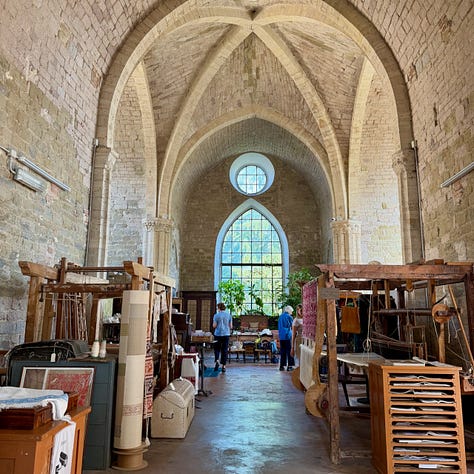
MINI GUIDE TO PERUGIA
We just finished our Umbria tour, and it was the first one we hosted in Perugia. We loved being in the center of this charming town. Although I’ve lived in Umbria for the last 30 years, I have to admit that I rarely make it to Perugia—which is a mistake I’m now trying to correct.
Perugia, the capital of Umbria, is a fortified hill town overlooking the Tiber Valley. I think one reason many visitors skip it is that getting there can feel a bit daunting. The ring roads that surround the city can be mind-bogglingly confusing, and once you finally make it up the hill, you’ll need to park in one of the municipal parking garages.
But once you’re there, the rest couldn’t be easier. All of the parking areas are connected to the historic center by a network of escalators, elevators, and the wonderfully efficient MiniMetro. And once you arrive in the center of town, you’ll wonder why you waited so long. There are great restaurants (always a plus), surprisingly few tourists, and plenty of locals. Perugia is also a university town, which gives it a youthful energy that many hill towns lack.
If you do make it there, here’s my very short list of things to see and do in a day.
8 Things to See and Do in Perugia
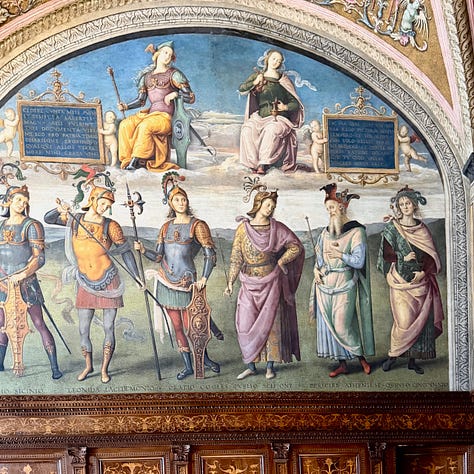
Collegio del Cambio
A jewel-box of a building decorated with magnificent Renaissance frescoes by Perugino.Galleria Nazionale dell’Umbria
One of the great museums of central Italy, with an extraordinary collection of Umbrian painting and sculpture.Museo Atelier Giuditta Brozzetti
Housed in a deconsecrated church, this small museum and workshop keeps the art of Renaissance weaving alive.Rocca Paolina
An extraordinary 16th-century underground fortress where you can still walk through the buried streets and houses of medieval Perugia.Piazza IV Novembre and the Cathedral
The beating heart of the city, anchored by the beautiful Fontana Maggiore and Perugia’s cathedral.Corso Pietro Vannucci
Perugia’s elegant main street, perfect for a passeggiata and a stop for coffee or pastries at the historic Caffè Sandri.Porta Sole
Climb to the highest point in the city for panoramic views across the Umbrian countryside.The Medieval Alleys
The best thing to do in Perugia may simply be to get lost. Wander the maze of steep lanes, hidden stairways, and medieval passageways that give the city its unique character.
If you’ve been paying attention, you know I don’t quite have a kitchen yet. While that hasn’t kept me from preparing meals (I do have a fridge and a microwave), I’ve realized there’s one food group that’s custom-made for my current situation: appetizers.
Yes, I can happily live on appetizers.
You all know my fondness for chips, but even I realize a bag of chips is not a meal (at least, not usually). There’s also the fact that Domenico (my very Italian husband) gets sad when I call a bag of chips dinner. So I’ve come up with a solution: as long as I put a little more effort into it and arrange everything on a beautiful platter, we’ll both be happy.
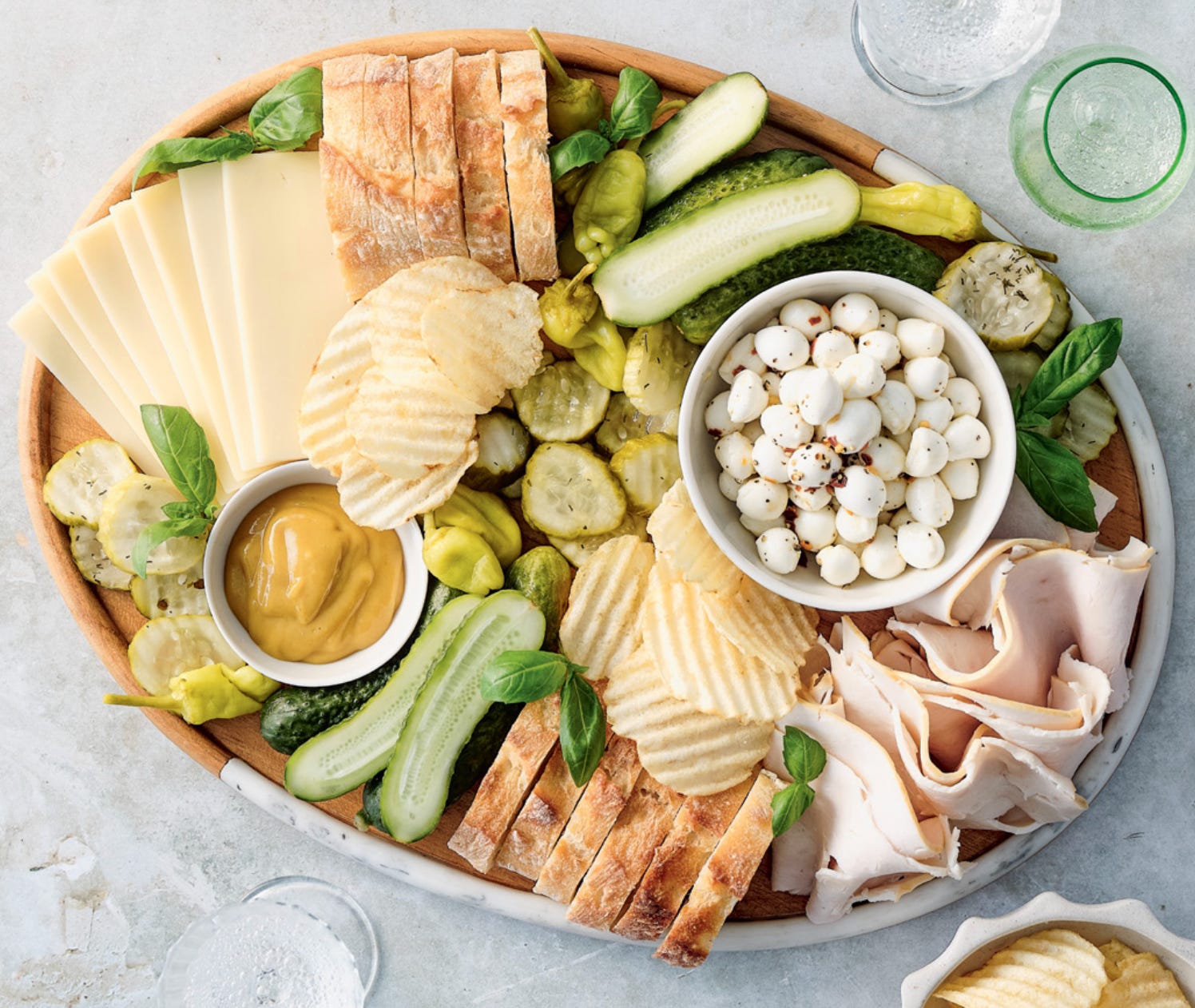
I recently found inspiration in Via Rosa guest host Marissa Mullens’ book I’ll Bring the Apps. So if you’re wondering what we’re having for dinner tonight, wonder no more. FYI: it pairs perfectly with vodka.
The following ‘recipe’ is literally called “Snacks for Dinner Plate.” While Marissa’s original version uses Havarti, bread-and-butter pickles, and sliced turkey (that’s her photo above), I’ve obviously substituted Italian ingredients. You do you. The main point is that you don’t have to cook.
Who needs a kitchen, anyway? Problem solved.
And if you’d like to come to Italy, to gather ingredients for your own cheese board, you can. Marissa is hosting a tour for us next Spring!
We still have no kitchen. And in case you are wondering exactly why it’s taking so long, it’s because the entire thing is being crafted by hand in Gubbio. Curious what that looks like? Here’s walk through we did in the workshop 2 weeks ago. You’ll be happy to know the entire kitchen is now being painted and should be entering our house in 10 days!!
x,Elizabeth
Comments
Nothing yet. Say the first thing.
Sign in to join the conversation.