
When you think of cowboys what comes to mind?
Welcome! You’ve reached Spark. Learn more here or just read on. This one goes on a bit but, like Lonesome Dove, it gets somewhere. If your email is cut off, just click now to come on through and read. I want to know what you think!
Lonesome Dove is a big fat beautiful book. Two pages in and I was blinking in the sun that bleached out the flat, shrubless Texas landscape where the journey begins. I wanted to get out of the heat, the dust, and step away from the little wooden house with the pigs on the porch and the cowboy/ex-Ranger who sips from his jug and follows his thoughts. I wanted to get off the 858-page horse I’d climbed on but it kept moving with sureness and a sense of promise. I didn’t embrace Lonesome Dove as much as I succumbed to Larry McMurtry’s storytelling. It’s worth the read just for the sunrises and sunsets alone, just for the descriptions of the shifting landscape from the Texas border to the green grass of Montana.
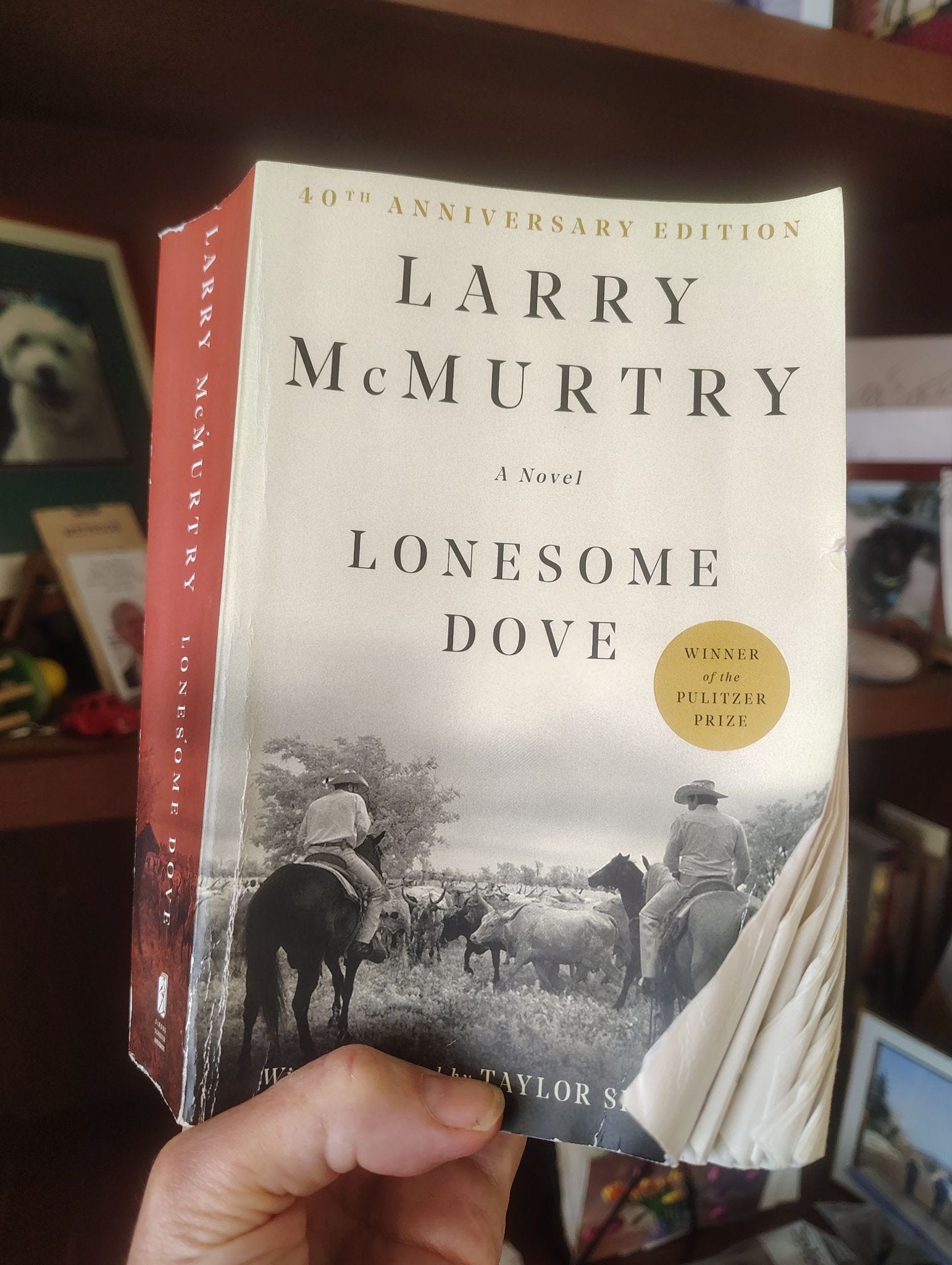
I read the book when I was not feeling my best. And perhaps there were other things at work. Here is what I wrote about it shortly after reading the last page:
Lonesome Dove is about men mainly. Men at middle age seeking one last flap on the dock and a bunch of others who go along for the ride. There are so many men in this book. Smart men. Stupid men. Greedy men. Lazy men. Evil men. Young men. Most of them never bathe. A lot of them never go near a woman. For those who have sex, accurately described as a “poke,” poor personal hygiene is not much of an obstacle. For those who don’t, it is still less of an obstacle. In either case, men are not required to remove their clothes – or their boots.
At my most absorbed, I am sorry to say that I still wondered about the stink, the layers of grit and sweat, semen, unwiped butts, the fleas, the encrusted undergarments when there were undergarments to be encrusted. These conditions would probably be viewed as advantages by those in charge of healthcare in our current government. What doesn’t kill you, strengthens that immune system, right?
And the women. The women in this big fat beautiful book do not just have to survive the harsh landscape. They have to survive the men. Many of them do not. The ones who do have to rely on the protection or gullibility of men until, like Clara Allen, are widowed and left with a business, property, and the wisdom and resources required to hold onto it all. She makes it to matriarch status, respected by men. She is the one who ultimately provides safe haven for Lorena, town prostitute and the lone woman who travels with the cattle drive and is brutalized along the way.
As the previous paragraphs seem to indicate, I came to Lonesome Dove with a chip on my shoulder. It’s not the overwhelming maleness of the book, or at least not only that. I have read hundreds of stories centered on men in all kinds of settings without any resistance. I will go to my grave loving Patrick O’Brian’s Master and Commander series without reservation. I am as fascinated by male friendships as I am about any friendship human beings forge in the pages of a novel. Yet, when I am confronted with a story about the American West and its men, a small hard shell of skepticism forms around my heart. I am ashamed of this lack of objectivity, this almost reflexive reaction even when I am reading a beautifully-written story like Lonesome Dove.
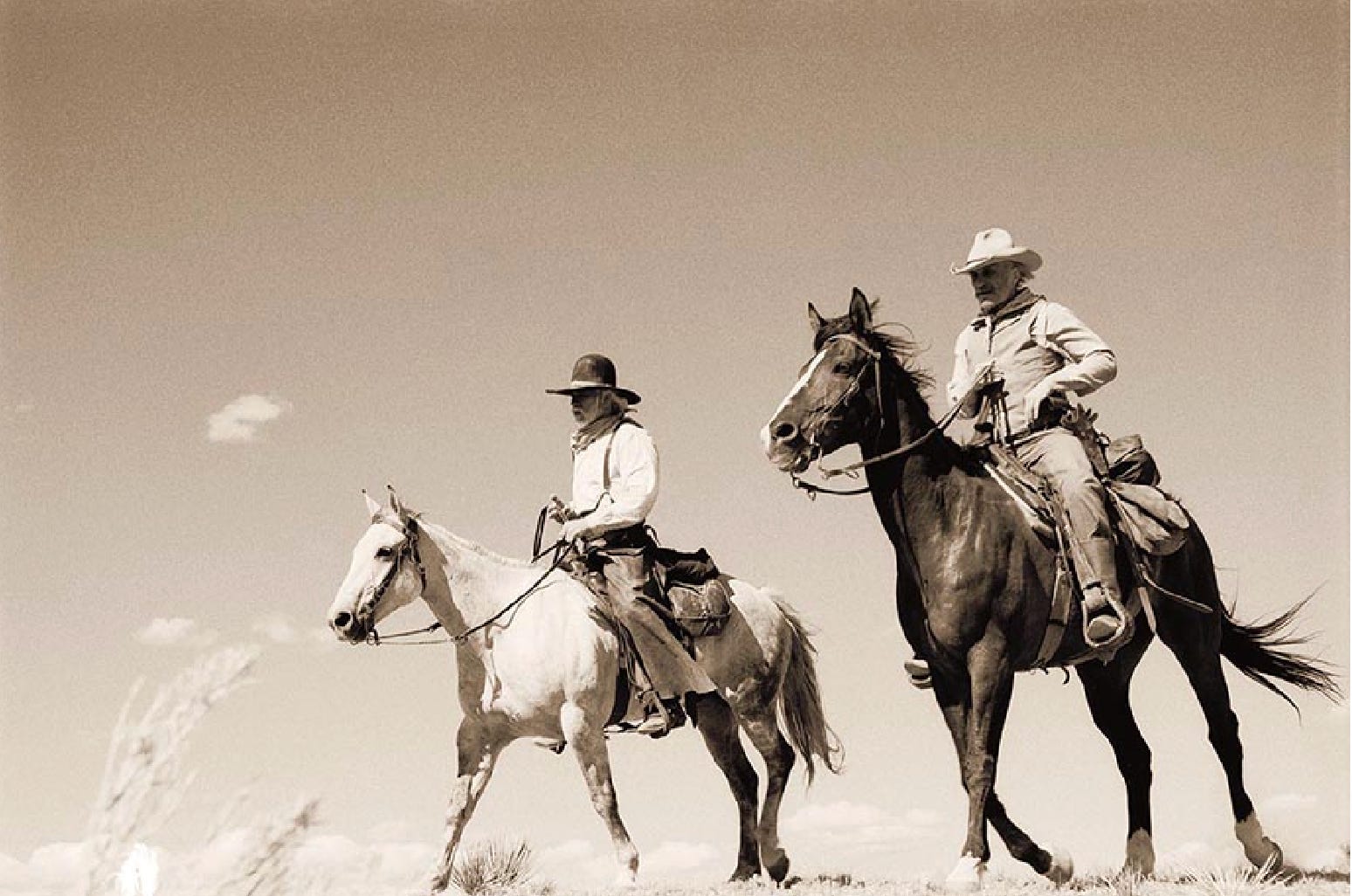
It’s not about the stereotypes in and of themselves. It’s about the place of the cowboy in American culture and what that has meant for women. A story of the West is inevitably about the conflict between the wild untamed state and domesticity. This is reflected in everything from the relationships between men and women to the effects of “civilization,” crushing the lives and livelihood of Native Americans as it inches forward from the East by foot, horse, wagons or coaches, and eventually by train. It’s reflected in the tension between the acceptance of laws and the reliance on individual moral codes.
These themes are as old as stories themselves. So why does their presence in Lonesome Dove rankle me? It may have something to do with coming of age in the Seventies when I began to study books by women and about women. It may have even more to do with the small story I’ve added to the end of this post. Or, it could be that everywhere I look in today’s political landscape I see that same adulation of the cowboy as both symbol and model, that same tension between individual and community and between men and women as rights are whittled away in the name of family and freedom.
Lonesome Dove is set in what the internet refers to as the “twilight years” of the Old West, when cattle drives were increasingly headed for the nearest railhead to load the stock on trains. Its two lead characters, Augustus McCrae and Woodrow Call, are middle-aged with enough years behind them to know that they have fewer years ahead of them. There is no heroism behind the cattle drive that is launched at the outset of the novel. No one’s life depends on the successful arrival of a couple thousand cattle in Montana. There is only the chance to go somewhere new and unsettled, to be first on the scene. The underlying question that drives the journey: how will two men, ten years retired from their days as Texas Rangers, use up the rest of their lives? One of them, Augustus McCrae, doesn’t need the journey so much as he wants to see what happens. The other, Woodrow Call, needs to work like some people need to drink. Those who go along need to grow up, to eat, to do something they know, or to have someone tell them what to do. Not everyone will make it to Montana. And the ones who do won’t find what they believed or hoped they would.
I can’t lie. I loved reading this book despite the shouting and arguing that went on in my brain as I went. I kept reading even when I was furious with a character (usually Woodrow Call), reeling from the violence, or aching with sympathy for those caught up in the consequences of being born into a time and place that was so unforgiving. The novel’s beauty lies not only in the landscape but in McMurtry’s grasp of the varied and complex nature of individual human beings, their vulnerability, and the quest for something that makes meaning of their lives even if it leads them to suffering or destruction. He doesn’t rescue his characters from themselves. He doesn’t make them heroes. He tantalizes with questions that fuel their individual journeys:
Will Augustus McCrae, watcher of sunsets, observer of human nature, lover of conversation, his blue pigs and women, ever find his way back to Clara, the woman he should have married years before?
Will Woodrow Call, born to lead men, at a loss without work to do, driven by a moral code that he violated, ever acknowledge the consequences of his lapse or realize that his refusal to do so is far more destructive than the lapse itself?
Will Newt, orphan son of a dead prostitute adopted by the crew at the horse trading ranch owned by Call and McCrae, survive and come of age? Will he ever know who his father is?
Will Jake Spoon, charmer, gambler, lover, and former Ranger who rode with McCrae and Call back in the day, overcome the weakness at his core? Can he sacrifice his own needs for anyone else?
Will Lorena, Lonesome Dove’s lone prostitute who dreams of a life in San Francisco, find her way out of Texas with her body and soul intact?
What might make Pea Eye ever remove his long johns?
Lonesome Dove is undeniably a Western. It is also a literary novel that captures the inevitability of change, the passage of time, and the temporary nature of our lives. The whole of Lonesome Dove plays out over six or so months and 2,500 miles. A blink of an eye when one considers, as McMurtry does, the journeys of all those who came before and who will come afterwards. After the shocking loss of one of their number, Augustus McCrae talks with young Newt who is shaken by it.
“It’s all right, though,” Augustus said. “It’s mostly bones we’re riding over anyway. Why, think of all the buffalo that have died on these plains. Buffalo and other critters too. And the Indians have been here forever; their bones are down there in the earth. I’m told that over in the Old Country you can’t dig six feet without uncovering skulls and leg bones and such. People have been living there since the beginning, and their bones have kinda filled up the ground. It’s interesting to think about, all the bones in the ground. But it’s just fellow creatures, it’s nothing to shy from….The earth is mostly just a boneyard. But pretty in the sunlight.” — Larry McMurtry, Lonesome Dove
If you’ve read Lonesome Dove, let’s talk (watch out for spoilers). If you haven’t read it, what’s kept you from it?
How did Lonesome Dove surprise you if at all?
What was your favorite aspect of this novel?
How do you feel about cowboys? Feel free to tell me why I’m all wrong about them.
What made you reach for Lonesome Dove when you did? How did you feel after reading it?
Every year it seems that Lonesome Dove crops up on the radar of readers and writers here. This summer there has been a small swell of readers and writers who have carried me along with them. I’d always wanted to read McMurtry but never got past my resistance. Suddenly I saw it mentioned everywhere and, thanks to both Mike at Books on GIF and Kolina Cicero I bought my copy.
Four years ago, Jeremy Anderberg led a Big Read of Lonesome Dove and wrote about his own first time with the novel here. Mike at Books on GIF got me to buy it with this post. More folks are reading it or leading discussions about it or both. You’ll find a nice list here.
If you like what you see or it resonates with you, please take a minute to click the heart ❤️ above or below - it helps more folks to find us!
“I had been diagnosed 18 months before with a chronic health condition that destroyed my life. At the time, I had been bed bound for almost two years aged just 23. I couldn’t work, see friends or have any sort of ‘life’. I was stuck in bed and would wake up every single day just waiting for it to be over…One of the only things I could do in this time was read, and this desperation, paired with my ferocious relationship to reading, is what led me to Suleika’s book. Just like me, aged 22, her life changed forever when she was diagnosed with leukemia, and the book is about her enduring it all while also trying to understand ‘how’ to live.”— Martha Adams in her interview for The Right Book at the Right Time, Suleika Jaouad’s Between Two Kingdoms: What Almost Dying Taught Me About Living:
She’s twenty, he’s twenty-one. Their marriage is three months older than their son who is not yet two. The marriage is straining at the seams. Their budget burst through its seams a long time ago. Somehow, though, they have come up with the cash to pay for a small pitcher of beer and a pizza at the Tin Palace, the pricey tavern in the university town where they are both students. They will figure out how to pay for the babysitter later.
It’s her idea to be there. She’s even got an agenda, all written out in the notebook she is pushing towards him. On this agenda are words like “budget,” “goals,” “responsibilities.” She’s young but already believes in words, in lists. Her mother makes lists all the time. Her mother is also divorced but she remains the authority on how to be an adult, at least for now.
The husband squints at the list lying next to the sweating pitcher of beer and the half-eaten pizza as though it were a rattler. “Why do you always have to make things so complicated?”
This is not a new question. Today, though, she presses on. She has to behave like an adult even though she has no idea what that really means except that it makes her boring, an outlier in this place full of students who laugh between swallows of beer and bites of pizza that they can afford without thought. They will go home to dorm rooms, frat houses, or apartments they share with a handful of others. They will not be thinking about who changes the diapers, who makes the meals, who has to stay home from class when the babysitter cancels. A year and a half ago, she was like them. A bit more serious perhaps but not this serious, not this rigid, not this tired. And not this frightened or, yes, angry. He’s right, it should not be so complicated. And it wouldn’t be if he just tried to see things the way she did. If he just looked at the list, suggested where they could cut back spending, do more to help, or even confessed that he was just as scared as she was.
She notices that her husband is shifting restlessly in his seat. He waves at someone he knows from one of his classes. She envies the camaraderie he has with his friends from his engineering program, from soccer, from high school, and from the job he had that summer. She resents how quickly he is able to find reasons to be away from her, to be busy when she needs him to watch the baby, to acknowledge that her classes are important too.
Being frightened and tired has made her more judgmental, critical. She struggles now not to give in to the urge to jump on him, point out his failings. That hasn’t gotten them anywhere. Today was supposed to be the beginning of a talk that would take them forward to a place where they were equals solving their problems together. It’s 1976. She’s read about equality in relationships, talking things through. Marriage can still work if they do all the right things. She clings to this notion despite her parents’ divorce, the divorce of his parents, and the dismal statistics for teenage parents who marry because of a pregnancy.
“Well, what do you think we should do about all of this?” she asks, waving her hand encompassing her list, and the two of them, all of it. He lets out an exasperated sigh. He waves his own hands, pushing all of what she just encompassed away.
“It used to be easier in the old days,” he says. “Men did certain things. Women did certain things. You didn’t have to talk about every little thing. It was understood.”
She opens her mouth to point out all that was wrong with this statement but he is leaning forward now, speaking with an intensity that she has rarely seen him bring to this subject. “I wish I was living out West, back in the old days,” he says. “A rustler on the range.”
She is stunned, as if he’d started speaking in Mandarin or something. He is studying to be an engineer. She has her sights on either teaching or journalism. The nearest range to their university town were the cow pens and horse paddocks outside the agricultural studies barn.
“Didn’t rustlers steal horses?”
Another wave of the hand, this time dismissive. “Everyone did what they had to do. Men went out and got food or money.”
“What about the women?” She thinks of tired women hauling children, buckets of water, or aiming shotguns at intruders. She thinks of teenage prostitutes, venereal disease, early death.
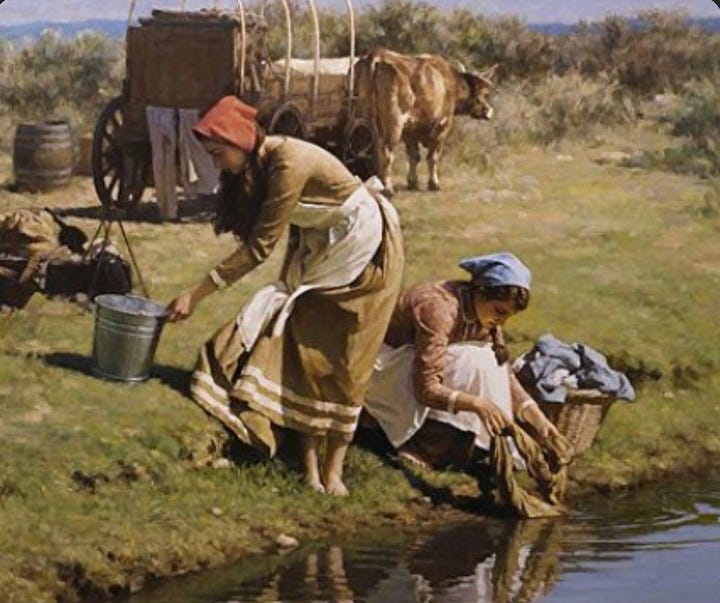
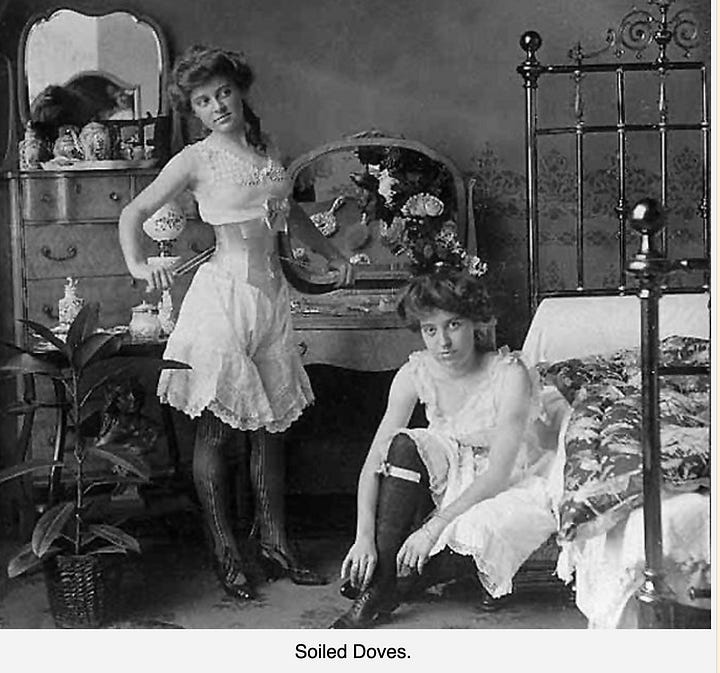
“Women took care of the house and kids or whatever,” he says. “They did what they had to do too. No one thought less of them. No one had to tell each other what to do. You just did it.”
He isn’t looking at the other students anymore. He’s looking past her, past the tavern, past the main street of the university town, past the university itself, his classes, the expectations of their parents, the baby who would need to be picked up soon, and her. Way past her. She feels his longing wash over her. He feels it so acutely, this desire to be free. This sudden and very specific image of the freedom he imagines for himself makes her want to laugh but also cry. She doesn’t need to ask where he’d gotten this image. The silhouette of a Stetson-hatted man atop a horse — she’s never seen him ride one — is as American as the flag. He’d found it in the pages of the Louis L’Amour novels his father and he had read for years. He’d seen it on television in black and white or on the big screen in vivid color. The Lone Ranger. Magnificent Seven. Gunsmoke. The Rifleman. Clint Eastwood movie after Clint Eastwood movie. Hero, anti-hero — it didn’t matter, they all had one thing in common: they rode alone.
“But this is 1976,” is all she can muster but he is already out of his seat. Ready for this to be over.
She senses that there is nothing she can say to bring them back to the conversation she’d hoped to have. Even though they pay the bill together and walk side-by-side back to the married-student housing to retrieve their child, she knows he is riding the open plain that he’s imagined. She half-feels that once they get to their apartment, he’ll stand at the door while she walks inside with their son. Then he’ll kiss her cheek, climb up on his horse with all he needs packed into a saddle bag. He’ll turn the horse and head for open country. Free.
If you’ve just subscribed, thank you so much for being here. If you would like to check out past issues, here’s a quick link to the archives. Be sure to check out our Resources for Readers and Writers too where you will find links for readers, book clubs, writers, and writing groups. And if you’d like to browse for your next read, don’t forget to check out books by authors in our community at the Spark Author Page. If you are a published author, we’d love to share you and your work. Click here for more info. Another great source: the many wonderful reviews you’ll find among the #Bookstackers.
The more the merrier! Please share with your friends and invite them to join us!
We don’t do paywalls but we do work hard so if you’d like to show your support for Spark, consider a paid subscription ($5/month or $35/year) or use this as a link that will allow single contributions of any amount via PayPal.
There will be no paywalls. All subscribers will still have access to every post, archives, comments section, etc. If finances are an issue (and when are they not?), you can still show your support for Spark by participating in our conversations, “liking” a post by hitting that heart, and by sharing Spark among your friends. All of these things help bring new subscribers into the fold and every time we expand our audience, the conversation grows and deepens. Click below for more info.
Let me know how you are and what you’re reading. If there’s an idea, book, or question you’d like to see in an upcoming issue of Spark, let us know! Use the comment button below or just hit reply to this email and send your message directly.
And remember, If you like what you see or it resonates with you, please take a minute to click the heart ❤️ below - it helps more folks to find us!
Ciao for now!
Gratefully yours,
Betsy
Text within this block will maintain its original spacing when published
Cowboys ain't easy to love and they're harder to hold
They'd rather give you a song than diamonds or gold
Lone star belt buckles and old faded Levis
And each night begins a new day
If you don't understand him, an' he don't die young
He'll prob'ly just ride away
Mamas, don't let your babies grow up to be cowboys
Don't let 'em pick guitars or drive them old trucks
Let 'em be doctors and lawyers and such
Mamas don't let your babies grow up to be cowboys
'Cause they'll never stay home and they're always alone
Even with someone they love
Cowboys like smoky old pool rooms and clear mountain mornings
Little warm puppies and children and girls of the night
Them that don't know him won't like him and them that do
Sometimes won't know how to take him
He ain't wrong, he's just different
But his pride won't let him do things to make you think he's right
Mamas, don't let your babies grow up to be cowboys
Don't let 'em pick guitars or drive them old trucks
Let 'em be doctors and lawyers and such
Mamas don't let your babies grow up to be cowboys
'Cause they'll never stay home and they're always alone
Even with someone they love - Ed Bruce and Patsy Bruce
What is YOUR moment of Zen? Send me your photos, a video, a drawing, a song, a poem, or anything with a visual that moved you, thrilled you, calmed you. Or just cracked you up. This feature is wide open for your own personal interpretation.
Come on, go through your photos, your memories or just keep your eyes and ears to the ground and then share. Send your photos/links, etc. to me by replying to this email or simply by sending to: elizabethmarro@substack.com. The main guidelines are probably already obvious: don’t hurt anyone -- don’t send anything that violates the privacy of someone you love or even someone you hate, don’t send anything divisive, or aimed at disparaging others. Our Zen moments are to help us connect, to bond, to learn, to wonder, to share -- to escape the world for a little bit and return refreshed.
I can’t wait to see what you send!
And remember, if you like what you see or it resonates with you, please share Spark with a friend and take a minute to click the heart ❤️ below - it helps more folks to find us!
Comments
Nothing yet. Say the first thing.
Sign in to join the conversation.