
The release of the Ratepayer Protection Pledge this spring was a double-edged coup for the President. First, it provided a clear expectation for hyperscalers that they needed to bring their own new generation assets. Second, it demonstrated that the White House could accomplish significant policy objectives without the inconvenience of actual policymaking.
To be sure, the Trump administration’s second term is rife with examples of end-runs around Congress. Some were designed to test the limits of executive authority, others to override the will of the minority party—but rarely because the speed of policymaking and the level of consensus needed to write new laws are inapposite to the challenge of harnessing AI.
The Pledge also stands out in that regard. In nearly all other areas, the White House has purposely allowed the development of AI to progress unrestrained by regulation. In fact, when the President has sought Congressional action, it has been to preempt state laws regulating AI. But where the physical layer of hyperscaling—the data centers, the transmission lines, the sub-stations—might be managed through corporate concessions, the intelligence layer cannot.
Which brings us to today’s dilemma, the next chapter in the ongoing feud between the Trump administration and frontier AI lab Anthropic.
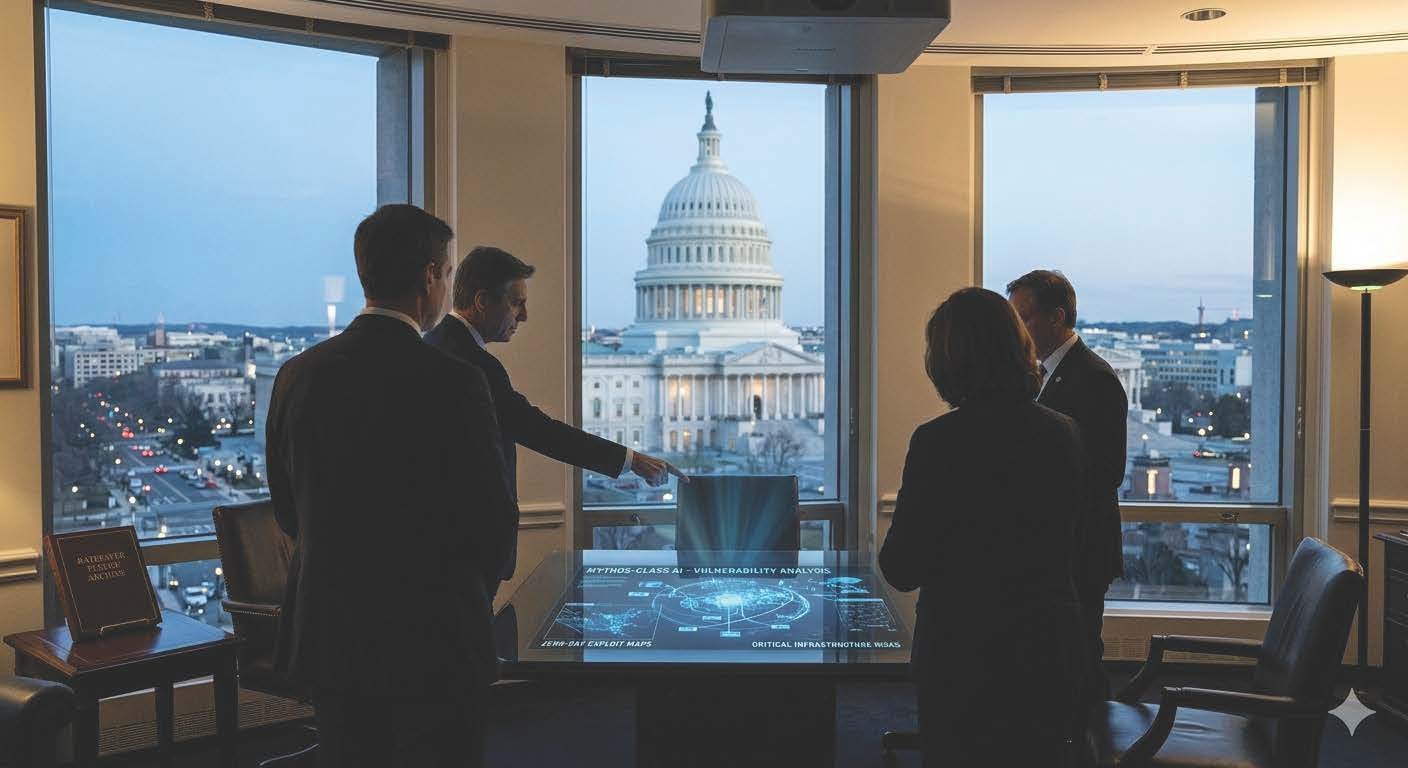
To catch up quick, Anthropic’s latest breakthrough (the “Mythos-class” model tier) has demonstrated abilities that have national security officials, companies, and competitors in a quiet panic. Far from a large-language model, this AI can identify and exploit zero-day cybersecurity vulnerabilities that have sat dormant in critical infrastructure software for years. In the wrong hands, it could bring the global economy to its knees. No cap.
Two weeks ago, the White house responded with an Executive order calling for AI developers to voluntarily submit their new models for government review before releasing them to the public. But many in the tech sector and close to the President argued that approach is insufficient. OpenAI, for example, suggested that the Center for AI Standards and Innovation (CAISI, an office within the National Institute of Standards and Technology) conduct mandatory reviews of new models—think a Food and Drug Administration for AI tools.
And as Anthropic moved to release a scaled-back version of Mythos called Fable 5, Amazon CEO Andy Jassy and Treasury Secretary Scott Bessent sounded the alarm that the model could be jailbroken to cause as much damage as Mythos. This time, the White House went nuclear, calling for export controls on Fable 5 that would prevent its use by any foreign national. Anthropic complied by cutting off access to the models completely.
But export controls are a blunt instrument. They cannot simultaneously hold Mythos at bay and allow the unfettered, competitive growth of the domestic U.S. AI industry. To draw a hard, legally binding line between a safe model and a dangerous one, the President needs Congress.
But Congress is still the unwieldy, dysfunctional forum where urgency goes to die. Case in point is the long-awaited, bipartisan discussion draft on AI governance that landed with a thud in the House last week. The framework, from Reps. Jay Obernolte (R-CA) and Lori Trahan (D-MA), contains hundreds of recommendations on AI safety—including a voluntary role for CAISI—with a three-year moratorium on state laws regulating the development of frontier models. But sweeping opposition from both sides has all but doomed the bill as a serious vehicle.
In a perfect world, Congress would have been making real progress on a comprehensive, bipartisan AI regulatory framework that would justify preemption of state laws. Now, with Mythos breathing down everyone’s neck, the need for a durable solution is both more necessary and further out of reach than ever.
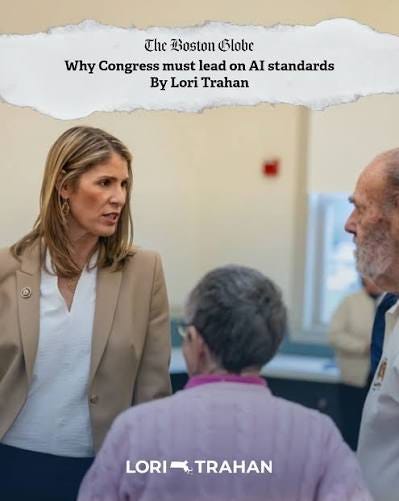
Over in the Senate, Marsha Blackburn (R-TN) is emerging as a potential dealmaker. After tanking the state law moratorium in the One Big Beautiful Bill Act, her massive “Trump America AI Act” proposal approaches AI safety from a populist, national security angle. It introduces a broad range of controls: it attempts to rewrite Section 230 immunity, introduces strict copyright liabilities for training data, and creates aggressive developer liability standards for “unreasonably dangerous” AI products.
Reports now suggest the White House is negotiating directly with Blackburn on a new measure to address AI safety while threading the needle on state preemption. But the effort would need to appeal to AI hawks within the GOP like Sen. Josh Hawley (R-MO), who has been increasingly outspoken on the need to rein in AI, as well as Congressional Democrats, who really have no desire to work with the President after a blistering year and a half of futility and an election looming in the near future.
If the White House engages the Legislative branch with the urgency the situation demands, a deal is possible. The Obernolte draft, for example, deserves another look and an upgrade in intensity. And if Blackburn’s proposal is the vehicle, it would include a codification of the Ratepayer Protection Pledge, but not out of necessity. It will be more like a shrine than a statute—a monument to the brief, wild window of time when the White House could govern the frontier of technology with nothing but a megaphone and a handshake.
Heads up: FERC is expected to issue a rule addressing the large load interconnection proposal as soon as tomorrow, June 18. (FERC.gov)
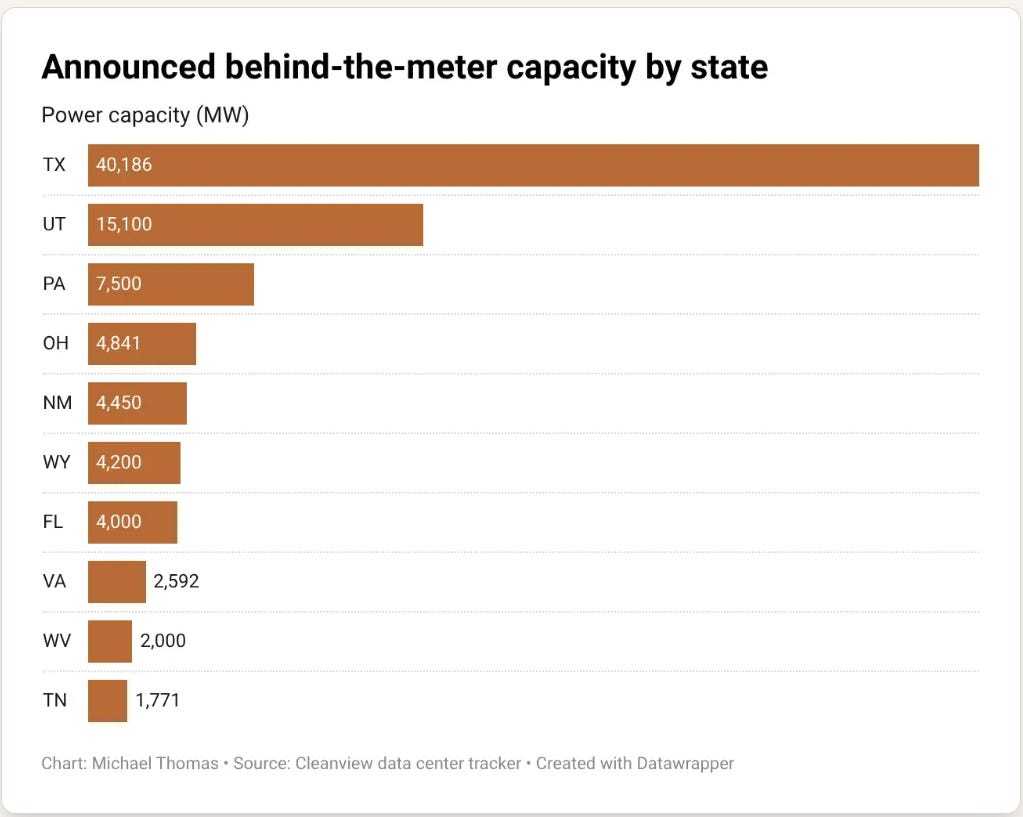
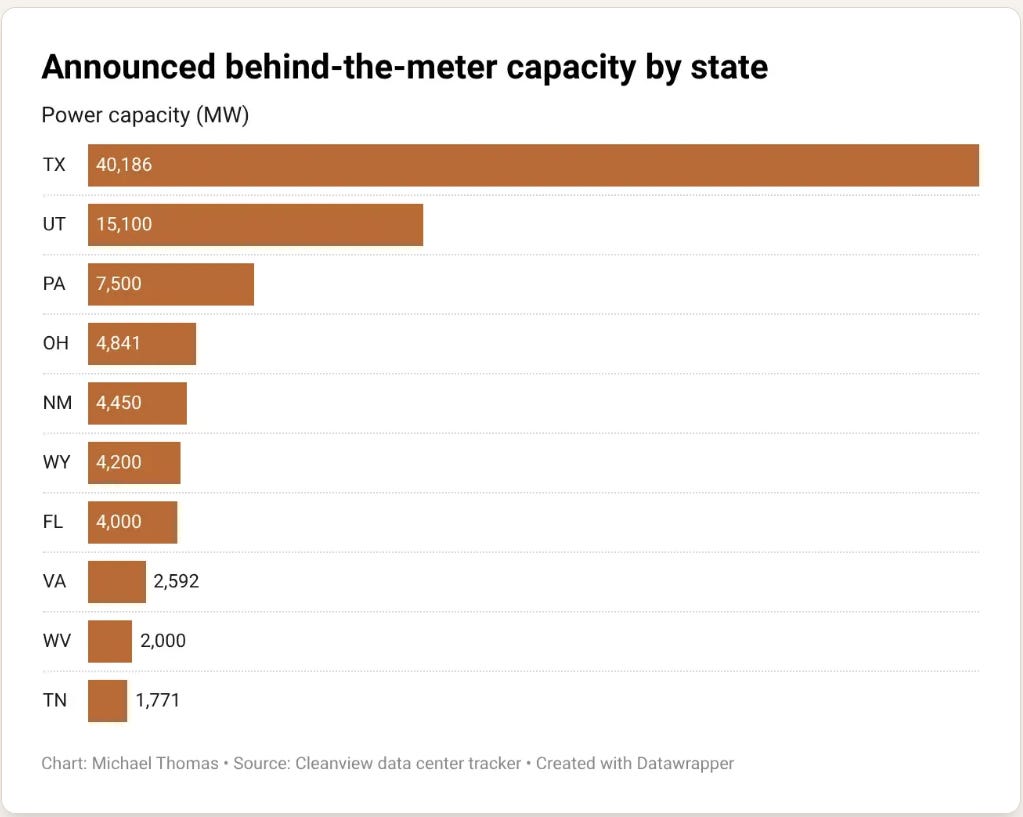
Unpacking the on-site power trend. Remember, “behind-the-meter” implies there is still a grid connection while “islanded” or “off-grid” mean there’s no utility involvement—and the terms “co-located” and “on-site” describe both arrangements without distinguishing whether there’s an interconnection present, expected, or absent. And we can’t trust that everyone is using these terms correctly. In any case, it’s all happening in Texas. (Cleanview, Bloom Energy, EnergyTech)
Lots of discussion about data centers’ water use as public concern mounts and new data centers increasingly occupy drought-stricken areas. Google offered a new framework it says should become an industry standard for water use, and Amazon disclosed for the first time its water consumption. (The Guardian, Axios, Latitude Media)
This piece on how data centers are impacting the investor-owned utility model is required reading from Travis Kavulla: “How Will Data Centers Pay for Power?” (American Affairs Journal)
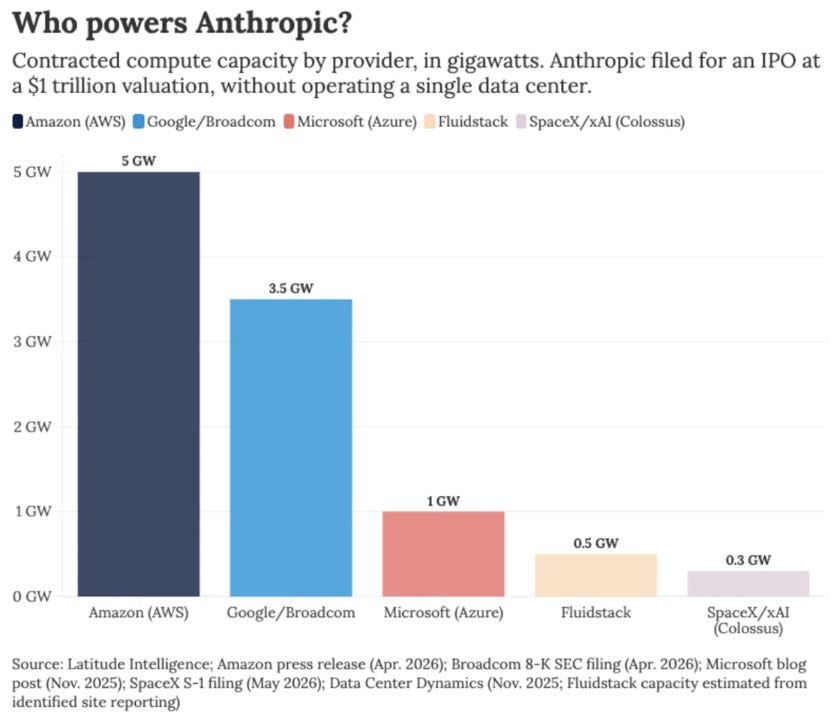
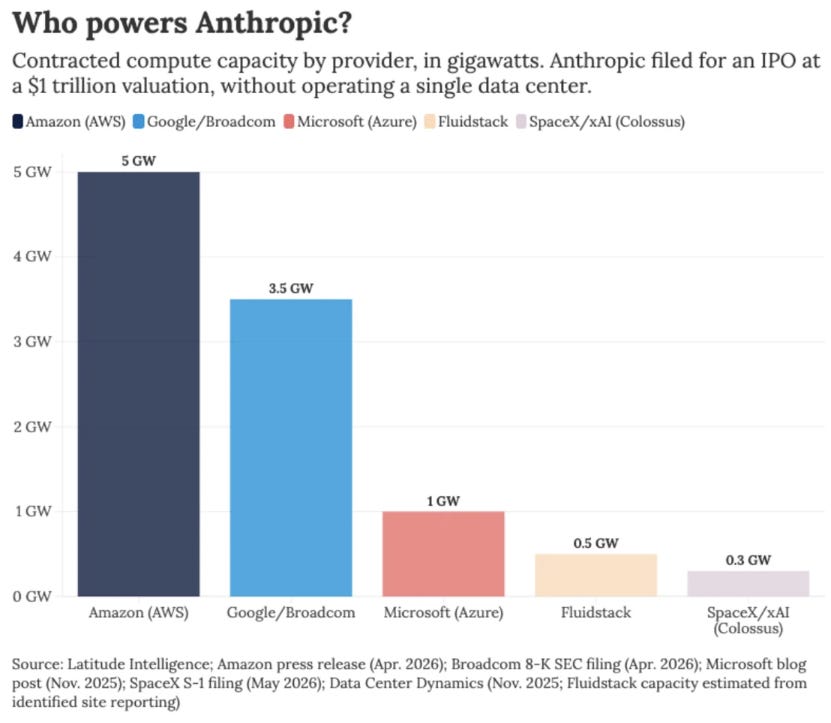
A really helpful primer distinguishing hyperscalers from frontier AI labs by Nick Zenkin (for example, Anthropic doesn’t own any data centers).
Google is building its first energy park with Intersect Power, the energy company it acquired in December. The location? Texas, of course. (Latitude Media)
FERC approved PJM’s new fast-track generator interconnection process. The good news? Projects over 250 MW with state backing could get approved within 10 months. The bad news? PJM will only address 10 projects a year through the new process. (Utility Dive)
Is China behind public opposition to data centers? Some in Congress think there’s enough evidence to investigate. (Politico Pro)
Microsoft is considering dropping its 100% clean energy pledge, which could put the company on a collision course with state emissions goals in Virginia, where it manages dozens of data centers. (Inside Climate News)
Big tech is getting involved in a FERC fight over transmission competition in SPP and MISO. Some incumbent utilities think competitive bidding should be suspended to get projects built faster, but the Electricity Customer Alliance and Electricity Consumers Resource Council (which represent large load customers) disagree. (Politico Pro)
If you can’t beat ‘em: This group of Ashburn neighbors is looking to sell the entire community development of 143 homes for a premium rather than fight the data centers next door. (Business Insider)
Check out this municipal utility absolutely killing it by hosting more data centers per square mile than any other West Coast town - and negotiating significant benefits for the community. (Data Center Frontier)
Latitude Media’s Maeve Allsup parses out FERC Chair Laura Swett’s comment that PJM may be “too big to function” (with some quotes from yours truly!) (Latitude Media)
That’s all for this week! If you’re concerned about the cybersecurity of critical infrastructure, give your Member of Congress a call. An operator at 202 224-3121 will connect you. And if you’re looking to make a more nuanced policy argument, give me a call.
Thanks for reading!
Comments
Nothing yet. Say the first thing.
Sign in to join the conversation.