
I’ve been making a mistake that I swore to myself I would avoid when stuck in one spot with a need to move to another: I have been working along one straight line. I have been doing this even as I know it is the wrong thing to do.
In the age-old “habit” vs “willpower” battle happening in my mind, “habit” wins again. Even after all the amazing changes in my life, changes that I self-realized through will, hard work, and sacrifice, along with grace and the support of others, some old habits have returned, narrowing my options.
Dang.
As we often do when heading outdoors to enjoy these sunny/crisp early days of spring, we realize some maintenance within our homes is in order. So, like dealing with the cobwebs and mildew that have been creeping in over the winter, it is good to take a look at what habits also need to be dusted away within our minds. For me, it is the habit of linear-thinking: I must take step A to get to step B. While true on paper, in fact, real life is never as neat and tidy as good, old-fashioned, Euclidian geometry.
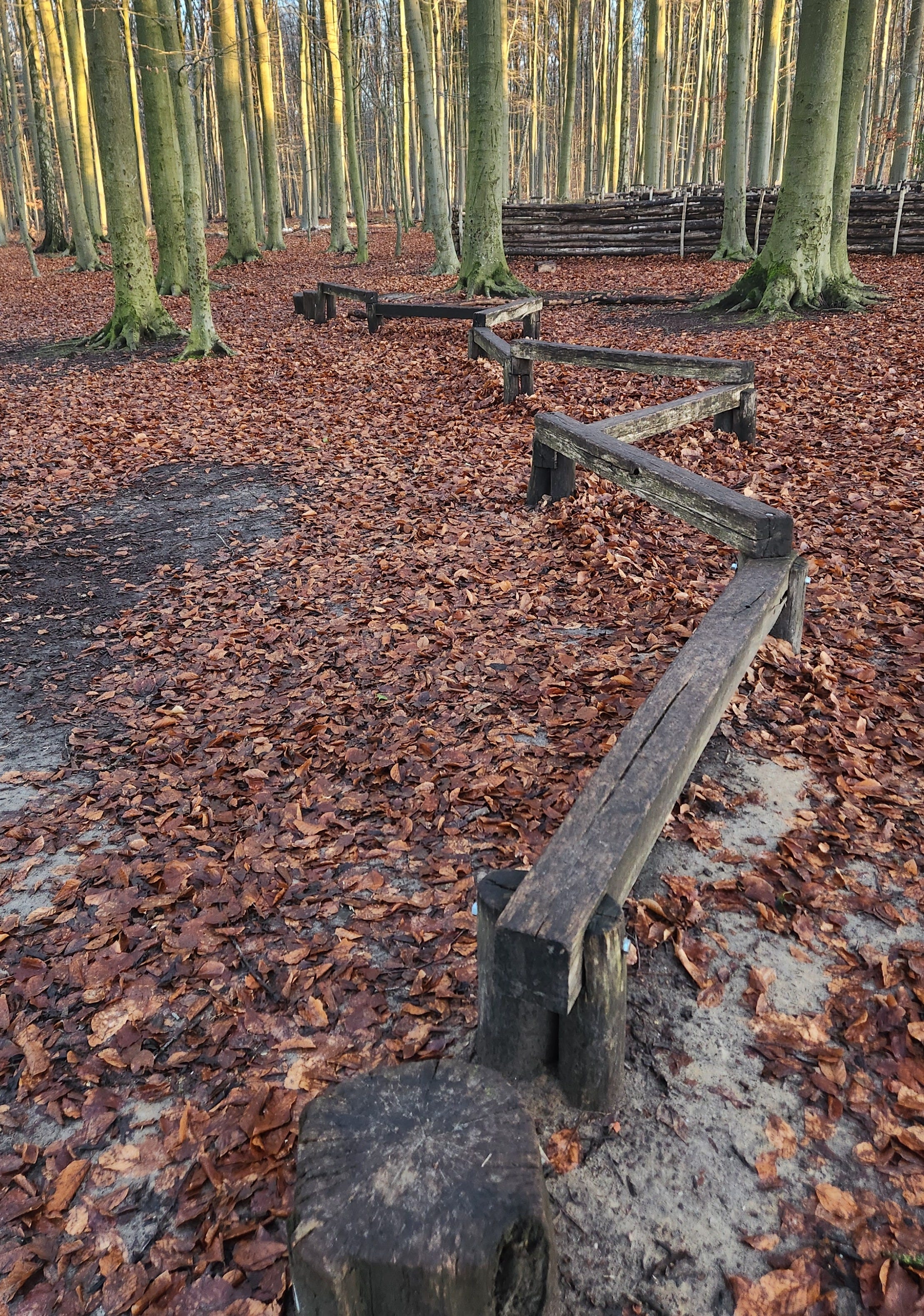
When faced with an uncomfortable challenge that is hard to solve, my habit is to choose one possible path to a solution, and stick with that. Maybe, I think to myself, if I try it again, it will work this time! Again and again, I will pound away, repeating that one action, attempting to move in this one direction, even if it is clear that it is not working. My habit-entrenched mind reminds itself of what it learned in elementary school, and says, “But this is the right way to do this! The shortest distance between two points is one straight line! Euclid, the father of geometry, said so, and it has been true for 2,000 years!” Also, external forces prompt me to set myself on repeat: “click-bait” emails and notifications that some algorithm has sent me after noticing my patterns dangle in front of me like digital carrots; loved ones set their own patterns alongside my own, making it harder to cause disruption; the world gets crazier and scarier, causing me to turn my head downward and watch as my feet just plod forward along what felt, at one point, like the safest path.
So, I go along that one line, even when I am not particularly successful. Usually, another part of me is aware that I need to add several other lines, all attempting to get to my goal from different angles, but whether or not I am willing to do that extra work depends on how exhausted I feel from the whole process. The problem is, once I feel exhausted by failing over and over again in my one attempted direction, I tend to collapse and stop trying.
Because challenges involve change, and change is hard, uncomfortable, and full of unknowns, the truth is that this may have been my goal from the outset: to exhaust myself and then stop trying. In this way, I avoid getting to that scary goal altogether!
Hang on…that sounds like something a little kid would do. Hmm.
In these moments, when I realize I am behaving this way, I have to take a deep breath, concentrate, and imagine myself hugging and brushing off my frustrated and frightened inner child. I imagine letting her know that she is ok, and that I will take care of her. I tell her that she needn’t worry - that I will try new things for both of us.
Today, with the lovely blue skies, warmer weather, and fresh air bolstering me, I will try to tackle my challenge by moving along not one line, but eight of them, and see which gets me to my goal fastest.
One of the reasons we humans get stuck in thinking along linear, serial pathways, where we take one step and then move to the next, rather than attempting several simultaneous steps, is that our minds are influenced by our bodies. Look around you: everything around you was designed for your two able-bodied human legs to carry you around from one point to the next. No wonder we think the only way forward is to take the next step.
As an arts producer, I worked with fantastic people who helped make venues more useful for disabled communities, and was amazed by just how much typical public spaces are built without a diversity of physical experiences in mind. From stairs to written wayfinding signage and so much more, our spaces tend to favor able-bodied people who move easily from one place to the next.
Your very language was influenced by your body’s movement through space: are you feeling down today? Look, to take the first step, and get back on your feet, sometimes to go the extra mile, you have to stop dragging your feet, find your footing, and learn how to walk before you can run. But, I know you are up to the challenge - soon you’ll rise to the occasion and you’ll be strutting your stuff! Several modern philosophers and cognitive scientists believe that abstract human thought is always considered through the lens of our human bodies, and so how we see the world is actually connected to how we move through it. This is part of what is called “embodied thinking.”
Given that your thinking may be limited by your two-legged point of view, here’s an experiment: what would happen if you imagined moving through a space as an octopus? How would you move with eight arms that work independently all at once, each featuring suction cups filled with nerves that act as extensions of your brain? How might your way of thinking about how to get to your goal change if instead of moving about on two legs, you did so on eight arms?
You can watch the animated movie below that my daughter and her buddy created to see who tends to fare better: a two-legged, or an eight-armed being…
But seriously, ask yourself this: is your two-legged way of moving through space somehow better than that of an octopus? We all share this planet, and we all move around on it in our own way. What if we can try to walk a mile in someone else’s shoes and imagine a new way of thinking about how to get to our goals?
As someone who moved her family and two dogs to Europe from the US in 2023 - with no contacts or job waiting there - I followed steps very carefully, but also had multiple backup plans in place, and “feelers” that were always active in case we needed another way to move forward. But this “multi-pronged” behavior is not a permanent condition for me - I need to keep on top of my mindset to be sure I do not go too “linear” again. For me, this relates to a new job hunt, now that I have full residency and work rights in the EU. Without the language skills and the right network, however, given my “humanities” background, also given other constraints related to my family’s needs, even with my residency card and two passports this is still deeply challenging. Somehow, rather than acting like an octopus right now, I am behaving much more like a hermit crab, headed for cover and digging in deep.
But what about for you? Is your process stuck on “repeat” even when you do not attain the results you desire?
Whenever you get stuck in a pattern and find it hard to do things differently, you eventually see yourself doing it, and you learn things you might not have learned any other way. I’ve known people who hit rock bottom, survived it, and today are deeply grateful for it as it was what they felt finally got them to change for the better. Others use stretches of “unsuccessful” time to see, and find acceptance for, weaknesses within themselves and those close to them. These, now revealed, can be worked on. Still others, when finally done beating on their proverbial dead horses, can finally quiet their own self-centeredness and anger and see, and feel glad for, the successes of those around them. These, now given full attention, can be celebrated.
Know this: the child-like and adult fears you have about change are real, and you have the right to feel them. The world around us feels out of control, worsening our response to fear in our already overloaded and highly sensitive hearts and minds. If you find yourself ruminating, or, by extension, reducing creativity and digging into just one presumed solution that fails again and again, start by taking a breath and considering your situation. What are you learning right now that can serve you? What truths are being revealed through your discomfort? Even if you can recognize them now and pack them away to be dealt with later, you are actually one step ahead of where you began.
Ok, so you are stuck repeating the same behavior, and you are not attaining your goal. Here is what I recommend you do:
Assess and state your goal. After banging my head up against the employment wall here for awhile, it has occurred to me to ask myself what my goal is. I had assumed it was “get a new job” but is there actually a deeper goal? I am currently in the process of figuring this out. With the Belgian system covering healthcare and providing a monthly financial supplement related to my kids, I do not have as much at stake with seeking formal employment, but, like everyone, I do need money and the satisfaction of purposeful work. I recommend you take the time to be sure of your goal, because once you go a bit deeper, you may discover there are other paths to achieve that deeper need.
Write down the path you’ve tried. Then write down seven other potential paths. Go full-Octopus on this. What are seven alternative behaviors or actions you could try as you pursue your now better-understood goal? This is just a thought experiment, so go ahead and get creative. But in the end, you will likely have at least one or two other actionable paths you had not previously considered.
Add just a few new actions to your daily work. You don’t have to try all seven new paths - you just have to try one or two. Take a moment to assess how much time you’ve been giving to your prior low-success attempts, then just carve a bit of that time out for these new ideas. You do not have to abandon your former path, just find time to add in some new things. For me, this means setting aside time for networking. It means leaning toward remote contracted work. It means finally setting up my website and opening up consulting hours.
Fun fact: we live in a 3D world; in fact, we live on a sphere, so the shortest distance between points on Earth is a curved line. It even has a cool name: a great circle route. Latitude and longitude, these navigational lines that we imagine crisscrossing our planet, are all curved, right? When planes fly from place to place, they do so along these 3D curves, even if on a 2D map, this appears straight. Even Einstein threw Euclidian geometry a “curve ball” by establishing that spacetime itself is curved by mass and gravity, so even light, which always travels by the shortest path, will move along a curve when near massive objects. So, perhaps the shortest route is not the direct path you had previously assumed.
Maybe you need to veer off course every now and then.
Wherever your great circle route is taking you, I hope you can stretch out your arms, imagine you have six more, take multiple actions rather than just one, and embrace all the curves along the way.
No posts
Comments
Nothing yet. Say the first thing.
Sign in to join the conversation.