
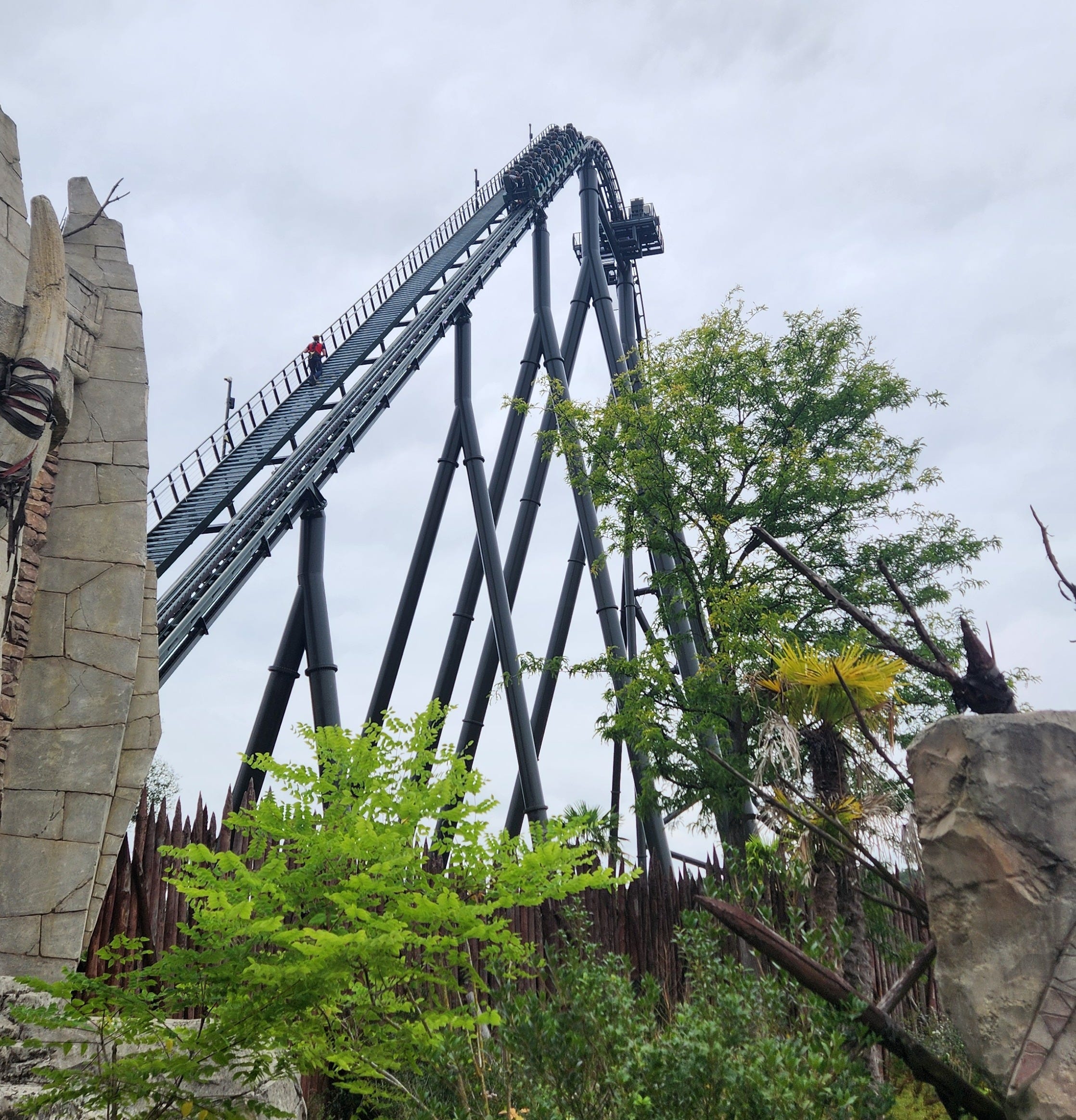
I have noticed that here in Belgium people are generally speaking nice and polite. Even when stuck at the highest tipping point of one of the region’s tallest roller coasters, Kondaa. I saw this happen at our local amusement park last summer, and I watched with amazement as folks just sat there quietly and gazed at the sky for fifteen minutes on an uncomfortably angled, super-tall, broken-down roller coaster. When it started running again and it finished its cycle, I watched the riders run out of the exit, check photos in the gift shop, and laugh with one another about this harrowing event.
If this had happened in the Six Flags theme park I visited as a kid, this would have resulted in fifteen minutes of cursing and shoe throwing, followed, when finally released, by a horde of berserkers heading off en masse to the ticket booth to rage until assuaged with complimentary fast-passes or snack bar freebie coupons.
Kondaa, as you learn while reading the walls as you wait in line, is not just a roller coaster, but a terrible beast thrashing about as mythic warriors tame it in order to use it as a mega-weapon against their enemies. It awaits your domination within the Skull Island-styled, cave-painted, craggy and dangerous realm of Walibi Belgium’s Exotic World. Unless there is an electrical issue and they have to stop the ride. Then a teenager in a red Kondaa jacket snaps a carabiner onto a safety cable and climbs up a thousand tiny steps to ask politely in Dutch for your patience. Then, you sit at the tipping point and wait.

Waiting at the tipping point is not a naturally comfortable thing. But according to reliable news sources, that is exactly what we are doing right now: we are strapped into a broken down machine at the very top of a major tipping point. This time the machine is not a roller coaster car, but instead it is democracy, climate change, technology and the world economy all twisted up into the battle between strongman-led power systems.
And in less than fifteen minutes, in fact, according the Bulletin of Atomic Scientists, who every year since 1947 announce the time on the Doomsday Clock, in less than ninety seconds, it will tip.1 Yikes.
In leaving behind a life and career in the US, I have sat here in Europe at various tipping points awaiting some kind of critical change many times - seeking employment, citizenship, the acquisition of languages, and more - not just for me but for every member of my family. I have learned some methods to deal with this, and in this essay, I will suggest two things to help you figure out how to live here if you, too, or indeed if we all, are at a tipping point:
Physical Change - stepping off the ride: I will offer a few things to help you step off this ride - to lift off those “safety belt” traps, take the hand of a stranger, grab the railing, and walk down the thousand steps to exit safely back the way you came in - or at least, step out, stretch, and take a look around. Because yes, this is still an option. No, we do not simply need to stay locked in, staring at the unknown, unable to move at the top of some real or imagined cliff, while outward forces who control our experience request our patience.
Mental Change - experience the ride differently: I will offer some ideas on how to view your situation differently if unlocking the weights gripping down on your shoulders for your own protection and stepping off the tipping point is simply not possible, and one way or another, you are going over this hill. No, I am not great at this, but I when I am able to do it, it makes an enormous difference.
Just start moving. Your body is paired with your overwhelmed, upset brain. You can make both of them work better together by simply moving around. Taking a walk when you are at the tipping point seems so dangerous - what if you miss something important? What if something happens and you are not immediately aware of it? If you are having these kinds of feelings, then it is even more important that you change your literal point-of-view. When you get your blood flowing a bit, your mind will settle down.
Get out among other people. Go to the grocery store. Go see a movie. Get offline and step out to a coffee shop. It is even better if you engage with others but just being around others will typically have a positive effect.
Focus in on fixing just one broken thing that frustrates you in your physical environment. Clean out just one closet. See how quickly it eases your tired mind.
Add small physical changes that speak to your senses. Start keeping a cinnamon candle lit in your home. Fry up some onions in butter and sniff it. Play calming music in the background. I know, I know…but actually do this stuff. It helps.
Help someone. Get out of your home, put down your phone, and go volunteer to help someone. When you have kids it is harder to do this formally, but there are many informal things you can do: old person living down the street? Go salt their sidewalk. Neighbor got the flu? Bake a banana bread, wrap it up and leave it in their mailbox with a card. Too much work and too upset about world events? Just do the card - it is the thought that counts. And get this, this thought counts for you, too, because helping people is a known, scientifically proven way to get yourself out of a funk.
Consider it an emergency: you need a good dose of awe and wonder in your life at the tipping point. The toughest part of sitting in this space is that it feels purposeless. What was all that work of your life for, anyway, if you are just going to be flung over some tipping point into the uncomfortable unknown? You need to see beyond all of it and gaze into a different abyss - the one that surrounds us constantly yet we forget it is there: the universe.
Check out the magic of particle physics: sure, watch Cosmos and be amazed and awestruck by what dwells out there but then be gob smacked by what is happening right within yourself: quantum entanglement? Wha? The nature of time itself? Huh?! And we really don’t totally know everything? WOW! Grab a physical book from the bookstore about this, fold the pages, spill a little coffee on it as you actually sit among other people in a cafe while you read it, and revel in wonderment about it all!
Go to an art museum: Sure, maybe they are closed on Tuesdays. But given the typically dark, dirty days of winter, these are places worth visiting: they are full of intense color, typically well circulated and warm air, and cool-looking people with nose-rings who will politely check your coat for the afternoon. Give yourself permission to drift around from art work to art work until you actually see something that moves you. Read about the artists, and think about the historical events they were responding to. Or spend the five bucks for the listening wand and take yourself on a little tour - even better, accept the human contact of a tour guide. Just interacting with a kind stranger as you consider these things will do you some good. All of it will bring you perspective. This is, after all, not the first, nor the last, tipping point.
Speaking of art museums, let’s add experiencing beauty to the list. If your days are about stressing out about world and local events, working, and serving others, it is important to add a bit of a beauty treatment. You need to see at least one beautiful thing every day. Since beauty is all around you, it is simply an exercise of noticing it. But each time you notice beauty - even if it is just a particularly fluffy little winter bird hopping about outside, or a child’s smile - your brain consumes it like a little vitamin pill, and it helps you to feel better.
Most powerful of all, is recognizing your mindset, and forgiving yourself for it. As I have mentioned in prior essays, your senses exist to help your brain understand its environment. But your mindset acts like a sense, too, and it is the most powerful of all as it will act like a special “filter” that all of your other senses are run through prior to getting into the decision-making part of your brain. Mindsets are both built and inherited, so they are very tough to change. As the crazy stories of AI-gone-wrong teach us, mindsets are also incredible complex and hard to replicate. But we are able to generally recognize them (“I am a New Yorker, so I tend to view things harshly but also feel things deeply and want to improve the world if I could just get my grouchy ass moving…”) and in doing so, we can say to ourselves “I see you” which is a great first step toward forgiving ourselves for the sins of our customary thinking patterns and start moving toward acceptance and change.
Look, our most credible news sources are today telling us things like “life as we knew it…is over.” The world order as we understood it has, we are being told, come to an end. But life as we knew it was always filtered for each of us through our own personal physical states and our mindsets. Going back to those atomic scientists I mention above, as Albert Einstein understood and told us, the truth about life - and about order in the world - is that it is relative. Just what was this life as we knew it before launching over the tipping point, anyway? Comfortable? Well fed? Safe? For who? The answer is relative to each person and their mindset.
My best advice from a highly tipping-point filled life: address your physical and mental state; do your best to help others; and name and forgive yourself for your mindset. It is high time you stopped doom-scrolling, ruminating over the actions of others, and worrying about the absolute disasters you assume are awaiting you on the other side of the tipping point. Instead grab your mental spear and put in the work to tame and put to good use that wildest Kondaa beast of all: yourself.
Thanks for reading Elizabeth's Substack! This post is public so feel free to share it.
No posts
Comments
Nothing yet. Say the first thing.
Sign in to join the conversation.