
Ah, hubris, probably the best known of all Greek words except kudos (also Greek and not a plural noun, despite the final s). Remember when you were taught the myth of Icarus, probably as a child? It was the example par excellence of hubris: ill-advised confidence in your own greatness. Hubris made you tempt fate; fate never fails to give into temptation. There’s Icarus, flying too close to the sun despite his father’s warnings. He thought he could do it! But his confidence was too great, and he tumbled out of the sky and into the sea, where he drowned. Hubris!
Well, no. Hubris had nothing to do with the fate of Daedalus and Icarus, and everything to do with the president of the most powerful country in the world.
In ancient Greece, hubris was an offense against the community or an offense against the gods, which resulted in big trouble for the community. Daedalus, however, was only trying to escape the cruel King Minos with his son. Icarus was only guilty only of being a disobedient kid. A dangerous activity, to be sure, but hubris played no part.
The notion that hubris is dangerous overconfidence, the pride that leadeth to a fall, was attached to the Greek word well after the classical era. Medieval Christianity rechristened it superbia, Latin for ‘arrogance.’ Superbia was the worst of the Seven Deadly Sins, the sin that led to all others. By the time hubris slid back into contemporary usage in its original Greek, it had shed its religious significance, but not the overtone of a dangerous character defect.
To get a better idea of the original meaning of hubris, we can go back to the 8th century BC, when Homer’s Odyssey was composed. This was two hundred years or so before Athens was a fully functioning (and dysfunctioning) democracy.
The poem begins when the Trojan War had been over for many years. The hero Odysseus has still not returned to his island kingdom of Ithaka. There’d been no news of his whereabouts. He was most likely dead. A cadre of well-born young men who’d grown up in the king’s absence decided that they’d waited for him long enough. They were joined by dozens of men from other islands, for a total of 108. Homer tells us each of their names and where they were from.
A regime change, they thought, would be advantageous, and great fun besides.
So all of them moved into the absent king’s palace, set about eating up his livestock and crops in nightly drunken dinner parties, sexually assaulted the slave women of the household, mocked, ignored, and eventually made plans to kill his teenage son, while pressuring Odysseus’s presumably widowed wife Penelope into choosing one of them to marry. Mind you, she hadn’t expressed a desire to remarry; nevertheless, they allowed her to choose which of them she’d marry, because they were gentlemen.
Why did they do these things? Because they wanted to. There were peaceful and appropriate ways to apply to the queen for her hand in marriage. But really, why keep the peace when you can keep doing whatever you want?
The suitors used humiliation, theft, assault and intimidation in order to do as they pleased. Hubris was specific; it was not a general term for moral failing, much less a fatal flaw, a term that did not exist in antiquity. It harmed an entire community. Hubris was an outrage, a violent, transgressive action of those who have power over those who do not.
(Rest assured, the suitors got theirs when Odysseus came home. The Odyssey, unlike the Iliad, ends happily, or what counts for happily in a hero’s epic: every last one of them killed in the great hall where they’d feasted.)
Now, Homer’s epics were first written down in Athens in the mid-6th century, before the emergence of democracy in the 5th century. But the definition of hubris had not changed. Rather, it expanded
What about hubris in tragedies, written roughly 200 years after Homer’s epics? It’s really no different. In Oedipus the King, the hero’s hubris lies not in his attempt to outrun his fate. It’s his violent and abusive treatment of anyone who gets in his way. Every action in the play stems from his road-rage murder of a man he later learned to be his father. When the seer Tiresias tries to tell him what he’d done, he mocks his blindness. He threatens to kill his brother-in-law Creon, accusing him of plotting with Tiresias’s help to overthrow him.
In Sophocles’ last play, Oedipus at Colonus, the hero is now a blind, helpless old man, banished from the city he once ruled, wandering the countryside in rags with only the company and protection of his young daughter Antigone. For reasons too complicated to go into here (but you can read about the play here), Creon, now ruler of Thebes, tries to drag Oedipus away by force from the refuge he’s found in Athens. The horrified chorus exclaims, “Hubris!”
For Sophocles’ Athenian audience, the word would have immediate and unmistakable meaning: assault and degradation. In 5th century Athens, hubris was much more than arrogance., and it was not a victimless crime. Hubris was the legal term for rape, assault and battery, and intentional public humiliation and intimidation of others, in word and deed. Any free citizen (i.e., male, born in Athens) could charge another with hubris, and take him to court.
The punishment for hubris in Athens was atimia, literally ‘dishonor.’ Legally, atimia (ah-tim-ME-ah) meant ‘disenfranchisement.’ Once convicted of atimia, a man could no longer serve in the assembly, as a juror in a court of law, or bring a legal action against anyone else.
Hubris was then an attack on the community. For that reason, those guilty of hubris could no longer participate in its safeguards: the legislature and the courts of law.
The suitors of the Odyssey, Oedipus, Creon, and anyone guilty of hubris in Athens: all of them used some combination of violence, humiliation, and intimidation to get their way.
That was then, but it is also now. We are suffering as communities, individuals, institutions and basic rights because of one man’s hubris — the Athenian kind. The free hand given to ICE stormtroopers is only the latest, and it won’t be the last.
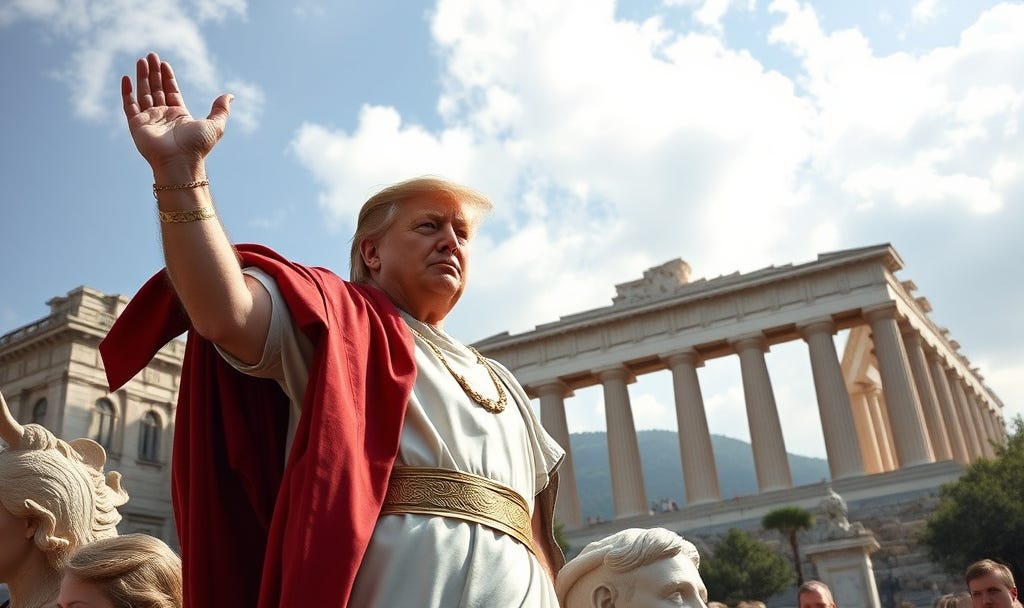
Like the suitors of the Odyssey, Trump wants goods and honors and possessions to which he has no rightful claim. Canada. Greenland. Panama. Gaza, which, after driving away citizens who have managed to survive there, he would monetize as the Gaza Riviera, complete with gigantic golden statue of himself. The Nobel Peace Prize. Venezuelan oil. Cuba. Colombia.
In Athens, a charge of hubris could be brought against someone who used public humiliation purely for his own enjoyment. Because schoolyard insults have been Trump’s principal means of official communication ever since he discovered Twitter (now X), there are too many to list. Sleepy Joe Biden. Lil’ Marco Rubio (who’s forgotten that one, I guess). Lock her up. Crooked Hillary. Dumb as a rock Kamala. Mentally impaired Kamala. Stupid AOC. Crazy Nancy. Traitor Mike Pence. Adam Schitt. The Seriously Retarded Governor of Minnesota. Fake News CNN. Failing New York Times. Maggot Haberman. Dictator Zelensky. Haitians eat people’s pets. Somali garbage. Somalia is not even a country. Shithole countries. Gender transition is child abuse. She was very disrespectful. Quiet, Piggy.
As I write, on Jan. 21, 2026, Trump has gone well over time in a speech to the World Trade Organization in Davos, Switzerland, saying that the host country “is only good because of us.” “Canada lives only because of us.” Greenland is “a piece of ice,” and if European leaders do not hand it over, “we will remember.” “It’s a very small ask.” “We probably won’t get anything unless I decide to use excessive strength and force where we would be, frankly, unstoppable. But I won’t do that.”
Instead of force, Trump’s plan is to levy tariffs so extreme that they would wreak havoc on our trading partners’ economies. Trump just admitted that he ordered a 39% increase on tariffs of Swiss exports because “she [Karin Keller-Sutter, the Swiss president] rubbed me the wrong way.” Quiet, Piggy.
I don’t have room here to quote all the insults and threats he is blithely tossing at our economic partners and military allies. It’s as if he were in Puerto Rico after Hurricane Maria, throwing rolls of paper towels to survivors. He does it because he can.
Let’s hope that our democracy is stronger than the wax meant to hold Icarus’s wings in place.
Thanks for reading! If you enjoyed this, please let me know why. Comments and little hearts are always appreciated, and restacking makes my day.
No posts
Comments
Nothing yet. Say the first thing.
Sign in to join the conversation.