

Dionysus was the Greek god of intoxication, dramatic performance, and a few other things, like fertility and madness, all of them falling under the general heading of transformation. A sapling becomes a tree, a child becomes an adult; alcohol soothes or inflames; an actor becomes the king of Thebes; an audience is transported there with him, surprised until the lights come back up.
So it’s particularly fitting for the god that Studio 54, once a decadent nightclub, is now a fine theater — especially so, because as I write, the curtain is coming up on an ancient play transformed into a modern one. Robert Icke’s Oedipus, an adaption of Sophocles’ Oedipus the King, has been playing there to sold-out audiences this winter.
Sophocles’ play was first performed in 429 BC at the Athenian festival in honor of Dionysus. For his Oedipus, Icke changed the complicated original plot so that it makes sense to a modern audience, making the mythical city of Thebes an unspecified modern Western nation. [For my earlier posts about about Sophocles’ original, see the link below.]
Sophocles’ original centers around a backstory that is never fully explained; it was already known to the original audience. The spur of the action is a divine prophecy: a son born to the king and queen of Thebes would kill his father and marry his mother.
Here is that backstory: King Laius had tried to keep the foretold future at bay. When the ill-fated son is born, Laius gave him to a shepherd, with orders that the baby be abandoned in the countryside. We aren’t told what Queen Jocasta knows, or feels. Still, the prophecy seems to have been avoided.
But the softhearted shepherd can’t bring himself to do it. Instead, he gives the baby to the king and queen of Corinth, who have not been able to conceive. The abandoned baby is raised as a prince. And all would have been happily ever after if Oedipus had not turned out to be so much like his father: overly confident in his ability to avoid fate, and ready to kill anyone in his way.
Oedipus, now a young man, gets wind of the prophecy. He doesn’t know that he’s adopted, so he assumes that these loving parents he knows are destined to be his victims. His solution: run away from home. On the road to Thebes, the city of his birth, he crosses paths with an important-looking man in a grand chariot, accompanied by a small entourage. Get out of my way, the man says, and hits him on the head with his staff. In return, Oedipus kills him and all but one of his attendants.
Like father, like son: two hair-triggered men in a road rage incident. With that, the prophecy is half fulfilled.
We don’t know how much time passed between the death of Laius and Oedipus’ arrival in Thebes; time collapses in myth, so trying to make it work out is pointless. All we know is that Oedipus saved the city from a man-eating monster, the Sphinx, by his wits alone. As a reward, he was offered the throne and the hand of the king’s widow: Jocasta. She was still young enough to have children, and with her Oedipus fathered two sons and two daughters. Oedipus was never connected to Laius’s death, and apparently gave it no thought at all.
That’s the backstory. As Sophocles’ play opens, Oedipus has been king for some time. The city is suffering from a plague unleashed on every living thing. The Theban elders have come to beg their king for help. And now another message from the gods is revealed: the city is harboring Laius’s murderer, and until he is found, the plague will continue. Oedipus, being Oedipus the brash problem-solver, promises the citizens to find the guilty man and expel him. Once again, he acts without knowing his own identity. The blind prophet Tiresius tries to tell him that he is killer who’s caused the plague. Oedipus accuses him of having been bribed to say so, and threatens him with death.
Little by little, Oedipus as detective reconstructs the day of Laius’ murder. He learns that there was at least one witness still alive; not only that, but the shepherd who gave him away is still alive. While Oedipus is still putting the pieces together, Jocasta sees the truth, and begs him to stop. But he doesn’t. She hangs herself. He then blinds takes a brooch off her dead body and blinds himself. He then begs to be led away from the city. The man who sees all can now see nothing at all.
Read no further if you plan to see the play and don’t want spoilers; they are about to make their entrance.
Icke faced a massive challenge in adapting the play. The prophecy that Laius received about his unborn son; that son’s murder of his father; a plague sent from heaven that he must fend off — how do you make any of that work in a modern setting?
Icke’s solution is quite elegant. He invents a new, poignant and believable story to explain Laius’ death at his son’s hands. Believable, because the gods and prophecies and fate have been written out, and with the result that this Oedipus is transformed into a ticking time bomb of a thriller.
In this Oedipus, as in the old play, Laius has long been dead. The people of Thebes were told that the old man died of a heart attack. But a rumor has survived: the heart attack story was a coverup. Oedipus is married to Laius’ widow, Jocasta. Is there something suspicious there? Jocasta is a few years older than Oedipus, but not enough for the difference to be scandalous.
Oedipus must be beyond suspicion.
The title character is a modern day populist politician about to be elected to an unspecified high office. We first see him through a news reporter’s camera lens as he enters his campaign quarters. Speaking off the cuff to a crowd of supporters, he swears to find the truth, if indeed there was a coverup, and the murderer, if indeed there was one. He does so on a whim; it made for good TV, and it seemed like a good idea at the time. When his brother-in-law, also his chief of staff, berates him for making such a foolish promise, he accuses him of envy, verbally abuses him, and fires him.
We’ve only seen this unpleasant side of him until he celebrates his certain victory. His wife Jocasta and their three children complete his sense of having finally arrived where he was meant to be. He’s a pater familias, herding everyone to the dinner table, making toasts, trying to jolly the kids into being nice to each other (they won’t) and to stop being so horrid in front of grandma (they don’t). Even so, his family makes him happy — except for Grandma, who spectre-like, exits and enters repeatedly, pleading for a private word with Oedipus. Unlike the rest of the family, his mother is completely Icke’s invention; Sophocles’ play had no such character. Without her, this new Oedipus would not work, although this becomes obvious only in the last minutes of the play.
As with the old play, the truth slowly comes to light. Laius didn’t die of a heart attack. He was killed in a two-car accident on his way to a secret assignation. The driver of the other car was none other than the 18-year old Oedipus, a country boy raised in humble circumstances. The terrified driver of Laius’s vehicle kept Oedipus from seeing the body, telling him to run and not look back. He did, never knowing whom he’d killed. He didn’t know who the dead man was, much less that they were father and son.
So it wasn’t murder. It was an accident. These four words are repeated many times. It was an accident. It was an accident. It was an accident.
Everything that happens in this play is an accident. Accidents, however, have necessary outcomes. Icke sees that the consequences of accidents can usher in the future just as well as prophecies, if not better.
So now, how to explain the son’s marriage to his mother? Iocasta has had four children by Oedipus, all of them known to us through Sophocles’ Antigone and Oedipus at Colonus. [A link to my posts about those plays is below.]
Only one person knows the truth of Oedipus’ birth. In this new play, that person is Oedipus’ adoptive mother — the woman he has always believed to be his birth mother. Throughout the play, she keeps trying to talk to him in private, but he’s too busy being absolutely hateful to his hard-working brother-in-law, and then celebrating his imminent victory with his messy family. His poor mother can’t get him alone. While the teenage kids are in the next room, he is too busy with Jocasta. He kneels on the floor and sticks his head under her long, flowy skirt and bobs up and down while she moans with pleasure. Icke could hardly have shown us their mutual passion in any ickier way. (Yes, I went there.)
As the clock ticks towards the final moments, Oedipus’s mother finally insists that he listen to her. She and Jocasta despise each other, but Oedipus makes the two sit together to hear what she has to say. He learns that he’s adopted; but who are his birth parents?
Jocasta then takes up the tale. Laius had a taste for young girls, and she fell into his hands as a teenager. He got her pregnant. To avoid scandal, he had the baby taken from her against her will. He waited until she was of age, then married her, making her his queen. By then the baby was long gone; Jocasta assumed that he’d been killed.
With this, the truth is finally out: Oedipus was given to the woman sitting next to Jocasta on the couch.
Jocasta’s tale, for me, was by far the most moving moment in the play, presented with powerful restraint by Denise Cormier. Her sorrowful pity for her younger self, isolated and terrified into submission, was a much needed moment of poignant quiet in the fast-paced, high-volume dialogue that characterizes the play. Indeed, her speech was the one point that didn’t feel like just another puzzle piece clicking into place.
Her way out, like Jocasta of old, was suicide. Then things take a regrettable turn for the ridiculous: Oedipus blinds himself with her stiletto heel. Why the playwright felt the need to maintain this element of Sophocles’ play when he’s changed so many others, I don’t know. (I’ve written at least three different endings in my head.)
The preposterous act, however, is not the plays’ fatal flaw. Oedipus has a hollow center. The populist politician is a clever man with a bad temper, just like the mythical hero, and he’s as good as his word: the truth must out. But unlike the old Oedipus, he’s not too angry to listen to the one person who knows his true identity; he’s just too busy. I lost count of how many times he told her that.
Sophocles’ Oedipus was angry because he was afraid. He became increasingly isolated in his frantic search for the killer. Every step took him closer to being a pariah. From birth, he was a problem to be solved.
By contrast, Icke’s Oedipus is never lonely. No one turns against him. And, really, he has done nothing wrong. Laius’ death? It was an accident. Accidents remove responsibility. He didn’t choose to have a head-on crash with a car.
In the ancient world, your choices and your fate were inseparable. Character is destiny. That was true for Laius, who tried to get around the prophecy that would destroy him, and true for his son, who thought he was evading his fate by running away from Corinth, and true for both of them in their violent tempers.
The new Oedipus’s hollow persona may in fact be the point. He’s the kind of politician who exists only in the reflection of others’ admiration. When you look for his character, there’s not much to find. Mark Strong is a magnetic actor, so forceful that his bravado hides the emptiness.
Like all the ancient tragedians, Sophocles gave his audience something to think about if they wished. Can human beings foresee the consequences of their actions? Does seeking the truth make your life better? Is striking out at anyone who gets in your way good for you in the long run? There’s nothing approaching such questions in Icke’s Oedipus.
The nearest approach to a question is the tagline chosen to advertise the play. “Truth is a Motherf**ker” (sic) is emblazoned on mugs, t-shirts, pins (!) and baseball caps, all for sale in the lobby or online. [https://broadwayworldshop.com/collections/oedipus. Makes the perfect gift.]
As the late Rob Reiner’s Nigel Tufnel famously told us, It’s a fine line between clever and stupid, isn’t it. Indeed. And whoever came up with that slogan has turned it up to eleven.
Ah, well. Dionysus, in his many forms, has been known to promote poor judgement in his celebrants. One is tempted to forgive.
Did you read ‘Oedipus the King’ in high school or college? What did you make of it? I’d love to know. If you’d like to read my earlier posts about Sophocles’ play, you can start here. Click on the picture below. That’s the young Oedipus conversing with the monstrous Sphinx as if they were old friends. Then he kills her (not without reason).
Were you taught that Oedipus (and other tragic heroes) were born with a ‘tragic flaw’? Scroll past it to see what I have to say about that in my post, “Au Revoir, Tragic Flaw.”
Running Away From Yourself: Oedipus the King
·
January 12, 2024
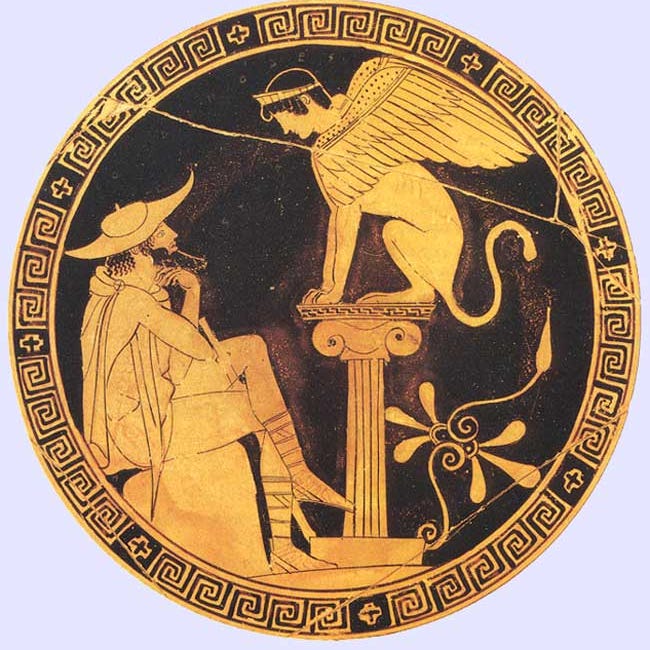
I feel a deep emotional connection with Sophocles’ tragic hero Oedipus. Yes, that Oedipus, who was fated to kill his father and have sex (and children) with his mother.
Au Revoir, Tragic Flaw
·
April 14, 2024
Oedipus the King ends with a great man brought low. Whose fault is it? His? His father’s? A mortal’s fate, that not even the gods control (or so it seems)? Why did it have to happen? Thanks for reading This Won't End Well: On Loving Greek Tragedy.! Subscribe for free to receive new posts and support my work.
No posts
Comments
Nothing yet. Say the first thing.
Sign in to join the conversation.