
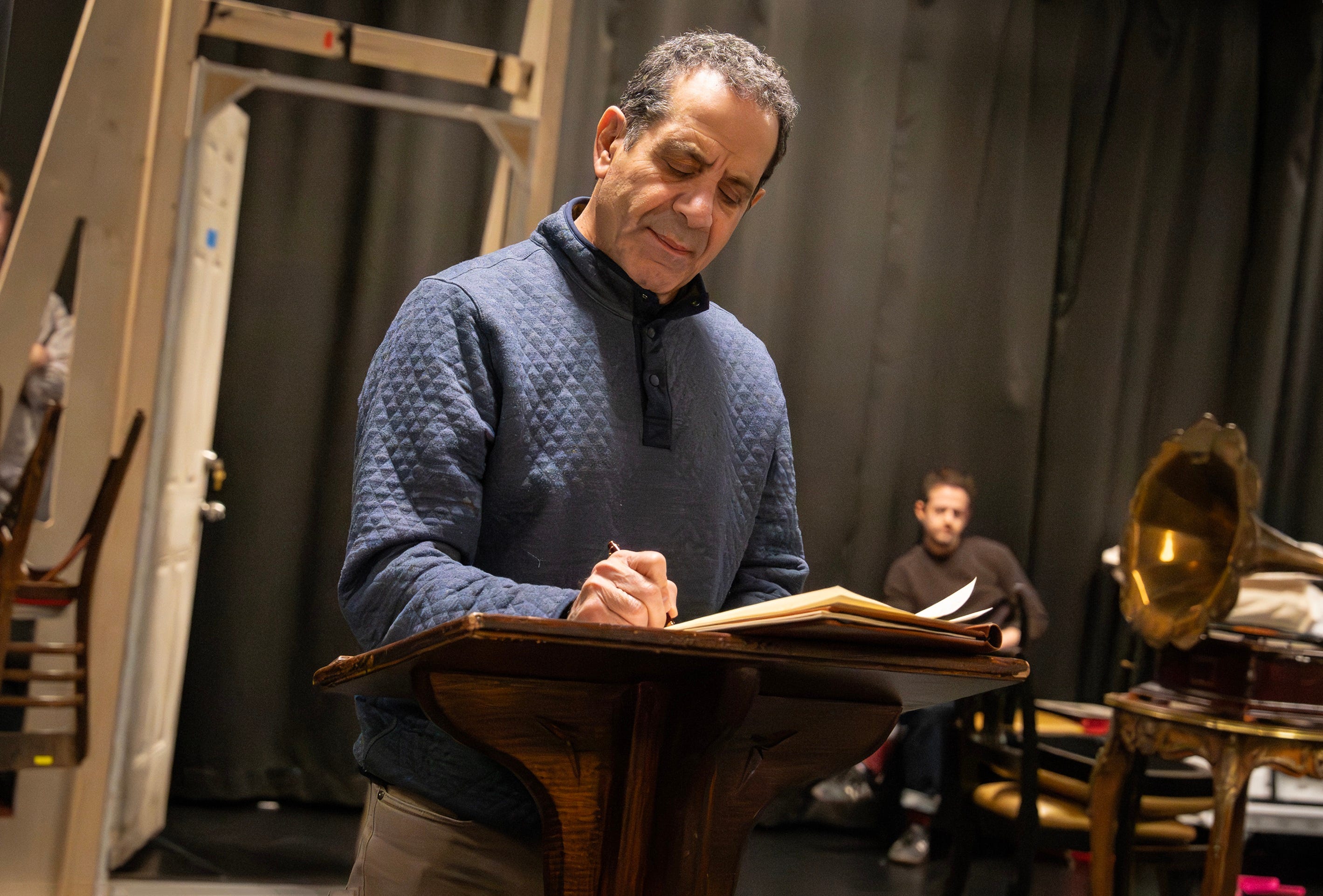
Tony Shalhoub in rehearsal for the role of Creon (credit: Joan Marcus)
Dear Readers,
You may have noticed that I’m a tad obsessed with Sophocles’ Antigone. And why not? It has everything: the big emotions of grief, love, rage and hatred; the oppression inherent in gender roles, for both men and women; the often fatal tension between religion, ethics, and the law; the disaster of suicide; the careless power and cruelty of an authoritarian regime.
It’s no wonder, then, that Antigone has been an inspiration for countless dramatic adaptations. The newest of these, Anna Ziegler’s Antigone: [This Play I Read in High School] will have its world premiere at The Public Theater on February 26th, just a week from this writing. Tony Shalhoub, pictured above, is one of the leads in a cast of award-winning Broadway veterans.
I’ve kept the Public Theater’s website open for months, waiting for tickets to go on sale. And now I have them. What’s more, I’ve had the astounding privilege of reading an early, in-process draft of the script that let me see the intent of the adaptation.
In both the very old and the brand new play, Antigone is an orphaned teenage girl. She defies the law, as personified in her uncle Creon, the city’s dictator. Although she is the daughter of the former king, Oedipus, her lineage doesn’t matter in the eyes of the law. She is merely a young woman, like any other. The laws are not hers to make, and certainly not hers to defy. Creon believes that life must be lived according to the law, even when doing so causes him pain. He has the power to ignore the law, but he can’t abandon the stand he’s taken, any more than Antigone can abandon hers. (For a recap of Sophocles’ Antigone, have a look at my most recent post: https://elizabethbobrick.substack.com/p/when-execution-is-not-enough).)
Ziegler’s play is fast and witty, modern in its concerns, but firmly fixed on the foundation of Greek tragedy: the paradox of choice. Choice is sometimes delusional, impossible, or limited, or all of the above. It may or may not be the expression of freedom; mortals have a limited store of power. Choices are often confined to options that none would willingly choose.
Whether we make our choices or have them thrust upon us, they will affect our community: others will either suffer or enjoy the consequences. In ancient Greece, Ananke — Necessity — is what forces us to make choices, or have them made for us. Free will was not yet a concept. Only the gods were free from the kind of ananke that constrained mortals; almost every choice was open to them.
Antigone [This Play I Read in High School] is also a play about choice, but it’s more than an old story in modern dress. It speaks to our concerns, right now, especially here in America. If we have not chosen the lawgiver, must we obey his laws? Do we have the right to do what we wish with our bodies? What do we owe to those who love us, even as they hate what we love?
To frame these questions, Ziegler has shifted the dramatic center of the play away from the unburied body of Antigone’s brother onto the young, very much alive body of his sister. Who should control the body of Antigone? Antigone, yes, no matter what she does? But do we want our young people to do anything they wish with their bodies? Let’s think about it. Who gets to choose?
(Dear readers, I hope that you are by now thinking about the term ‘pro-choice’ and the overturning of Roe v. Wade.)
It’s not easy to feel empathy for Creon in this play, and all but impossible in Sophocles’ (for me, anyway). And so what I especially admire in Ziegler’s Antigone is her refusal to make Creon a cardboard oppressor/villain, or to depict Antigone as a pure-hearted innocent. The relationship between uncle and niece here is exquisite, in the old sense of the word: attained with great care. As with The Minotaur, another of Ziegler’s plays with a classical theme, her characters are not transparent. They are unpredictable, which makes them particularly suited to tragedy. In turns angry, sarcastic, sad, and funny, they try and fail to disguise their vulnerability and need. In other words, they are just like us, except with better dialogue.
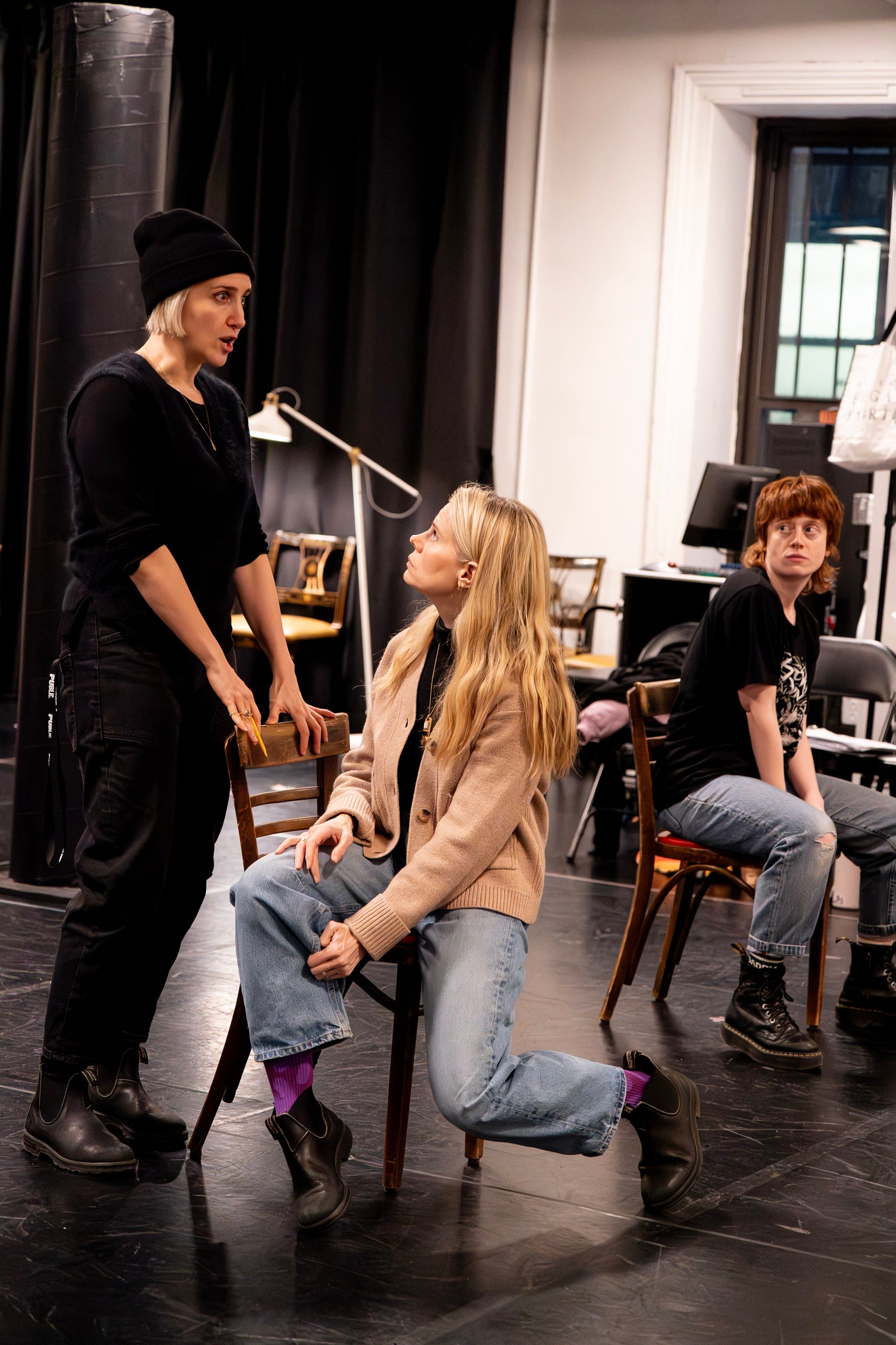
In rehearsal (left to right): director Tyne Rafaeli, Tony award winner Celia Keenan-Bolger as the Chorus, and Susannah Perkins as Antigone. (credit: Joan Marcus)
I’ll see the play during the first week of its run and report back. In the meantime, I offer excerpts from Andy Lefkowitz ‘s advanced feature of the show in New York Theater Guide (January 28, 2026). (A link to the complete article is below. Note that it’s not a review; those come out only after opening night.)
Here are excerpts from Mr. Lefkowitz’s article:
"At the Public, Ziegler’s Antigone (This Play I Read in High School) approaches the myth through a contemporary lens, where a young woman seeks to understand why the ancient voice of Antigone still resonates.
Ziegler maintains the core conflict of Antigone standing against her uncle Creon (played by Tony Shalhoub) and, with startling directness, updates the stakes for a 2026 audience. While the original Antigone defied Creon, a king, to bury her brother, Ziegler’s Antigone breaks the law by getting an abortion.
The production, according to director Tyne Rafaeli, embraces “intentional and unapologetic anachronisms” to create a “theatrical tapestry” that exists in both the past and present. Rafaeli described the play as existing in a “multiverse” that feels “extremely theatrical and extremely poetic.”
“Antigone is singular in its conversation around what one citizen can do in the face of unjust laws,” Rafaeli observed. “That sense of people wanting to make a difference in the world they see around them in the face of increasing injustice and oppression is something that resonates acutely for our current moment.”
Central to the tragedy is Creon, who’s tasked with enforcing the law at the cost of his family. In Ziegler’s script, Creon is described as an unremarkable novice who is ill-equipped to lead. Shalhoub saw his character’s conflict as one of impossible human balance rather than simple villainy.
“The struggle for him is so great because he’s caught between being this father figure to her, and caretaker, caregiver, and also the king,” Shalhoub said. “So he’s looking at the bigger picture. It puts both of them in a very intimate and intricate relationship with each other and with their respective agendas.”
“The renaissance of ancient texts like Antigone suggests that in a modern landscape dominated by digital noise, audiences crave the “elemental condition of the human problem,” said Shalhoub. He compared Ziegler and Rafaeli’s theatrical experience to a spiritual one, noting that “it’s a sit up, lean in, check, stay in, work a little bit” show that “requires a certain amount of reverence and focus.”
Full text of Andy Lefkowitiz’s article: https://www.newyorktheatreguide.com/show/44377-antigone-this-play-i-read-in-high-school.
He includes a review of Robert Icke’s Oedipus, recently closed after a successful run off-Broadway. My own review of that play can be found here: https://elizabethbobrick.substack.com/p/oedipus-goes-to-new-york
For more about Ziegler’s Antigone, some marvelous cast pictures, and a link for buying tickets (hurry up!):
https://publictheater.org/productions/season/2526/antigone-this-play-i-read-in-high-school/
I’ve written three earlier posts about the original Antigone. One features Putin:
https://elizabethbobrick.substack.com/p/when-execution-is-not-enough
Another dissects Trump’s hubris (which was not an attitude but a crime in Sophocles’ day): https://elizabethbobrick.substack.com/p/when-democracy-was-new-hubris-was
And my first post ever, about the mourners of unburied bodies, written immediately after the beginning of the war in Gaza:
https://elizabethbobrick.substack.com/p/unburied-grief
To see some art and sculpture inspired by Antigone over centuries: https://www.thecollector.com/antigone-sophocles-art/
You can read all my posts on the homepage of This Won’t End Well: On Loving Greek Tragedy, at elizabethbobrick.substack.com. As always, tell me what you think! My posts (usually one a month) are forever free: they won’t break the bank or your inbox. Thanks for reading! Likes and restacks are appreciated more than you know.
#theater #off-Broadway #Antigone #drama #Anna Ziegler #Tony Shalhoub #Tony winner
No posts
Comments
Nothing yet. Say the first thing.
Sign in to join the conversation.