

Aristotle said that Oedipus the King was the most perfectly constructed play of all tragedy, but for me Antigone is equally powerful. It has everything that keeps a tragedy from becoming arthritic with age: the big emotions of grief, love, rage and hatred; the simmering oppression imposed by gender roles, deadly for both men and women; the often fatal struggle between religion, ethics, and the law; the disaster of suicide; and the careless power and cruelty of an authoritarian regime. It’s no wonder that the play has given birth to countless adaptations all over the world, the rebellious teenage girl raging through them all.
In Sophocles’ original, the newly crowned king, Creon, declares that his nephew’s dead body will lie unburied because he’s a traitor who waged war on his own city. Creon ignores their family ties. He decrees further that anyone who even tries to bury his nephew with be punished with death. A king must enforce the law, even a law he made up, like this one, that goes against time-honored custom. Even the dead man’s sisters, Creon’s nieces Antigone and Ismene, are forbidden to so much as cover the body with a few handfuls of dirt. Antigone defies him, is caught in the act, and led off to her death — with terrible consequences for Creon.
If you’ve been with me here for a while, you’ll know that I’ve written about the play more than once as a way to think about authoritarianism in our time, roughly 2,500 years after its performance in Athens. (You can read them below, or skip over them and come back later.)
When Execution is Not Enough
·
Feb 18
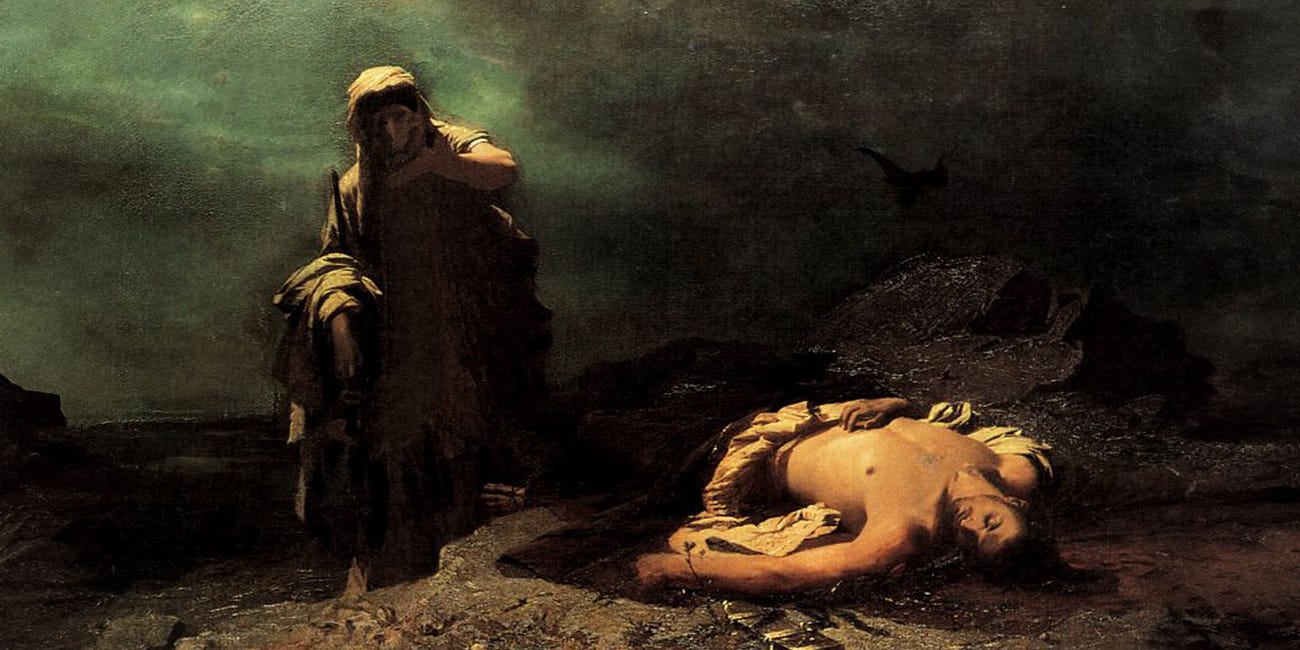
Painting “Antigone in front of the dead Polynices” by Nikiphoros Lytras (Wikimedia Commons/National Gallery of Athens)
When We Are All Enemies
·
October 22, 2025

When I was in high school, we were taught that Sophocles’ Antigone represented the eternal struggle between the individual and a repressive state. As far as I can tell, it’s still taught that way. That interpretation would have puzzled the Athenian audience of the mid-fifth century BC, but for children of the 1970s like me, anyone who fought what was th…
And if you read my last post, you’ll know that I’ve been waiting for months to see Anna Ziegler’s intriguingly named Antigone [This Play I Read in High School], now off-Broadway at the Public Theater, and now I have.
It’s not a perfect play. I thought that the first half (it’s divided by an intermission) was superb, and the second half powerful but uneven. The denouement was, to me, unsatisfying. That said, this new Antigone is provocative and timely, fiercely intelligent, and unexpectedly funny. Given its complete transposition to modern times, I found it surprisingly true to the spirit of the ancient original. There, as in this new play, expressions of love, grief, anger and anguish are larger-than-life but true to life. So are the cruel consequences of one-man rule.
I’ll get to all that in a bit, and I’ll offer my thoughts about the New York Times reviewer’s surprisingly inaccurate statements about Greek tragedy that inform (or misinform) her understanding of the play. First, I’ll tell you as much as I can about the play in this limited space.
Like Sophocles’ Antigone, Ziegler’s is a political play that centers around the question of crime and punishment. Who gets to dictate what is a crime and what is not? Who decides if a punishment is just, or even useful as a deterrent? For all its timeliness, and Ziegler’s obvious political sympathies, her play is not a one-dimensional manifesto.
Every playwright who adapts a Greek tragedy has to figure out what to do with the chorus. Ziegler decided on a high-wire act: a one-woman chorus (named Chorus), the one who read the play in high school, and then in college, and “kept finding her [Antigone]” in her own life. Chorus opens the play, with a quick chorus-appropriate (albeit funny) summation of the action leading up to the play. She then tells us that she will tell us “a different story of Antigone” — the adaptation we will see.
Chorus steps further away from ancient Thebes when she takes on an additional persona, a contemporary woman named Dicey. Dicey’s first-person tale becomes more tightly woven into Antigone’s story as the play goes on. Both ask this question: can we say that a woman ever has control over her own body, when she is so vulnerable to physical and social control? When a six-week old fetus has more power over her future and her identity than she does? This parallel and then braided narrative structure sounds overly complicated and stilted, but, to my genuine surprise, it worked on stage, thanks to Celia Keenan-Bolger’s stunning personification of the two roles.
What does Chorus add to the play? She reminds us that a play can speak to you, even from the ancient past, and change the way you understand your life. She also reminds us that our struggles and griefs are not so different from those of the past, something that readers new to Greek tragedy tend to find surprising.
It’s unlikely that an ancient tragedian would use a framing device like this — I say ‘unlikely,’ because we have all of 30 plays left out of hundreds that were performed. But a major alteration to a familiar story would not faze an ancient Athenian audience one bit. The tragic playwrights regularly refashioned old stories in order to focus on a different idea — and all the tragedies are plays of ideas.
For example, Euripides and Sophocles both wrote plays centered on the murder of Agamemnon. They are quite different from each other and from their dramatic ancestor, Aeschylus’ Oresteia. And that famous ending of Medea, in which she kills her children? It was Euripides’ invention. He took the story of Jason and Medea — or one of the stories, for there were many — and added the killings and Medea’s escape from the consequences. (The entire play is about….so much. I’ll be writing about it before long.)
Ziegler retains all the protagonists of the original: Antigone, Ismene, Creon and Antigone’s betrothed, Creon’s son, Haemon. In Sophocles’ Antigone, however, the unburied body of Antigone’s brother is at the center of the play. In Ziegler’s play, however, there’s no rotting corpse outside the walls of Thebes;. He’s dead and buried before the story begins.
In her notes in the Playbill, Ziegler explains why she made that change.
“When I set out to write this adaptation of Sophocles’ Antigone, it was more traditional, more faithful to the original. And then a friend read an early draft and asked me a question I couldn’t easily answer: where do you see yourself in the play? I realized that I had to start over….The answer to my friend’s question emerged when I discovered that I could center the story around Antigone’s body, around how female bodies have been treated across time. And around how governing collapses when the body of the state is unjustly pitted against individual bodies.”
That last sentence — “how governing collapses when the body of the state is unjustly pitted against individual bodies’“— is a completely accurate summary of the conflict at the heart of Sophocles’ play as well. Ziegler has constructed her play around that central question: who has the right to control a woman’s body and her choice to carry or end a pregnancy? In this case, the bodies in question are Antigone’s and Chorus’s, and the answers are not simple or simplistic.
The play opens on the day of Creon’s coronation as king. Antigone has skipped the ceremony to hang out in a bar and hook up with the bartender. She then goes home to find a very angry Ismene, her sister. Antigone enters, loudly. In dress and demeanor she differs greatly from her lady-like sister Ismene and (faultlessly turned out fiancé Haemon, whom we meet next). Wearing a motorcycle jacket, chunky boots, a kilt, and with a septum ring in her nose, her sexy punk look would fit right in on my college’s campus.
She’s snarky, funny, rebellious and reckless as only a teenager can be. She’s as rude to Ismene as only a sister secure in her love can be. She tells Ismene that she’s pregnant and doesn’t want to be. Haemon, she says, is unlikely now to want to marry her; and anyway, no one like her should reproduce and pass on the family curse. She tells Ismene, “We are abominations,” the offspring of a monstrous incestuous marriage. Their father is Oedipus. Their mother Jocasta was his mother, too. No one, including him, knew his true identity.
Ismene tries to convince her sister that she’s no monster and that she should stop worrying about might happen. (Later in the play, Antigone observes, “I’m the product of not worrying enough about what would happen.”) Her edgy, ironic humor typifies the unexpected and effective comedy in this play. It works as her defense against disaster — until it doesn’t.
There are no villains in this play, dead or alive. No one is without fault. There are only mortals caught in a trap they created or one that they attempted to escape. That’s the essence of tragedy.
Ismene has news for her, too. Because Antigone didn’t go to Creon’s coronation, she doesn’t know that he’s announced a new law: abortion is now a criminal offense, punishable by death. Ismene begs her not to go to a back-alley abortionist. Unsurprisingly, this Antigone, just like the old one, isn’t interested in sisterly advice. She starts to write to Haemon about her change of heart, but then goes to talk to him in person. He is so charming and happy that she loses her courage.
And finally, we meet Creon.
One element of the play that I particularly admired was Ziegler’s choice to make him a genuinely sympathetic character, not at all like Sophocles’ Creon. The brand new king is not cut out for the role he’s found himself in. He’s afraid of looking weak, because he knows that he is weak. In one of many comic bits, his security guards have to tell him that he can tell them to leave the room; it’s the only way they’re allowed to leave. He’s a distracted father to Haemon, who wants to impress him.
He loves his niece, and she loves him. They are tender with each other; she even drops her snarkiness, and we see their bond. In one powerful moment, they talk about how much they miss Antigone’s mother Jocasta, his sister. They are bound by heartbreak. Creon tells Antigone a story about how good Jocasta was to him when they were children, his face softening with a cherished memory.
The conflict between uncle and niece can’t be avoided, however. In a central dialogue of the play, Antigone points out that he is king, and doesn’t have to condemn her to death. He has power to save them both from the choice of evils. Creon tells her that her choosing to keep the baby and marry Haemon would save him from having to make that choice. Then he wouldn’t have to break the very law he made. Everyone would be better off. Thebes needs more babies, he reminds her, after a long civil war.
She gets a back-alley abortion, the only one available now that the legal clinics have been shut down. She is caught, and brought before her uncle.
Desperate and exhausted, they exchange a series of variations on the words ‘can’, ‘want,’ and ‘will.’ I can pardon you, but I won’t. I can pardon you, but I don’t want to. I don’t want to have a baby, so I won’t. I don’t want to, but I will. I want to, but I can’t. I want to, and I will. I want to, but I couldn’t.
Creon decides that Antigone must be punished. His word is now law, and if he disobeys the law, why should the people continue to obey him? All he wants, he says, is to unite Thebes after a civil war, when brother fought brother — including Antigone’s brothers. The city can’t withstand any more uncertainty.
As Antigone begs him to change his mind, blood begins to run down her legs. She’s haemorrhaging. (By the way, ‘Haemon’ comes from the Greek word for blood.) Creon orders her to be taken away. She bleeds out in prison and dies before our eyes. As in the original, Haemon commits suicide. Here, Ismene also commits suicide.
Every bit of what happened in this play was the choice of one person. At the same time, the only accident was Antigone’s pregnancy and the incestuous family she was born into. No one chose that.
Choice is a deceptive freedom. Choice exists only within available options, often ones that no one would choose in the first place. (Think of William Styron’s Sophie’s Choice, for example.) Ziegler’s focus on the dangers of anybody’s impassioned choice is true to the spirit of the ancient Antigone, itself an often misunderstood, complicated play of ideas. We’re moved to think about the nature of choice, an element at the heart every one of Sophocles’ plays. Is freedom of choice necessarily a good thing, when we are so ignorant?
In the final scene before she is taken to prison, Antigone has blood all over her: on her shirt, her thighs, her crotch. I felt the visceral grab that I think all women feel, or remember having felt, at the sight of unwanted blood showing the world its stain. It’s a feeling that no man can understand.
For some audiences, I’m sure, it’s too much. Not what they signed up for. And some will be disappointed that the play focuses on abortion rather than what seem to be larger, more universal matters: war, censorship, persecution. There are many Antigones, in too many adaptations to list here even if I could count them all. Let me tell you briefly about one of them.
The dramatist Jean Anouilh’s Antigone is still the most famous of modern adaptations. Ziegler’s play has much in common with it, and my guess is that Anouilh’s play is never criticized for being too focused on fascism. It didn’t pretend to be anything but focused on fascism, but Anouilh somehow got it produced in 1943 in Nazi-occupied France.
Ziegler’s play enacts the consequences of authoritarian control of women’s bodies. The Supreme Court opened the door to that just four years ago by permitting states to criminalize abortion. Abortion rights are not as universally accepted in America as fighting Nazis used to be.
The right to a safe abortion is not glamorous. It’s not the French resistance. To write a play about abortion rights is to dramatize the difficult questions of what it means to own a body — your own body, or the body of someone less powerful than you. It’s no mystery, by the way, that Trump began the persecution of trans people on his first day in office. Clearly, their bodies are not their own either.
I know. You’re tired. I’m pretty tired, too. And yet, somehow, Sophocles was never tired. Most of his surviving plays are centered around the body’s vulnerability and its need for protection by the state, even when the state is dangerous to that same body. Sophocles knew about the dangers of governing too hard.
When we read Antigone in high school or even in college, we didn’t learn that he was a widely admired member of an elite and powerful family, a general in the Peloponnesian War, and a high-ranking civic magistrate, in addition to being a prolific and beloved playwright.
So now, back to Ziegler’s Antigone. I’ve told you what I admired, but not everything, because I don’t have room. Here are some things that I found puzzling and/or that I thought didn’t quite work. Haemon’s uncertainty about his sexuality is hinted at and then dropped as if it hadn’t been said. Calvin Leon Smith in this role was marvelous in the first half, and then surprisingly underused in the second. Creon’s off-stage wife, Euryidice, we were told, had been brow-beaten into permanent silence, but by whom? Tony Shalhoub’s Creon was clearly not a life-long intimidator of women; otherwise, his transformation into a dictator wouldn’t have been interesting. I wanted less humor at the most serious moments of the second act — much less. The uplifting ending didn’t work for me, not because I’m against being uplifted (well, actually, I kind of am) but because it didn’t feel tightly tied to what had come before.
The play has caught some particularly unfortunate and misinformed criticism from the new chief theater critic at the New York Times, Helen Shaw. I think she was disappointed in the play in part because she expected it to be more like the play she read in high school. Knowing that it was an adaptation, I wasn’t expecting anybody to be draped in a metaphorical chiton. (Not a toga. Togas are Roman, although Romans also wore chitons. Different garment altogether. But I digress.)
One doesn’t expect a total rave in the NYT, for they are rare, and for good reason. Anyone could write a rave, whereas a more nuanced critique is meant to display the reviewer’s sensibility and knowledge. One can’t argue with sensibility — you don’t like what you don’t like — but Ms. Shaw’s knowledge about Greek tragedy is imperfect.
For example, she found fault with the character of Chorus. It’s true that the character Chorus doesn’t behave like an ancient Greek chorus. As we know by now, however, this is an adaptation, not the original in modern dress. But her understanding of what a Greek chorus is leaves something to be desired — accuracy, for starters.
“Typically, Greek choruses contextualize a tragic plot by addressing wider existential issues. Ziegler’s one-woman Chorus, though, considers only herself.”
Ms. Shaw is simply wrong about what is ‘typical’ for choruses in tragedy. Scholars have long argued about the meaning and dramatic function of choral odes (the songs the Greek chorus sings while they dance). These differ greatly from playwright to playwright, and from play to play. I could point to ode after ode in the tragedies that do not provide context, that don’t even seem connected to the action or the plot, or that don’t make a lot of sense in themselves. (This is especially true for Aeschylus, who established what we think of as the traditional Greek chorus).
One more thing: tragic choruses worry about what will happen to them a lot. Stop me before I point out example after example.
Ms. Shaw’s most misleading statement is this: “There’s a bizarre absence of true conflict — or agon if you’re being fancy.” I don’t know what play she saw, but there was pretty much nothing but true conflict in Ziegler’s play. What’s more, the central scene of the play, when Antigone and Creon are trying to persuade each other and explain themselves, is exactly what an agon is in Greek theatrical terms — if you want to get fancy. It’s the scene in which two major characters clash in a big word fight, dialogue thrown back and forth like arrows.
Ms. Shaw gave Antigone’s snarkiness a run for its money.
“Mostly, Chorus worries about being a stifled person — she hopes to learn outspokenness from Antigone — and her show-ending triumph is that she finally hears her inner voice. This fun discovery happens as Antigone bleeds out in front of her. Maybe, I don’t know, apply pressure first?”
Antigone and Chorus don’t interact at any point in the play; only their stories entwine. Did Ms. Shaw think that Chorus should have stepped in as a first responder? In my view, she was so unhappy with Chorus not being a Greek chorus that she missed the metatheatrical aspect of the play, i.e., that this is a play based on the Chorus’ growing understanding of a play she read in high school. When a character in a play remarks on their presence in a play or their relationship to another play, that’s called metatheater — if you want to be fancy.
Back to Antigone [The Play I Read in High School].
At one point, Antigone is trying to write a break-up letter to Haemon. She tells him that she loves him and cares for him but doesn’t want to marry him. It’s not too late, she says, “to nail the lid back onto Pandora’s box.” What could be more true to Greek tragedy than trying to avert what is sure to be a dreadful outcome?
During the agon, Creon says to Antigone that “People need to care for the state. The state is my child.” Antigone replies, “The state is not a body.” Finally, she says to him, “You’re not wrong, but also I’m not, and that is our tragedy.”
And that, dear readers, is the beating heart of Sophocles’ Antigone, one that time and tyranny have not yet stopped.
#theater #off-Broadway #AnnaZiegler #PublicTheater #GreekTragedy #TonyShalhoub #CeliaKennan-Bolger #Antigone #HelenShawNTY
Do you have a favorite play or movie that explores a social or political issue, or a favorite modern adaptation of a classic, ancient Greek or other? I’d love to hear from you.
The 1978 film ‘A Dream of Passion,’ starring Melina Mercouri, is a great one. Mercouri is an actress preparing to play Medea. As part of her preparation for the role, and a publicity stunt that wasn’t her idea, she visits an American woman imprisoned for killing her children to punish her husband, as Euripides’ Medea did. Things don’t go well.
If you want to find out more about criminal charges brought against women recently in cases of miscarriage and stillbirth, The Marshall Project has reported them state by state:.https://www.themarshallproject.org/2025/04/02/law-pregnancy-california-ohio-georgia-alabamacases.
No posts
Comments
Nothing yet. Say the first thing.
Sign in to join the conversation.