
A MAJOR AMERICAN NOVEL – A WORK OF ASTONISHING POWER, RANGE, AND VISION
Foreword to Antarctic Navigation Volume 1
At the beginning of the austral summer of 1990-1991, my wife Elizabeth Arthur and I flew to Christchurch, New Zealand. We spent two weeks touring South Island and then circled back to where we had begun. I returned to the United States while she prepared to board a big-bellied U.S. Navy LC-130 bound for McMurdo Station, the American research facility run by the U.S. Antarctic Program, located on the tip of Ross Island. It was the successful culmination of a year-long campaign to get her to the Ice, the setting for the last two-thirds of her longest, most audacious, most inspired novel.
Liz had been at work on Antarctic Navigation for years by that time. Other books had been written and published while she read and researched, changed direction, became more driven. She had been inspired by events both personal and historical. Her teacher, friend, and mentor, Lorna Morey, had written Liz a letter as she lay dying in a hospital in British Columbia. It had taken her days. Her handwriting was shaky, barely legible, but indicative of enormous willpower and determination. Her letter to Liz was the last thing Lorna Morey ever wrote.
Likewise, Liz had been profoundly moved by the journals the great British explorer Robert Falcon Scott had left behind him in the Antarctic. With frozen fingers, dying of hypothermia, Scott had kept writing up to the moment of his death in a tent in a blizzard on his return from the South Pole. Scott’s last written words were an exhortation to “For God’s sake, take care of our people.”
These two models of courage, fortitude, and love were an inspiration and a summons. They had spurred Liz on - examples of people with enough faith in the supremacy of language to expend their last breath writing. When Lorna had been Liz’s teacher, she had awakened in her a profound understanding of the reach and power of metaphor, while Scott had been an explorer who wanted to reach the South Pole on his own terms, under his own power, according to his own moral values, rather than through the ruthless efficiency of a man like Amundsen, who was willing to kill and eat the very dogs who were pulling his sledges ever South.
With this wind at her back, Liz imagined a new journey to the Pole - in the steps of Scott and using his techniques, to prove that it could be done, and that his death was merely the result of happenstance and accident and not of faulty planning.
The draft she had completed before her trip to Antarctica was, as she knew, unfinished; much of the section that dealt with Antarctica itself remained unwritten. It also featured a male hero - a calculation made in the face of her belief that male reviewers would be skeptical of an epic adventure with a female lead. But since all of her books set in far-off places had been written after those places were familiar to her, she’d felt the need to experience Antarctica for herself and not rely on photographs, written accounts, or video footage. So she’d applied to the National Science Foundation for one of a very few and very select “Artists and Writers” grants.
The application involved writing letters; sitting for interviews; soliciting support from experts and previous grant recipients, as well as from a New York editor; submitting a rationale for her trip as well as a clear plan for what she wanted to accomplish in Antarctica; and providing both evidence of her prior accomplishments as a writer and verifiable assurance that she would finish the project that was taking her to the “highest, driest, coldest place on earth.” In other words, proof that the National Science Foundation would get a return on its investment.
The application process was an obstacle course of enormous difficulty, one very few people finished and even fewer conquered. But in the spring of 1990, Liz had gotten a letter from the head of Polar Programs, with the news that she was in.
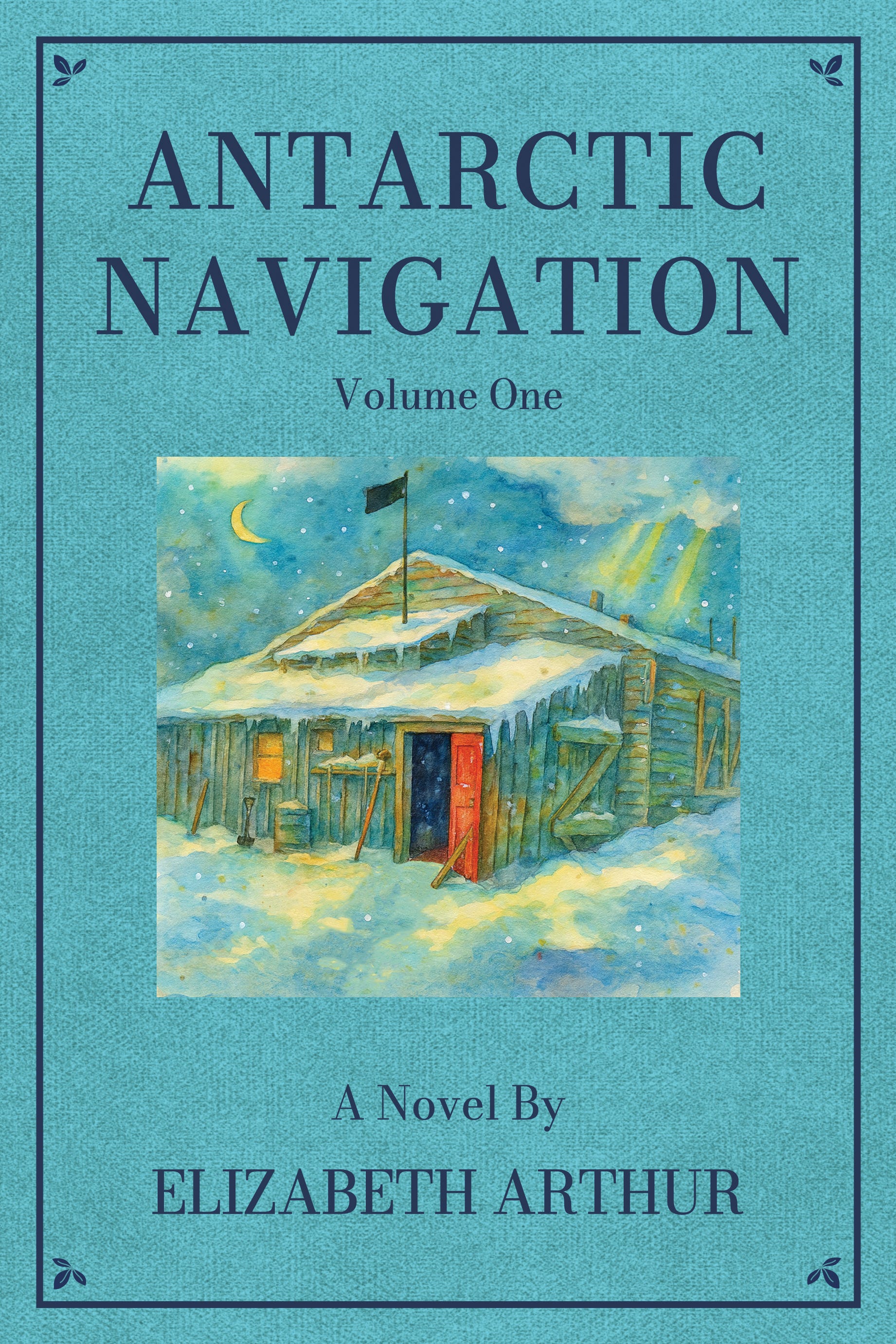
Her time on the Antarctic continent was extraordinary. Not only did she get to tour McMurdo Station and interview its administration; she was able to experience its military discipline and see for herself the National Science Foundation in full operational mode, with its rules, regulations, strictures, and requirements. But the true prize was that she was allowed to spend a week away from the grit, noise, and high-pitched energy of McMurdo Station in favor of the pristine icescape of Cape Evans - where she lived in a wanigan, visited Greenpeace’s Antarctic station, and, most importantly, spent her days writing in Scott’s still-standing hut, from which the Terra Nova Expedition had set forth for the Pole.
There she found, preserved by the cold, supplies of food and equipment in their original boxes with stenciled markings that took her back to the turn of the twentieth century. There she studied the active volcano Mount Erebus, watched penguins, seals, and thousands of wheeling and diving seabirds, and imagined herself back in 1911 and 1912 when the hut was packed with men whose lives, histories, and expertise have become the stuff of historical legend.
But beyond imagining, she had the otherworldly experience that these men had not been dead for almost a century but were out on the Ice for the day, doing scientific research, and at any moment would reappear, pouring through the door and into the hut, red-cheeked, laughing exuberantly. These were living presences to her - not ghosts or specters, but pure spirit, pure essence, benevolent unseen watchers.
Liz became quick friends with the Greenpeace volunteers, who hailed from Germany, Argentina, Denmark, and Sweden. One day, with their help, she was able to use a radio link, and her distant tinny voice bounced off a satellite and into my ear on the landline in Indiana. She was fine, she was great, she’d see me soon. It was now late December and my parents were visiting from New Jersey for the holidays. I had put up and decorated a tree; the house was burnished with golden light; it was cold outside, but no snow. Liz flew back from Christchurch through L.A. and took a midnight flight on Christmas Eve, landing in Cincinnati at 2:30 a.m.
She was radiant with happiness. The flight, with just a few people on board, had become a party, and the experience she’d had down south followed her like a vapor trail. The photographs she’d taken were jaw-dropping, as were her tales of what it had been like to be on Cape Evans.
In the new year - 1991 - she got back to work. The hero of her epic was now a young woman named Morgan Lamont. She bore certain similarities to Liz - her fascination with Scott and her observations of the Antarctic icescape - but in all important ways she was an alter ego. Liz is an artist, not a scientist, but because she is ferociously curious, she created a complex and totally believable young woman who grows up to be a volcanologist. She had to learn knotty scientific concepts and then render them in easily understandable and readable prose.
The book is filled with unforgettable set pieces - Morgan’s uncanny, detailed memory of her birth and its echo in an early sled ride and in the sleds the Ninety South Expedition hauls to the Pole; the deaths of Morgan’s father and mother; the introduction, one by one, of the friends and acquaintances Morgan gathers around her and convinces to go with her on her journey; her flight into Antarctica; and the long, remarkable trek in the footsteps of Scott across the polar plateau. Beryl Bainbridge wrote in a review of Antarctic Navigation that for a time she’d been sure that Morgan’s polar trek was the actual result of real experience and not of acute, focused, inspired imagination.
I read many drafts of this novel before its publication and edited each one. Yet when I finally held the eight-hundred-page volume published by Knopf in 1995, it was totally new, as if I were reading each incandescent word for the first time. This has proved true again and again. Each reading is a revelation. In the current Collected Works, the book has been divided into two volumes, in order to comply with current publishing requirements, and to make it easier to hold, while reading.
Thirty years have passed since Antarctic Navigation first appeared, and yet it is as fresh and vital as the day it was published. If anything, it has become more relevant, more prescient, more magisterial as time goes by. Unlike the preponderance of contemporary fiction, it has no truck with popular culture or contemporary referents which soon turn stale, even rancid. It was written with a view to the future, and today, the atmosphere of Antarctic Navigation is as clear and pure as the polar air. If you are reading this novel for the first time, you have ahead of you an experience of unparalleled depth, intellectual excitement, and sheer beauty. This is a book that will last; like Moby-Dick - the novel Liz used as inspiration - it will come to be seen as a seminal, quintessential American novel.
Steven Bauer 2025
Please Note: The button below will take you to Part One of Antarctic Navigation. To order Part Two as well, you will need to go to the bottom of the series page.
A New York Times NOTABLE BOOK and Winner of THE OHIOANA BOOK AWARD FOR FICTION “A tale of yearning and discovery as vast and crystalline as the continent it portrays…spiritually rich and unfailingly dramatic…a blend of romance, high adventure, science, and philosophy.” ~ Donna Seaman, “All the ingredients a reader could hope for: parallel historical and contemporary dramas, a contest between personal aspirations and the powers of nature, the testing of human relationships under extreme conditions, and a magnificent setting.” ~ “A triumph of the novelist’s art.” ~ “This huge novel is filled with riches…Arthur’s unabashed attempt to shape all that she knows into a book others can share makes her achievement truly astonishing. I was, quite literally, thrilled to be reading it.” ~ James Mustich, “Magnificent and enthralling…what literature is supposed to do: sweep us away, hold us spellbound, and finally transform us.” ~ Ron Hansen “A work of luminous and lasting beauty.” ~ Tim O’Brien
E
Comments
Nothing yet. Say the first thing.
Sign in to join the conversation.