
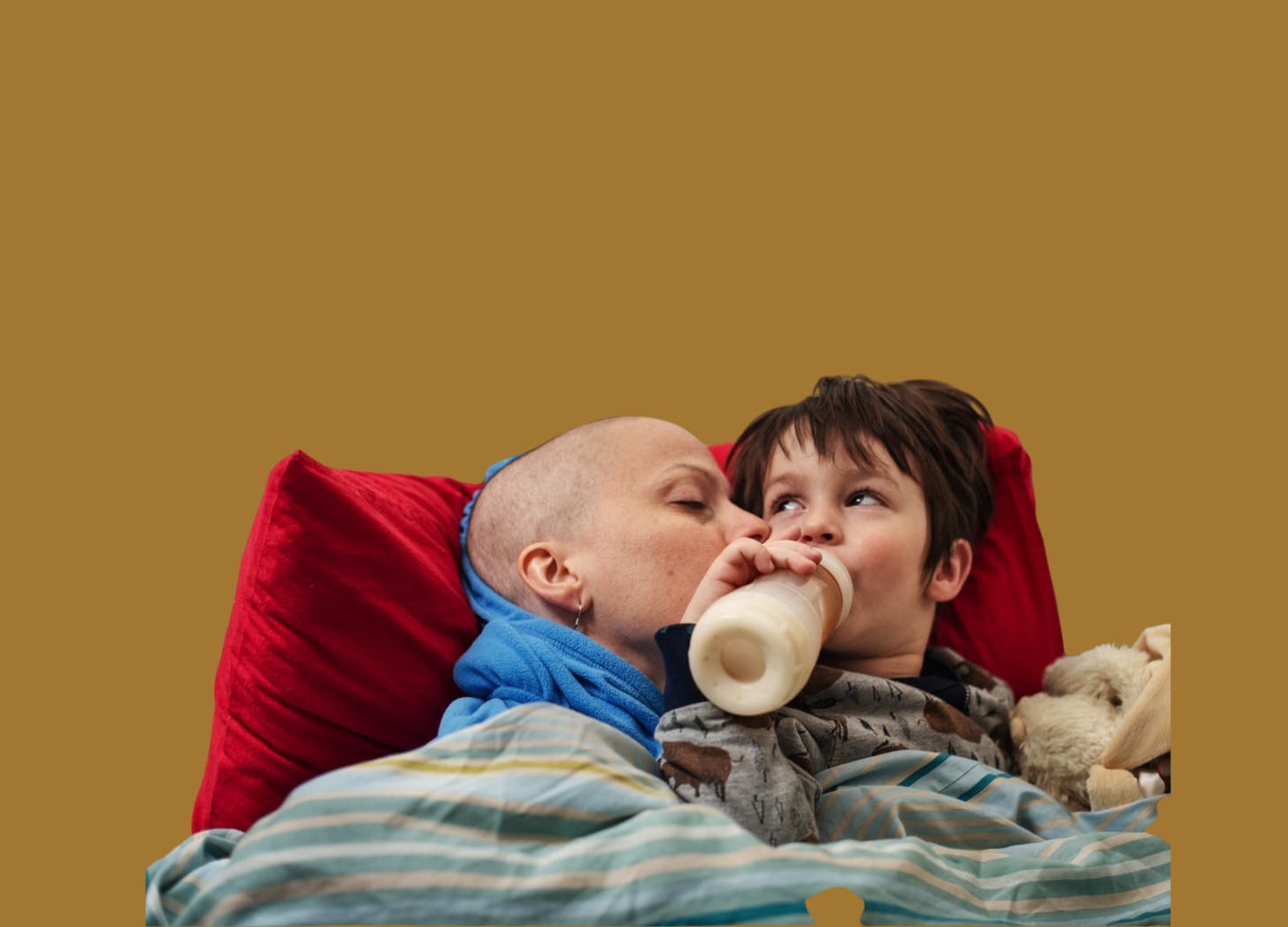
Meet Jordan Rathkopf, a photographer whose work, alongside the work of his wife Anna, makes the often invisible work of cancer caregiving, and care-receiving, visible.
I wanted to talk to Jordan because I was deeply touched and awakened by his and Anna’s images—touched and awakened in a way that I could explain in words, but I far prefer for you to scroll down and experience them yourselves.
In our conversation below, I learn why he and Anna decided to bring the camera into their family life as they navigated Anna’s cancer and parenting a young child, and how that decision impacted the experience overall.
The Rathkopfs’ photos have me thinking about how, in the age of smartphones and social media, many of us take pictures with the goal of capturing something shareable, rather than documenting the truth of the moment.
I think this is especially the case with parenting and caregiving, which can often trick us into believing that the only images worth sharing are those that prove things are going right—that our care yielded a product. But the product is never the point with care. It’s all about the process, and the process requires a lot from parents and caregivers. Yet we so rarely think to capture it by way of a still image.
Jordan’s work has inspired me to take more pictures of the process of care, and fewer of the products of care. I hope it does the same for you.
ELISSA: Jordan, let’s start with your family’s care and cancer story. What happened?
JORDAN: In 2016, we had just started talking about growing our family. My wife was 36, about to turn 37 that December. It was on her 37th birthday that she first felt a lump in her breast. She told me later she knew right away it wasn’t good.
Not long after, she was diagnosed with an early-stage but aggressive cancer type called HER2-positive. We went from dreaming about a second child to researching five-year survivorship odds. Our doctor told us that because of how aggressive her tumor was, we were in for a difficult year. What surprised us both was that the years after that first one challenged us in ways no one had warned us about.
ELISSA: At what point after learning about the diagnosis did you decide to weave photography into the cancer and cancer caregiver experience?
JORDAN: The day after Anna got the call telling her she had cancer, we woke up and agreed we wanted to document the experience. It wasn’t meant to become a project at first. It was a way to express feelings we couldn’t yet put into words. We were in shock, raw and exposed, and the camera became a tool that helped us navigate our new reality.
ELISSA: What was it like to photograph this life chapter? How did it feel?
JORDAN: At times, it was the only way to escape. I remember her first chemotherapy session, I was terrified.
As a caregiver, I’d been doing the research. Anna was in shock from the trauma of the diagnosis and I wanted to help her anyway I could, and one way was by learning what I could about her treatments. Much of what I found scared me, including the possible side effects of chemo.
I was so afraid going into that first session that I turned it into a photo documentation, almost like I was on an editorial assignment. I needed to detach from our reality. I must have taken 500 photos that day. She looked at me like I was crazy. It actually kind of made her laugh because I was almost getting in the way of the nurse.
Other times, the camera was my way of holding onto a love and gratitude I’d never experienced at that level before. I hoped that if I captured those moments, I could hold onto them no matter what happened. The camera let me show love in ways I didn’t feel comfortable saying out loud.
ELISSA: Were there ever moments when you felt like the camera was too much? Or pictures you deleted because it was too painful?
JORDAN: I never deleted any pictures, but there were some I didn’t want to share, not with Anna, not with anyone. I think I was compelled to take them as a way of proving to myself that what we were going through was real, and that what I was feeling was rational. I’d started feeling isolated from the world around me, lost in feelings I was afraid to share, and yet I needed to see them in front of me.
ELISSA: Would you encourage others to document caregiving in this fashion? Caregivers are often encouraged to journal, but that is a very different way of documenting the experience compared to photography which is way more embodied and relational. Why photograph?
JORDAN: I couldn’t find the words. I was scared to even say out loud what I was feeling. Photographs could communicate things spoken or written language couldn’t, at least for me at that time. Eventually I did find that writing served its own purpose too. But there’s something unique about the power of an image, how universal it is. I remember in college, in a film history class on silent cinema, writing a paper on Charlie Chaplin’s Modern Times. You could feel everything in his films, great joy and deep sadness, through visual storytelling alone, with no spoken word. That left an impression on me. It was somehow so simple, so accessible and yet so deep.
ELISSA: Any practical tips on how to take pictures as caregivers without being invasive, inappropriate or controlling—and maintaining dignity for all?
JORDAN: Consent matters to me above all. There were moments when I knew a photo would have been powerful, but I chose not to take it. Because taking it would have meant putting the “art” ahead of the person in front of me. I wasn’t willing to make that trade.
For others who want to capture some of their own experience, a few pieces of advice that I received stayed with me. First, the best camera is the one you have with you. I started with a DSLR, and over time incorporated a smaller compact camera that was nearly silent and barely noticeable so that the process of taking the image did not impact what was happening in the environment or annoy others. I have almost never shot on my phone up to this point, but I’ve seen others do powerful work that way. I’ve also seen people do beautiful portraits with medium format cameras which require a lot of intention and time. The tool needs to serve you as the person using it.
The second piece of advice was don’t always shoot so close. When something intense is happening in my life, the instinct is to stay tight on the subject and intimate. I was given advice from an editor once that sometimes you need distance instead. A wider and/or more distant perspective can reveal things about an experience that need room to breathe.
ELISSA: Will you share some of your favorite pictures from HER2, your photography book documenting the years your family spent navigating cancer and care, and tell me why they are so meaningful to you?
JORDAN:
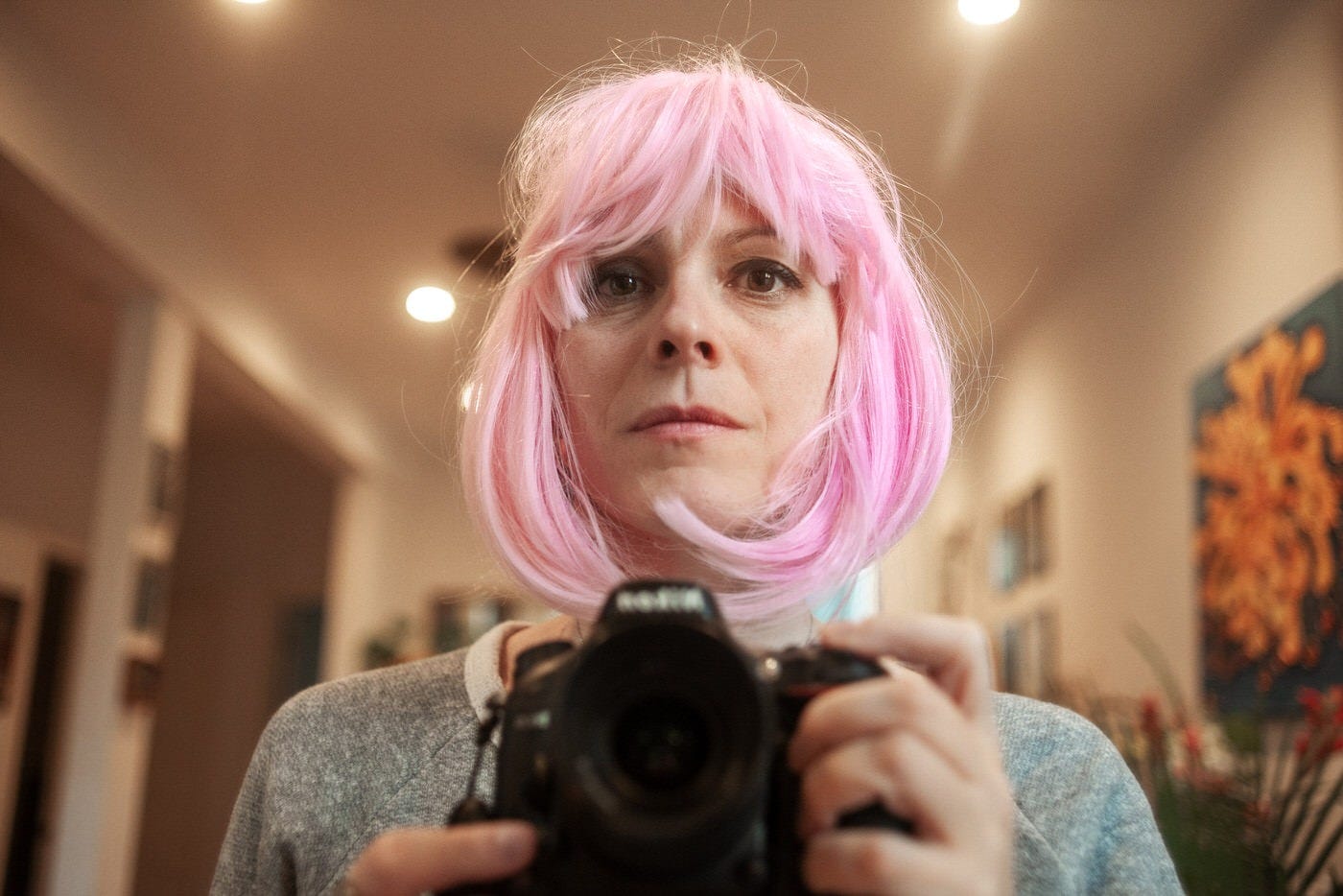
Anna’s self-portrait in the pink wig:
Anna’s self-portrait in the pink wig is one of my favorites, for a few reasons. First, it showed me her courage, and inspired some of my own. If she could face this, camera in hand, so could I. It was also the photo that shifted how I understood what she was going through. Years later, she told me she’d taken it because she no longer recognized the person in the mirror. That’s when I understood how lost she felt.
The hospital portrait of us together:
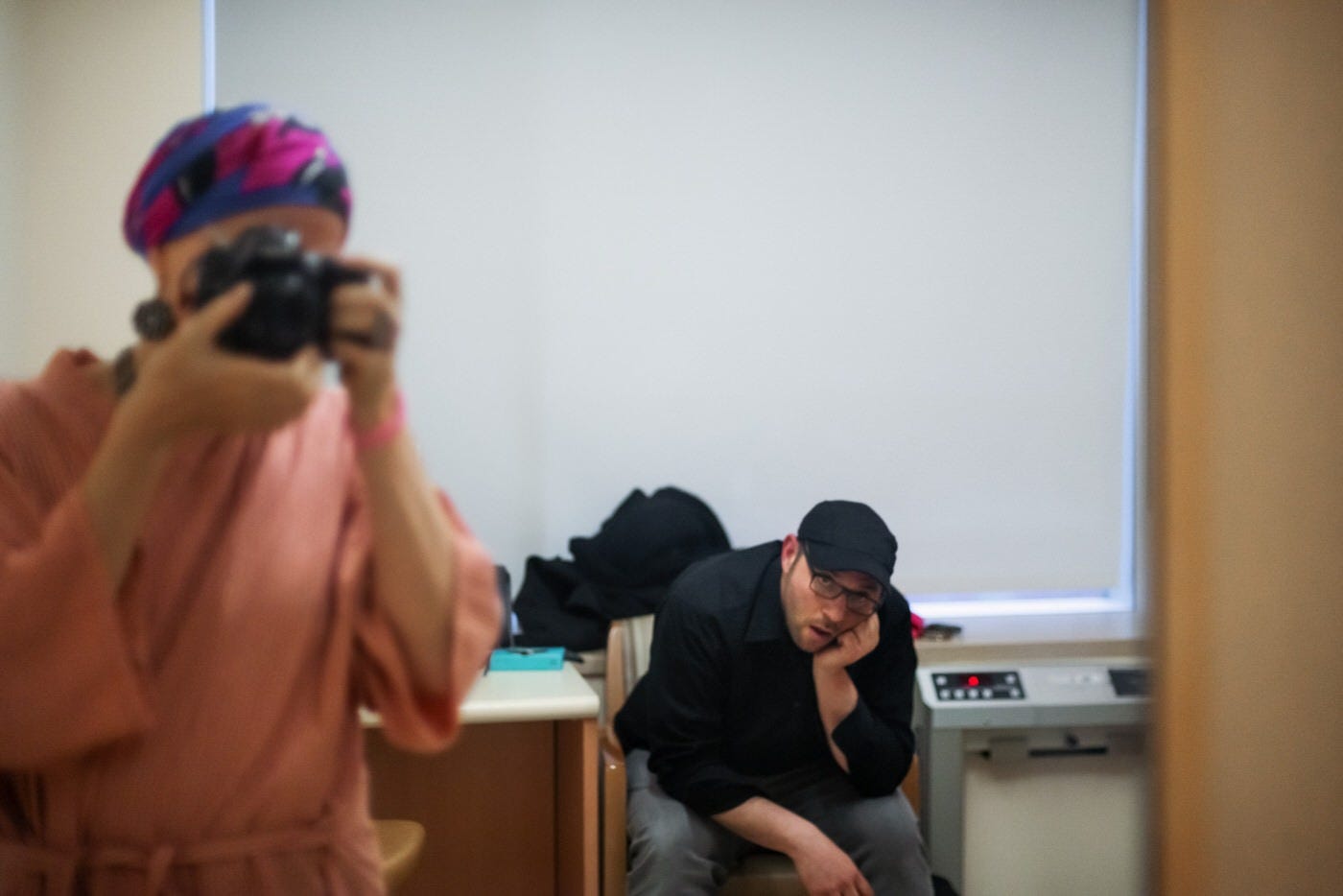
Another photo that means a lot to me is one Anna took of us together in the hospital, waiting for her oncologist. She caught a moment where I didn’t realize how shattered I looked. I thought I was projecting strength but in reality, the mirror reflected how I was crumbling under the weight of it. There are several photos she took of me that I’m only grateful for now, years later. Even as I tried to hide how much pain I was in, she saw it anyway, and loved me through it. She didn’t need me to always be strong. She needed me to be there.
Anna and Jesse in bed:
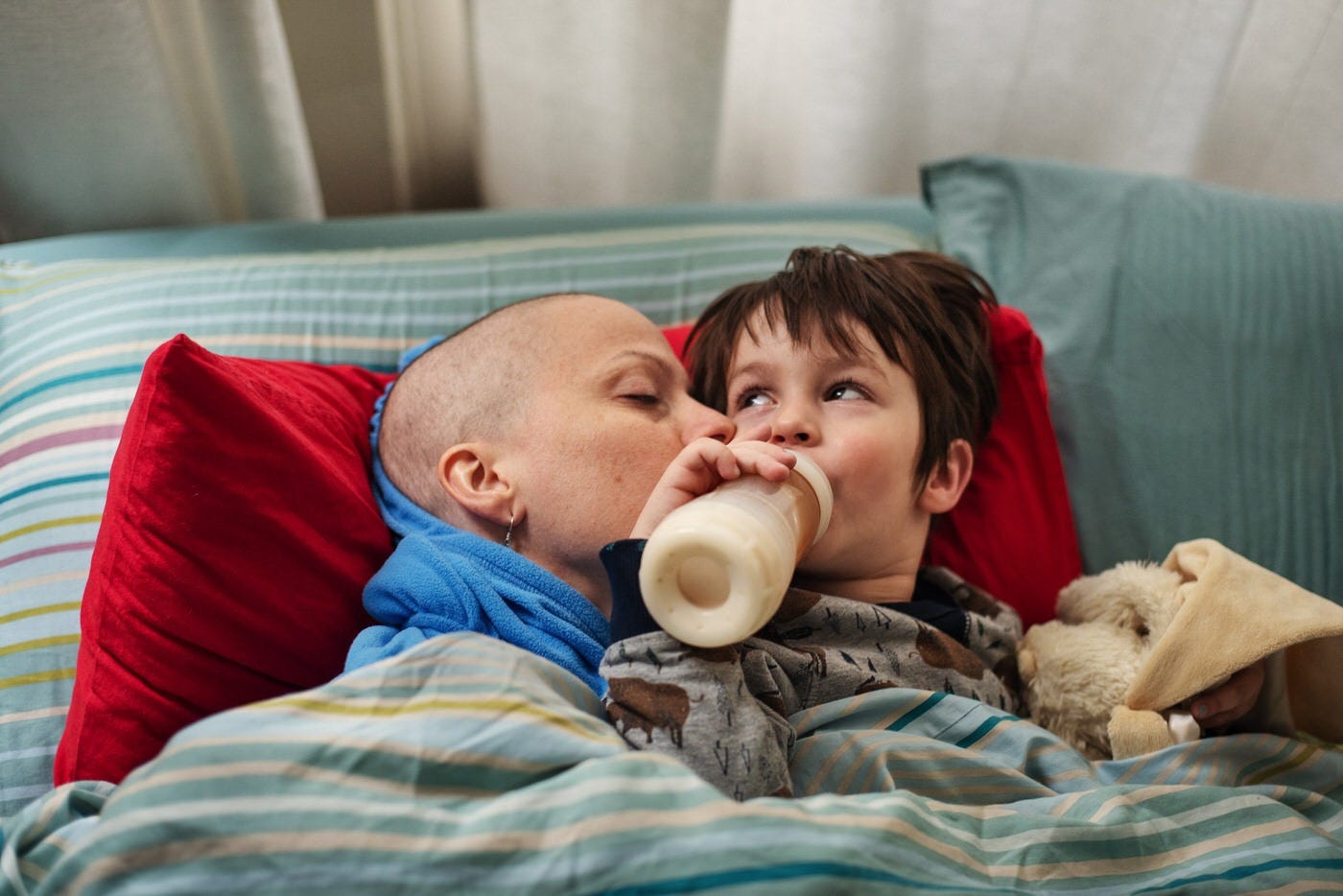
There’s an image I took of Anna and Jesse in bed. She’s kissing him, and he has a bottle in his mouth. She was feeling so sick, and Jesse sensed it. He came to her with his bottle, his duck doll, and his book, caregiving for her almost as much as she was caregiving for him. Every difficult treatment she’s endured, and still endures on medication to reduce her risk of recurrence, is so she can be here for us. She actually often says she would do anything to be here for him and I have to remind her I need her too :)
Me and Jesse, embracing:
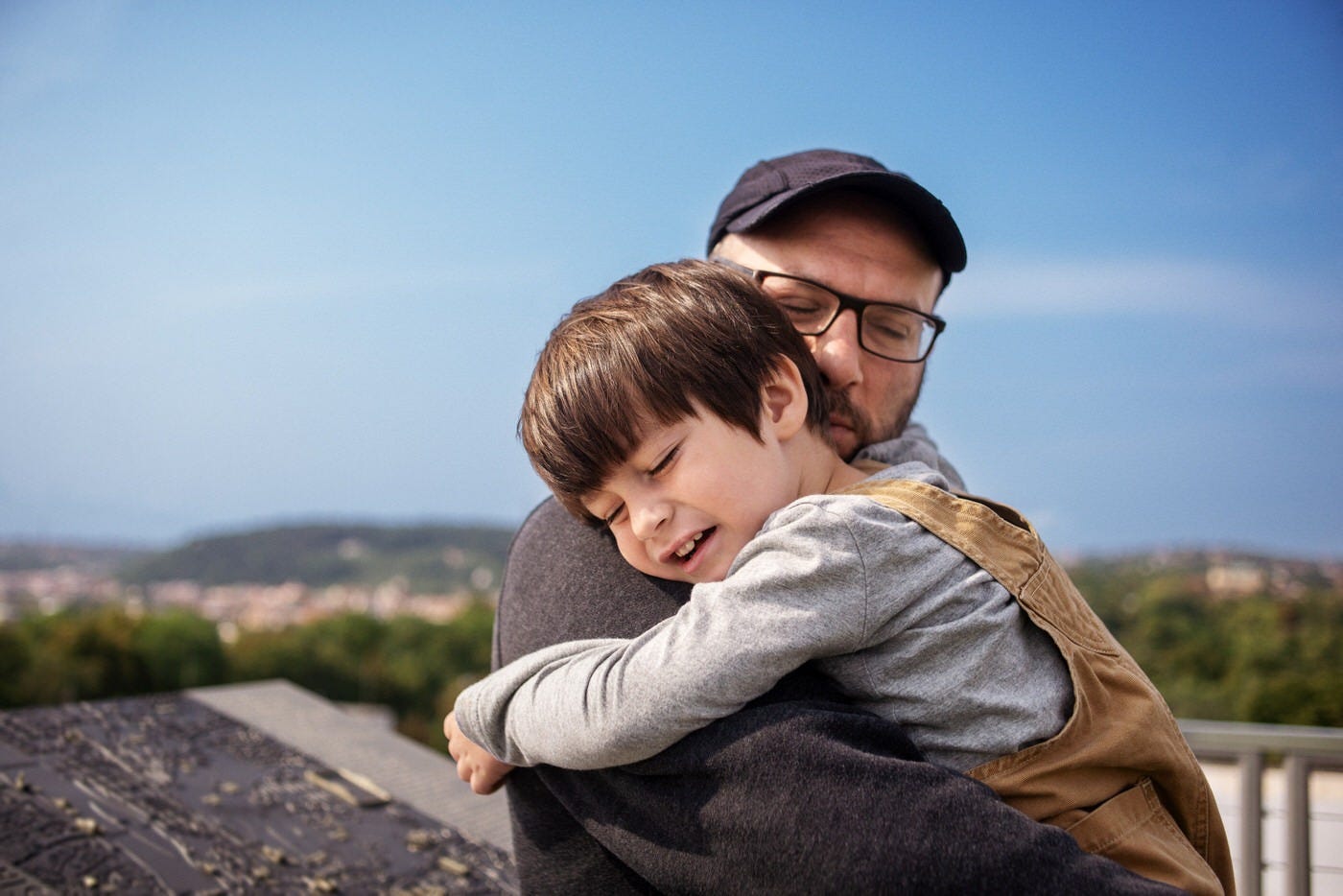
There’s a photo Anna took of me holding Jesse, the two of us under a bright blue sky. My eyes are closed, holding him tight. That photo reminded me I was caring for Jesse just as much as I was caring for Anna. And feeling Anna’s love for me in that frame meant something too. As a “caregiver,” I’d developed a habit of minimizing my own experience. Seeing myself through her eyes reminded me that mine mattered too. And not just to me, but to her. I felt very loved.
The journal entry / CBT photo:
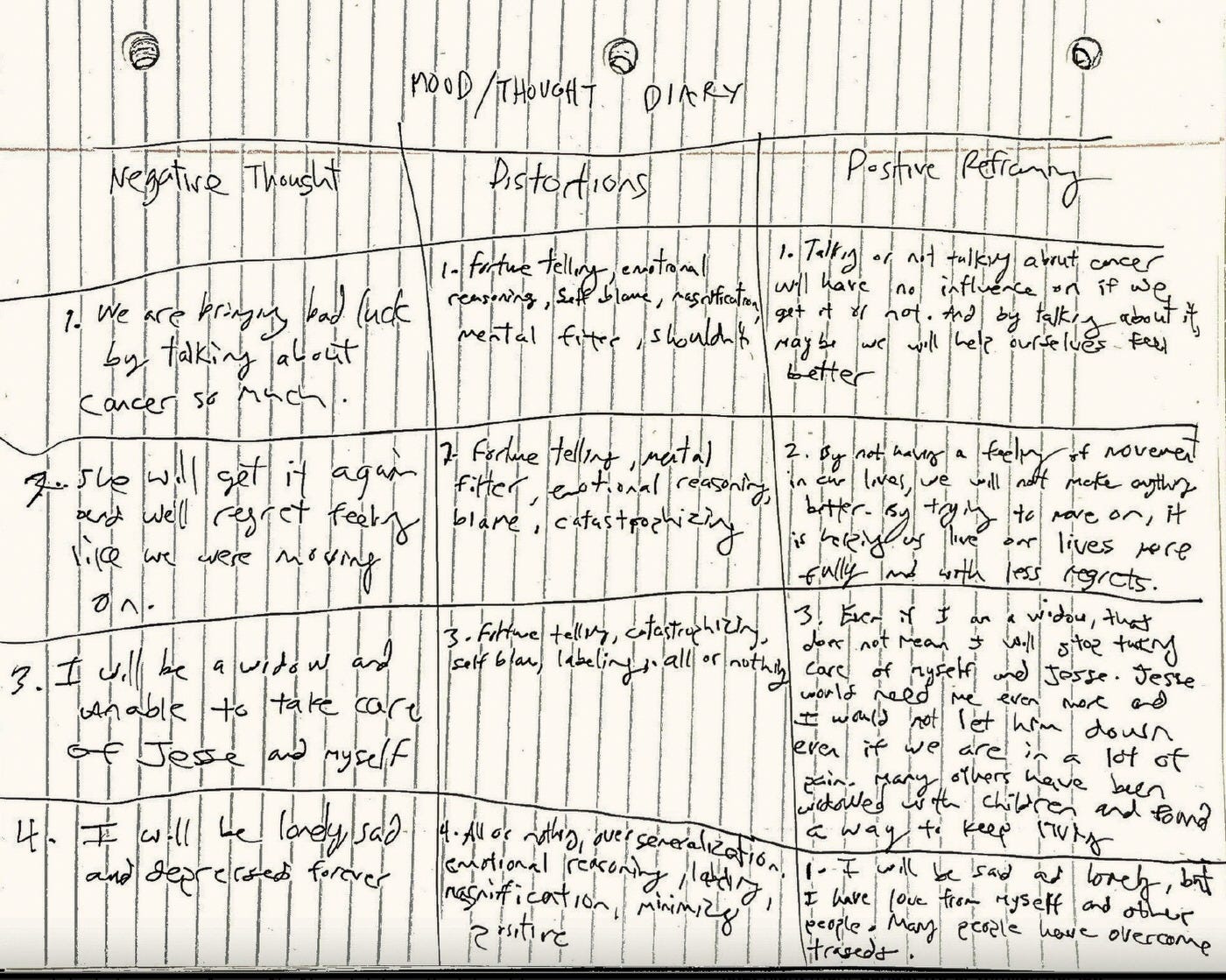
Early in Anna’s treatment, I found cognitive behavioral therapy because I was having thoughts about death, anticipatory grief about the possibility of being a widowed parent, that felt unbearable. CBT became a tool that helped me. One image in the book is a photo I took of a journal entry from while we were working on the book itself. The process of making it dredged up emotions I thought I’d buried, so I went back to CBT, and decided to include it in the book because in sharing our project, I hoped we might help someone else too. As a male caregiver, I’ve met many other men who struggle to say what they feel. Journaling and CBT are tools I wanted to share, partly because they’re available to anyone. No money needed, no insurance, no waiting for an appointment. You can turn to them whenever you need to. You just need to know about it to access it. It doesn’t work for everyone, but I’ve been surprised by how many male caregivers I have met who told me it has also helped them.
The photo Jesse took:
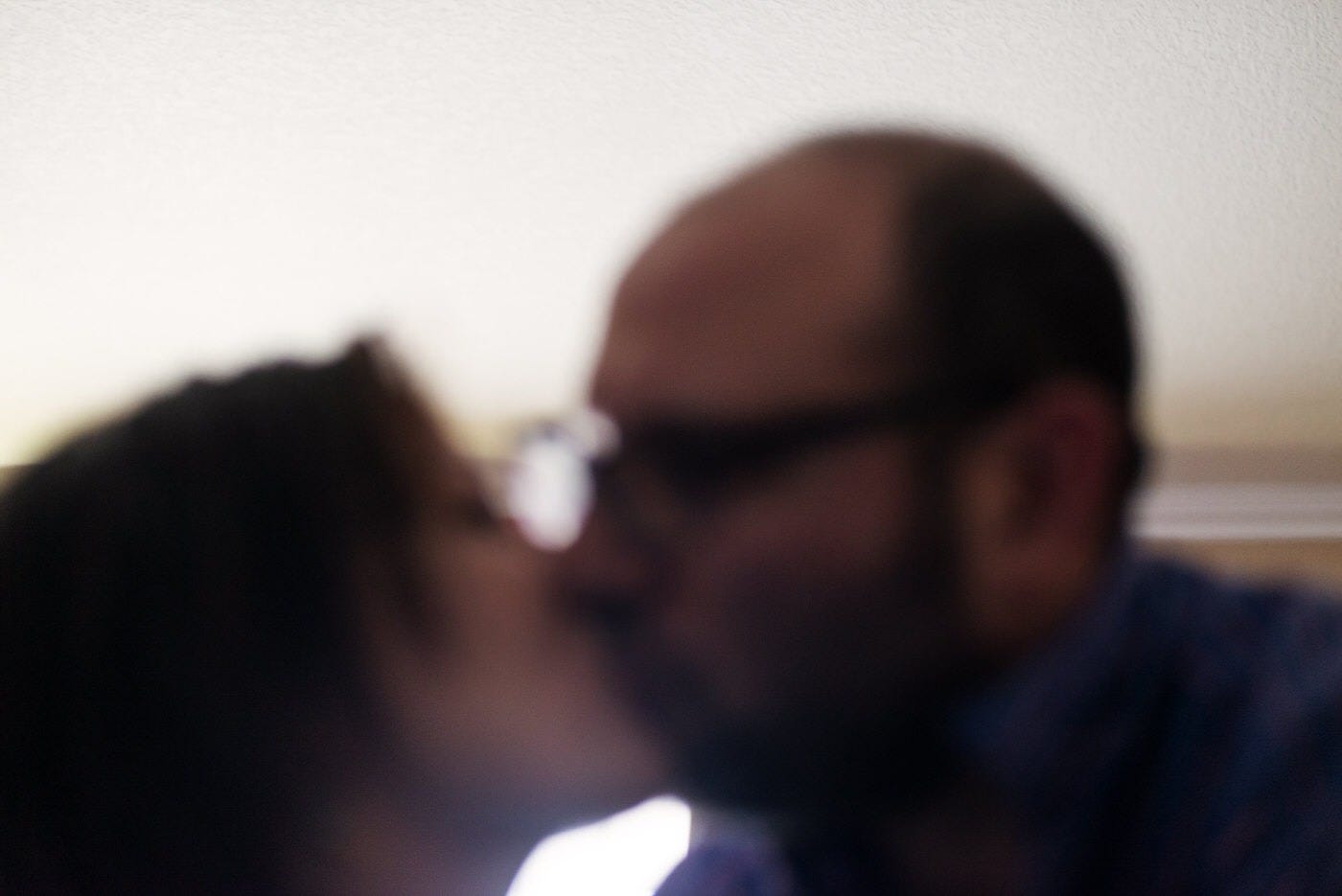
There’s a photo in the book that Jesse took. As he got older, and we moved into what her oncologist called “survivorship,” he noticed more. He saw we were always taking pictures and wanted in on it, so we handed him the camera and told him to shoot whatever he wanted. The camera was so big in his small hands I was worried he would drop it! He told us to kiss, because he wanted to see us kissing because “we loved each other.” Through everything Anna and I were working through, Jesse saw what he needed. Our love. The photo’s out of focus, we’re fuzzy, half-silhouetted and somehow it is one of the most perfect pictures in the book for me. In its imperfection it somehow feels perfect.
The Red Clay Family Portrait in Shadow
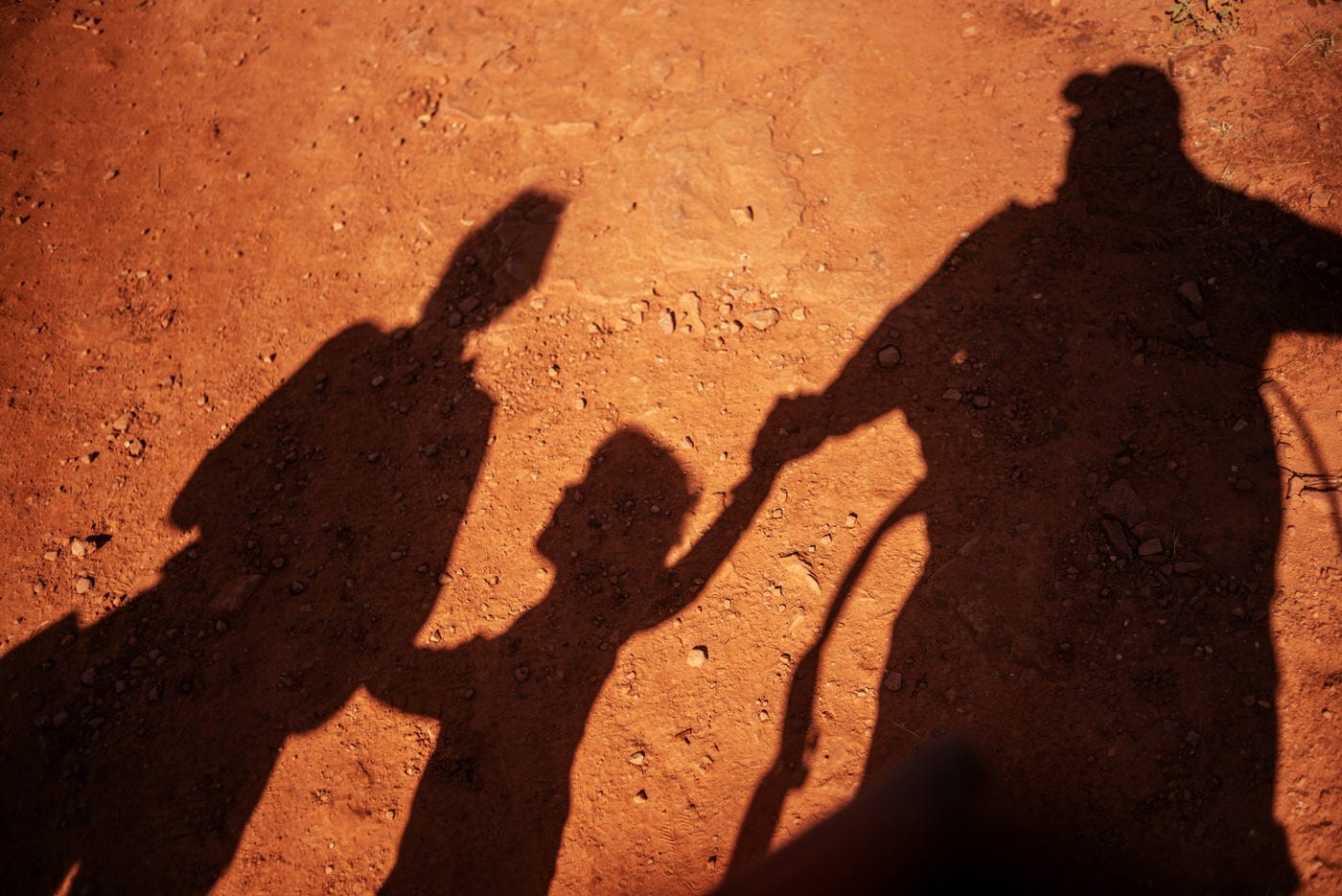
It is the only image in the book that all three of us are together. Our shadow is reflected on red clay in Arizona for a trip we took. It shows us a family unit, me and Anna together caring for Jesse, and the brightness in the photo feels full of hope.
Follow Jordan on Instagram and connect on LinkedIn.
YOU MIGHT ALSO LIKE:
Comments
Nothing yet. Say the first thing.
Sign in to join the conversation.