
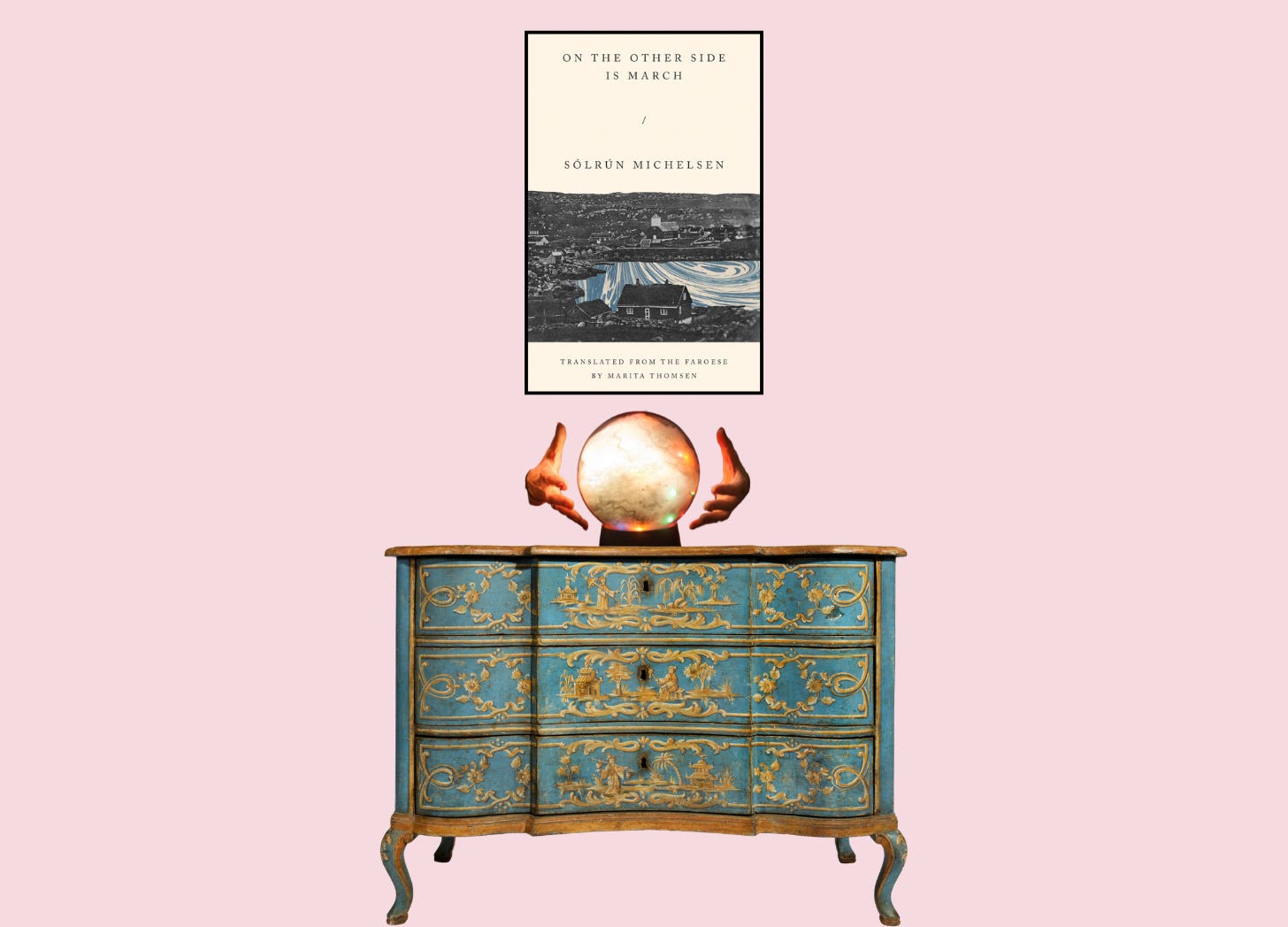
Earlier this year I received a review copy of “On the Other Side is March,” a newly translated Faroese novel by Sólrún Michelsen. I read it in one sitting and found it to be—and I know this is a lot, but it is also sincere!—possibly the most insightful novel on caregiving I have ever read.
I quickly pitched a review of it to a number of editors I work with who then kindly told me that the book sounded great, but it was too quiet to cut through the noise. Pass. One said they had run something else about care a few months ago and it felt too soon to run another essay…about one of the most fundamental building blocks of humanity, no less interesting or elemental than the economy which these publications run essays on all the time…but I digress.
Rejection is never fun, but in a way I am glad they all said no. To write about this book in a way that kept the focus on literary analysis but ignored matters of the heart, would have been doing both the book and my experience of the book a disservice. I love this book not just for its ideas and prose, but because it unearthed a deep, hot and salty, spring of inchoate feelings about parenting and caregiving. So this is that review. A bit feverish, a bit exposed, and a whole lot more honest.
***
Caregiving is the enemy of contemplation, or so we’ve often been told.
Discrete task followed by discrete task, the feeding, wiping, schlepping, all enough as it is but constantly threaded through with interruptions functioning like a real-life version of the regressive slides in a game of Chutes and Ladders. Who has the capacity for an inner life when one’s outer life proceeds in loose threads of time, emotion, and actions?
I am going to humbly suggest that this is the wrong way to look at it.
Our sense that caregiving is the enemy of contemplation is because we are so impoverished when it comes to mental maps of what caring for others really entails.
I loved “On the Other Side is March,” because it offers such a map, honing in on one of the most essential, and existentially trying and thrilling, aspects of caregiving: when we care for another we not only tend to their needs, but also become collaborators in the stories of their lives.
The book tells us the story of a woman in her early 60s, “somewhere between late and never,” a mother and a daughter, caring for her mother with dementia and her grandchildren. If you are a person who loves plot, this isn’t your book. If you are a person who opens a book in pursuit of a walled garden filled with a bright pageant of psychological insights and lyrical, mystifying prose, this is for you. She reflects on her life, her mother’s life, her children, her island, her language, and what it means to be responsible for holding, telling, and even creating, others’ stories.
There is a scene when she visits a fortune teller, an old lady, who is “telling her truths about herself.” At first our narrator resists, but then she realizes that in the face of the fortune-teller lived “the grandmothers in my life.”
“Before I knew it she had shoved a crystal into the palm of my hand, clasped my hand in both of hers, and was telling me truths about myself, which only I knew and brought tears to my eyes as she put them into words. In the end she told me to make three wishes.”
That’s it, I thought. Caregivers are fortune tellers. We do our best to divine what others think and desire, and then spin it into a story we can live in together. We do our best to make their wishes come true.
There is another scene when our narrator attempts to clean out her aging mother’s drawers, only to discover them bursting with memories of the life they shared together. A tin once used for collecting berries, “cards and letters from us children, after we moved away from home.”
“The drawers are full of her moments…much love from…I give the drawer a gentle push shut. I really should start the clear-out somewhere else entirely.”
Wait, that’s it, I thought. Caregivers are archivists. We take the flotsam of daily existence and decide what to keep and how to arrange these pieces to form a story we can live in together.
Fortune-tellers and archivists are both storytellers.
Parents and caregivers are fortune-tellers and archivists, engaged in the most challenging act of storytelling imaginable, responsible for divining and maintaining the stories of those who we care for, while keeping ourselves in the story as well. Even with all the help in the world—and we can all definitely use more help—this fundamental aspect of caregiving will never go away.
And, if we are doing it well, it will inevitably be difficult.
When we care, we are pushed to attempt to make sense of the person we care for, reckoning with all that is unknowable in them, while holding onto what we can. Touch, memory, presence, bodies in time and place, estrangement and familiarity all factor into the wayfinding. Nobody is fully up to the task, a source of humor and regret in the book as it is in life. But we try and we try, hashing out the meaning of our lives and the lives of our loved ones in the process.
I’m currently caring for two people, which is to say, two life stories, which are currently particularly challenging to collaborate on. Two people I love dearly. Two people with whom boundaries between self and other have always been porous. Two people who my reality depends on. Two people whose experience of reality is changing, which puts them in the liminal space between intimate and stranger.
The first of these people is my teenage son. The second is a parent with memory loss. It would be easy enough to stop trying to collaborate on their stories, to give them space and take more space and time for myself. It’s tempting. It is. But that would be a failure of care.
Because I want to keep caring for these people, even as they change.
Comments
Nothing yet. Say the first thing.
Sign in to join the conversation.