
It all started in February, when the film Hamnet was finally released in France and I went to watch it with a couple of friends. We were so enamoured by it that we decided to immediately start a bookclub so we could read and discuss the book Hamnet, while I also decided I needed to revisit the original story.
Me and the OG Hamlet go way back. I first read (and watched) Shakespeare’s play in my high school English classes, and immediately felt a kinship with the angsty protagonist. What depressed teenage literature nerd wouldn’t be touched by soliloquies with opening lines like “O that this too too solid flesh would melt, Thaw, and resolve itself into a dew!”? It’s also funny, and there are plenty of lines that just read as absurdist Tumblr humour. “Take you me for a sponge, my lord?”
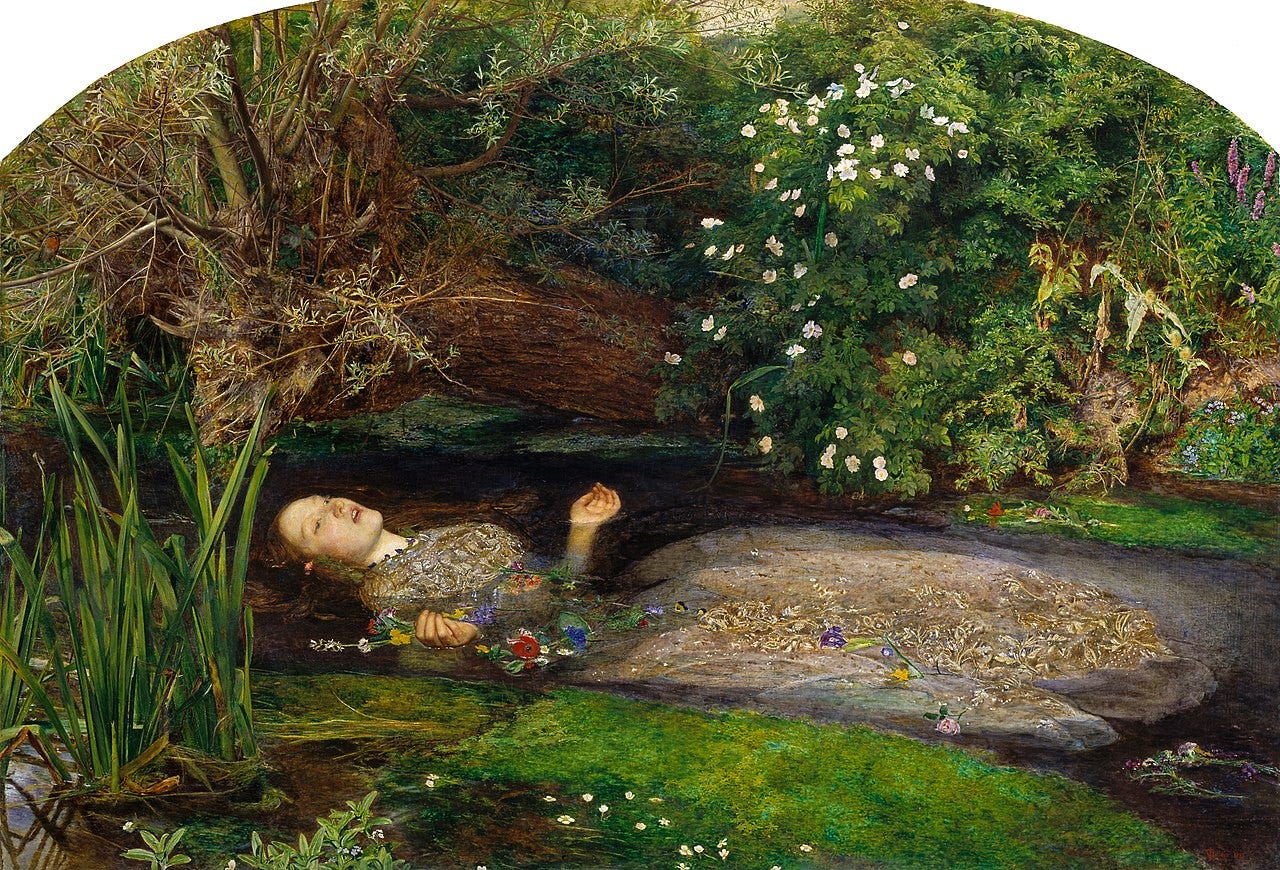
I then read it again for a British literature class in university, where I did a group project analysing the representation of women in Hamlet. As you can probably guess, it’s pretty lacking. Although Ophelia is arguably Shakespeare’s most iconic female character, her part in the play is small, as a mere supporting character to Hamlet’s internal drama and the drama in the court. Even her suicide is just a plot device triggering the final battle between her brother and Hamlet.
(*A term I made up to mean something like “study based on speculation”, as an homage to the greatest maker-upper of words in the English language)
Not only is Shakespeare and his oeuvre plagued by a patriarchal worldview, most of the scholarship around them is, too. We also just don’t have much information on his personal life, or on those around him. This is where the historical fiction of Maggie O’Farrell has come to help, with her story focusing on the women in Shakespeare’s life, as well as the traditionally feminine sphere of ~emotions~ as felt by and influencing the work of the man himself, something I fear has been missing from more formal scholarship on Hamlet.
Though the details of the world and the story she created are fictional, the bases for them are true:
The facts of his marriage and three children
The fact that his son, whose name could be spelled both ‘Hamlet’ and ‘Hamnet’, died in 1596 (cause unknown, although the Black Plague was going around at the time)
The fact that Shakespeare spent most of his time in London from 1592, became a successful playwrite, and that his play Hamlet was first performed in 1600 or 1601 (so he was likely writing it around the change of the century)
The fact that Hamlet, the play he wrote 3-4 years after his son Hamlet’s death, deals with issues such as death, grief and father-son relationships
With this in mind, I find it frankly absurd that Maggie O’Farrell’s Hamnet was the first time I had heard anyone talk about there being a potential significant connection between his son’s death and the play. Granted, I’m not a Shakespeare scholar, but I did study it, in academic settings, twice, and nothing I heard or read presented the recent death of his son Hamlet as an important event through which one might study the play. As far as I know, it wasn’t even mainstream knowledge until O’Farrell’s book came out and quickly became a bestseller.
After watching the film, reading the book and doing some preliminary research, I decided I needed to revisit the source material, through the lens provided by O’Farrell, and answer for myself the question: could Shakespeare’s play Hamlet have been inspired and impacted by the recent death of his son of the same name?
I went into my third read of Hamlet with a clear bias: I wanted to find evidence for Shakespeare’s own grief being reflected through the play. This was not hard to do.
The plot of Hamlet is loosely based on a Scandinavian legend in which the protagonist Amleth’s father, the ruler of Jutland, is killed by his brother for his title and his wife. In that story, Amleth is a young boy, scared of being his uncle’s next victim, and feigns madness to protect himself. Depending on the version you read, he ends up killing everyone, becoming the king, having either one or two wives, and finally being killed himself either for revenge or in a battle over land.
Shakespeare’s version keeps a lot of the main plot points (although instead of the marriage and the wives he kills off the protagonist’s only love interest and adds a whole raving speech against marriage… I wonder what that says about him), but he adds his famous air of tragedy and philosophical soliloqies in between the action scenes. He also adds in a Ghost — an element likely taken from what is now called the Ur-Hamlet, another stage adaptation of the story by an unknown author dated to 1587 that is thought to have also influenced Shakespeare’s own Hamlet.
It was impossible for me to read Hamlet’s interactions with the Ghost without thinking of the line in Hamnet in which Agnes realises that William has written the play to switch places with his son, and to die instead of him. In fact, Shakespeare is theorised to have played certain parts in his own plays, one of them being the Ghost in Hamlet — a book from 1709 states this role was “the Top of his Performance” as an actor, although as it is not a direct account, written almost a century after his death, its reliability is not 100% certain.
Either way, could this image of a ghostly father speaking to his loving, living son have been something that attracted him to the Ur-Hamlet, and inspire him to write his own version?
Ghosts don’t frequently appear in Shakespeare’s plays; when they do, they are usually there to haunt their murderers, and it’s never really certain if they’re real or a figment of the guilty character’s imagination. Hamlet’s Ghost in contrast is proven to be very real: he is seen by other characters in the play first, and Hamlet’s elaborate ploy (the “play within a play”) proves that the Ghost’s words are true. It also doesn’t haunt its murderer. In Hamlet, the barrier between the living and the dead is crossed in order for a father to speak to his son and make a final request to be avenged or, in his own words, to be remembered.
Hamlet goes through a host of emotions throughout his grieving process. We see him overwhelmed with despair and angry with his mother and uncle, then empowered by the relevations and mission given to him by the Ghost, followed by a period of hesitation and madness (whether real or feigned) and culminating in a flurry of emotionally driven and confused action. But he isn’t the only character in Hamlet to lose a father. After Polonius is killed, we see two distinct portrayals of grief in his children: Laertes’ immediate readiness for revenge (as opposed to Hamlet’s procrastinating), and Ophelia’s heartbroken madness culminating in suicide (something Hamlet dreams of doing, but is scared to, as he discusses in his “To be or not to be” soliloquy). Compared to the two siblings, Hamlet is so overwhelmed or just trapped in his own head that it paralyses him until the last scene, which ends with him both dead and a murderer at once.
In real life, the death of Shakespeare’s son was most likely due to natural causes. It’s not hard to imagine a grieving parent may have dreamed of having someone to blame for this death, something concrete to direct his anger at, a specific action to take — the catharsis of revenge, or of restoring a sense of justice. Hamlet is a play riddled with death, and none of them are natural. In the play, death is something inflicted upon people by other people, or, in the case of Ophelia, by themselves. The unpredictability and unfairness of nature is taken out of the equation, giving the characters a power that people in real life rarely have.
The main argument I’ve seen against the theory O’Farrell posits is that, since death was such a regular part of life in his era and almost every parent experienced the loss of a child, it’s unlikely that Shakespeare would have grieved his son’s death heavily enough to still be influenced by it four years later. To that I say, have you even read or seen Hamlet? The protagonist’s very first speeches ooze grief and pain:
[in response to his mother, the Queen, asking why he still seems so grief-stricken two months after his father’s death]
“Seems,” madam? Nay, it is; I know not “seems.”
‘Tis not alone my inky cloak, good mother,
Nor customary suits of solemn black,
Nor windy suspiration of forced breath,
No, nor the fruitful river in the eye,
Nor the dejected ‘havior of the visage,
Together with all forms, moods, shapes of grief,
That can denote me truly: these indeed seem,
For they are actions that a man might play:
But I have that within which passeth show;
These but the trappings and the suits of woe.
This is soon followed by his O, that this too too solid flesh would melt soliloquy, in which he literally talks about wanting to kill himself.
Do these sound like the words of a man who doesn’t know grief? “The fruitful river in my eye” is a personal favourite line. If you’re still not convinced of Shakespeare’s familiarity with grief, consider the speech given by Constance in another of Shakespeare’s plays written at around the same time, King John:
Grief fills the room up of my absent child,
Lies in his bed, walks up and down with me,
Puts on his pretty looks, repeats his words,
Remembers me of all his gracious parts,
Stuffs out his vacant garments with his form;
Then, have I reason to be fond of grief?
While I was sitting in that dark cinema hall watching Hamnet, something I thought about a lot was the fact that death, grief and trauma were so ubiquitous in society up until recent history. We have plenty of evidence in art that people did still experience grief and pain hundreds of years ago. In fact, “grief” was considered a legitimate cause of death — it was widely accepted that people could experience such acute emotional pain and suffering from grief that they could die from it. It’s likely that there were also those who hardened themselves against emotion, and that’s where we would probably find people capable of great cruelty, exemplified by the character of Shakespeare’s father in O’Farrell’s novel. But just like there are people who are more emotionally sensitive now, there would have been then, too. Artists typically belong to that latter group. If they didn’t, we wouldn’t have characters as introspective and anguished as Hamlet, with lines like “You cannot, sir, take from me anything that I will more willingly part withal; except my life, except my life, except my life”.
It’s true that people had to accept death as part of life in a much more visceral way than we do today, and find ways to carry on. Most couldn’t afford to take a break from life’s duties to grieve. But the emotions still existed, and they would have come out one way or another. I find it logical that artists like Shakespeare would have processed their feelings through their creative work, just as we do today.
Perhaps the ubiquity of grief and death was part of what made Hamlet so successful in the first place. People came for the court drama and stayed for that feeling we all know, when art reflects back to us our innermost pain and heartache and we realise we are not alone.
Hamlet is a play about revenge, madness, politics and theatre — but also about death, grief, fustration with life and the struggle to act in the face of overwhelming emotion. While I wouldn’t go so far as to say the character Hamlet was directly modelled after Shakespeare’s son Hamlet, it is, in my mind, highly likely that his recently dead son would figure in his imagination while he wrote a play where the main character shared his name. I also find it hard to believe that the many contemplations on death and representations of grief were not influenced by his own experiences with loss.
More than 400 years after his death, Shakespeare’s works continue to be read, studied, adapted and reworked. Hamlet is arguably his most influential play. What compels us to keep coming back to this story of murderous kings and mad, vengeful princes?
Though we are much more shielded from death now, especially in the West, than people were in the 14th-15th centuries, grief is still a universal experience we all have to face at some point in our lives. And it is still something that seems insurmountably difficult. I have no idea how I will survive my parents dying — and yet, the only way I can avoid it is by dying myself.
In between the medieval battles and politics, Hamlet manages to deal with this universal topic in a way that will always be relevant. The death of a loved one will always feel cruel and unjust, occasionally driving us to a near-madness and a contemplation of whether life is worth living at all.
Is there any better example of the universality of grief than a film produced in 2025 based on a book written in 2020 based on a play produced in 1600 based on another play produced in 1587 based on a legend written down in the 12th century based on a poem from the 10th century? We will always die, we will always suffer loss, and it will never be easy.
Resources
Besides Hamlet, the Hamnets and various Wikipedia pages, here are a few more resources that aided me in my deepdive:
How Accurate is Hamnet? by The Shakespearean Student (part 2 as well)
The Hamlet Podcast, which I am still working my way through
MOOC by HarvardX Shakespeare’s Hamlet: The Ghost
Comments
Nothing yet. Say the first thing.
Sign in to join the conversation.