
‘What is your favourite play by Shakespeare?’ a reader with a bright and bubbly smile asked me a few months back following a talk at a literary festival. And then she put out her hands and waved excitedly as she added:
‘Wait, wait! Don’t tell me, let me guess — Is it Hamlet? Macbeth? Is it A Midsummer Night’s dream?’
I was captivated and charmed by her genuine joy and enthusiasm. I have seen people talk like this when they are keen to discover someone’s astrology sign. ‘Wait, wait, don’t tell me — Is it Taurus? Is it Pisces? Capricorn?’
So I kept quiet and she kept going in this vein. ‘Is it King Lear? Macbeth? Othello? Oh, I know! Is it The Merchant of Venice?’
‘I am so sorry,’ I said. ‘You asked me such a difficult question, but if I have to choose just one play, if you are giving me no other option, I think it would always be Antony and Cleopatra.’
‘Oh!’ she said as her expression crumpled. ‘Really? I wasn’t expecting you to say that.’
I don’t know why she was so surprised. We smiled awkwardly at each other, and I couldn’t help feeling like I had somehow let her down.
I just love Antony and Cleopatra.
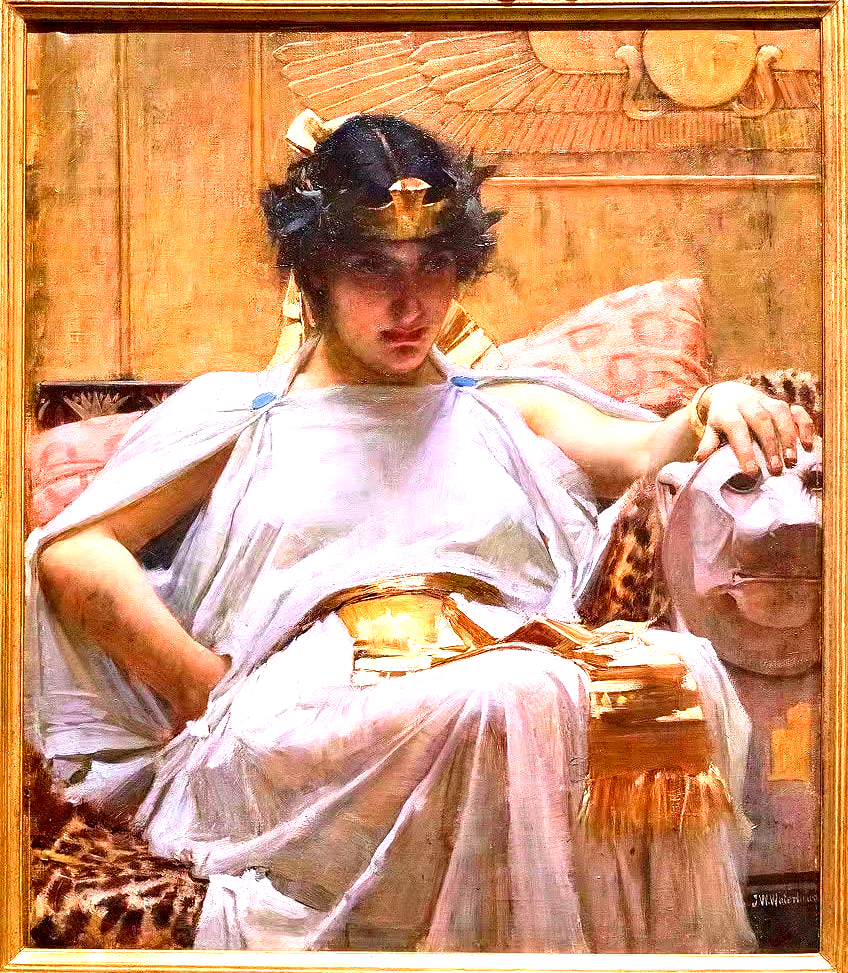
The late literary critic Harold Bloom had a very interesting approach to this particular play, which was first performed around 1607. Bloom invited his readers to slow down and ask themselves what exactly they saw when they looked at Cleopatra — whom, many have labelled as “the most seductive woman” in all of the bard’s oeuvre.
Let’s pursue this line of thought for a moment: Who is the Cleopatra we see in our mind’s eye? A cunning plotter? A selfish, indignant and greedy virago? The reincarnation of goddess Isis? Or perhaps, a widow/mother trying to survive in a ruthless world of power, patriarchy and hierarchy?
Maybe for some of us it is Elizabeth Taylor, actually. Harking back to an unforgettable scene in that iconic 1960s film, in which she makes her grand entrance after being smuggled into Rome inside a rug.
Equally, what do we envisage when we look at Antony?
A weak man or a pitiful leader who has sadly lost his mind, his heart, his status, all because of his love and lust for a foreigner?
Harold Bloom writes eloquently: “If you think Antony a ruffian in decline and Cleopatra an ageing whore, then you know better how you feel, but the greatness has evaded you.” Then he adds these lines, however:
“Should you find Antony, the Herculean hero still glorious as he wanes, and Cleopatra the sublime of erotic womanhood burning to a final kindling, you are far closer to joining in the sad yet wonderfully comic celebration.”
The paragraph concludes with an unexpected remark:
“In Antony and Cleopatra how you see is who you are.”
This sentence makes me pause. Makes me wonder. Isn’t it the same with all novels, all stories, all poems, in truth, all of literature?
Everything we read we do so through the prism of our own inner state. Our gaze, our past, our consciousness, our dreams, our expectations, our fears, our biases, our beliefs…. they all seep into our interpretation of a text. Of any text.
Maybe we can take the remark a step further and arrive at a mystical place, a spiritual land. After all, isn’t it the same perhaps with life? With the entire world around us?
Everyone we meet we tend to evaluate through the prism of our own inner state. Our gaze, our past, our consciousness, our dreams, our expectations, our fears, our biases, our beliefs…. they all seep into our judgment and understanding/misunderstanding of “the other.”
To go beyond those cognitive and cultural limits. To transcend the borders of the mind and of the self, and experience a gentle but profound shift in awareness, we need literature, we need art.
Reading fiction is how we leave the husk of the ego behind and learn to fly, at least for a few hours, a few days.
Reading is un-selfing.
“Imaginative literature is otherness and as such, it alleviates loneliness.”
If you agree with me, may I ask:
‘How would you have answered that question?
What is your favourite play by the bard?
Comments
Nothing yet. Say the first thing.
Sign in to join the conversation.