
I wanted to start by sharing some screencaps from a recent episode of Jeopardy (via my close audiovisual associate).
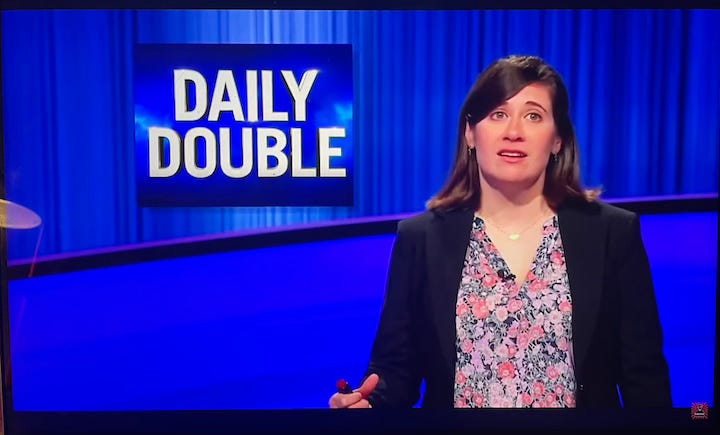
In the first picture, you can see contestant Shannon Crisenbery, from St. Clair MI, realizing that the clue she just chose was the Daily Double.
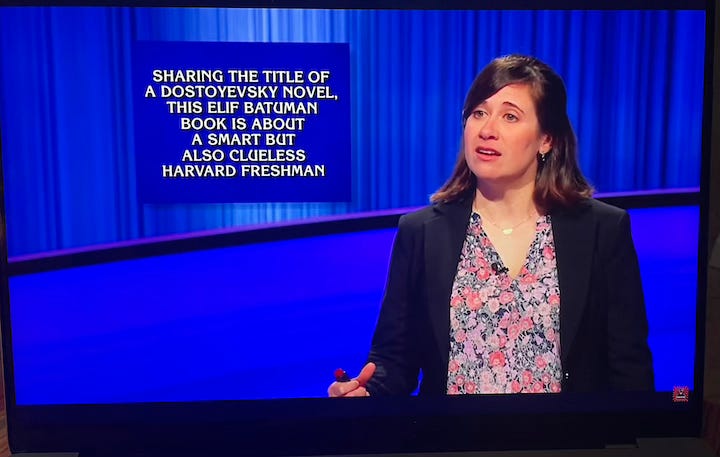
In the second image, she listens to the clue.
And then—she realizes that she knows the answer.
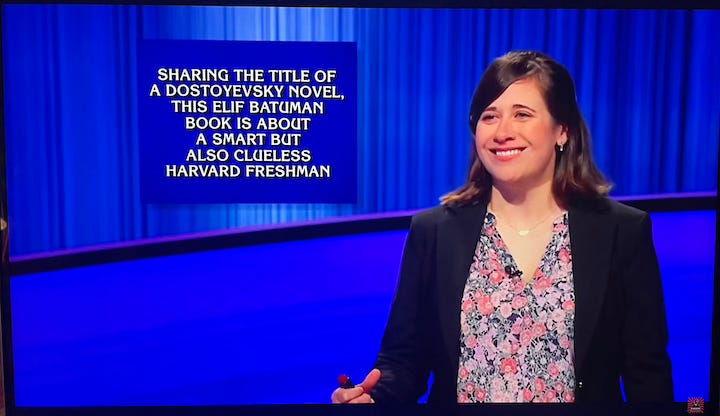
Her facial expression made me so happy! (She won the game.) Though this also made me realize how terrible it would feel to see someone lose money because they hadn’t heard of my book: a problem that had never occurred to me before, and I am relieved to have dodged for one more day.
(Also, if I branch out to merch I want to do royal blue T-shirts with “smart but also clueless” in the Jeopardy font.)
Moving on, I’m also really excited to share a link to a recent conversation I had with James Wood about The Death of Ivan Ilyich. This involved (for me) rereading The Death of Ivan Ilyich, which I somehow found more entertaining than I did on any of the previous occasions I had read it (most recently, three years ago, when I was hanging up curtains). Tolstoy is so savage! Check out these 2 sentences where he obliterates Ivan Ilyich’s father:
… an official who had made a career in Petersburg in various ministries and departments, of the sort that brings people to a position in which, though it becomes clear that they are unfit to perform any sort of substantial duties, still, because of their long past service and rank, they cannot be dismissed, and, therefore they receive invented, fictitious posts and non-fictitious thousands, from six to ten, on which they live to a ripe old age. Such was the privy councilor, the unnecessary member of various unnecessary institutions, Ilya Yefimovich Golovin.1
Haha there goes all of organizational culture.
Then you hear about Ivan Ilyich’s work life (as an examining magistrate/ high-court judge), which consists entirely of various displays of power—and that’s “justice”—and the reason he’s so obsessed with his job is because of this horrible experience he had in his 30s, when he was enjoying social pleasures, and married a girl from a good family, and everything seemed to be going fine—except then she got pregnant and her whole personality changed, and suddenly she wouldn’t let him go out and play cards or do anything fun—and when he tried to go out anyway, she would freak out—and at first he tried to ignore her…
But one time his wife began to abuse him so energetically in crude terms, and so stubbornly went on abusing him each time he did not fulfill her demands, obviously firmly resolved not to stop until he submitted, that is, sat at home and was just as bored as she was, that Ivan Ilyich became terrified.
He realizes that the only possible escape—the only place he can go, without her screaming at him—is work. So he spends all his time at the office, controlling people. Meanwhile more children are born, and get sick (“two of the children died, and therefore family life became still more unpleasant for Ivan Ilyich”), so he has to work harder and make more legal judgments—and at the bottom of it is this terror that his freedom could be curtailed, like his wife’s.
Who will be surprised to learn that this picture of marriage—similar to the one that appears a few years later in The Kreutzer Sonata—is based on Tolstoy’s own. The young Tolstoy, too, was incredulous that his wife’s constant pregnancies were supposed to be his problem; and Sofia Andreyevna was equally incredulous and had to resort to screaming and machinations to try to win back any rights at all. (I think I already mentioned this book, The Kreutzer Sonata Variations, which unites Tolstoy’s text with novellas by Sofia Andreyevna, plus relevant extracts from diaries and letters? It is riveting.)
At first, Tolstoy clearly just thought he was right and his wife was wrong, she should be joyfully embracing motherhood… but I think by “Ivan Ilyich” he has reached the terrible realization that women are also people, and the rest of the story is kind of a guilt fantasy where now Ivan Ilyich is the one who is housebound and suffering horribly, and his wife and his daughter go out shopping and can’t hide that they’re enjoying themselves.
One thing that struck me on this reading is that, in Ivan Ilyich, as in Kreutzer Sonata, Tolstoy makes many of the same observations about gender inequity that Shulamith Firestone puts forth in The Dialectic of Sex. (Firestone’s thesis is that Marx and Engels were almost right about everything, except that the first inequity wasn’t economic class, but the reproductive division of labor. In the childhood chapter, she gets into the terror little boys feel when they understand their mother’s unfreedom, and how they spend the rest of life pushing it away, with the result that the world becomes such as we know it.)
Comparing Tolstoy and Firestone, I find myself thinking, these are two writers I really admire, and they’re saying a lot of the same things, but they do it so differently, and have such different strengths. So there are a lot of choices in writing that they can help a person see more clearly.
E.g. Tolstoy’s greatest strength is describing the different sides of an impasse in a detailed way—literally nobody is better than him at this. That said, I think Tolstoy is less great at articulating problems (let alone solutions).
(I wrote about this in an earlier post, about War and Peace—the narrative shows again and again that the reason men go to war is to escape their mothers/ wives—but Tolstoy doesn’t seem to realize this himself, and never states it outright. And in the historical essays, when he does try to state why men go to war… well, he’s good at disproving other people’s theories, but his own theory rests on the illusory nature of free will, and let’s just say it is not very compelling.)
Shulamith Firestone is the opposite. All she cares about is articulating the problem. So for her, description is a distraction. This is an actual quote: “We don’t need to elaborate on the subtle psychological pressures of family life. Think of your own family.”
From a writing POV, I find it exciting to think about turning the dial between these two modes—between spelling things out, in order to trigger people’s imagination, versus just asking them to draw on their experience. It’s a spectrum, right?—we can tune it either way. Personally my default tuning is more towards the spelling-out, Tolstoy end… so I find it helpful to remember how vividly Firestone can evoke so much from so little, and how it proves her point about these structures being huge and relatively invariant over time and place.
The Tolstoy-Firestone comparison also made me think about a question I have been avoiding on panels for many years now, about novels versus essays. E.g. “You, Elif, started out publishing essays and not novels, then you switched to novels, but the novels aren’t that different from the essays, and the essays use ‘novelistic’ techniques (like dialogue, etc.); so why didn’t you just keep writing essays, and how do you think novels are different.”
I’m not sure what it is, but something about this formulation makes me feel exhausted to the depth of my very bones. My default response is to deflect—to question the meaningfulness of the boundary line between novels and essays (“these genres are more related to marketing than to writing”; “I’m interested in doing what I want to do [explain], I don’t care so much what it’s called,” etc.).
That said… as I work on my new book I realize I’m sometimes asking MYSELF, “wait, is this part like in an essay or like in a novel”—and in my head, it’s not a meaningless question and it’s not related to marketing, it has a process-based reality. And I think there is a glimmer of this in the juxtaposition of “Think of your own family” versus “Every unhappy family is unhappy after its own fashion.”
Coming up after the paywall: 1800 words about how I’ve been thinking about essay v. novel, with a specific example from my book in progress, plus the story of a rabbithole I went down, about how an abandoned proposal to rename St. Petersburg’s international airport after Dostoevsky.
Thank you for reading!
Comments
Nothing yet. Say the first thing.
Sign in to join the conversation.