
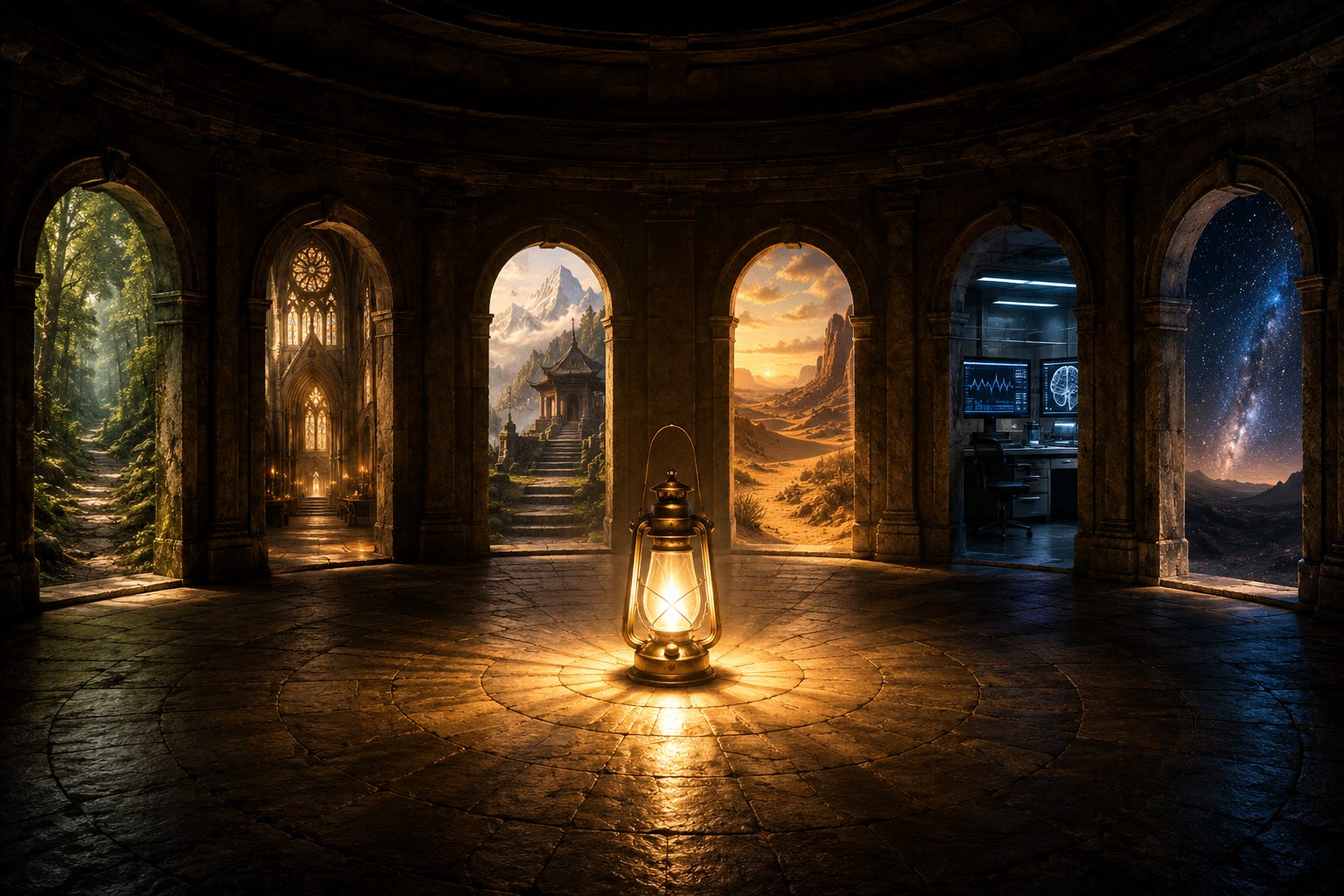
These essays began while writing The Open Door, but they are not excerpts from the book. The book tells a story. These essays investigate the questions that story raised. They are invitations to compare observations, explore ideas, and let curiosity lead a little farther than certainty.
If ten people describe the same mountain from ten different trails, we expect their stories to differ. The forests are different. The weather is different. The villages are different. Even the reasons for climbing may have nothing in common.
But if all ten reach the summit, something curious begins to happen.
Their descriptions of the view start to rhyme.
For centuries we’ve compared the world’s contemplative traditions by asking whether their beliefs agree. Unsurprisingly, they rarely do. They disagree about God and gods, souls and no-self, subtle energies, cosmology, morality, ritual, and even the purpose of practice itself.
What if we’ve been comparing the wrong thing?
What if, instead of comparing explanations, we compared experiences?
That simple shift has quietly changed the way I read almost everything.
Years before I ever recorded my own brain with an EEG, before words like cessation had any technical meaning to me, something strange had begun happening in my own experience. I found myself entering states of unusual stillness through prolonged arousal—not because I was following a spiritual practice, but because I had accidentally discovered a way of calming a nervous system that had spent decades living on high alert.
Like most people confronted with something they cannot explain, I went looking for someone who had already named it.
I expected to find the tradition that had the answer.
Instead, I found something much more interesting.
At first glance, the traditions seem almost impossible to reconcile.
Taoist internal alchemy speaks of refining jing into qi and shen.
Tantric traditions describe liberation through practices embedded within an entirely different philosophical framework.
Christian mystics speak of union with God.
Aleister Crowley writes about will, ritual, and sex magick with enough theatrical flair to make it difficult to separate insight from performance.
On the surface, these worlds appear incompatible.
If our goal is to determine which explanation is correct, we quickly find ourselves arguing about metaphysics.
But I gradually realized that wasn’t the question I cared about.
I wasn’t trying to decide whose cosmology was true.
I was trying to understand what human beings actually reported experiencing.
That turns out to be a very different investigation.
When I stopped comparing beliefs and started comparing descriptions, an unexpected pattern emerged.
The methods were wildly different.
The languages were wildly different.
The goals were wildly different.
Yet the experiences themselves often shared recognizable features.
A temporary loosening of the ordinary sense of self.
An overwhelming feeling of peace or bliss.
A collapse of ordinary time.
A profound difficulty describing what had happened afterward.
Lasting psychological reorganization.
None of this proves that every tradition is describing the same underlying reality.
But it does suggest something worthy of careful attention.
Independent observers, separated by centuries, cultures, and entirely different worldviews, repeatedly describe experiences that share a striking family resemblance.
That convergence is interesting even if we never settle the metaphysical questions.
I have increasingly come to think that conversations about consciousness become confused because we accidentally mix together three very different questions.
First: What did the person actually experience?
Second: How did they interpret that experience?
Third: What, if anything, was objectively happening?
Those are not the same question.
A sixteenth-century Carmelite nun had one vocabulary.
A Taoist adept had another.
A modern neuroscientist has yet another.
Each interprets experience through the language available to them.
But interpretation is not identical to experience.
The reports themselves deserve to be examined before we decide what they mean.
That, to me, is where the real investigation begins.
I’ve started using the phrase convergent phenomenology to describe this approach.
By that I mean the careful comparison of first-person experiences that arise independently across different cultures, traditions, and practices, looking for recurring structures before arguing about their explanations.
This isn’t an attempt to erase meaningful differences between traditions.
Those differences matter.
Nor is it an attempt to flatten every mystical report into one universal theory.
It is something much simpler.
If independent observers repeatedly describe similar experiences despite profound differences in belief, method, and expectation, then the convergence itself becomes worthy of investigation.
Science often pays attention when independent observations begin pointing in the same direction.
Perhaps consciousness deserves the same curiosity.
One of the things that surprised me most was discovering that the same structural descriptions appear to emerge through many different doors.
Meditation.
Prayer.
Trauma.
Near-death experiences.
Psychedelics.
Sexual practices.
Spontaneous moments that seem to arrive without invitation.
That doesn’t necessarily mean these experiences are identical.
It doesn’t even mean they share the same mechanism.
But perhaps they sometimes reveal neighboring territory.
If that’s true, then traditions may have spent centuries arguing over their doors while quietly describing remarkably similar rooms.
I don’t know whether Taoist alchemy, Christian contemplation, Tantra, and modern neuroscience ultimately point toward the same reality.
I’m not ready to make that claim.
But I do think we’ve spent an enormous amount of time comparing explanations while giving far less attention to the experiences themselves.
Perhaps that order should be reversed.
Perhaps the reports deserve to meet one another before the philosophies do.
If nothing else, it seems like a better place to begin.
I don’t know whether these traditions ultimately describe the same metaphysical reality.
I do know that they repeatedly describe experiences that rhyme despite radically different beliefs.
If you’ve encountered an experience that didn’t fit comfortably into the vocabulary you inherited—through meditation, prayer, psychedelics, trauma, spontaneous insight, or simply ordinary life—I would genuinely like to hear how you described it before you knew what to call it.
Sometimes the most interesting discoveries begin when we compare observations rather than conclusions.
—Elias
Comments
Nothing yet. Say the first thing.
Sign in to join the conversation.