
Welcome, subscribers!
This week, we reviewed a diverse group of investor letters and pulled together seven compelling ideas spanning AI infrastructure, payments, semiconductors, industrials, transportation, IT distribution, and healthcare. While the businesses differ, they share a common setup: strong competitive positions and underappreciated earnings potential obscured by customer concentration, regulatory uncertainty, cyclical concerns, litigation, or fears of technological disruption.
If you know someone who enjoys investor letters and discovering new ideas, feel free to forward. 📬
This week, we’re sharing 7 new ideas, including:
A former contract manufacturer reinvented as a critical AI infrastructure partner, with next-generation networking and rack-scale systems driving rapid growth and margin expansion.
A high-quality analog semiconductor franchise positioned to benefit from the shift to 800-volt data-center power, faster optical connectivity, and rising semiconductor test intensity.
An industrial flow-control leader where the market may be overlooking a potentially significant nuclear power opportunity and a growing base of high-margin aftermarket revenue.
North America’s largest full-truckload carrier, positioned for an earnings recovery as regulation removes capacity, freight rates rise, and demand begins to improve.
A traditional IT distributor concealing a rapidly growing AI infrastructure business serving the world’s largest hyperscalers.
A mission-critical medical sterilization business purchased after a forced seller finally exited, with upside tied to litigation resolution, debt reduction, stronger cash conversion, and a durable regulatory moat.
Disclaimer: Nothing here constitutes professional and/or financial advice. You alone assume any risk with the use of any information contained herein. We may own positions in the securities listed. Please do your own due diligence.
To the investment managers who read this, you can send us your letters at elevatorpitches@substack.com or on Twitter (and Threads!) if you’d like to be included in a future issue.
Let’s get to it.
Celestica has transitioned from its legacy roots as an IBM captive manufacturer to become a design and technology integration leader within the AI and cloud infrastructure space. Celestica was founded in 1994 as a subsidiary of IBM Canada. It was subsequently acquired by PE, and then IPOed in the late 1990s. The company’s strategy from there was an acquisition model for the next two decades, acquiring various electronics and computer peripherals manufacturing and supply companies, highly tied to major OEMs like IBM, Avaya, and Lucent. At the beginning of the AI boom, the company found itself incredibly well positioned to provide specialized design, operational, and engineering services to large technology companies looking to build data centers or associated integrated rack systems.
The business segments of Celestica are split into two highly specialized operational segments: Advanced Technology Solutions (ATS) and Connectivity & Cloud Solutions (CCS). Within the CCS segment, the company serves enterprise AI companies and the hyperscalers, including Google, Meta, Dell, HPE, IBM, Juniper Networks, and Oracle Corporation, among others. Within the ATS segment, Celestica supports highly complex capital equipment, aerospace, and defense programs for Tier-1 customers such as Applied Materials, Honeywell, Lam Research, and Raytheon.
Its customer base has significant near-term customer concentration among hyperscalers. This is one of the main knocks on the company. In the first quarter of 2026, Celestica’s top three customers individually accounted for 35%, 15%, and 15% of total revenue, representing a collective 65% concentration. In early 2026, reports that Google intended to diversify its L10-L11 TPU server assembly orders to Taiwanese manufacturers like Inventec caused an immediate 8% decline in Celestica's share price. To mitigate this risk and further entrench the company into hyperscalers, Celestica has integrated its operations into its customers' long-term capacity roadmaps. The company expanded its domestic manufacturing capacity in the United States, scheduled for completion in 2027, to support Google’s U.S. production of complex TPU systems and secure multi-year program visibility. To be clear, Celestica is extremely tied to Google’s TPU architecture success; any investor in Celestica should be bullish on Google’s TPU systems.
High quality business model
Celestica’s business model combines global manufacturing capabilities, specialized engineering services, supply chain orchestration, and aftermarket lifecycle support, giving the company exposure to both data center design and construction as well as ongoing service and support.
The Connectivity & Cloud Solutions (CCS) segment represents the primary volume engine of the company, generating 80% of total revenues in the first quarter of 2026. Within CCS, the Communications vertical accounts for 60% of total revenue, driven by 800G networking switch ramps and hyperscaler networking demands, while the Enterprise vertical contributes 20%, supported by next-generation AI/ML compute program ramps and storage platform growth. The core differentiator within the CCS segment is the Hardware Platform Solutions (HPS) portfolio (previously called Joint Design and Manufacturing (JDM)). HPS builds custom system-level rack integrations, which command higher margins than its traditional design process.
The Advanced Technology Solutions (ATS) segment comprises highly regulated, capitalintensive businesses across Aerospace & Defense, Capital Equipment, HealthTech, and Industrial/Smart Energy. This segment provides a strategic counterweight to the rapid technology cycles of the cloud market. ATS programs are characterized by long product lifecycles, strict regulatory barriers, and high switching costs.
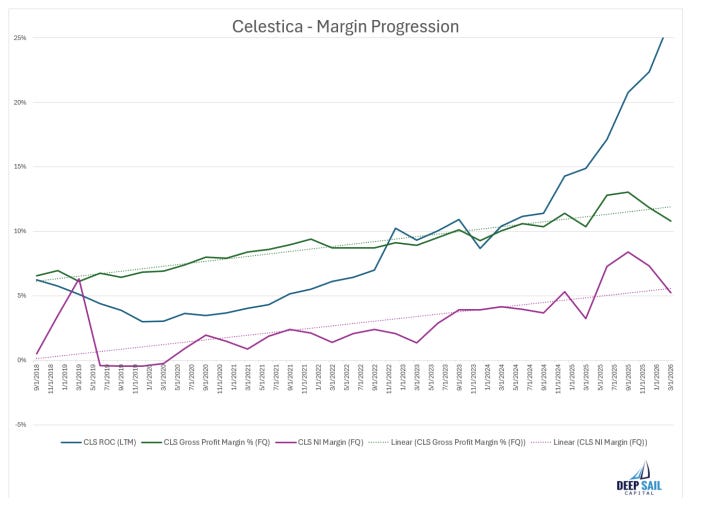
Celestica is undergoing a structural margin expansion driven by its shift away from standard, low-margin contract manufacturing toward proprietary JDM services-led monetization. By codeveloping proprietary, highly complex hardware with customers, the company compresses product launch cycles by approximately 30% per IR materials while capturing premium engineering margins. This HPS strategy allows Celestica to capture higher ASPs and secure customer stickiness through co-designed intellectual property. The financial success of this strategy is evident in the company's profitability progression with non-GAAP adjusted operating margins expanding from historical ranges of 4.0% to 5.0% to a record 8.0% in the first quarter of 2026, supporting further margin expansion.
Outstanding management
Overall, the management team is a group of long-tenured Celestica executives who have been with the company throughout its transition into this new AI landscape. Robert Mionis has served as President and Chief Executive Officer since August 2015 and assumed the role of Chair of the Board in 2026. Mionis brings a deep operational background, having served as President and CEO of StandardAero. He also held senior leadership positions at Honeywell, Honeywell Aerospace, and GE. Over his ten-year tenure at Celestica, Mionis has realigned the company's physical footprint with customer demand, reducing the company’s manufacturing footprint by consolidating underutilized sites. He also holds over 1M shares in Celestica, almost 1% of the company.
Chief Financial Officer Mandeep Chawla leads the company’s capital allocation and financial risk management and has been with the company since 2010. Overall, the financial management of the company is conservative with a debt-to-EBITDA ratio of 0.6x. The company repaid over $530M of debt in the last year, which was a near term major use of excess cash. The company also has periodically executed share buybacks with excess cash over the last 5 years, reducing shares outstanding by 8% since 2020.
Substantial Long-Term Growth
Prospects Celestica is well-positioned for multi-year revenue and profitability growth, driven by secular tailwinds in AI data center expansion specifically leveraged to 1.6T networking and Copackaged Optics (CPO), both of which are burgeoning trends in data center architecture.
The primary driver of Celestica's long-term growth is the rapid expansion of AI applications and the associated data center infrastructure required. As hyperscalers scale their cloud networks to support complex large language models, demand for integrated AI/ML compute, high-density storage platforms, and complex rack systems are growing. The global data center networking market is projected to expand at a compound annual growth rate (CAGR) of 17.2% from 2025 to 2033. Celestica is a key hardware partner in this ecosystem, providing custom rack integrations, AI servers, and high-speed switches directly to hyperscaler clouds. The company's visibility is supported by non-cancelable, non-returnable long-term agreements, which provide superior revenue and capacity planning compared to previous technology cycles.
The transition within data communication networks from 400G to 800G and next-generation 1.6T networking platforms represents a significant near-term catalyst for the company. Within its HPS portfolio, Celestica is ramping up production of its DS5000 800GbE switches, capturing higher average selling prices and superior margin profiles compared to legacy systems. Looking further ahead, the company has secured three separate 1.6 Terabit switching platform program awards with major hyperscaler customers, with initial production volumes scheduled to begin ramping in 2027.
Additionally, Celestica has secured a strategic CPO Ethernet switch design win with a leading hyperscaler (likely Meta).
Reasonable valuation
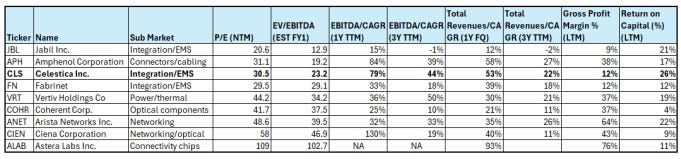
At a current share price of approximately $340, Celestica trades at a forward EV/EBITDA multiple of 20.8x. Relative to other AI-datacenter-leveraged GARP companies (VRT, ANET, APH, FN, ALAB), this multiple is very cheap, especially when you consider the company is forecasted to grow 53% in 2026 and 40% in 2027. My assumption is that the margin improvements will continue into 2027 as CPO and 1.6T program ramps occur.
This valuation gap suggests the market may still view Celestica as a traditional contract manufacturer rather than a custom hardware and systems integration partner. Analyst sentiment remains strongly positive, with all but one analyst rating the company a Strong Buy or Buy.
Catalysts and Conclusion
• Hyperscaler AI design wins and CPO announcements: Investors are looking for confirmation that Celestica is expanding beyond rack integration into higher-value networking platforms, including co-packaged optics (CPO), 1.6T Ethernet switches, and next-generation AI infrastructure. It’s assumed Meta is already a CPO partner, but any other hyperscaler announcements would be bullish for long-term revenue forecasts.
• Execution of the $1 billion capex program: Celestica's 2026 expansion plan is fully funded through operating cash flow. Progress on new U.S. manufacturing facilities (widely believed to support next-generation Google TPU systems and other hyperscale AI programs, including AMD Helios) would reinforce the company's long-term AI growth outlook while helping alleviate concerns around customer concentration.
• Ramp of next-generation AI infrastructure platforms (1.6T Ethernet & rack-scale systems): The transition to 1.6T networking, liquid-cooled rack integration, and custom AI platforms (including its AMD Helios collaboration) should increase the dollar content per AI deployment. Successful production ramps would support higher revenue growth and margin expansion over the next several years.
Overall, I still believe the AI data center ramp has at least three years left in it, with very significant architecture changes driving huge demand across all hyperscalers in 2027 and 2028. These are the years that architecture in data centers begin to push the envelope of technology and physics, which requires specialty design, engineering, and manufacturing that Celestica specializes in. Celestica is the cheapest way to invest in growth in these AI trends; believe me I have looked at the entire space.
Paid subscribers can keep reading for six additional ideas, including a durable payments network confronting disruption fears, an analog semiconductor beneficiary of AI infrastructure, an industrial positioned for a nuclear-driven growth inflection, a trucking leader entering a tighter rate environment, an IT distributor with a hidden hyperscaler business, and a medical sterilization compounder emerging from litigation and forced-selling pressure.
If you find value in seeing how professional investors frame new ideas, upgrade to keep reading and get the full archive.
Need a nudge? Many subscribers work in asset management, research, or corporate finance and expense it as a research tool. Here’s a quick script you can use.
Hi [Manager’s Name],
I’d like to expense a subscription to Elevator Pitches, a newsletter that curates stock ideas from professional investor letters, often highlighting overlooked opportunities and special situations.
With a paid subscription, I’d receive full access to every stock write-up they publish each week, which would support my ongoing market research and idea generation.
The cost is $90 for the full year. Given the depth and frequency of the analysis, I think it’s a cost-effective addition to my research toolkit.
Please let me know if this works.
Best,
[Your Name]
Comments
Nothing yet. Say the first thing.
Sign in to join the conversation.