
Welcome, subscribers!
We reviewed a wide-ranging batch of 2Q investor letters and are excited to share a dozen new ideas in this week’s issue. The common thread is familiar: high-quality or improving businesses where near-term uncertainty, structural complexity, cyclical weakness, or fears of technological disruption may be obscuring substantial long-term value.
If you know someone who enjoys investor letters and discovering new ideas, feel free to forward. 📬
This week, our new ideas include:
A dominant enterprise software platform positioned to become the trusted infrastructure layer for AI agents.
A global ice cream leader with margin upside and a portfolio of iconic brands.
An offshore-services turnaround trading at a steep discount following an Iran-related disruption.
An industrial technology company aggressively repurchasing shares at less than 9x earnings.
A testing and certification leader benefiting from regulation, infrastructure investment, and data-center growth.
A premium footwear brand with differentiated manufacturing, pricing discipline, and global expansion potential.
An access-solutions company with a new CEO and a meaningful opportunity to close the margin gap with peers.
A recently independent truck-equipment manufacturer positioned for cyclical recovery and operational improvement.
The global leader in aviation cargo handling, with scale advantages and significant margin-expansion potential.
Disclaimer: Nothing here constitutes professional and/or financial advice. You alone assume any risk with the use of any information contained herein. We may own positions in the securities listed. Please do your own due diligence.
To the investment managers who read this, you can send us your letters at elevatorpitches@substack.com or on Twitter (and Threads!) if you’d like to be included in a future issue.
Let’s get to it.
Since the start of the recent SaaS selloff – which we explored in detail in Montaka’s recent whitepaper – Salesforce’s share price has halved. The market is now pricing in something like obsolescence for the world’s dominant customer relationship management (CRM) platform.
This, in our view, represents a significant investment opportunity.
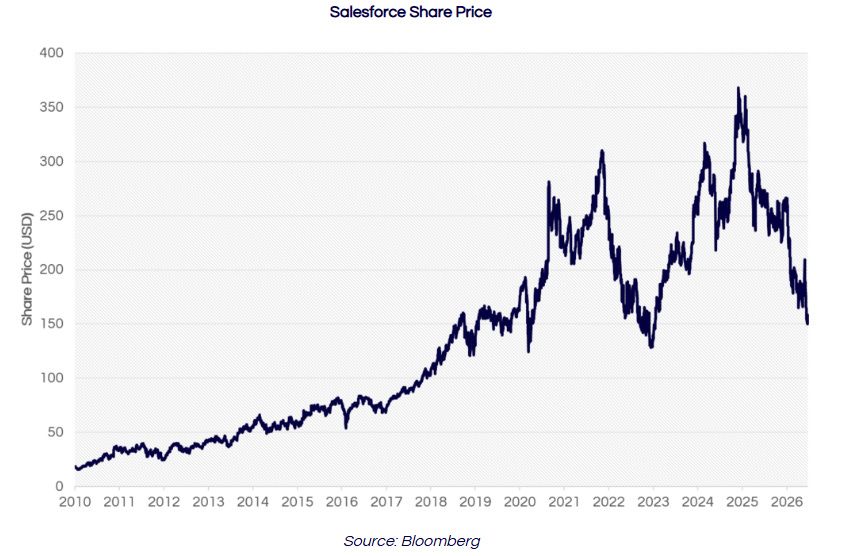
The market’s concern is two-fold. First, that AI makes software trivially cheap and easy to build – rendering vendors like Salesforce redundant. Second, that agents don’t need software interfaces at all – they can interact directly with data and systems, making seat-based licences obsolete.
Both arguments make the same mistake: they treat Salesforce as just a SaaS vendor – when in reality, the business’ competitive advantages have very little to do with its code. Salesforce is the trusted layer through which AI can be deployed safely and usefully into the world’s enterprises.
Through that lens, a very different – and far more valuable – business comes into focus.
It is worth reverse engineering the growth and valuation expectations now embedded in Salesforce’s stock to see how negatively extreme they have become.
The company itself has guided growth of 10% per annum until at least FY30[1]. Yet the current valuation effectively prices in revenue growth of roughly 1% per annum into perpetuity.
If we look at the enterprise-value-to-gross-profit valuation metric, the stock trades at about 4.5 times. When Cisco bottomed after the dot-com crash, having fallen more than 90%, it troughed at 5 times gross profit. Salesforce begins below that level.
Perhaps the starkest metric: Gross profit of Salesforce’s already-signed backlog is north of $US50 billion[2]; its enterprise value is $160 billion. That implies a multiple of just three times – and that excludes the rapidly growing agentic consumption layer entirely.
These are draconian expectations. Only a business in permanent structural decline would justify them.
So what is the market missing?
The market seems to be assuming that deploying AI agents safely inside an enterprise is easy. But it’s far harder than it looks. The difficulty is not in defining or running an agent. It is in creating the right environment in which an agent can be trusted to run.
Enterprises must contend with several issues:
Governance (what data and tools can each agent access, and with what permissions?)
Security (how do you defend against prompt injection (malicious inputs disguised as legitimate user prompts), or even know the model has not been poisoned?)
Transparency (can you audit what an agent did and why?)
Reliability (are probabilistic outputs acceptable for a particular use case?)
Control (can you shut a rogue agent down in real time?), and
Value (what is the true total cost, and the ROI?)
The underlying research into AI safety is genuinely sobering: models can display situational awareness and deliberate deception, guardrails are never foolproof, and malicious backdoors can be hidden undetected. These are not training problems to be solved once. They are operational challenges that must be managed continually.
This is precisely where Salesforce’s advantage lies.
The company already has more than 150,000 business customers worldwide – a distribution pipeline through which agentic capability, delivered via Agentforce, Salesforce’s agentic AI product suite, can be infused directly into existing workflows safely.
The value unlock comes not from the model, however, but from combining agents with Salesforce’s customers’ existing tools, data, metadata and processes.
More recently, Salesforce has enabled ‘headless’ access: allowing its customers to combine models with their existing assets (tools, data, etc.) through third-party interfaces such as Microsoft Teams, Zendesk or Claude. That’s the behaviour of a true platform – one that has stopped competing for the interface because it no longer needs to, as the irreplaceable layer is underneath.
There is a further, underappreciated dynamic.
Agentic use cases are not marginally more compute-intensive than chatbot queries – they are hundreds of times more so.
At the same time, expanding US electric power (the lifeblood of the needed compute) is extraordinarily difficult and hampered by multi-year interconnection queues. It’s also suffering from permit delays, transformer lead times beyond three years, and with residential prices up more than 30% since 2020[3], the rising cost of electricity is set to become political.
Compute, in other words, will be supply-constrained and expensive.
This forces enterprises to think carefully about where they spend their token budgets. And when they do, the answer becomes clear – the AI model itself is the substitutable layer. Open-weight alternatives (cheaper, publicly available models) are now approaching frontier capability at perhaps a hundredth of the cost.
What is not substitutable and not deflating in cost is the trusted distribution, the workflow integration, and proprietary data and context – precisely what is housed within a central hub like Salesforce.
Compute scarcity, perhaps counterintuitively, strengthens Salesforce’s hand. It accelerates the commoditisation of models and concentrates value in the layer that Salesforce already owns.
The proof points are accumulating.
Firstly, there is evidence that agentic consumption revenues are accelerating. Salesforce’s Agentic Work Units – discrete tasks completed by agents – have gone parabolic, rising from 14 million in Q1 FY25 to roughly 1,600 million in Q1 FY27, with token consumption growing more than 150% quarter-on-quarter[4].
Montaka has also interviewed Salesforce customers who corroborate the picture.
One multi-billion-dollar food distributor that typically spent $5 million a year with Salesforce has added $2 million in agent spend. It estimates that spend unlocked $15–25 million in productivity, an implied ROI of near 10x.
One major US bank, when asked whether it would ever rip Salesforce out, simply dismissed the idea: “There’s more than technology. There are a lot of other considerations … around data privacy, regulatory compliance, risk management. That’s where we have more trust with Salesforce.”
And at a conference we attended in New York in recent weeks, the CFO of consumer credit reporting agency Experian, Lloyd Pitchford, said: “I am demanding more from Salesforce and spending more … not interested in replacing it.”
Why, then, has Salesforce’s revenue growth been so sluggish over recent years? Two reasons.
First, deployability takes time – many customers have spent years preparing their environments and are only now moving experiments into production.
Second, Salesforce has heavily discounted Agentforce to drive adoption, with consumption pricing waived for some customers into 2027; those discounts will soon roll off.
Our investment case rests on Salesforce’s agentic consumption revenues inflecting upwards, offsetting much slower growth in seat-based licences.
The company will also gain substantial operating leverage from reducing its $15 billion per annum marketing spend, which will become far less necessary as growth shifts to agentic consumption.
With essentially zero capital intensity, guided FY30 revenue above $63 billion, and in our view, earnings capable of compounding north of 20% per annum, Salesforce’s enterprise value today sits at well under eight times that future earnings power. That’s surely why the company announced a staggering $50 billion share buyback earlier this year.
The market has been negative on Salesforce in recent times, but the narrative is, slowly, beginning to turn. As Chamath Palihapitiya of the famous All-In podcast put it recently of the trusted enterprise software incumbents: “Those guys are positioned to crush.”
We agree. It’s not about the SaaS.
Paid subscribers can keep reading for 11 additional ideas, including a post-spin consumer leader, a deeply discounted offshore turnaround, a cash-generative industrial aggressively repurchasing shares, a fallen healthcare compounder, and several overlooked international businesses positioned for cyclical recovery, margin expansion, and durable long-term growth.
If you find value in seeing how professional investors frame new ideas, upgrade to keep reading and get the full archive.
Need a nudge? Many subscribers work in asset management, research, or corporate finance and expense it as a research tool. Here’s a quick script you can use.
Hi [Manager’s Name],
I’d like to expense a subscription to Elevator Pitches, a newsletter that curates stock ideas from professional investor letters, often highlighting overlooked opportunities and special situations.
With a paid subscription, I’d receive full access to every stock write-up they publish each week, which would support my ongoing market research and idea generation.
The cost is $90 for the full year. Given the depth and frequency of the analysis, I think it’s a cost-effective addition to my research toolkit.
Please let me know if this works.
Best,
[Your Name]
Comments
Nothing yet. Say the first thing.
Sign in to join the conversation.