
If you want to get into a top college today, you need to know this concept.
It’s one we coined here at ElevatEd, which we call the ‘Double Pyramid Game.’
The first pyramid is quite simple:
You compete in established games, contests and competitions
These tests are famously zero-sum: if you win, someone else loses (sad, but true)
A concrete example: You enter something like Science Fair/ISEF, work your way up to regionals, nationals + recycle your research… and send it to other top competitions!
Or: if you’re a humanities kid, you compete in Model UN and Debate, working your way up to the national/international level.
Same idea for written competitions like Scholastic, National History Day, etc. etc.
In short, climb the same ladders everyone else is climbing, and try to get higher than they do.
Look – I’ll be the first to admit this strategy works.
College admission officers want to see you can perform well in established contests.
They’re hard to win for a reason! They (AOs) know just how prestigious it is to qualify for AIME, or become a USABO semifinalist, or have published research in a reputable university cardiovascular journal.
But here’s the problem: you cannot get into an Ivy League school with this pyramid/game alone.
This is why so many high-achieving students fail.
They completely ignore the second game, which we here at ElevatEd call the Inverted Pyramid.
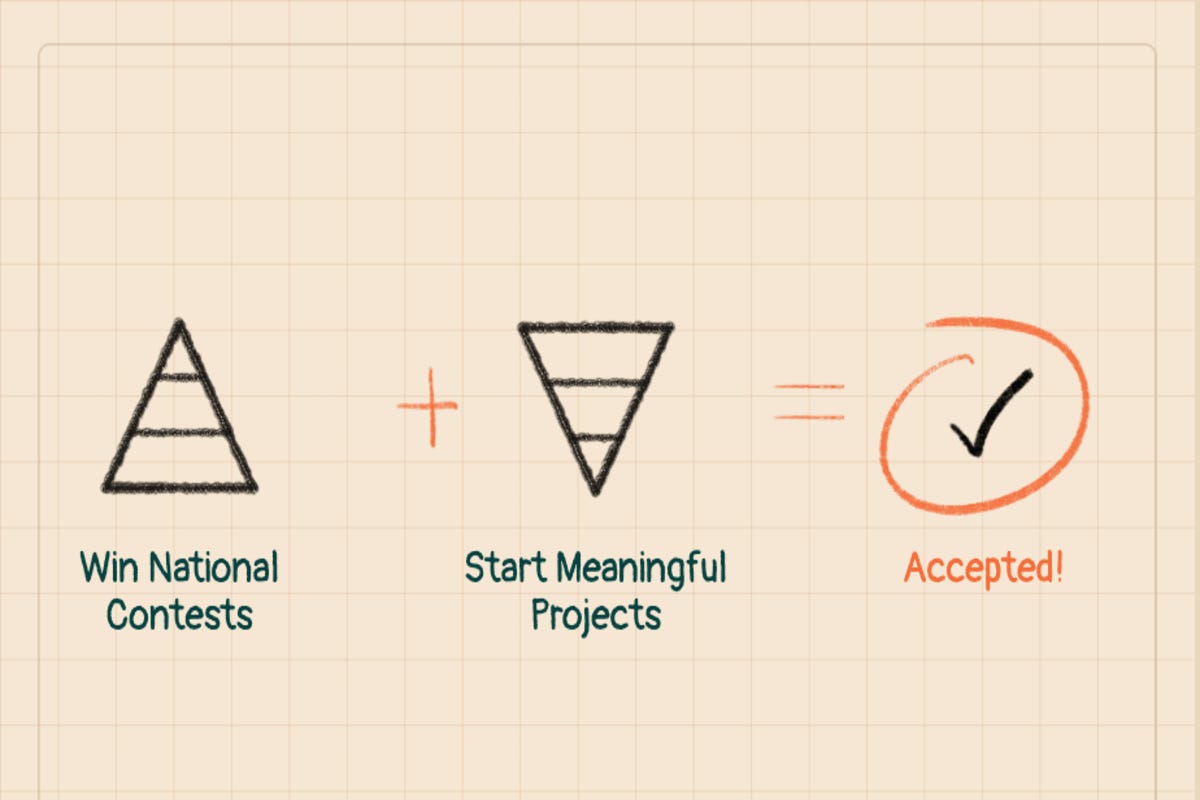
In short, the Inverted Pyramid is all about creating something out of nothing. Passion projects, nonprofits, even new initiatives you start within bigger organizations count!
This is particularly critical for Asian-American applicants who have been historically criticized for lacking leadership and initiative (that’s roughly paraphrased from the Harvard affirmative action case btw).
Unlike the normal pyramid, the inverted pyramid says: “The higher you climb, the more people you help.” Essentially, real world entrepreneurship.
To clarify, this is an infinite game, not a zero-sum one. It’s a strategy that thrives on heartfelt collaboration, not cutthroat competition.
Exhibit A:
One of our students two years ago was a cancer detection researcher (I know that sounds impressive, but it’s actually quite common 😭).
She could have doubled down on doing research for hundreds of hours; instead, she launched a free workshop series for underfunded schools, teaching middle school students how to break into the world of academic research with beginner statistical frameworks + tools!
*She got into Johns Hopkins for pre-med by the way :)
Exhibit B:
Another one of our students (and former media interns) ran FBLA Canada with a focus on Indigenous, rural and disabled communities.
On paper: business club. In reality: she built her own unique financial literacy program in a native language for underprivileged folks, ran weekly Zoom classes for 200+ immigrant students across Canada… and also placed top 5 nationally in DECA.
The combination of competition wins and self-built community work— that’s what made her profile demand admission to Wharton.
A national award says “I can compete at the highest level.”
A self-directed project says “I make things that didn’t exist before I showed up. I’m creative. I take action!!”
One proves you can win someone else’s game.
The other proves you know how to build your own.
Together, you get a formula and personal brand that admission officers just can’t get enough of!
Speaking of which… want to know where you stand in the admissions game?
Fill out this form to access our free college admissions rubric! → elevated.school/getstarted
Depending on your responses, you may even qualify for a free consultation~
Until next time, Kevin @ ElevatEd
P.S. If you’re a junior reading this and your activities list is mostly clubs, competitions and volunteering — no passion project or national nonprofit — this is still fixable!
Reply to this email and we’ll tell you exactly where to start.
Know a junior or senior who needs to hear this? Forward this email — it’s free, and it might change how they approach the next six months!
No posts
Comments
Nothing yet. Say the first thing.
Sign in to join the conversation.