
Disclaimer: No one else can do this for you. When there is something strange in your neighborhood, the only call you need is to your inner reserve. Your natural ally for life changing perspectives is already installed. It is called self-efficacy:
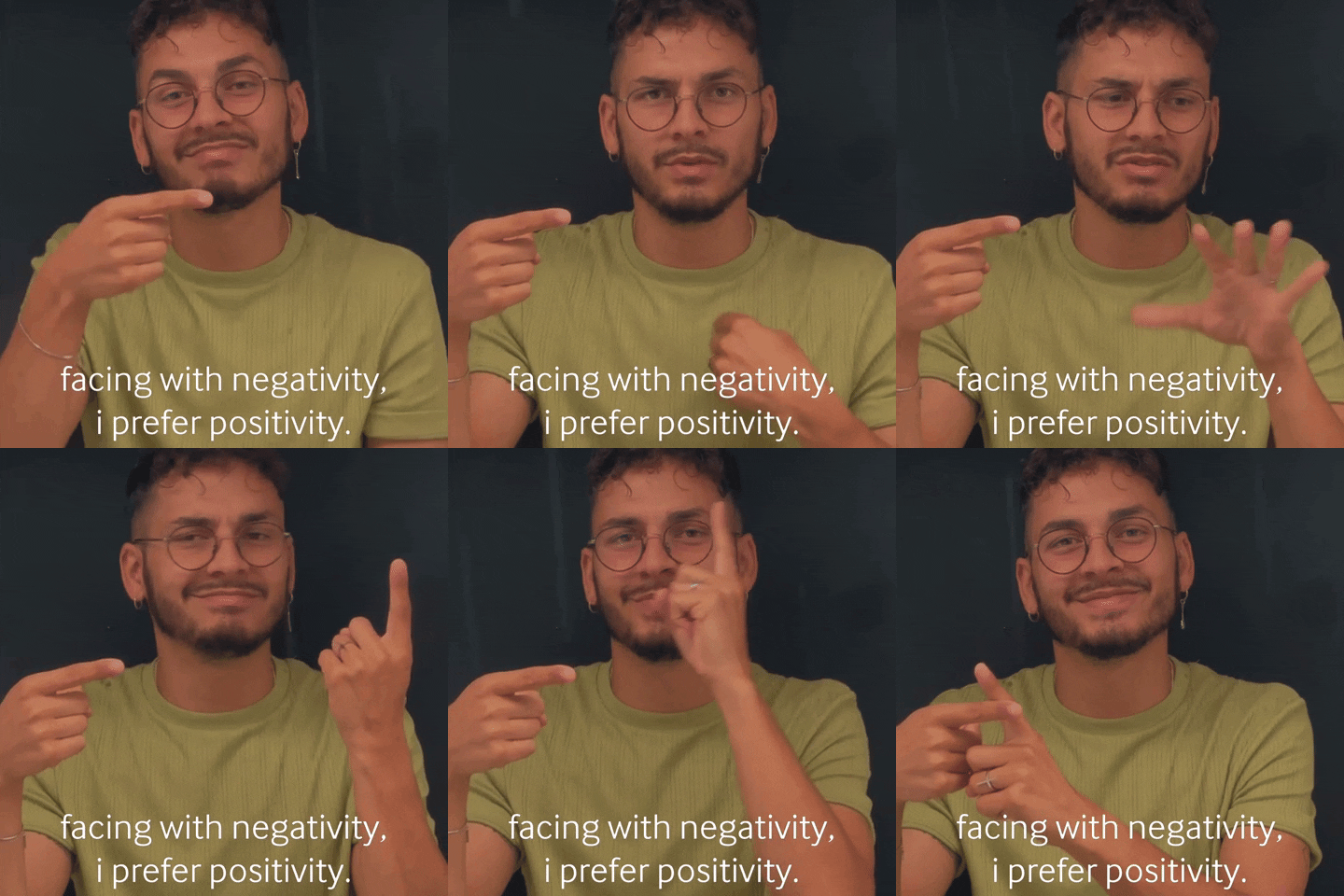
Of course we cannot erase a prior memory or trauma. There is no way on earth we can brain freeze or mind meld an old negative experience to magically become a positive. Or, can we…?
If I could invent a neuralink port into the brain connecting directly to a laptop to upload some cutting edge noggin-code to egg-beater your grey matter just enough to scramble the old shit and mix it in with the new stuff, I would be like Elon Musk. Alas, I am not. Thank goodness. However, we CAN shift a prior negative that is etched in our memory into a balanced new experience, by choice. A self-affirming, healthy positive choice. No magic wand or Harry Potter Latin spell to memorize. It will just be a decision to explore that negative memory briefly, then put it back on the shelf, and then fill that ugly crater it made with something positive, of your own choosing.
How do we choose, how do we balance, and how do we start? Let’s start with one easy example, then touch on a difficult one to address later.
Thus; Alohomora Aberto Accio Alarte Ascendare !!
Let’s say you feel a tad bad for snapping up someone’s parking spot at the mall. Their blinkers were on, waiting before you pulled up. But you rushed in to steal the spot. Afterwards, you lament the whole incident, feeling a tinge of schadenfreude for rushing in for the steal. Yes, you had a deadline to pickup the items, or you knew you couldn’t postpone the appointment, but still, it was a slightly negative incident. The natural result is dissonance, or feeling sorry for what happened, so what to do with that?
Or consider an even more intense, profound sense of grief that weighs heavy on your heart. Something so deep that you feel that it may never be resolved. It may not have been your fault, but your deep pain is harsh and feels overwhelming. You feel this beast of burden so strongly, that it clutters your thoughts and gets in the way of your daily perspectives. This is much more challenging to summon the light at the end of the tunnel. BUT - there is a way to bring it into a smaller jar to keep on a shelf, and only open it up when you have the bandwidth.
With the gift of existence comes suffering. There is no getting around that. Being grateful for only the good things leads to selective resentment of the things we cannot control or prefer not to look at. Being truly grateful for all of it allows us to place value in the negative, if not only to correct it by smoothing it out, but to also learn from it and compensate for it. To compensate for trauma, we can use that residual pain as rocket fuel to strive towards the better path of gratification, happiness and balance.

So, after experiencing something that makes you feel icky, how do you set a better path forward?
Here’s one way: draw a vertical line down the middle of a page, and on the left column write the two or three word incident. On the right side, brainstorm a few opposites of the thing on the left. The opposite of snagging a parking slot from someone who was waiting there first might be to offer a space the next time you see one. Another option might be to wave to a car driving by that is obviously seeking a space, and walk them to your spot so they can get in line first, as you back out. Another might be to find one first in your car, but seeing someone else roll after yoiu, to give them rthe space, and allow them a win for the day. You will find one a little bit farther out from the stores, but you can get in an extra 100 steps on your step-tracker device. A win-win.
After thinking up five or six options for opposite the negative on the left, prioritize the top three. Then write on the other side of the sheet the left side incident, and the top three opposites on the right.
Read it a few timers to yourself, then ask your dearest self to try one of those options the next time you park in a busy lot. So easy t do, yet so hard to implement this positive supplanting an old negative. Plus, you have two other options that you might try to see which one FEELS the best for you to make a habit of it.
I am a Libra, so working with an inner scale is in my celestial make up. You too can tip the scale of dissonance for your own satisfaction, and know that you are a good person, making good decisions to get better as a human. Which leads to better self-efficacy. Whoch leads to less stress to some degree. If you take this challenge, practice it two or three times and find some results, please let us know in the comments.
Whatever the weight of your regret, or embarrassing moment, or bad decision, guess what…? We are all human. We are all allowed to practice something new, and keep in mind, practice makes progress.
You can easily do this same process to map out some opposites of trauma: writing in clear BLACK & WHITE some of the opposites to the ugly trauma, then pick one or two to try out sometime. Just for yourself. For your life.
Here are some sample opposites to trauma:
Connection - letting someone else know that you experienced a similar trauma, making a bonded connection with that person that you two never shared before.
Sharing - Describing the way you were able to work up the courage to disclose your own trauma memory to a close friend. They may have a hidden incident festering inside that they might be able to meet you in that space. Sharing a negative with someone can be a very positive experience. Go ahead, try it a few times to see for yourself.
Replacing - Try looking at your past trauma kerfuffle with a grain of salt. Just think about it, without fear of haveing a panic attack, or dying by hyperventilating, but as an epidode that happened to your inner child. Talk to her, or him, and reassure that although it did happen, and it was painful, and it left a scar. Then what would you tell your teey little sister, or brother, what to do with that memory? Yes it happened, so there is no need to try to go back in history and change it. That is a waste of time and energy. What would you say to get this precious, beautiful soul that your are now talking to, to put that down on paper, then draw up some opposites to help a balance take place from this point forward? Visiting others that have the same kind of trauma to gather, chat, and provide a safe space to vent. Starting a FaceBook group that is open to privacy and sharing. Hosting a group at church about something with a general title, to allow others to participate in anyway that helps.
Whichever path you forge, consider the difficult parts as rocket fuel to help plow through the rough waters towards the calm of self confidence; to own it. Sharing similar trauma helps one feel less isolated.
Shattered is not destroyed.
The Japanese art of repairing broken pottery with gold is called kintsugi (金継ぎ), or sometimes kintsukuroi (金繕い). It literally translates to "golden joinery" or "golden repair." Instead of discarding broken items, kintsugi emphasizes the repair, making the cracks and breaks a part of the object's history and beauty, often using lacquer mixed with gold or silver powder.
Text within this block will maintain its original spacing when published
Double Click Below
Our gift is to exist. With living comes hardship, pain, and trauma. To honor our gift of life, practicing the balance beam enough to get through the pain is part of our purpose. If you see it that way, practice that way, enjoy that way, then you can elevate your life, moment by moment. You are a work in progress, all of us are, and now you have permission to celebrate your beautiful broken improving self by choice.
Kintsugi HAI !!
Comments
Nothing yet. Say the first thing.
Sign in to join the conversation.