
Last September, when I began making my way back to art, I intentionally started from a very simple place.
And this was partly because I was traveling a lot and didn’t have many art supplies with me, and because I had no idea where to begin.
Even though I’d once had an art language, twenty years prior, this return wasn’t a return to the same inner state. It was new territory. A new relationship with making.
And I knew I definitely didn’t want to have this idea of productivity involved in any of the things I was doing artistically.
This was very specifically about being immersed in an art practice that had nothing to do with, and no room for, any ideas or notions about selling, about what I was going to create, or whether something outside of me would deem it worthy or likable or even art.
I’d been plagued by all of that before.
So I began with a black pen, black ink, and a notebook. That was it.
I went back to one of the things I’ve loved my entire life: freeform mandala making. Circles. Lines. Patterns. Repetition. The simple, ancient satisfaction of letting the hand move before the mind has a chance to make everything complicated.
I was also, as one does, wandering through Pinterest looking at different forms of doodling and pattern-making. I found myself in the world of “Zen Doodle” and “Zentangle,” which, by the way, I have feelings about. Strong ones. Possibly a future essay. For now I’ll simply say: I don’t love the names given to this.
But the practice itself opened a door. It gave me a way in.
There was no pressure. No performance. No demand that the work become something. It made it easy for me to sit down and let the immediate impulse guide the pen without having to think about mediums, colors, techniques, outcomes, or whether any of it was “good.”
So I started there: black pen, paper, pattern, breath, hand, line.
Eventually, of course, the practice began to expand. I filled an entire beautiful art journal with those drawings. Several, actually. At some point I’ll share them here.
Then color started calling.
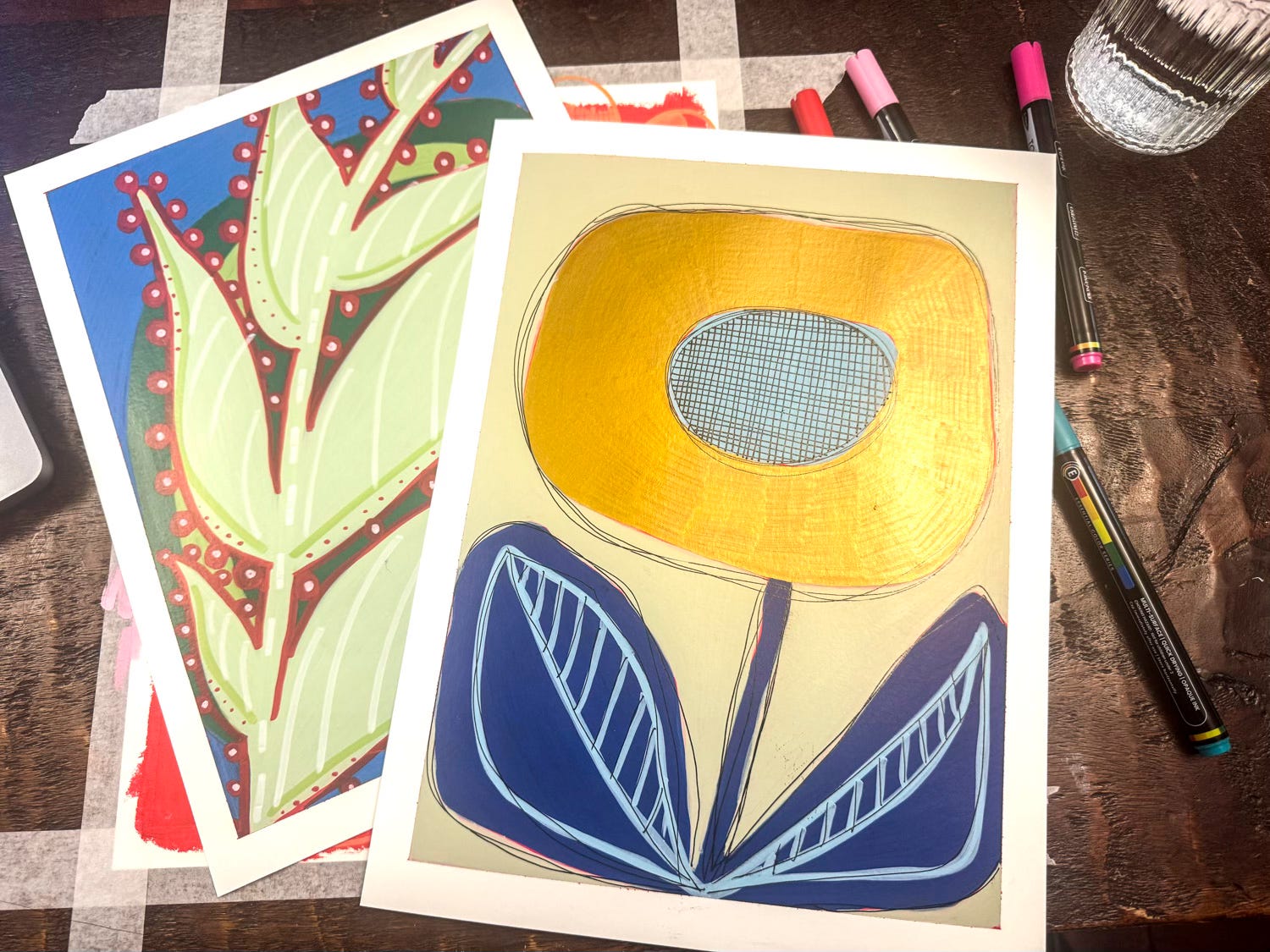
Markers came in. Then acrylic paint pens, which were, and remain, a phenomenal discovery. A little dangerous, honestly, because they’re so deeply fun.
Then tempera paint sticks entered the room, and I swear I could write whole poems about tempera paint sticks. The pleasure of them. The glide. The immediacy. The way they let color move across the page with this childlike, sensual, unapologetic joy.
For months, this has been an incredible journey of discovery and fun and flow. Until today.
Today, the practice hit a wall.
For the last couple of months, I’ve been doing a lot of work with tempera sticks in an art journal. Then I moved into larger pieces on thick watercolor paper, and I started to feel the edge of the medium. What I was playing with wanted more than the tempera sticks could give me on their own.
So I returned to combining tempera paint with acrylic markers.
And this morning, I reached for a color. I wanted something specific. I opened a brand-new marker, one I’d only been using for a few minutes, and suddenly there it was: streaky, half-dry, half-not, utterly disappointing nonsense.
The pen was not penning.
The marker was not marking.
The paint was not flowing.
And I felt the record scratch inside my whole body.
Because here’s the thing: I’m burning through supplies. Black ink. Tempera paint sticks. Acrylic markers. None of this is cheap. This is one of the reasons I’ve been playing with the idea of letting this Substack directly support the art practice. If you want to subscribe, I love it, because every dime that comes through here goes straight into more pens, more inks, more markers, more paints.
And when I’m in that flow state, when the practice is moving, when the color is alive and the page is receiving me, the last thing I can handle is suddenly being betrayed by a streaky marker.
I’m not being hyperbolic when I tell you that the level of frustration in me becomes immediate and feral. I want to hurl the pen across the room in utter disgust. I start cursing the pen company. I start wondering why no one has created a marker luscious enough, opaque enough, juicy enough to meet my desires.
I love a deeply opaque, lush color.
I cannot abide streaking.
Streaking offends me on a spiritual level. I’m not even joking.
Which is what got me thinking: maybe it’s time to move into paint.
Not paint pens. Not markers. Actual paint.
There’s a space issue right now though. I don’t currently have the kind of setup where I can spread out paper and palette and water and brushes and leave everything open and available. That will come. It’s not here yet.
But something in me knows I’m reaching the edge of this current form.
And that’s part of the practice too.
Because this art-making has become a deeply spiritual practice for me. Every morning, when I sit down to create a mandala, or paint, or draw, what I’m making is often very simple. The point isn’t complexity. The point is the color language. The visceral stroke language. The feeling of running a marker across paper, moving a tempera stick over the surface, smearing pigment with my fingers.
It’s a kind of journey, a kind of prayer, a kind of devotional descent into the body.
And when I’m inside that, the interruption feels personal. The dried-out marker feels like a spiritual attack. The failed line feels like an insult.
But then I remembered something I teach all the time.
When I talk to my students at The Holy Witch about closed-eye breathing meditation, I always say the same thing: everyone thinks they’re bad at meditation because they get distracted.
But the distraction isn’t the failure of the practice.
The distraction is the juice of the practice.
Because the moment you notice you’ve wandered off, you’re given the real opportunity. You get to acknowledge what happened, and then choose again.
“Oh, I see the distraction, and now I return to the breath. I see the frustration, and now I return to the body. I see the impulse to quit, curse, throw the marker, declare the whole practice ruined, and now I return to the page.”
That’s the practice.
Not the uninterrupted flow. Not the perfect conditions. Not the endless supply of exactly the right shade of green with fifty backups waiting in a drawer.
The practice is the return.
So this morning, after my embarrassingly dramatic inner monologue about marker quality and artistic betrayal, I had to laugh.
Because there it was again: the teaching I already know, the teaching I give to other people, the teaching that had the nerve to show up in my own hand, in my own body, through a half-dry acrylic marker.
As a teacher, I’m constantly humbled. Constantly returned to beginner mind. Constantly reminded that the practice doesn’t stop being the practice just because I’m annoyed.
The streaky marker wasn’t outside the devotional field. It was inside it. The frustration was inside it. The pivot was inside it.
And maybe it’s time to change mediums. Maybe it’s time to move toward paint, toward a more abundant, fluid, unlimited way of laying color down. Maybe I need something that can glide, generously and sexily, across the page without the tiny heartbreak of a dying nib.
But even that shift won’t remove the practice.
There will always be another interruption.
The brush will dry.
The color will muddy.
The page will buckle.
The hand will hesitate.
The mind will interfere.
And I’ll have to choose again.
Return to the breath.
Return to the body.
Return to the page.
Return to the present moment.
No posts
Comments
Nothing yet. Say the first thing.
Sign in to join the conversation.