
Full disclosure: I’ve taken the liberty of generating a list of common “tells” that might indicated if one has employed generative AI in their writing. The following is completely generated in Chat GPT using a prompt from me. I then used this text to generate a few posters in Claude Design, a feature of Claude that is in beta.
I’m a big fan of AI—it’s totally changed how I handle design, teaching materials, and writing. I treat tools like ChatGPT and Claude as my virtual assistants, and I’m always open about using them. But lately, I’ve been seeing a ton of content on LinkedIn that feels super robotic and obviously AI-generated. I don’t mind people using AI, but I do mind the bland, generic style that comes with it. If you’re going to use these tools, please use them well and make sure your own voice actually shines through. Hopefully, this list helps you use chatbots more mindfully and keeps your writing feeling authentic.
Important: No single item proves that AI was used. Human writers use these patterns too, and AI-assisted writing may be heavily revised. Look for clusters of signals, verify claims, and avoid treating an AI-detector score as conclusive evidence.
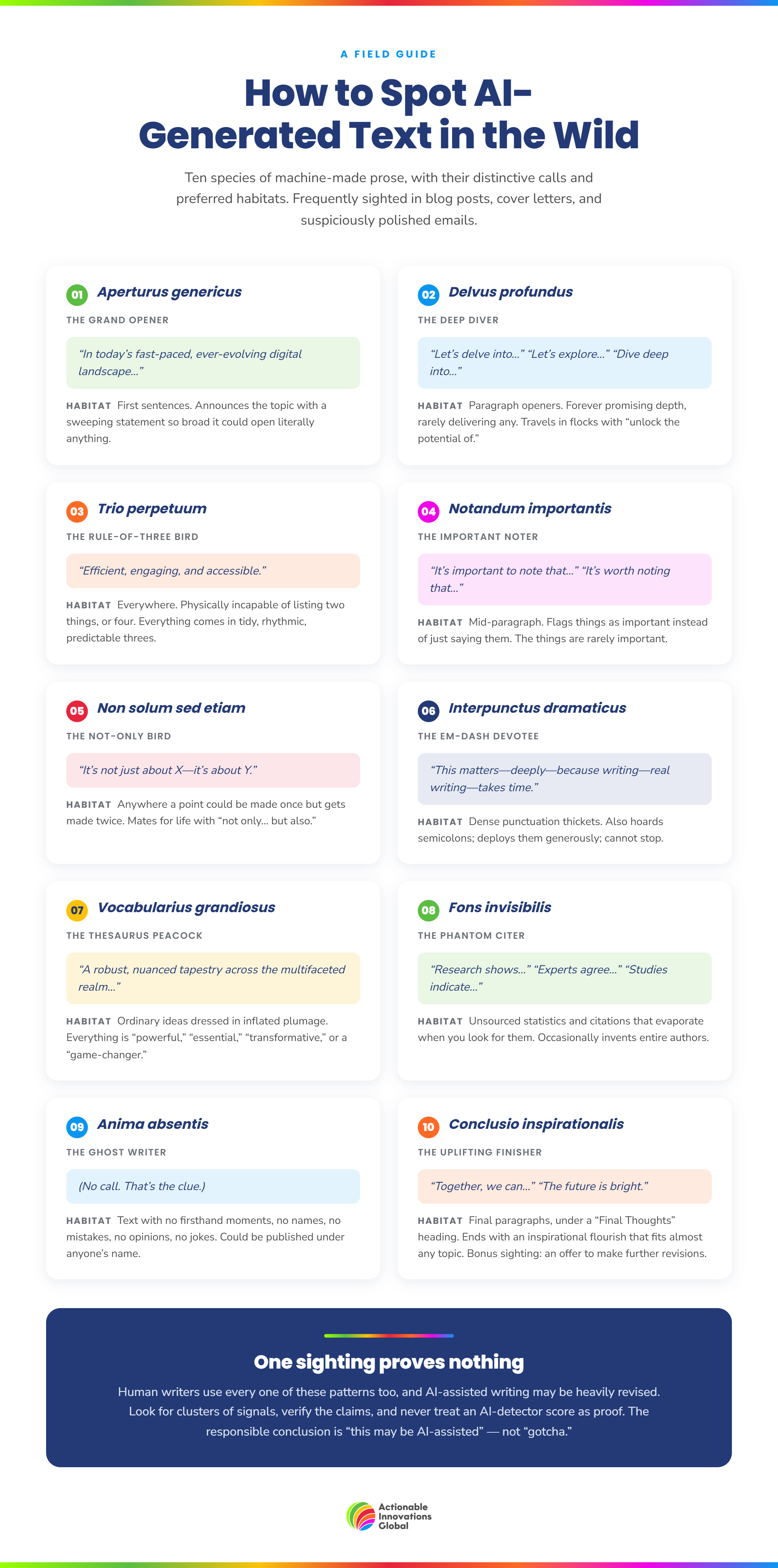
☐ Opens with “In today’s fast-paced world…” or “In an ever-evolving landscape…”
☐ Begins with a broad, obvious statement instead of a specific idea
☐ Restates the topic without establishing a real argument
☐ Starts with a generic rhetorical question
☐ Ends by summarizing points that were already clear
☐ Uses a heading such as “Final Thoughts,” “Looking Ahead,” or “Conclusion”
☐ Finishes with an inspirational statement that could fit almost any topic
☐ Ends with “Together, we can…” or “The future is bright”
☐ Adds a call to action even when one is not needed
These expressions are not inherently bad. Frequency, predictability, and lack of specificity are the stronger clues.
☐ “It’s important to note that…”
☐ “It’s worth noting that…”
☐ “At its core…”
☐ “The key takeaway is…”
☐ “This is where ___ comes in”
☐ “Let’s explore…”
☐ “Let’s delve into…”
☐ “Dive deep into…”
☐ “In today’s digital age…”
☐ “Now more than ever…”
☐ “Whether you’re a beginner or a seasoned professional…”
☐ “From ___ to ___…”
☐ “By leveraging the power of…”
☐ “Unlock the potential of…”
☐ “Navigate the complexities of…”
☐ “Foster a culture of…”
☐ “A testament to…”
☐ “A game-changer”
☐ “A powerful tool”
☐ “A valuable resource”
☐ “A holistic approach”
☐ “A seamless experience”
☐ “Meaningful impact”
☐ “Transformative potential”
☐ “The possibilities are endless”
☐ “Ultimately, the choice is yours”
☐ Frequently uses three-part lists: “efficient, engaging, and accessible”
☐ Repeatedly uses “not only…but also”
☐ Repeatedly uses “It’s not just about X—it’s about Y”
☐ Frequently contrasts “While X offers benefits, it also presents challenges”
☐ Uses “Whether X or Y” constructions throughout
☐ Relies heavily on em dashes
☐ Uses semicolons more often than the writer normally would
☐ Repeats the same sentence rhythm paragraph after paragraph
☐ Produces sentences that are polished but unnecessarily long
☐ Uses transition words mechanically: “Moreover,” “Furthermore,” “Additionally,” and “Consequently”
☐ Rephrases the same point several times without adding information
☐ Uses inflated language for ordinary ideas
☐ Describes nearly everything as “powerful,” “essential,” “critical,” or “transformative”
☐ Overuses words such as “landscape,” “realm,” “journey,” “tapestry,” “nuanced,” “robust,” or “multifaceted”
☐ Uses corporate jargon without explaining what it means
☐ Sounds relentlessly upbeat, diplomatic, or reassuring
☐ Avoids strong, controversial, or unusual opinions
☐ Sounds authoritative without demonstrating expertise
☐ Uses language that is technically correct but unnatural for the intended audience
☐ Shifts between formal and conversational language
☐ Refers vaguely to “stakeholders,” “leaders,” “organizations,” or “communities”
☐ Sounds like promotional copy even when the piece is supposed to inform or analyze
☐ Uses an extremely predictable introduction-body-conclusion structure
☐ Divides everything into evenly sized sections
☐ Uses exactly three, five, seven, or ten points
☐ Gives every section a polished explanatory heading
☐ Uses excessive headings for a short piece
☐ Capitalizes every major word in headings
☐ Places a summary or takeaway after nearly every section
☐ Uses bullet lists when connected prose would be more natural
☐ Presents every issue as a neat list of benefits, challenges, and solutions
☐ Follows the requested format so mechanically that it feels templated
☐ Contains no firsthand experiences
☐ Includes no concrete moments, conversations, mistakes, or observations
☐ Offers no details that only the named author would know
☐ Avoids names, dates, places, numbers, or identifiable examples
☐ Uses hypothetical examples that sound plausible but generic
☐ Claims to understand an audience without showing real familiarity with it
☐ Describes emotions instead of conveying them
☐ Contains no humor, quirks, frustration, uncertainty, or surprising language
☐ Reveals no personal preferences or point of view
☐ Could be published under almost anyone’s name
☐ Says a great deal without making a clear argument
☐ Covers the topic broadly but never goes deeply into it
☐ Provides obvious advice as though it were new insight
☐ Offers solutions that are too general to implement
☐ Treats complex issues as easily solvable
☐ Presents both sides without evaluating their strength
☐ Creates artificial balance where the evidence is not balanced
☐ Avoids acknowledging meaningful disagreement
☐ Includes contradictions between sections
☐ Introduces ideas but never follows through on them
☐ Answers a slightly different question from the one asked
☐ Includes material that seems added merely to reach a desired length
☐ Says “research shows” without identifying the research
☐ Refers vaguely to “experts,” “studies,” or “industry leaders”
☐ Includes statistics without a source
☐ Uses citations that do not support the associated claim
☐ Cites sources that do not exist
☐ Invents titles, authors, organizations, quotations, or URLs
☐ Provides links that lead to homepages rather than supporting evidence
☐ Misstates dates, names, or publication details
☐ Combines real facts with plausible-sounding fabricated details
☐ Uses quotations that cannot be found in the cited source
☐ References outdated information as though it were current
☐ Confuses people, organizations, products, or events with similar names
☐ Uses the wrong terminology for the field
☐ Misses local, historical, or organizational context that an informed writer should know
☐ Provides correct-sounding but unusable instructions
☐ Claims a feature, policy, law, or program exists when it does not
☐ Gives inconsistent dates or numbers
☐ Makes confident predictions without evidence
☐ Fails to distinguish facts from assumptions
☐ Does not recognize that information may have changed
☐ Invents connections between unrelated ideas
☐ Does not sound like the person’s other writing
☐ Uses vocabulary well outside the writer’s normal style
☐ Is much more polished than the writer’s usual work
☐ Suddenly uses perfect grammar and elaborate formatting
☐ Uses phrases the writer would not ordinarily use
☐ Lacks the writer’s usual humor, directness, opinions, or storytelling
☐ Repeats the same AI-like style across writers who normally sound different
☐ Includes American spellings in an otherwise British text, or vice versa
☐ Shifts voice, reading level, or terminology within the same piece
☐ Sounds unlike the writer when they discuss the topic aloud
☐ Includes instructions such as “Here is your revised blog post”
☐ Contains placeholders such as [insert example] or [your organization]
☐ Leaves an unfinished sentence or template field
☐ Refers to “the information provided” without explaining what that information was
☐ Mentions a prompt, user request, or source material not visible to the reader
☐ Says “As an AI language model”
☐ Includes Markdown symbols that were not properly converted
☐ Uses fake links or placeholder URLs
☐ Repeats the title or assignment instructions unnecessarily
☐ Includes an offer to make additional revisions at the end
☐ Compare the piece with verified samples from the same author
☐ Check unusual quotations, statistics, names, and citations
☐ Ask the writer to explain or expand on a specific claim
☐ Ask for drafts, notes, sources, or revision history when authorship matters
☐ Separate inappropriate AI use from permitted brainstorming, editing, or proofreading
☐ Avoid relying on an AI-detection score as proof
☐ Consider language background, disability, age, and writing support before making accusations
☐ Base any consequential decision on multiple forms of evidence
The strongest warning combination: generic language, predictable organization, confident but unsupported claims, little firsthand specificity, and a voice that does not match the supposed author.
Even then, the responsible conclusion is that the writing may be AI-assisted—not that AI use has been proven.
Stay tuned for additional posters on this topic!
Comments
Nothing yet. Say the first thing.
Sign in to join the conversation.