
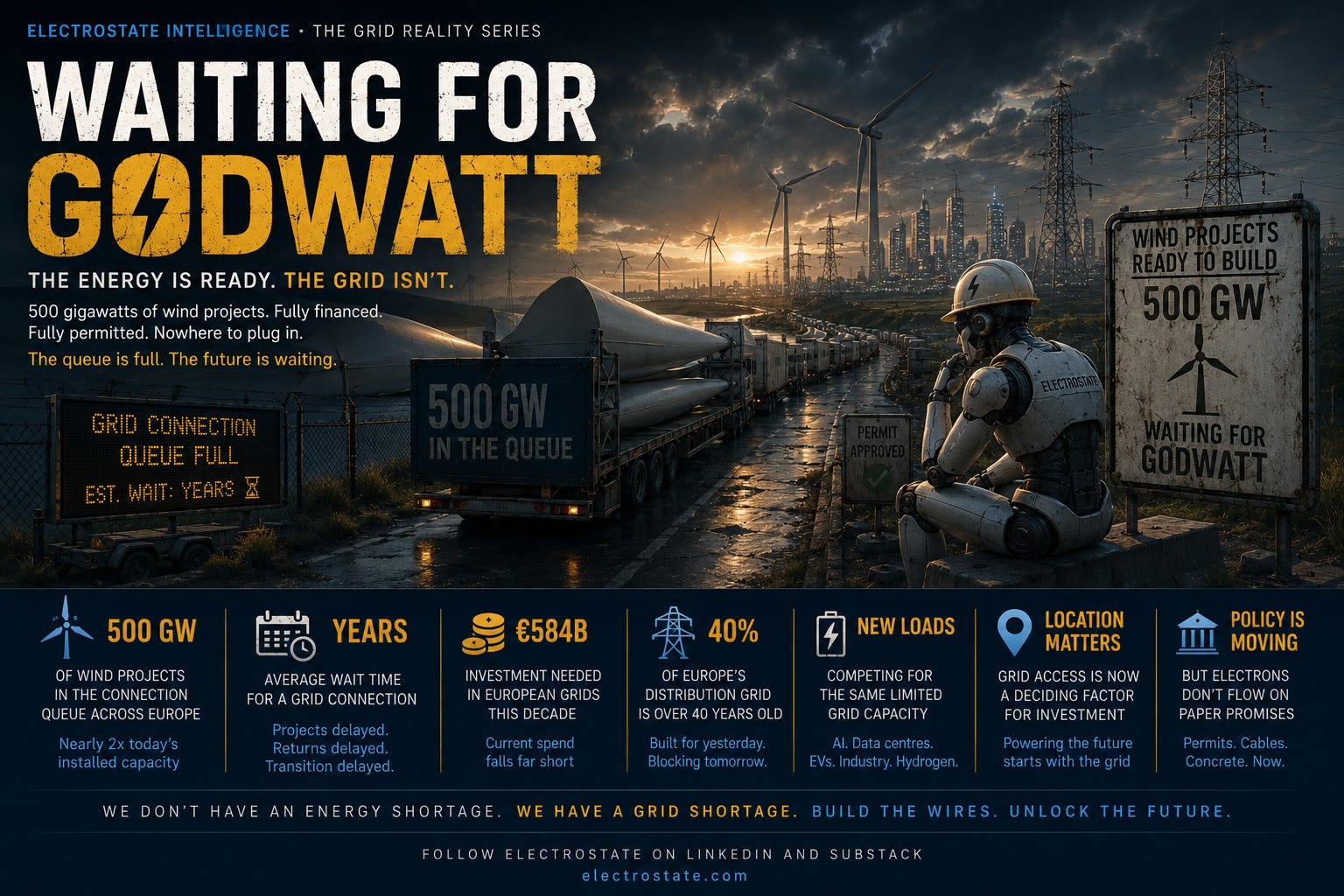
Five hundred gigawatts of wind energy projects are currently sitting in the European permitting queue, waiting for a grid connection. To put that number in context: Europe’s total installed wind capacity today is roughly 260 GW. There is nearly double that amount fully developed, financed, and ready to generate — except it can’t, because there’s nowhere to plug it in.
This is not a planning failure in the conventional sense. The turbines aren’t blocked by environmental objections or local politics, at least not primarily. They’re blocked by the grid itself. The wires aren’t there. And in many cases, even where the physical infrastructure exists, the connection queue is so congested that projects wait years simply for a slot.
This is the energy transition’s most underreported bottleneck.
The EU has been building renewable generation at a remarkable pace. Solar and wind additions set records in 2024 and again in 2025. Auction prices have fallen to levels that would have seemed implausible a decade ago. The economics of generation are, at this point, largely solved — cheap electrons are available in abundance, at least in theory.
The constraint is getting them from where they’re generated to where they’re needed. And that constraint is physical, slow to fix, and capital-intensive in a way that solar panels are not.
Forty per cent of Europe’s distribution grid is over forty years old. The transmission network was designed for a system of large, centralised power stations feeding predictable loads. Wind and solar are distributed, variable, and often located far from demand centres — in the North Sea, in Iberia, on rooftops across the continent. The grid was not built for this, and retrofitting it takes time and money that no single actor has the mandate or the balance sheet to deploy alone.
The number analysts put on the total investment need is €584 billion. Not over the next decade — this decade. The current pace of capital expenditure falls well short. The top twenty European grid operators are expected to spend around €59 billion combined this year, up 12% on 2025. The EIB has committed €75 billion in grid financing over the next three years. The EIB and Commerzbank recently signed a €2 billion cooperation agreement for German grids specifically. These are meaningful commitments. They are also, against the €584 billion requirement, insufficient on their own.
The European Grids Package, presented in December 2025, is the most serious policy response to date. It introduces binding permitting deadlines for grid projects, new transparency requirements for connection queues, and treats cross-border transmission as a European strategic priority for the first time in any meaningful regulatory sense.
The Commission is also proposing a fivefold increase in the Connecting Europe Facility — the EU’s infrastructure co-financing mechanism — in the next budget round. Cross-border transmission capacity is due to double by 2030 under current plans.
Whether these commitments translate into cable in the ground is a different question. Permitting rules help, but the actual work is local, physical, and political in the planning sense: substations need sites, pylons need routes, communities need to agree. The EU can set deadlines. It cannot dig trenches.
The grid queue problem has consequences that extend well beyond electricity bills and carbon targets.
New industrial loads — AI data centres, electrolyser plants, battery gigafactories, EV charging networks — are all competing for the same constrained grid connections. Microsoft and Google have signed multi-gigawatt power purchase agreements across Europe, but the constraint on where those data centres can actually be sited is increasingly the grid, not the renewable generation. West Texas and northern Scandinavia are attracting hyperscale investment in part because of grid access, not just cheap power.
This means grid infrastructure is becoming a determinant of industrial location in a way it hasn’t been since the electrification of manufacturing in the early twentieth century. The countries and regions that move fastest on permitting, investment, and physical build will attract the investment flows that come with new electrical loads. Those that don’t will watch the industry go elsewhere.
Germany is already experiencing this acutely. Its grid is congested, its permitting slow, and its energy costs — for the period when the sun isn’t shining and the wind isn’t blowing — remain high. The €2 billion EIB-Commerzbank facility is a recognition of the problem. It is not yet a solution to it.
There is a version of the energy transition debate that is still, in 2026, focused on whether solar and wind are cheap enough, reliable enough, or politically acceptable enough to replace fossil fuels. That debate is mostly over. The economics are settled. The politics are not simple, but the direction is clear.
The argument that actually matters now is about copper and cable. About permitting and planning law. About which countries are willing to run transmission lines across farmland and whose communities will accept a substation. About whether the EU’s new grid package has teeth or turns out to be another aspirational document.
Five hundred gigawatts in the queue. The electrons exist. The wires are the problem.
end
Nadim Chaudhry is the author of ElectroState: How the Electrification E-Flip, China, Geopolitics will Reorder the Global Economy, examining the global transition from fossil fuels to electrification through geopolitical and systems lenses.
ElectroState.com offer premium intelligence services and consulting for the electrical energy transition
Subscribe for free to receive the latest analysis. Premium intelligence briefing service available at ElectroState.com
No posts
Comments
Nothing yet. Say the first thing.
Sign in to join the conversation.