
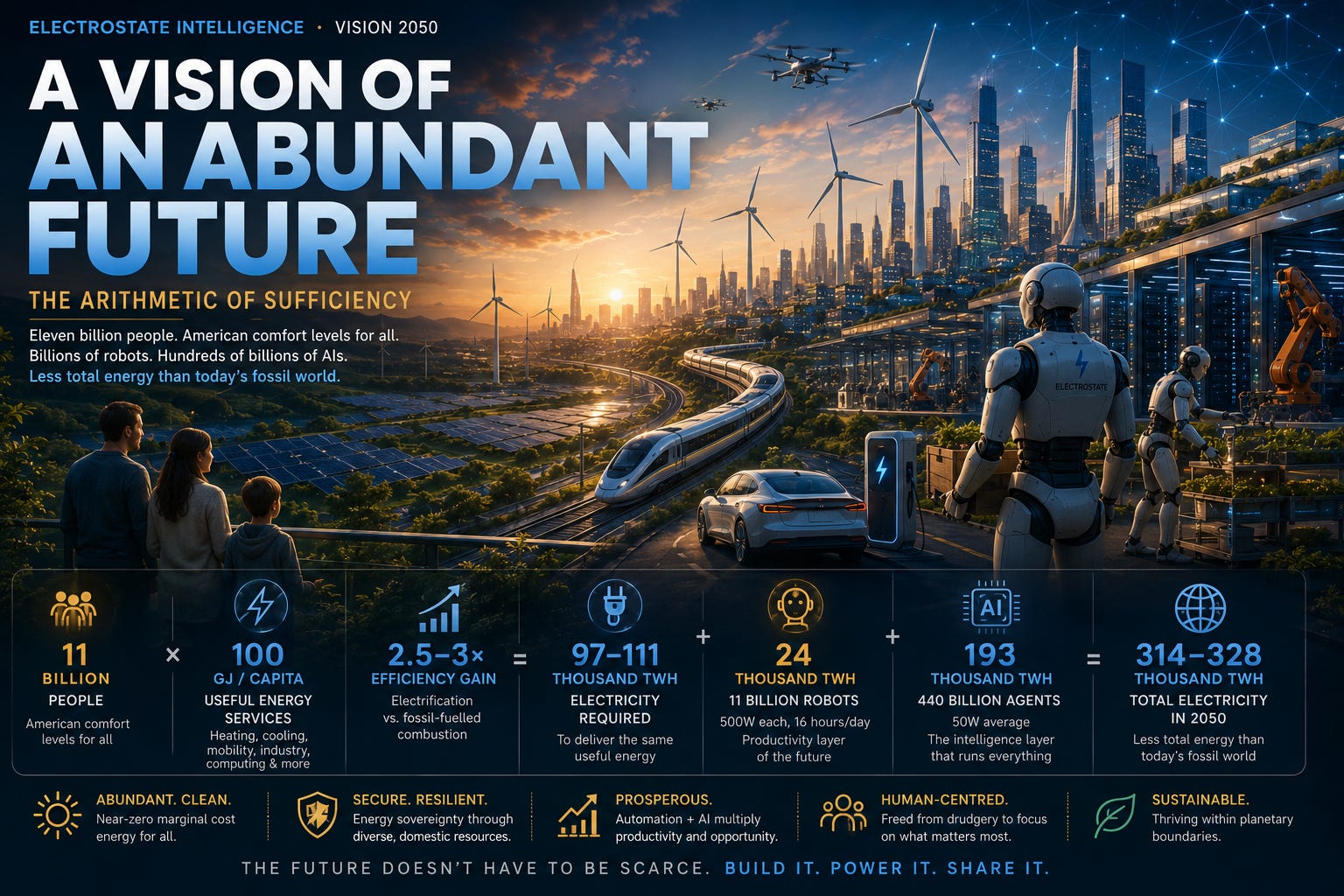
Imagine 2050. Eleven billion people inhabit the planet — a peak stabilising around replacement-level fertility in wealthy nations, continued growth in Africa and parts of South Asia. Each person lives at today’s global average standard: reliable electricity, clean water, thermal comfort, connectivity, modest personal transport, and access to healthcare and education. Not American excess. Not poverty. The median human life today, extended to everyone.
How much electricity does this world require?
The answer reveals something remarkable about the energy transition that gets buried in climate rhetoric: a fully electrified, fully automated world at today’s average living standards needs roughly twice the electricity we already generate.
Let me show the arithmetic.
The average human on Earth today consumes roughly 75 gigajoules of primary energy per year. About two-thirds evaporates as waste heat — in combustion engines running at 25% thermal efficiency, in gas boilers at 85–90%, in coal-fired power plants at 35%.
The useful energy actually delivered — the warmth in a home, the motion of a vehicle, the light in a room — amounts to roughly 23–25 gigajoules per capita.
Scale this to 11 billion people at that same standard:
11 billion × 25 GJ = 275 exajoules of useful energy required
Now electrify it with efficiency gains:
Heat pumps replace gas furnaces, delivering heat at a coefficient of performance (COP) of 3–4. One unit of electricity replaces 3–4 units of combusted gas.
Electric vehicles convert 85–90% of electrical energy to motion, versus 25% for a combustion engine.
Industrial electrification — induction heating, resistance furnaces, electric arc furnaces — typically runs 1.5–2× more efficiently than fuel combustion.
Across the energy system, replacing combustion with electrons yields a weighted-average efficiency improvement of roughly 2.5–3×.
The result: to deliver 275 exajoules of useful energy services electrically, you need:
275 EJ ÷ 2.75 ≈ 100 EJ of electrical input
Converting: 100 EJ × 277.8 = roughly 27,800 terawatt-hours per year
The world currently generates approximately 28,000–30,000 TWh of electricity annually.
Before we add a single robot or AI agent, electrifying today’s highest living standards for a projected 11 billion people requires roughly what we already generate. The efficiency dividend from electrification almost exactly offsets the effects of the standard of living and population growth. Now add the machines.
Imagine 11 billion robots. Not just bipedal androids — practical machines deployed in construction, manufacturing, agriculture, care work, and logistics. A second working body per person, operating 16 hours per day.
Each robot consumes about 500 watts continuously — motion, computation, sensing, and communication. The calculation is straightforward:
11 billion × 500W × 16 hours/day × 365 days = 32,000 terawatt-hours per year
This is real, additional electricity demand. Automation is not free. But it is enormously productive — robots don’t sleep, don’t take sick days, and can operate continuously in conditions too dangerous or remote for humans.
Now add 440 billion agentic AIs — roughly 40 agents per human, managing specific domains: optimising building energy use in real-time, routing delivery fleets, coordinating renewable generation and storage, managing supply chains, supervising infrastructure maintenance, providing health monitoring.
Most of these agents are lightweight, running on edge devices — inference chips embedded in thermostats, vehicles, appliances, and industrial sensors. A reasonable weighted average for edge-native inference hardware in 2050: roughly 2 watts per agent.
440 billion × 2W × 8,760 hours = approximately 7,700 TWh per year
But here’s the critical point: these AI agents are not just consuming energy. They are managing the energy system itself. Coordinating 11 billion EV chargers and heat pumps to shift load toward solar peaks. Forecasting demand with granular precision. Dispatching storage across continental scales. Eliminating stranded generation and wasted transmission capacity.
Conservative estimates for AI-driven demand response and system optimisation: 4,000–8,000 TWh of demand avoided annually — roughly equal to or greater than the AI layer’s own consumption.
The agentic AI layer pays for itself. Its efficiency savings cancel its energy cost.
11 billion humans (electrified, today’s living standards)~28,000
11 billion robots ~32,000
440 billion AI agents~7,700
Less: AI-driven efficiency and demand response−4,000–8,000
Net total~60,000 TWh
Today’s global electricity generation: ~28,000–30,000 TWh.
A fully automated world of 11 billion people runs on roughly 2× what we generate today. Solar and wind have grown at 20–30% annually for a decade. At that trajectory, the required capacity is reachable within 15–20 years — without heroic assumptions about new technology, only continued deployment of what already exists.
The automation layer — 11 billion robots and 440 billion AI agents — adds roughly the same electricity demand as the humans themselves. But it produces an economy qualitatively different from today’s: one where physical labour is automated, every system is continuously optimised, and energy poverty ends through economics rather than charity.
The abundant future isn’t a climate story. It’s a productivity story.
For two centuries, the global economy ran on fossilised sunlight — millions of years of accumulated photosynthesis released in days. That energy was abundant enough to build industrial civilisation, but so inefficient in conversion that most of it was wasted before it could be used. We built a world on 25% engine efficiency and called it progress.
Electrification changes this calculus not through sacrifice but through engineering. Heat pumps, induction motors, and semiconductors are simply more efficient than combustion. And automation — distributed robotics and edge AI managing every granular system — doesn’t add energy demand proportional to its output. The AI layer, as we have seen, pays for itself. The robot layer multiplies productive capacity per unit of energy consumed.
A world where every physical task is automated and every system is AI-optimised is not a resource-intensive future. It is a resource-efficient one: the same electrons move more material, grow more food, maintain more infrastructure, and deliver more care than combustion-era civilisation ever achieved.
The result: energy poverty ends through economics, labour scarcity drives wages upward as humans focus on work machines cannot replicate, capital becomes genuinely productive as AI eliminates systemic waste, and environmental regeneration becomes possible as economic output decouples from material extraction.
To generate 60,000 TWh per year — roughly 2× today’s electricity — you need:
Solar: At 18% capacity factor, about 34–36 terawatts of installed capacity (today: 1.4 TW)
Wind: At 35–40% capacity factor, about 15–17 terawatts (today: 1.1 TW)
Nuclear/hydro/geothermal: 4–5 terawatts for stable baseload
Battery storage: 150–200 TWh of global storage capacity (today: 20 TWh)
Transmission: Reinforced and automated for bidirectional flows and continent-scale balancing
The capital requirement is substantial — roughly $5–8 trillion over 25 years, or $200–320 billion annually. The world currently spends over $2 trillion annually on fossil fuel production alone. The transition doesn’t require extraordinary new capital; it requires redirecting existing flows.
The execution challenge is real: 195 countries, different political systems, supply chains that must be built at scale. But the economics are now firmly in favour — solar at $0.02–0.04 per kilowatt-hour, batteries at $100 per kilowatt-hour and falling, EVs at cost parity with combustion vehicles.
We’re at an inflection point with the technology that exists today. The economics are favourable. The constraint is political will and institutional coordination.
The 2050s will likely be a mixed world: some nations living with energy sufficiency and automated labour, others still constrained by fossil fuel dependency or governance failure. The transition won’t be uniform.
But the physics, the economics, and the engineering all point in one direction. Doubling global electricity generation is not a moonshot — it is the continuation of a trend already underway. What it requires is sustained policy commitment, capital mobilisation, and the institutional capacity to coordinate across borders.
That’s the real challenge. Not energy. Not technology. Not even capital.
Our ability to act at the scale required.
An 11-billion-person world — fully automated, with a robot and 40 AI agents per human — running on roughly 60,000 terawatt-hours of electricity per year.
That’s approximately twice what we generate today. It is within reach of current renewable deployment trajectories within two decades. And it supports a world where no one lacks energy, no physical task need be dangerous or degrading, and every system operates at a level of coordinated intelligence that combustion-era civilisation could never achieve.
The AI layer pays for itself. The robot layer multiplies output without multiplying waste. The humans at the centre consume no more than they do today — just more reliably, more cleanly, and with far greater productive support around them.
The transition won’t be smooth. Industries will vanish. Regional economies will face wrenching adjustment. Power will shift from those who controlled scarcity to those who manage coordination.
But the endpoint is not a fantasy. It is the serious consequence of trends already underway.
The question is not whether we can technically do this.
It’s whether we can build the political capital, institutions, and organisation to do so.
end
Nadim Chaudhry is the author of ElectroState: How the Electrification E-Flip, China, Geopolitics will Reorder the Global Economy, examining the global transition from fossil fuels to electrification through geopolitical and systems lenses.
ElectroState.com offer premium intelligence services and consulting for the electrical energy transition
Subscribe for free to receive the latest analysis. Premium intelligence briefing service available at ElectroState.com
No posts
Comments
Nothing yet. Say the first thing.
Sign in to join the conversation.