
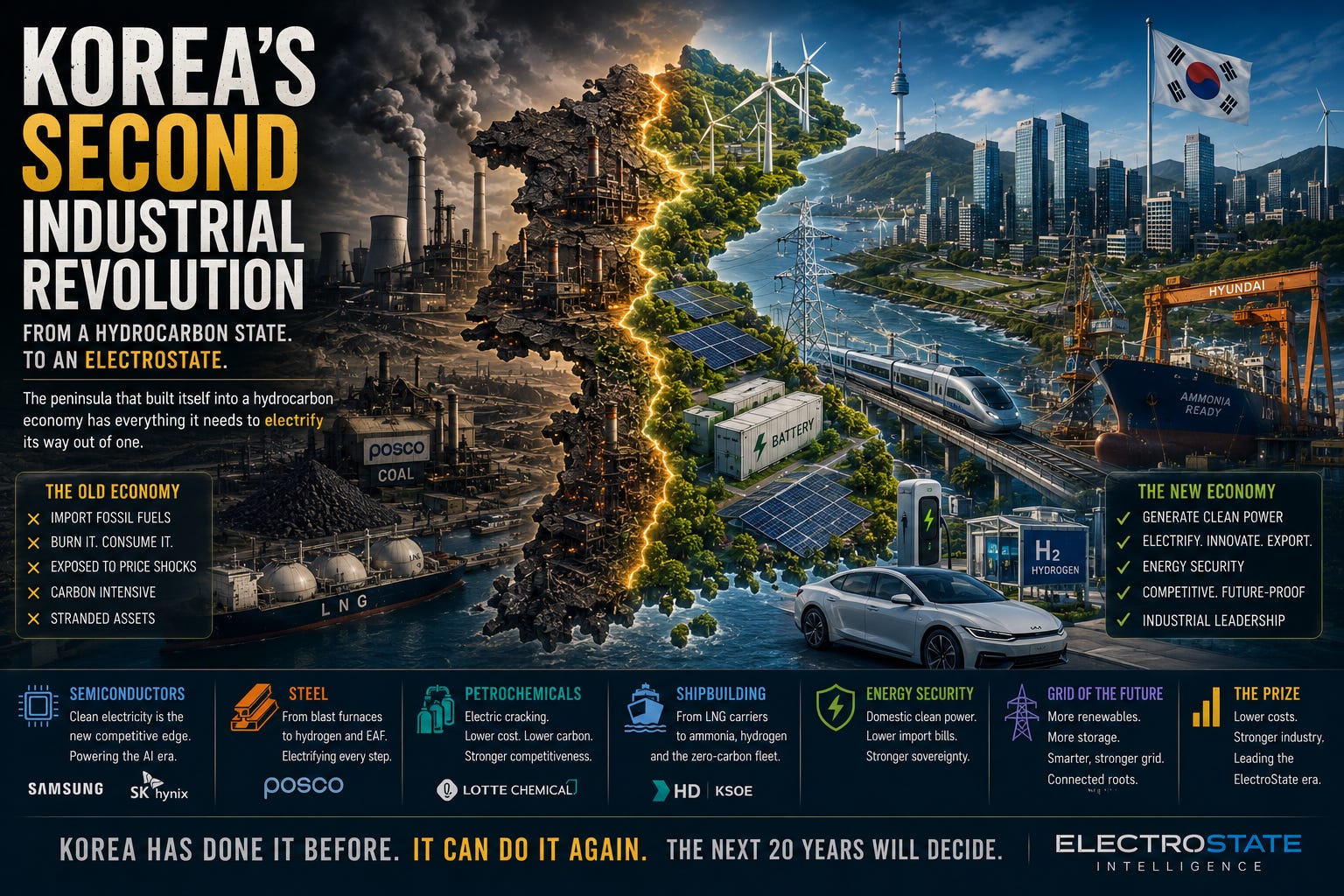
There is a version of the South Korean story that ends badly.
In this version, POSCO’s blast furnaces keep running on coal until they are too expensive to run at all. LNG terminals commissioned in the 2020s become stranded assets in the 2030s. Samsung and SK Hynix — companies that together supply roughly 60% of the world’s DRAM memory — lose data centre contracts to competitors in Taiwan and the Netherlands because they cannot demonstrate credible access to clean electricity. Korean shipyards, the finest in the world, keep building the vessels that carry the fuel the world is trying to stop burning, until the orders dry up. The economy that Park Chung-hee built in one generation is gradually dismantled by the energy transition his successors failed to lead.
There is another version. It is the version this essay is about.
To understand what Korea needs to become, you first need to understand what it decided to be.
In the early 1970s, South Korea was a poor, agrarian country with a per-capita income roughly equivalent to Sudan’s. Park Chung-hee, the military dictator who had seized power in 1961, looked north at an industrialising adversary and south at a region still dependent on raw materials, and made a decision that would define the next half-century. He would channel the full coercive capacity of the developmental state into a single bet: heavy industry.
Steel. Petrochemicals. Automobiles. Machine tools. Shipbuilding. Electronics. The Heavy Chemical Industry Drive of 1973 was not a market outcome — it was a command, backed by directed credit, protected markets, and a bureaucracy willing to pick winners and shoot losers. The chaebol system — the great industrial conglomerates that still dominate the Korean economy — was the institutional vehicle. POSCO, Hyundai, Samsung, LG, SK: all of them carry the fingerprints of that original political act.
What Park built was a Hydrocarbon State by design. Unlike the Gulf monarchies, Korea had no oil or gas to sell. It had no comparative advantage in energy at all. What it had was cheap labour, a disciplined bureaucracy, and political will. It imported the hydrocarbons and turned them into finished goods. Steel from coking coal. Plastics from naphtha. Ships to carry the fuel. Electronics running on coal-fired electricity. The entire industrial structure was an energy-conversion machine, taking in fossil inputs and outputting export revenue.
This is not a criticism. It worked. Korean GDP per capita grew from roughly $1,200 in 1970 to over $35,000 today. It is one of the most remarkable development stories in economic history. But it also means that Korea’s industrial challenge today is not simply a technical problem of replacing one energy source with another. It is a political problem of persuading a system built to do one thing — maximise the throughput of fossil-based industrial production — to do something quite different.
The good news is that Korea has done this before. The developmental state is a tool. The question is whether it can be repurposed.
The paradox at the heart of Korean energy is this: it is simultaneously one of the world’s most electrified industrial economies and one of the most dependent on fossil fuels.
Electricity already accounts for more than 50% of Korea’s total industrial energy consumption — higher than Germany, higher than Japan, among the highest of any major industrialised economy. That figure reflects decades of investment in efficient electric arc furnaces, electric process machinery, and the vast power demands of the semiconductor fabs that are now the crown jewels of the economy. In this sense, Korea is already substantially an ElectroState — in its industrial structure if not yet in its generation mix.
The generation side tells a different story. As of early 2024, Korea had 144 GW of installed capacity, of which 58% was thermal — coal, gas, and oil. Renewables remain a fraction of that. The offshore wind pipeline, which should be the obvious solution for a peninsula surrounded by ocean, has moved slowly due to permitting complexity, grid integration challenges, and regulatory friction. Korea built its grid for a centralised, fossil-fuelled system. It has not yet built the grid for the system it needs.
There is a number that concentrates the mind more than any other in Korean energy policy: 173,260 won per megawatt-hour. That is the industrial electricity rate for high-consumption users, those pulling more than 300 kilowatts, as of December 2024. It represents a 70% increase from 2022 levels, the product of KEPCO’s catastrophic financial position after years of selling electricity below cost while absorbing LNG price spikes. The utility accumulated combined losses of 43 trillion won between 2021 and 2023 alone, and its debt load reached 202.9 trillion won by mid-2024. The 9.7% industrial rate hike in October 2024 was a necessary correction. But it also, for the first time, pushed industrial tariffs above household rates, a political and economic rupture that signals something important: the era of subsidised electricity for Korean heavy industry is ending.
The competitive context makes this uncomfortable reading. China’s industrial electricity price in 2024 ran at approximately $0.088 per kWh — and has since fallen further as the country’s extraordinary renewable build-out floods the grid with cheap electrons. Chinese industrial electricity fell 8.5% year-on-year by mid-2025. Korea’s rate, at roughly $0.12–0.13 per kWh for large industrial users, now sits meaningfully above China’s. This is important for the energy-intensive industries of steel, petrochemicals, aluminium and glass. Every kilowatt-hour differential compounds across millions of tonnes of annual output. German manufacturers have already felt this exposure acutely, with industrial electricity running at roughly twice China’s rate. Korea, which competes directly with China across most of its export industries, faces the same structural squeeze.
The paradox is acute. Korea needs to raise electricity prices to fix KEPCO and fund the grid investment required for the energy transition. But raising prices while China’s renewable glut is actively driving its industrial electricity costs downward puts Korean heavy industry in a vice. The only resolution is to build domestic clean generation fast enough for Korean industrial electricity prices to fall as the grid decarbonises — as happened in Texas, where the wind-heavy ERCOT grid periodically produces electricity so cheap it is effectively free. That is the race. It is not primarily a climate race. It is an industrial competitiveness race.
The new South Korean President, Lee Jae Myung, finalised the 11th Basic Plan for Electricity Supply and Demand in February 2025, which sets a target of 70.7% carbon-free electricity by 2038. Nuclear sits at 35.2% of the planned mix. Renewables at 29.7%. Hydrogen and ammonia — much of it likely to be imported green hydrogen — at 6.2%. It is a plan that reflects the genuine difficulty of Korea’s position: land-constrained, grid-isolated, with an industrial base that requires massive, reliable power rather than intermittent supply.
Korea’s position is genuinely unusual and largely unappreciated in Western commentary on the energy transition. Critically, President Lee Jae Myung has secured President Trump's support for Korea to develop its own nuclear submarines for defence and to enrich and reprocess nuclear fuel to supply both the submarines and its fleet of nuclear power stations. Nuclear power’s share of total generation already rose to 31.7% in 2024, up from 25.9% in 2019. This increase largely offset coal’s decline from 40.4% to 28.1% over the same period. Construction of a new 1,400MW plant, Shin Hanul 3, began in May 2025, and Korea can build nuclear power competitively in a way that almost no other country can currently. The APR1400 reactor design, developed by KEPCO and certified by the US Nuclear Regulatory Commission, has been delivered domestically at reported overnight costs of around $2,300 per kilowatt, and at roughly $4,500 per kilowatt in the UAE under genuinely difficult construction conditions. Compare this to Vogtle in the United States, where two AP1000 units came in at approximately $15,000 per kilowatt, or the French EPR, which has been still more troubled. Korean nuclear is not the over-engineered, schedule-blown liability that Western nuclear has become. It is an industrial product that Korea knows how to make, at a cost that pencils out.
Korean LCOE modelling projects nuclear remaining cost-competitive with coal-fired generation through the 2030s, with fixed offshore wind converging from above around the same period. This matters directly for the industrial competitiveness argument: a grid anchored by cheap, reliable nuclear power providing firm baseload, complemented by growing offshore wind for volume and flexibility, is a grid that can credibly offer Korean heavy industry electricity at a price that competes with China. Nuclear is not a concession to the transition — it is one of Korea’s structural advantages within it. The APR1400 is also an export asset in its own right: operating across four units in the UAE and under active consideration in the Czech Republic, Poland, and Southeast Asia, it represents a Korean industrial product with decades of commercial runway ahead. The risk is treating nuclear as a substitute for renewables rather than a complement: a nuclear-heavy grid without the transmission investment and flexibility assets needed to integrate wind and solar will remain insufficient to meet the demand growth required by full industrial electrification.
But between the plan and the delivery, there is an uncomfortable fact. Renewable capacity increased sixfold between 2013 and 2023. Electricity generated from those assets only tripled. The gap between capacity and output is the grid integration problem made visible. Korea is building generation that it cannot fully use, because the transmission corridors, the market structures, and the flexibility assets needed to absorb it have not kept pace. This is not a Korean peculiarity — it is the same problem that Chile faced with curtailed solar, that Germany faced with wind surplus, that the UK faced with offshore output constrained by an inadequate onshore grid. But for Korea, with no interconnection to a neighbouring grid, it is harder to manage and more expensive to ignore.
The new Ministry of Climate, Energy and Environment, established in October 2025, is an institutional signal. For the first time, climate and energy policy sits under the same ministerial roof, separate from the trade-and-industry logic that previously governed energy decisions. Whether the signal becomes a structural shift that unlocks the flow of electrons is the question that will define the decade.
Korea’s industrial decarbonisation is not one problem. It is four distinct problems under the same name, each with different technical requirements, time horizons, and political economies.
Start with the easy one — easy not because the engineering is simple, but because the market pressure is unambiguous.
Korean semiconductor manufacturing is already almost entirely electric. The fabs in Pyeongtaek and Yongin run on electricity for virtually every process step: lithography, etching, deposition, and chemical mechanical planarisation. The decarbonisation challenge for Samsung and SK Hynix is therefore not about replacing fossil heat with electrons. It is about ensuring that the electrons come from clean sources.
This matters because the global customer base for advanced semiconductors is rapidly demanding it. Apple, Microsoft, Google, Amazon — the hyperscalers and device manufacturers that buy Korean chips in their billions — have all made net-zero commitments that flow down through their supply chains. A chip fabricated on coal-fired electricity is, increasingly, a chip that carries a liability. The carbon embedded in a DRAM wafer is not yet priced into the purchase order. It will be.
IEEFA has been blunt about the exposure: delayed deployment of renewables in Korea could directly threaten the competitiveness of its semiconductor and AI industries as customers tighten their clean energy procurement standards. This is not a distant risk. It is a present one. The semiconductor fabs are already among the largest single electricity consumers in the Korean grid. If they need to source clean power and the grid cannot provide it, they face a choice between building captive renewable generation — expensive and land-constrained — or watching competitors in more energy-progressive jurisdictions gain the contract.
The semiconductor sector is, in this sense, the purest case for the ElectroState thesis. The product is already electrical. The transition is about the source, not the technology. And the commercial pressure to get there is coming from the market, not the regulator.
POSCO is the jewel of Korean heavy industry and the hardest electrification problem on the peninsula.
Steelmaking at scale means high temperatures — blast furnaces operating at 1,500°C, reducing iron ore to pig iron with coking coal as both fuel and chemical reductant. You cannot simply plug a blast furnace into a socket. The decarbonisation of primary steel requires either substituting coal with hydrogen (direct reduction followed by electric arc furnace steelmaking) or a fundamental restructuring of the production process. Neither is cheap. Neither is fast. Korean modelling estimates that achieving net-zero in the steel sector by 2060 increases production costs by roughly 58% compared to the current fossil-based process.
The official Korean pathway runs through hydrogen. The government’s steel decarbonisation roadmap targets commercialisation of hydrogen-reduction steelmaking by 2040 and full transition by 2050. POSCO has announced plans to produce hydrogen-based DRI and has explored partnerships with Australian green hydrogen suppliers. The arc of the strategy is coherent.
But a different story is emerging at the process level, and it is more interesting than the hydrogen headline.
In late 2025, a Korean research team demonstrated an electrified annealing furnace for steel heat treatment that cut emissions by over 98% compared to the gas-fired equivalent — while maintaining the same throughput. This was not a laboratory curiosity. It was an industrial-scale proof of concept for a process that sits in millions of tonnes of downstream steel production: the heat treatment of galvanised strip used in automotive panels, white goods, and construction components.
The broader lesson is that steel decarbonisation is not a single problem with a single solution. The blast furnace problem — primary iron reduction — requires either hydrogen or carbon capture. But the downstream processing problem — all the heat treatment, rolling, annealing, and forming that happens after the pig iron is made — is substantially more amenable to direct electrification. Korea’s industrial base has the engineering depth to lead in both dimensions. The question is whether policy and investment follow the technology rather than waiting for a hydrogen-centred silver bullet that is still a decade and a half away from commercial scale.
Korea’s huge petrochemical industry is centred on the great complexes at Ulsan, Yeosu, and Daesan. They present the most technically interesting electrification challenge on the peninsula, and arguably the one where the ElectroState thesis pays out most directly.
The core problem is steam cracking. Naphtha cracking furnaces operate at 850°C, breaking hydrocarbon chains to produce ethylene, propylene, and other basic building blocks of the plastics and chemicals economy. These furnaces currently burn natural gas or fuel oil directly. They are enormous, long-lived capital assets and replacing them is not a switch but a generational capital cycle.
But the economic case for electrification over hydrogen in this sector is now quantified in the Korean context. Research by the Korean climate think-tank For Our Climate compared electrified naphtha cracking with hydrogen-based alternatives across a range of scenarios. The finding: NCC electrification using renewable electricity, when combined with a 25% reduction in production capacity to reflect global oversupply, delivers cumulative cost savings of up to KRW 128 trillion (roughly $95 billion) compared to hydrogen pathways. Agora Industry reaches a similar conclusion in its work on Korean petrochemicals: electrification is the more cost-effective decarbonisation route wherever it can directly replace fossil combustion, and hydrogen is the more expensive alternative that the industry is defaulting to partly because it preserves existing asset configurations.
This is the electrons-versus-molecules debate with a Korean accent. The hydrogen pathway is politically easier as it does not require admitting that vast amounts of existing capital are becoming stranded, and it gives the industry a longer runway before fundamental restructuring. But the electron pathway is cheaper, faster to deploy once the renewable generation is in place, and more consistent with the direction of global energy economics. A petrochemical complex running on cheap, domestically generated renewable electricity is a fundamentally different competitive position from one waiting for imported green hydrogen at a cost premium.
For Korea specifically, the import-dependency point cuts the hardest. Korea currently imports virtually all of its fossil energy. Every molecule of LNG burned in a cracking furnace is a dollar leaving the Korean economy. Every kilowatt-hour from a Korean offshore wind turbine is a dollar/won that stays.
The Korean shipyards of Hyundai Heavy Industries, Samsung Heavy Industries, Daewoo (now Hanwha Ocean) are the finest in the world. They built the LNG carriers that made the global gas trade possible. They built the VLCCs that carry the oil. They built the container ships stacked with the goods of the hydrocarbon-industrial economy.
The energy transition is about to restructure their entire order book.
LNG carriers will not disappear overnight as the existing fleet will need maintenance and replacement for decades. But the growth of the LNG trade is finite. The transition fuels that will replace bunker oil in global shipping are said to be ammonia, methanol, green hydrogen, and potentially advanced battery systems for short-sea routes. These will require different ship designs, fuel-handling systems, and construction expertise. The yards that develop that expertise first will own the next generation of the global fleet.
Korean yards are well-placed to pivot. They have the engineering talent, the capital equipment, and the industrial scale. Hyundai Heavy has already delivered ammonia-ready vessels. Samsung Heavy has signed development agreements on liquid CO₂ carriers and hydrogen fuel cell systems. The technology trajectory is visible.
But visible is not the same as committed. The pivot requires Korean yards to cannibalise their own existing competencies, make LNG carrier expertise less central than it has been, and invest in engineering disciplines that do not yet have mature commercial markets. The state that built Korean shipbuilding in the 1970s directed capital into industries that did not yet have customers. The same logic applies now. The customer base for zero-emission vessels is being created by regulation of the International Maritime Organisation (IMO)’s decarbonisation trajectory, the EU’s FuelEU Maritime rules, and carbon pricing that is beginning to bite in shipping corridors. Korea’s yards need to be building for that customer before the customer arrives in force, not after.
There is a phrase in the ElectroState framework that applies to Korea with particular force: the grid is sovereignty.
For Gulf states, sovereignty was always a question of who controlled the oil field. For Korea, which has never had an oil field, sovereignty over energy has always been a question of who controlled the import terminal and the price at which LNG and coal could be bought on global markets. The answer, for most of Korean history, has been: nobody in Seoul. The price was set in London, Houston, and Rotterdam.
An ElectroState changes the equation. If the electrons are generated domestically from offshore wind on the western coast, from solar on the southern reaches, from nuclear capacity that Korea already operates at world-class efficiency, then the fuel cost is a domestic variable, not an import price. KEPCO stops being an importer of commodity risk and starts being an operator of domestic generation. The entire macroeconomic exposure to energy price shocks changes character.
Korea’s grid isolation, which appears to be a constraint, is also a feature of this logic. There is no spill-over into a neighbouring system that can absorb surplus or fill gaps. Everything that happens in the Korean grid happens in Korea. The discipline that imposes on system design — you must build flexibility, storage, and demand response because there is no interconnection to bail you out — is also the thing that, once done, creates a genuinely self-contained electron economy.
The bottlenecks are real and they are known. Inadequate transmission and distribution. Power Purchase Agreement frameworks that do not incentivise renewable investment at scale. A Renewable Portfolio Standard that has proven ineffective at driving the quality of deployment needed. KEPCO itself, the sole transmission and distribution operator, is financially stretched and structurally conflicted between its role as grid operator and the interests of the fossil generation it has historically depended on.
The HVDC project, completed in 2024 — 500 kV underground transmission from the western coast to the Seoul metropolitan area — is the shape of the solution. It is expensive. It requires state commitment. But it is also the kind of infrastructure that, once built, is meant to last for a generation. Every additional gigawatt of offshore wind capacity on the west coast depends on that corridor existing. The grid is not just enablement — it is the rate-limiting step.
Here is the argument that the other Korea analysts tend to avoid, because it requires believing something unfashionable: the same political economy that created the problem can solve it.
The developmental state model is out of favour in mainstream economics. It implies industrial policy, directed credit, protected markets, and a bureaucracy with the power and the mandate to pick sectoral winners. All of these things have costs. They create rent-seeking. They insulate incumbents. They misallocate capital in ways that are hard to see until the failure is obvious.
And yet the Korean developmental state achieved something that markets alone almost certainly would not have: it built, in a generation, an industrial base that transformed a poor agricultural economy into a technology-exporting powerhouse. POSCO did not emerge from the market. Samsung did not emerge from the market. They emerged from political decisions that directed capital into industries the market would not have funded at the scale required and the speed required.
The energy transition demands exactly the same thing.
The investment required to build 14 GW of offshore wind by 2030, modernise the transmission grid, electrify the petrochemical complexes, develop green hydrogen infrastructure, and retool the shipyards is not something that the Korean private sector will do on a commercial timeline without a clear state framework. The projects are too capital-intensive, the horizons too long, and the policy risk — the risk that a new government changes the rules — too great.
The institutional signal from 2025 is, in this context, significant. A dedicated Ministry of Climate, Energy and Environment, separate from the trade and industry logic that long subordinated energy policy to industrial protection, represents a structural change in who sets the agenda. Whether it is sufficient depends on what mandate the new ministry actually has: whether it can set electricity pricing, direct grid investment, and impose timelines on KEPCO, or whether it is advisory around the edges of a system still run by MOTIR and the chaebol.
The test case is KEPCO. POSCO was the instrument of the steel-led development strategy. KEPCO is the instrument of the energy transition. A KEPCO that is genuinely restructured — with grid operation separated from generation, with electricity pricing reformed to reflect actual costs rather than politically managed tariffs, with a mandate to build the transmission corridors for the renewable system rather than protecting the economics of existing coal and gas — is the institutional prerequisite for everything else.
Let us be concrete about what Korea stands to gain if it gets this right, because the ElectroState thesis is not primarily an environmental argument. It is an economic one.
Korea currently spends roughly $180–200 billion per year importing energy — oil, gas, and coal combined. That is approximately 12–14% of GDP leaving the economy as payment for fuel that is burned and gone. Every percentage point of that import bill that can be replaced by domestically generated electricity is a structural improvement in the Korean current account. At full industrial electrification, the import bill does not go to zero — there are still raw material inputs and the capital costs of building the generating assets — but it shrinks dramatically, and the capital that remains in the economy circulates through Korean supply chains rather than flowing to Gulf producers, Australian coal exporters, and US LNG terminals.
The industrial competitiveness argument runs alongside this. A Korean steel industry running on domestically generated clean electricity competes in a global market that is moving rapidly toward carbon border adjustment mechanisms. The EU’s CBAM is already in its transitional phase. The tariff on carbon-intensive imports from Korea rises as the EU’s own carbon price rises. A decarbonised Korean steel sector faces no CBAM tariff. A fossil-dependent one faces a tariff that compounds over the 2030s as the EU carbon price climbs. The same logic applies to petrochemicals, aluminium, and cement.
And then there is the export economy of the transition itself. Korea already exports nuclear reactor technology — the APR-1400 design is operating in the UAE and under construction elsewhere. It has nascent offshore wind supply chain capability. It has world-class shipyards that could dominate green ammonia carrier construction. It has battery manufacturing capacity through LG Energy Solution, Samsung SDI, and SK On. It has semiconductor expertise that underpins every intelligent energy management system, every EV, every grid controller. The components of an ElectroState export economy are already present. They are not yet assembled into a coherent industrial strategy for the transition.
That assembly is the political task. It is exactly the task that Park Chung-hee’s generation performed in the 1970s and that Lee Jae Myung has now done identifying the industries of the next era, directing state capacity toward building them, and accepting short-term costs for long-term structural advantage. The difference is that this time, the market is pulling in the same direction as the policy. The transition is happening. The question is whether Korea leads it or lags it.
By 2040, there will be two versions of Korea visible in the data.
In one version, the country missed the window. The 11th Basic Plan’s 2038 targets were hit partially — nuclear held up, but renewables underdelivered because the grid was not built fast enough and the permitting system was not reformed early enough. KEPCO remained a centralised monopoly unable to attract the private capital needed to close the gap. The petrochemical complexes stayed on LNG because the electricity was too expensive and too unreliable for continuous high-temperature industrial processes. POSCO moved some EAF capacity but the blast furnaces kept running because the hydrogen was not there. Korean exports faced rising CBAM costs in European markets. The chaebol lobbied successfully for exemptions and phase-in periods. The transition happened, but slowly, expensively, and behind the curve.
In the other version, the developmental state repurposed itself one more time. KEPCO was restructured, transmission was built ahead of demand, and offshore wind scaled faster than anyone thought possible once the permitting bottlenecks were cleared — just as German wind scaled once the Energiewende created the market, and as US solar scaled once the IRA created the investment environment. Samsung and SK Hynix secured their green electricity supply, held their semiconductor contracts, and used their own energy procurement at scale to accelerate the grid transition. POSCO’s downstream processes electrified first, buying time for the hydrogen DRI pathway to mature. The petrochemical complexes began switching cracking furnaces to electric as renewable electricity costs fell below the LNG equivalent. Korean yards launched the world’s first commercial fleet of ammonia carriers, built to carry the fuel of the clean-energy transition between producers in the Middle East and Africa and consumers in Northeast Asia.
In that version, Korea’s second industrial revolution looks a great deal like its first: state-directed, chaebol-executed, export-oriented, and faster than its critics thought possible.
The electrons are there. The engineering talent is there. The industrial base is there. The question — always, in the Korean story — is whether the political will follows.
end
Nadim Chaudhry is the author of ElectroState: How the Electrification E-Flip, China, Geopolitics will Reorder the Global Economy, examining the global transition from fossil fuels to electrification through geopolitical and systems lenses.
ElectroState.com offer premium intelligence services and consulting for the electrical energy transition
Subscribe for free to receive the latest analysis. Premium intelligence briefing service available at ElectroState.com
No posts
Comments
Nothing yet. Say the first thing.
Sign in to join the conversation.