
The trade war with Washington has done something no domestic policy debate managed to achieve. It has given Canada a genuine sense of urgency about electrification.
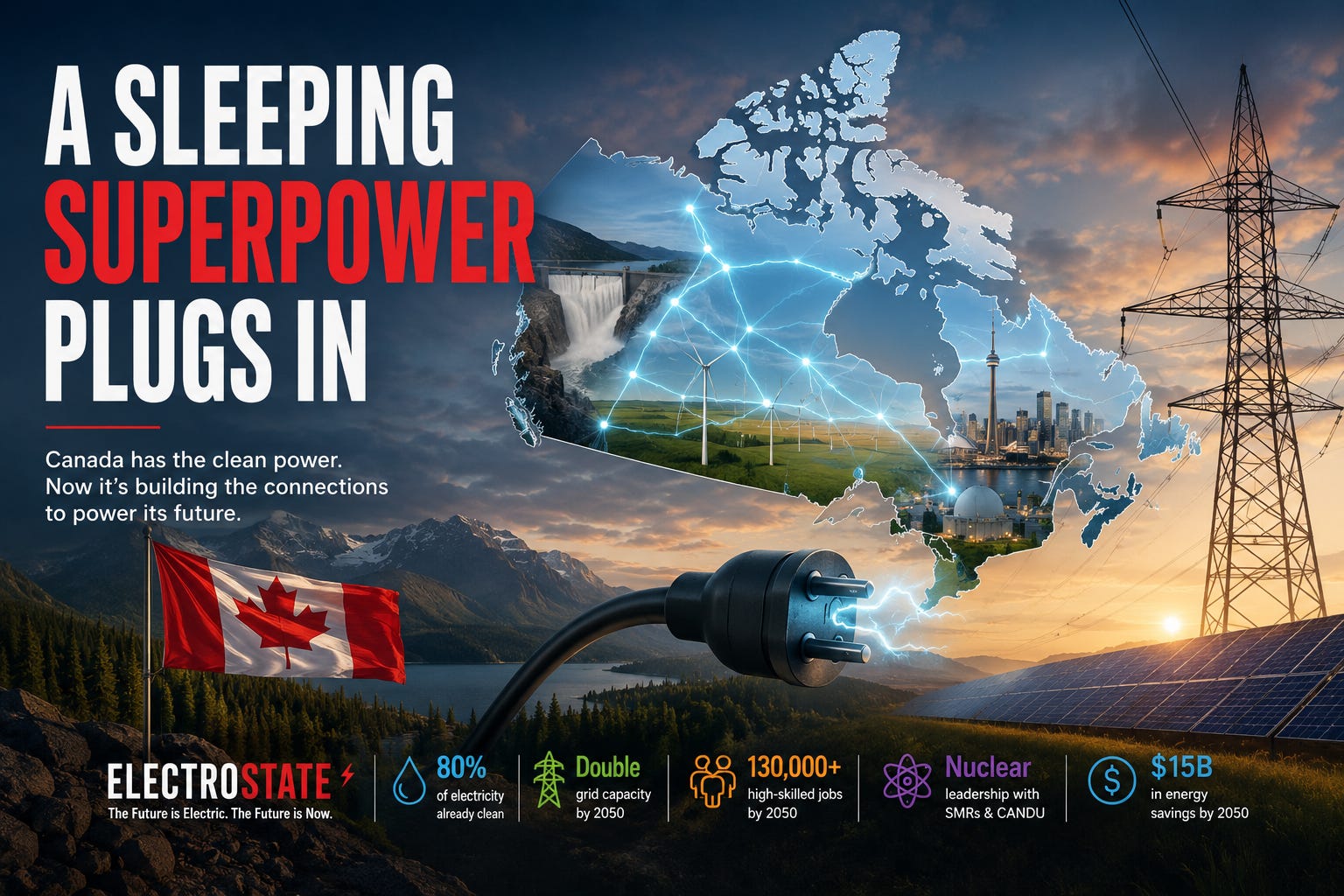
For decades, Canada sat on one of the cleanest electricity mixes in the G7 and did almost nothing with it. Today, roughly 80% of all electricity generation in Canada is already clean. That is an extraordinary starting point. The failure was never the grid’s carbon intensity. It was the grid’s fragmentation.
Canada’s electricity system is currently fragmented across provincial and territorial grids, a structure the federal government says costs billions of dollars in outages, duplicative infrastructure, and wasted power. A country with world-class hydro in Quebec, vast wind potential in the Prairies, and nuclear capacity in Ontario has been unable to move electrons east to west at scale. The provinces built grids for themselves. Canada never built one for the nation.
That is now changing. Rapidly.
On 14 May 2026, the Canadian government announced the launch of a new National Electricity Strategy. The strategy aims to double the capacity of Canada’s electricity grid by 2050 and supply clean, reliable, affordable power across the country for decades to come.
The demand case is straightforward. Canada will need to double the output of its electricity system by 2050 to meet anticipated demand growth driven by electrification, industrial expansion, and the emergence of energy-intensive sectors such as AI data centres and critical minerals development. Electricity demand is expected to double or triple before 2050 as industry, transportation, and heating all shift to electrons.
The interprovincial dimension is where the real leverage lies. The Strategy projects that interprovincial transmission infrastructure could grow by up to 27% by 2035 and 70% by 2050 to support greater electricity trade and coordination across provincial systems.
The economics of connection are compelling. A 2025 study found that doubling the capacity of the BC-Alberta interconnection could yield $1.7 billion in net benefits by 2050, and tripling the capacity between Manitoba and Saskatchewan could yield $2.3 billion in net benefits. At a macro level, a 2020 study found that a $1.7 billion investment in interprovincial transmission could attract an additional $6.6 billion in private funding for transmission alone and an additional $92.5 billion in renewable power over ten years.
The government expects the strategy to deliver up to $15 billion in total energy savings by 2050 and lower total energy costs for 7 in 10 Canadian households. Achieving it will require more than 130,000 high-skilled workers by 2050.
The interprovincial ambition is more than federal rhetoric. A new agreement, initiated by Ontario, brings together British Columbia, Alberta, Saskatchewan, Manitoba, New Brunswick, Prince Edward Island, Nova Scotia, Yukon, and the Northwest Territories to advance new electricity transmission projects and strategic interties across Canada (an intertie is a high-voltage transmission line that connects separate regional electrical power grids).
Specific corridors are already moving. British Columbia and Alberta have a legislated plan to restore nearly one gigawatt of transfer capacity on their 500-kilovolt interconnection by 2026. In the east, the Wasoqonatl Reliability Intertie between Nova Scotia and New Brunswick is supported by $217 million in Infrastructure Bank equity.
On the fiscal side, the November 2025 federal budget included a 15% Clean Electricity Investment Tax Credit for new generation, storage, and interprovincial transmission projects. The Canada Infrastructure Bank’s statutory capital was expanded from $35 billion to $45 billion with a broader mandate for nation-building projects.
Canada’s electrification story has a dimension most Western nations cannot match: a functioning domestic nuclear industry with an export-grade technology base.
Canada is one of only six countries in the world with domestic and exportable nuclear technology portfolios. Construction of the G7’s first Small Modular Reactor has started at the Darlington nuclear site in Clarington, Ontario. The programme is already bucking the Western trend of nuclear cost overruns — Canada’s CANDU refurbishment projects have come in ahead of schedule and under budget.
The regulatory pipeline is advancing. In March 2026, Ontario Power Generation applied to the Canadian Nuclear Safety Commission for a Licence to Operate the first SMR. The CNSC also cleared Regulatory Hold Point 1, authorising OPG to place the foundation for the reactor building and commence civil construction.
On the next-generation CANDU side, the government struck a deal with AtkinsRéalis (the engineering company previously known as SNC-Lavalin) to develop the MONARK reactor, a new CANDU design, providing up to $304 million over four years to cover 50% of the project’s design costs.
The macro numbers are significant. The Conference Board of Canada estimates that a four-reactor CANDU project could boost Canada’s GDP by $50 billion and generate $29 billion in tax revenue.
SMRs are also positioned as the solution for Canada’s vast northern territories. Remote mining operations, Arctic communities, and resource extraction sites all face prohibitive grid connection costs. Modular nuclear changes that calculus entirely. Canada’s Energy Regulator projects considerable growth for SMRs, particularly during 2035 to 2050, with Ontario, Saskatchewan, New Brunswick, and Alberta already aligned on a Strategic Plan for deployment.
Canada does not fit neatly into the ElectroState archetype as defined by China’s model of state-directed vertical integration, or even India’s demand-driven leapfrog. Canada is something different: a resource superpower that is redirecting its infrastructure investment from export pipelines to export electrons.
The geopolitical driver is explicit. The breakdown of the CUSMA relationship under Trump's tariff pressure is accelerating decisions that had been deferred for years. Canada is diversifying its energy trade towards Asia, reconfiguring its industrial base to reduce its dependence on America, and building the grid required to power that transition domestically.
Clean electrification modelling suggests the potential to deliver a 25-35% reduction in primary and final energy, a 65% increase in useful energy, and a doubling of GDP. That is the E-Flip in Canadian form.
The weaknesses are real. Canada’s grid fragmentation is a legacy of provincial jurisdiction, and doubling capacity by 2050 is a 24-year timeline requiring sustained political will across multiple governments. The SMR programme, however promising, has never been deployed at a commercial scale in North America. Workforce shortages across skilled trades remain acute.
But the direction is clear. Canada is electrifying in response to external pressure, which historically tends to be more durable than electrification driven by environmental commitment alone. Industrial sovereignty is a more powerful forcing function than net-zero targets.
Watch the BC-Alberta corridor. Watch the Darlington SMR licence process. Watch whether the east-west intertie ambition survives the complexity of nine provincial governments with competing energy interests.
Canada has the assets. The question is execution.
Gradually. Then Suddenly
end.
Nadim Chaudhry is the author of ElectroState: How the Electrification E-Flip, China, Geopolitics will Reorder the Global Economy, examining the global transition from fossil fuels to electrification through geopolitical and systems lenses.
ElectroState.com offer premium intelligence services and consulting for the electrical energy transition
Subscribe for free to receive the latest analysis. Premium intelligence briefing service available at ElectroState.com
Sources:
Prime Minister of Canada — PM Carney Announces Forthcoming National Electricity Strategy (14 May 2026): pm.gc.ca
Natural Resources Canada — Powering Canada Strong: A National Strategy for an Electrified Canadian Economy: natural-resources.canada.ca
McCarthy Tétrault — Building Out The Electricity Grid: Canada’s New National Electricity Strategy (May 2026): mccarthy.ca
McMillan LLP — Powering Up: Canada’s New National Electricity Strategy: mcmillan.ca
The Deep Dive — Canada to Release National Electricity Strategy Aiming to Double Grid Capacity (January 2026): thedeepdive.ca
New Economy Canada — New Agreement to Connect Provincial and Territorial Power Grids (March 2026): neweconomycanada.ca
Electric Autonomy Canada — Feds Announce National Electricity Strategy (May 2026): electricautonomy.ca
Ontario Power Generation — Darlington SMR Project Updates: opg.com
RBC Climate Action Institute — Atomic Advantage: Canada’s Generational Opportunity in a New Nuclear Age (March 2026): rbc.com
Carbon Credits — Canada’s Nuclear Boom: Big Investments in CANDU and SMRs: carboncredits.com
Canadian Nuclear Association — Operating Power Plants: cna.ca
Canada’s Energy Regulator — Market Snapshot: Canada’s Role in SMR Technology: cer-rec.gc.ca
World Nuclear Association — Nuclear Power in Canada (April 2026): world-nuclear.org
Ken McMullen — Canada’s U.S. Boycott: Delivering Results, Medium (May 2026): medium.com
No posts
Comments
Nothing yet. Say the first thing.
Sign in to join the conversation.