
Getting the Prices Right: The last should be first. The most important focus should be on the models for real-time prices. Only after everything that can be done has been done, would it make sense to focus on out-of-market payments and forward market rules. (Hogan, 2019)1
The neo-classical obsession of electricity economists is price – i.e. to translate the physics into the economics; that price should represent the best estimate of the marginal value of electricity at a particular point in time and space.
The Australian Energy Market Operator has recently proposed a rule change to the calculation of Marginal Loss Factors in the NEM. This, if approved, represents a fundamental shift in the principles proposed to be applied to price formation in market design.
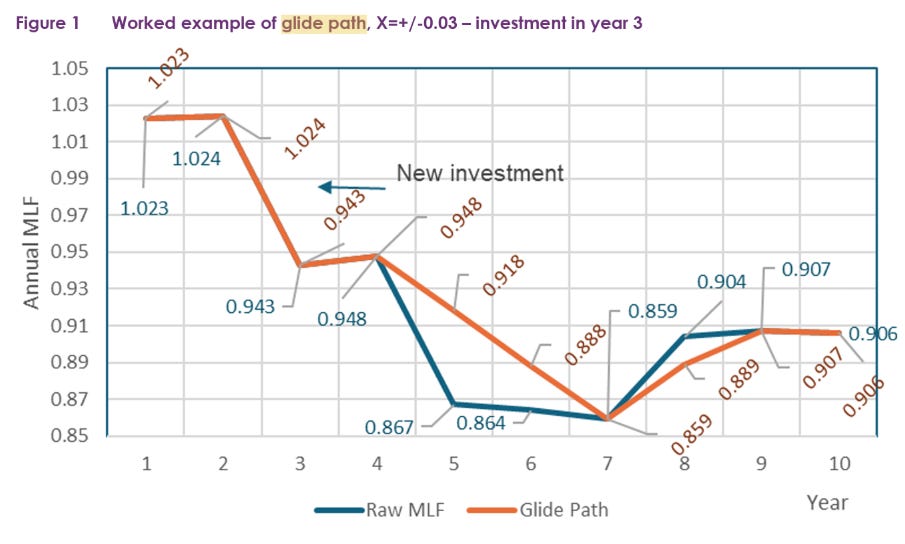
In what is proposed to be a fast-track rule, AEMO proposes that the determination of MLFs be subject to a competing principle of ‘investment stability’; with a ‘glide path’ that would limit extent to which MLFs can shift on an annual basis2.
In one sense, that MLFs have been brought up yet again should be no surprise. It is an old chestnut for NEM regulatory wonks. Yet, when looked at holistically, AEMO is proposing what would effectuate a material shift in the fundamental principles adopted to design electricity markets. While interventions in electricity markets to cap or stabilize prices do happen especially during crises (and often with a political motivation) – this represents the first direct proposal (to my knowledge) from a market operator to form spot prices with the specific objective of creating investment certainty.
To call the NEM’s current pricing model a zonal price does it a disservice. It is an approximate version of nodal pricing, reflecting design compromises of the time. See my prior post on this issue here.
The MLF is a fundamental element of that design, representing an annualised impact of marginal network losses on nodal prices generator and load connection points (CP) 3. It plays a fundamental role in determining prices, revenues and costs:
generator bids are divided by the MLF (vice versa load offers)
prices received by generators are multiplied by the MLF (vice versa for load )
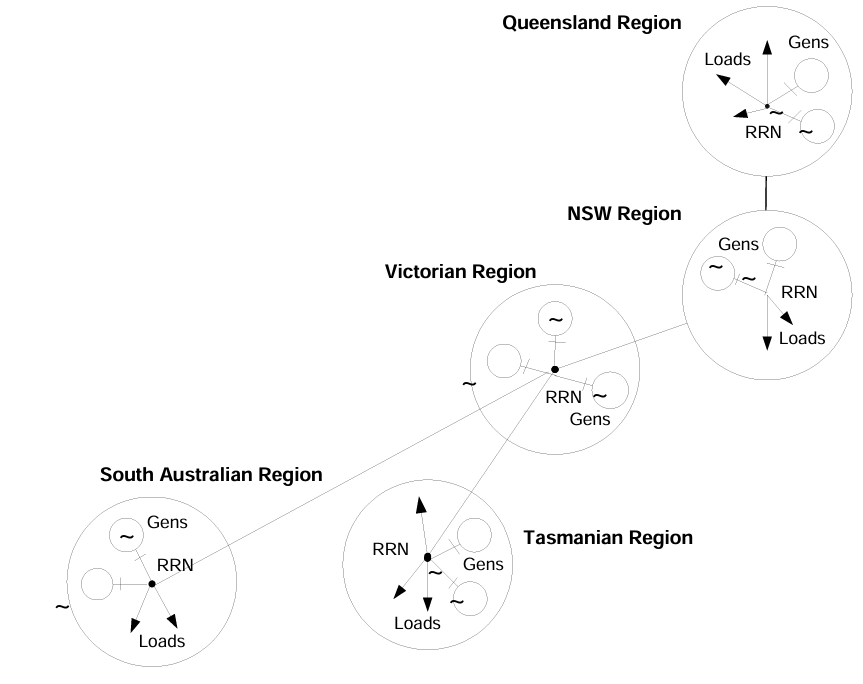
Yet, by today’s standard it is an imperfect and a rather crude approximation of network losses. Many market designs dynamically integrate losses into price formation, reflecting the variations of loss over location and time (and they do vary).
The fact that the MLF is an estimate means that there will be a difference between MLF estimated losses and actual losses. So who bears the difference — it falls into a bucket of charges known as “settlements residue due to intra-regional loss factors”, passed onto network providers, and ultimately recovered or paid to consumers.
MLFs have been a bane of investors in recent years. Renewables in particular have experienced material reductions and volatility in their MLFs. Part of this is fundamental (they been been built in poorly connected parts to the network; and with competitive and often uncoordinated build); and part is not; reflecting the inherent forecast uncertainty. MLFs are an imperfect and static estimate of losses in highly dynamic system.
Another challenge is the inability to financially hedge MLFs. A hedge market for MLFs has not emerged; despite the allocation of MLF risk being a major negotiation point in PPAs/CFDs. This is likely attributable to network effects, and the fact that MLFs are a subjective study of losses under a suite of assumptions (some backward-looking, some forward-looking).
The proposed rule has two fundamental aspects:
a new principle of investment stability in determining MLFs;
which is implemented via a ‘glide path’ that restricts how much MLFs can change on a year-to-year basis.
The former is most interesting to me. Previously proposed to MLFs failed to progress; they always struggled to meet the efficiency test of the National Electricity Objective (NEO) which was previously restricted to a focus on long-term consumer interests with respect to price, quality, safety and reliability.
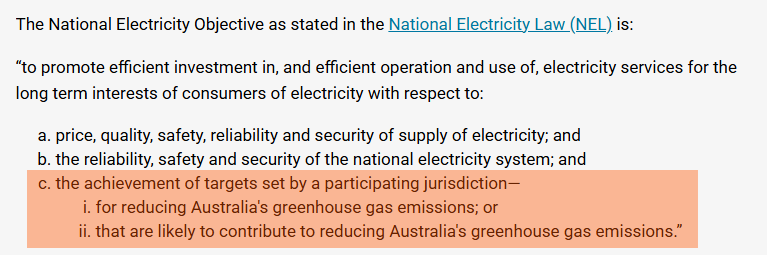
In 2024, a third set of objectives was added to the NEO allowing for specific consideration of the achievement of GHG emissions targets; requiring the rulemaker to explictly consider jurisdictional targets.
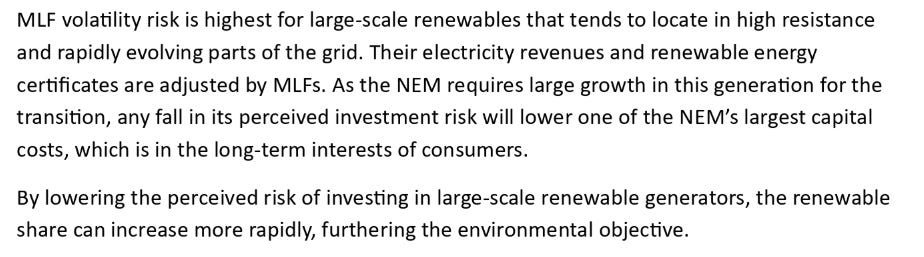
This has been specifically referenced in AEMO’s rule change proposal:
To be fair to AEMO, this has been the subject of long consultation. This proposal caps off over two years of stakeholder engagement and dialogue; and consideration of alternative proposals including a dynamic real-time loss factor.
I also note the proposal has received support from investors and consumer groups. That investors support this proposal should not be suprising, but the submission from the EUAA4 merits focus. While it misunderstands some of the settlement residue impacts it is supportive of the principle of ‘investment stability’ within price formation itself.

This also means that consumers would continue to bear the gap: now between actual system losses and the projected, smoothed estimate of losses.
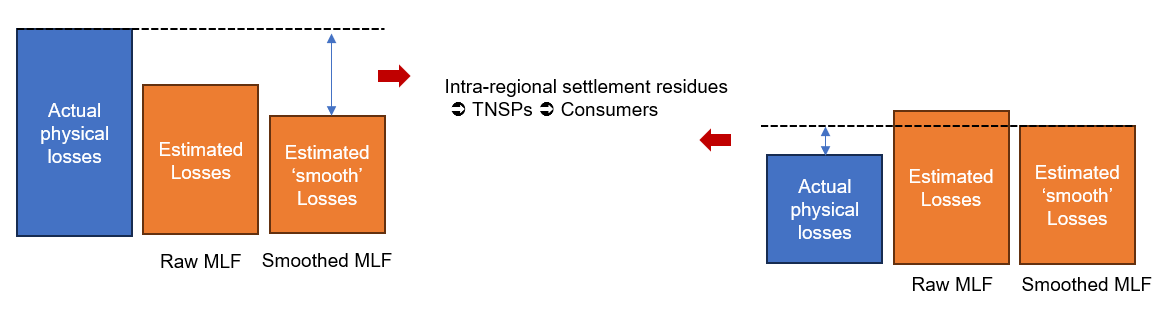
Taken together this represents a shift in perspectives on price formation.
Market design for electricity (as developed by Schweppe and others) is an elegant reconciliation between the physics of electricity and the economic incentives; here price is the critical medium. This leverages upon deep line of research on market design and markets more generally, most notably in Hayek’s view of the signaling value of price.
The Hayek' view of prices is as the critical communication signal for decision-making. It is an economic signal creating the incentives resources to be deployed when and where they need to be. However, it is also a fundamental technical signal that can guide operators, utilities and policy makers. It serves as an indicator of scarcity and congestion to owners, users and decision-makers of the shared-network; aiding in decisions on network augmentation, reinforcement and cost allocation.
Electricity prices are necessarily volatile because of the physics of networks. In theory, properly formed prices that reflect the components of energy, losses and congestion will continue to be volatile over time and space, because that is the fundamental physics problem at play. The physics of loop flow, voltage control, stability etc make the marginal value of electricity a volatile value that varies significantly in time and space and one that is subject to material tail risk.
It is also natural that investors who are risk-averse will seek revenue and cashflow stability. However, an important question lies in how that hedge is provided.
Market design theory makes a sharp disctinction between prices and exposure. Prices are the technical signal. Exposure is how we manage that signal. By creating a strong full-strength price, the technical signal to participants is clear and participants will make decisions based on that spot price signal5. Participants that are averse to the volatility of the price signal can hedge their exposure through trading risk instruments with other participants in the market.
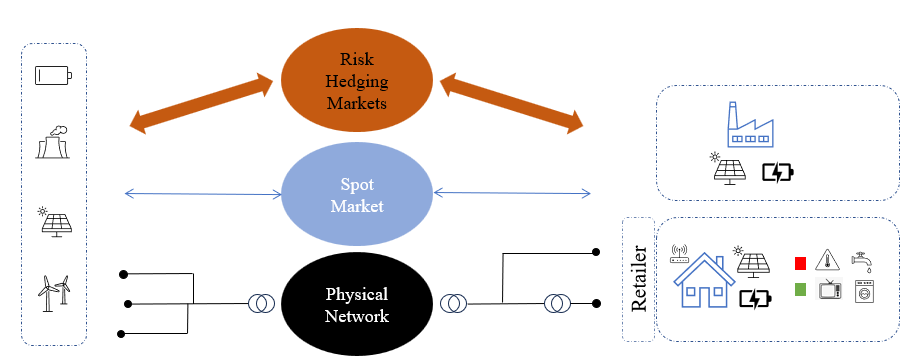
One branch of the theory also recognises that markets may be imperfect or incomplete.6 In such a situation, policy makers may intervene to provide hedges or support mechanisms to mute volatility. However, that such intervention takes place outside of the pricing mechanism is important. Why? Accountability and transparency. Strong and physically reflective price formation provides for clear accounting of the value of any subsidy or risk protection provided by a policy or administrative mechanism. This supports the social license of “the market” itself.
I do note that AEMO will continue to publish the unadjusted MLFs to compare against, but it may be a bit more complex to piece together the counterfactual impact on investment decisions.
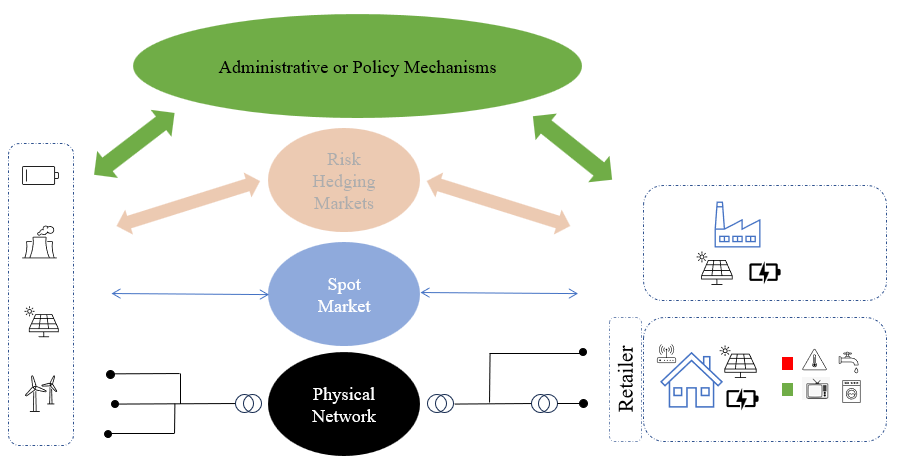
The inability to hedge MLFs suggests there may well be an incomplete or missing market. Yet, important to recognize as well that MLFs may themselves be the cause.
An obvious solution would be to incorporate losses directly in the Security Constrained Economic Dispatch (SCED). This would eliminate MLFs and instead incorporate losses directly and dynamically into dispatch and prices. This would also allow losses to be implicitly hedged via derivative and contract markets, because its now in the price.
However, a common challenge is inertia (not the power system frequency kind). As is argued in this case, as well as many others, the cost of system change relative to the benefit is perceived as too onerous. So the ‘glidepath’ is intended to reflect a practical compromise. This inertia also reflects in many other choices that are hard to change once embedded in market designs and sunk investment decisions; recent efforts to provide more spatially granular price signals provide an apposite example.
This is a fundamental dilemma of electricity market reform today, and MLFs are not the only rule change to reflect such compromises. It is equally worth reflecting that market design has always taken place in imperfect systems, and compromises have always been a part of market design.
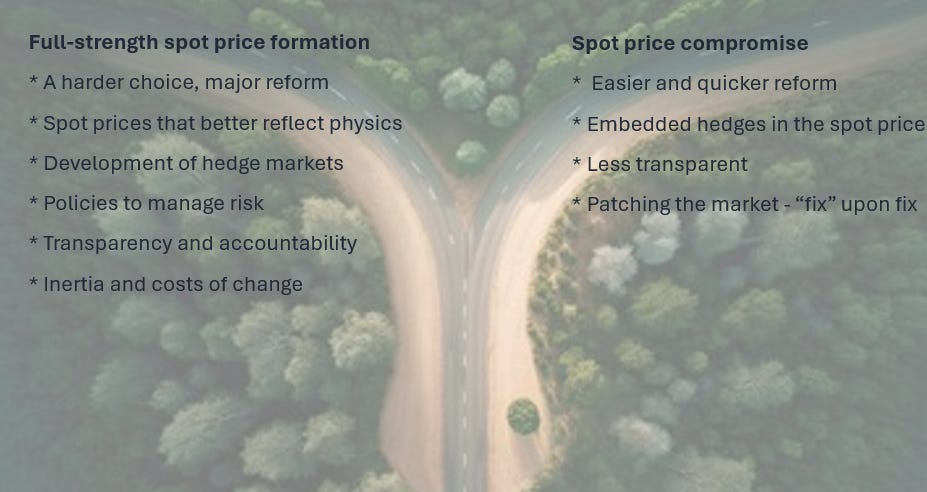
More broadly it reflects a pathway problem - do we look to restructure towards markets that provide the proper techno-physical signal with external policy mechanisms; or do we incorporate policy within the price signal itself. The new NEO seems to provide a new dimension to this; in the absence of a price on emissions it is proposed as a means to justify the latter - that is the direct provision of investment certainty within the price signal. It will be certainly be interesting to see how this evolves for electricity market design.
William Hogan, (2019) Electricity Market Design: Price Formation, International Workshop on Electricity Sector Modernization Ministry of Mines and Energy Brasilia, Brazil. https://www.gov.br/mme/pt-br/arquivos/7-hogan-brasilia-price-formation-090419.pdf
AEMO has a comprehensive website on this at https://www.aemo.com.au/energy-systems/electricity/national-electricity-market-nem/market-operations/loss-factors-and-regional-boundaries/marginal-loss-factor-framework-review
I also recommend the AEMO link for why Marginal rather than Average loss factors were adopted, as well as work by Ben Skinner here.
Energy Users Association of Australia
Hogan, William W. “Competitive electricity market design: A wholesale primer.” December, John F. Kennedy School of Government, Harvard University (1998).
Joskow, P. L. (2022). From hierarchies to markets and partially back again in electricity: responding to decarbonization and security of supply goals. Journal of Institutional Economics, 18(2), 313-329.
No posts
Comments
Nothing yet. Say the first thing.
Sign in to join the conversation.