
My prior post on auctions and electricity markets here highlighted some of the innovations in auction theory applied to products like telecoms spectrum and financial instruments to improve resource allocation. Here we examine how different price formation mechanisms can affect incentives and auction efficiency.
Competitive two-sided markets with multiple buyers and sellers make the work of the auctioneer easier, where simpler structures designed to encourage transparency and liquidity can still allow price discovery. The more complex situations arise with an intermediary acting as an agent for the consumer (or seller).
Capacity auctions most notably suffer from this incenctive dis-intermediation where the ‘capacity demand curve’ is an administrative setting (informed of course by studies and estimates but not directly by consumer preference). Centralised auctions for electricity hedges fall in to a similar bucket, where a central agency sells or purchses hedges; with the consequent risk exposures borne by consumers.
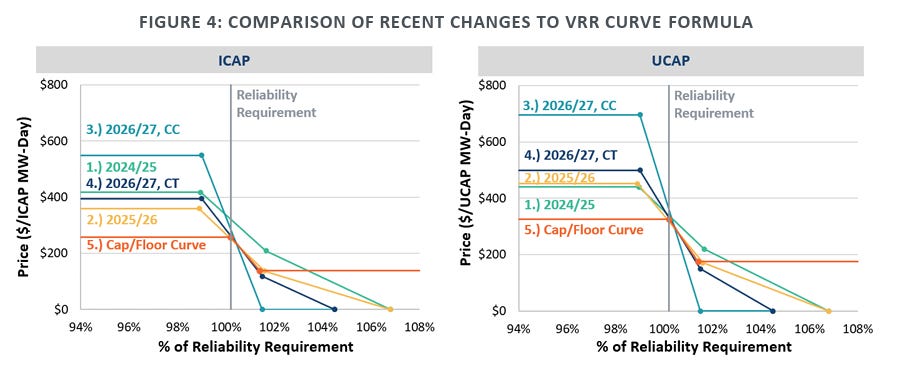
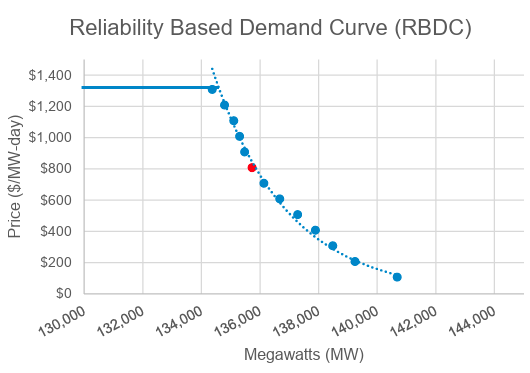
An illustration of recent changes to PJM’s VRR curve and of MISO RBDC above; the calculations of which are based ultimately on the ‘1-in-10 year reliability standard’ for which the basis still remain quite obscure1.
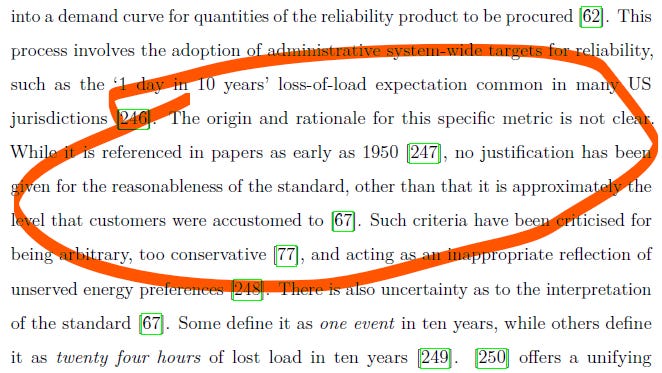
Where demand is administratively set (effectively a one-sided market), it is more important the auction creates the right incentives for bidders; to bid truthfully and inline with their true valuation of the product. For capacity auctions this value should reflect the ‘missing money’ of each resource; for hedges it should reflect the price needed to meet its the risk-adjusted costs-of and costs-on capital. This is the ‘incentive compatibility’ property.
Consider an auction for an electricity product, say a hedge product or ‘capacity’, (though note the implicit challenge of equating capacity with resource adequacy).2
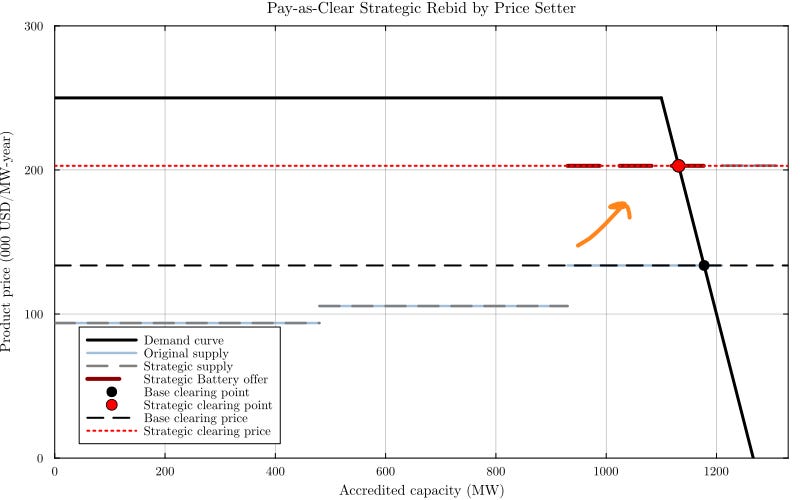
The below illustrates marginal price clearing (pay-as-clear) formation. (Note: The resource assumptions are not calibrated, its just an illustration). In an idealised setting, this provides good incentives for revealing costs. Participants are paid on the marginal clearing price; bidding higher than cost creates no extra value.
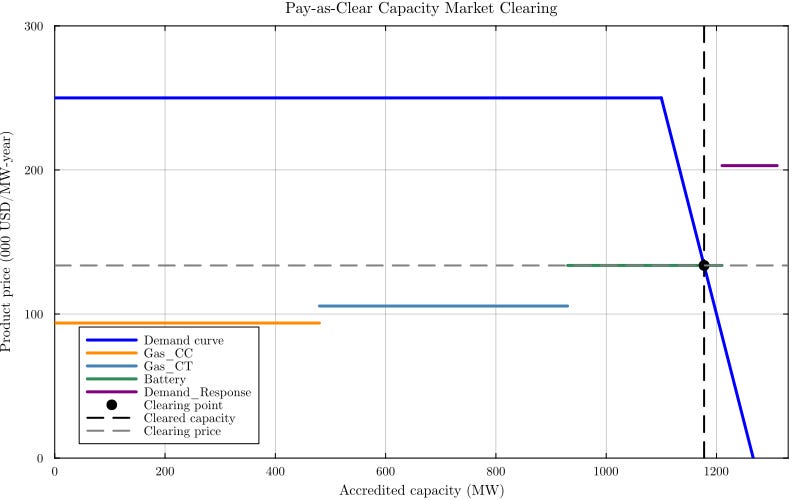
The challenge arises though with illiquid, concentrated markets and those where participants can exercise market power. In the example below, the marginal bidder can revise her bid (above cost) to form a higher marginal price and thus extract further rents from the auction. Of course the below is in a simplistic and deterministic setting; and the ability to extract these rents is impacted by many factors including supply curve uncertainty. However pre-publishing demand curves could work to reduce some of that uncertainty.
An alternative pricing approach is a pay-as-bid (or a discriminatory) mechanism, under which each cleared generator is paid its own offer price rather than a common clearing price. At first glance, this may appear to reduce system costs, but it relies on a naive intuition that generators continue to bid their true costs. In practice, rational participants anticipate that payments are tied directly to their submitted offers and therefore have an incentive to bid above their cost.
One price formation alternative for stronger incentive-compatibility is the Vickrey-Clarke-Groves (VCG) auction3. The most evident real-life application of VCG is for online advertising.
Here, prices are not formed by the marginal bidder, but instead pays each resource according to its marginal contribution to total system welfare. The VCG payment is therefore linked to the reduction in system value that would occur if the resource were unavailable.
Formulaicly, the VCG payment for resource g can be interpreted as:
\(\text{VCG Payment}_g = W_{-g} - \left(W - C_g\right)\)
W is total welfare when all resources are available; W_-g is total welfare when resource g is removed; C_g is the offer cost of resource g in the original solution.
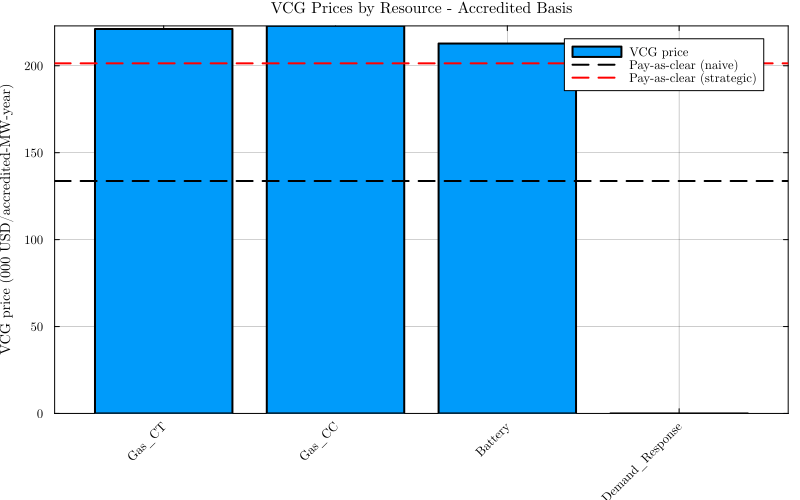
Where VCG is applied participants have muted incentives to ‘game their offer’ because it directly reduces its system value and impacts their payment. Though it may not always reduce total cost of the auction; applying VCG to the example above results in prices paid that are still above the marginal price when strategic bidding is incorporated.
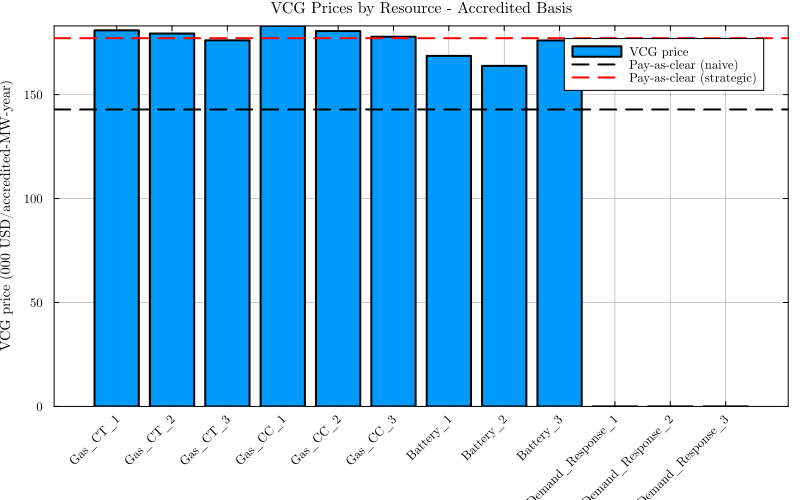
Though, in larger markets, this problem can be naturally muted with the size of each participant.
As with anything, it is no panacea. Its vulnerable to strategic collusion. Coordination and tractability also are important factors, which is one of the reasons it has struggled for practical application in markets like spot electricity markets. Additionally, while price formation mechansims can improve the alignment of incentives, consider importantly whether the problem core relates to how the auction is clearing, whether the auction product itself is properly defined, or whether it relates to fundamental distortions or incompleteness in the market.
However, where the challenge is fundamentally an auction design problem thinking more openly about appropriate alternative price formation mechanisms can create a pathway to extracting better value for consumers and the system.
Billimoria, F. (2023). Insurance Mechanisms for the Reliability of Electricity Supply. University of Oxford (United Kingdom). See for demand curve reports: Spees, K., Newell, S., Thompson, A., Snyder, E., & Bartone, X. (2025). Sixth Review of PJM’s Variable Resource Requirement Curve. New York, USA: The Brattle Group. Taylor, A. (2025) A Brief Review of MISO’s Reliability Based Demand Curve (RBDC) Implementation, MISO. https://www.in.gov/iurc/files/2.-A-Brief-Review-of-MISO-RBDC-Implementation.pdf
See Shu, H., & Mays, J. (2023). Beyond capacity: Contractual form in electricity reliability obligations. Energy economics, 126, 106943.
For more detail see here: Sessa, P. G., Walton, N., & Kamgarpour, M. (2017). Exploring the Vickrey-Clarke-Groves mechanism for electricity markets. IFAC-PapersOnLine, 50(1), 189-194. Also in part attributable to William Vickrey’s Nobel prize: https://en.wikipedia.org/wiki/William_Vickrey
No posts
Comments
Nothing yet. Say the first thing.
Sign in to join the conversation.