
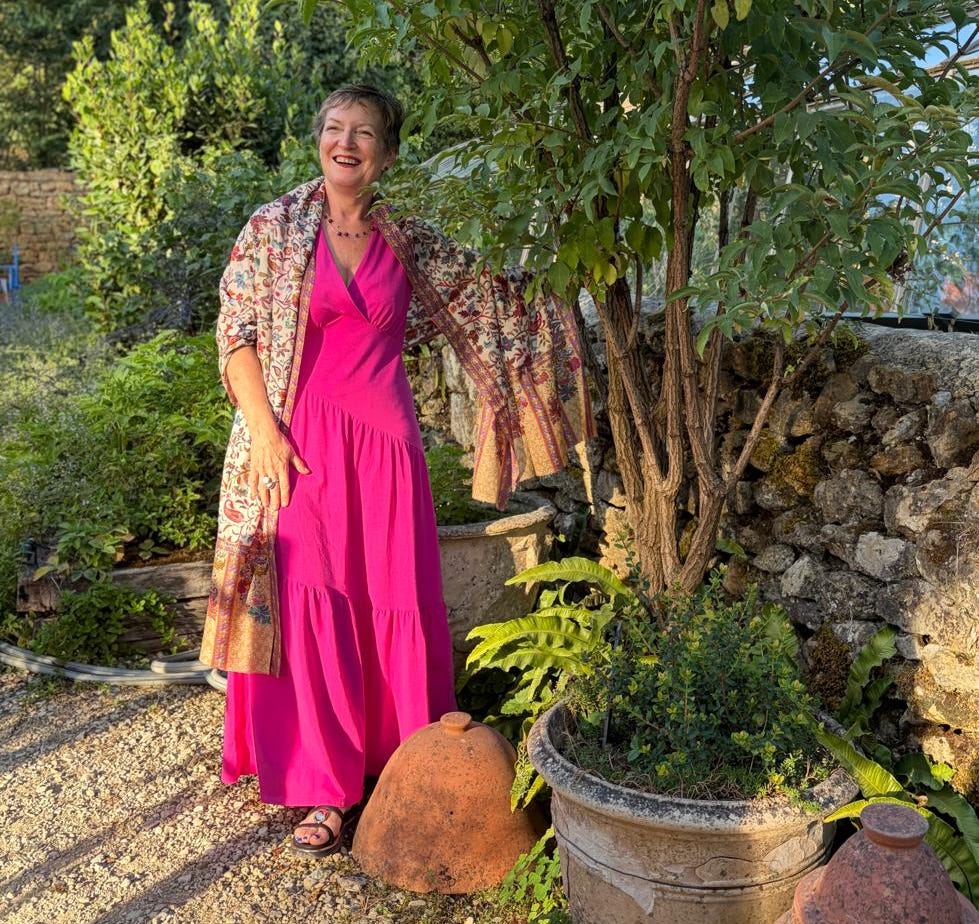
I turned 65 last week, an age at which almost everything I read tells me I should be downsizing: decluttering, simplifying, Swedish death-cleaning, getting rid of the accumulated stuff of a life and preparing, presumably, to take up less space. We’re doing the opposite.
We upsized.
Bought a country house, are filling bedrooms, planting things, buying reading chairs and hauling home rococo antique mirrors. Partly because, after a glorious week with my little Glam’daughter this summer, we are hoping for years of grandparenting à l’anglaise: grandchildren coming to stay, muddy boots and dogs and favourite bedrooms, friends around the table, family spilling into the garden. Children growing up with memories of a place that becomes, somehow, part of their own childhood.
I’ve done this before. Years ago I bought a summer house in Chautauqua to gather my geographically scattered family, where my kids could hang out with grandparents and cousins and generations could overlap. Oakdene is the latest iteration of this same ‘gathering’ thread - except this time I’m the grandparent, and the clock feels different from this end.
If Q3 runs roughly from 50 to 75, I’ve just entered its last decade. I’m banking on another ten years of healthy, energetic, peak-ish time; maybe I’ll get 30, maybe I won’t get 10. The man is seven years older than me, so neither of us is particularly interested in postponing the good stuff. We want to milk the time we have left, with all we still have to give and share.

Last week, in Seeing the Weave, I wrote about Lynda Gratton’s lovely metaphor of a long life, made up of productive and nurturing threads. One of the privileges of getting older, I suggested, is finally being able to stand far enough back from the life we’ve made to see its patterns — the themes, people and preoccupations that recur, sometimes without our noticing them at the time.
I’ve been thinking since about what comes next. Because perhaps Late Q3 isn’t only about seeing the weave we’ve already created. Perhaps it’s also when we become much more intentional about what gets woven in next — and for whom. And when we start preparing, consciously, for Q4.
Time no longer feels infinitely expandable. Neither does energy or, frankly, patience. And I can feel this creating a kind of hyper-mindful selectivity in me, about… everything: work, friends, invitations, money, travel and, it turns out, furniture. Does this deserve a day? A year? A wall? A call? A piece of the next decade?
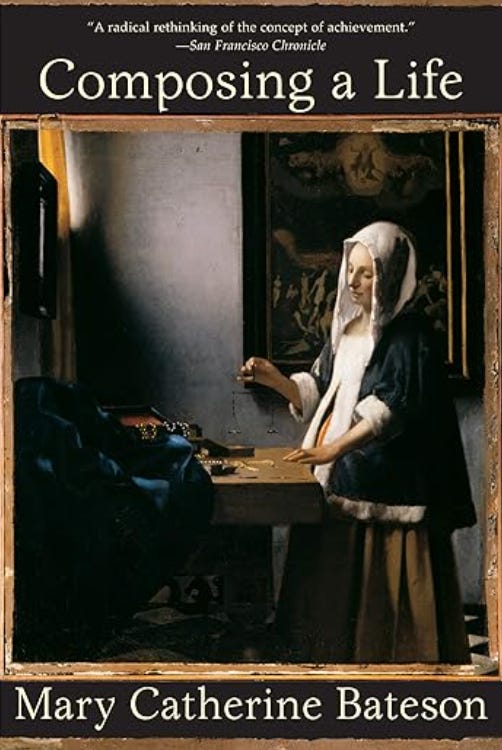
That isn’t quite the same as simplifying. It feels more like composing. No surprise Mary Catherine Bateson’s Composing A Life is one of my favourite books.
I’m not really slowing down. That’s another bit of the ageing script I don’t particularly recognise, despite my Substack friend Denise Taylor making a compelling case for it — while conspicuously failing to follow her own advice. I am, however, balancing differently, and increasingly asking what the time, money and experience we’ve accumulated are for.
On the financial side, that means figuring out what we need so that we can understand what we can give, support, loan and spend. On the work side, it means becoming choosier while remaining as ambitious as ever about impact. I’m on the Advisory Board of a new Healthspan Festival, working on building something like my Midlife Rethink programme for India, teaching at Oxford Said and exploring how we can scale our Longevity Leadership Programme from Lisbon through other business schools. These are the kinds of projects that interest me now: ideas that might travel, multiply and matter beyond the hours I personally put in.

Maybe ambition itself changes shape. I’m no less ambitious than I was, but I’m increasingly uninterested in proving or accumulating. I want to contribute, to build things that might scale beyond me, and to put my time and experience behind ideas capable of having an impact. It’s not less ambition. If anything, it’s ambition sharpened by a clearer sense of time. I’m starting to take deadlines much more seriously.
Which brings me, obviously, to the carpet.
I’ve been composing my study at Oakdene. It’s becoming the Elderberries Room, where I will write this newsletter, Zoom around the world, think, read and work — and, if all goes according to plan, occasionally do absolutely nothing.
Somewhere between choosing a carpet and buying a £2.50 cushion in a charity shop this week, I realised I was composing this little room in exactly the same way I’m trying to compose Late Q3. It’s an exercise in layering, remembering and embracing. Almost nothing in it has been bought because it “goes”. Instead, things seem to be earning their place because of the threads they carry into the room with them.
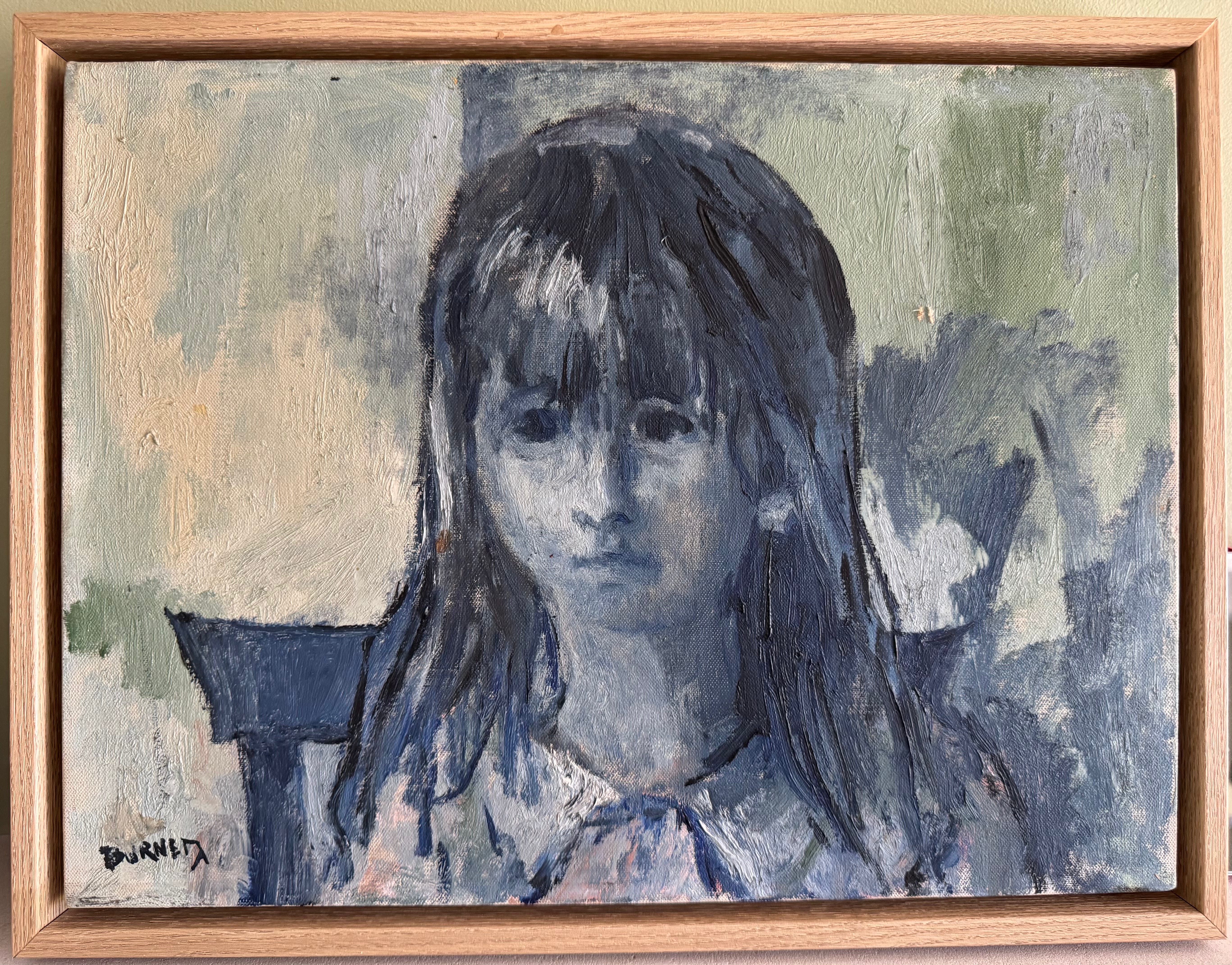
First, this girl. She came from my mother and the man had her beautifully reframed for my birthday. One of the more touching gifts of my life, this inter-generational care and legacy-shouldering. I don’t know much about it, except that it hung in my mother’s living room all my life. When my mother asked me what I might like after she died, I pointed at this portrait, seeing in her some inner part of my mother’s story - and my own. I suspect my father gifted it to her after I was born - the girl she had always wanted (she had my name ready before my eldest brother was born and had to wait two kids later to be able to bestow it).
The painting is by Louis Anthony Burnett (1907–1999), an American painter known particularly for his portraits of women and girls. Burnett was a mid-century figurative artist who exhibited at the Whitney and the National Academy. His portraits are characterised by subdued palettes, quiet light and psychological restraint. Mine seems to be typical: a solemn young girl emerging from washes of blue-grey, cream and dusty pink.
Only now, sixty years later, with the help of AI, I just discovered her provenance, sitting in a study already gifting me new understanding. One of those magical moments when new technology reaches backwards into an old life and illuminates something that has been talking quietly to me for decades.
She’ll hang in my Room With A View. Her colours perfectly echo the green walls I chose as a palette for my study. As the room comes together, everything else seems to be arranging itself around them.
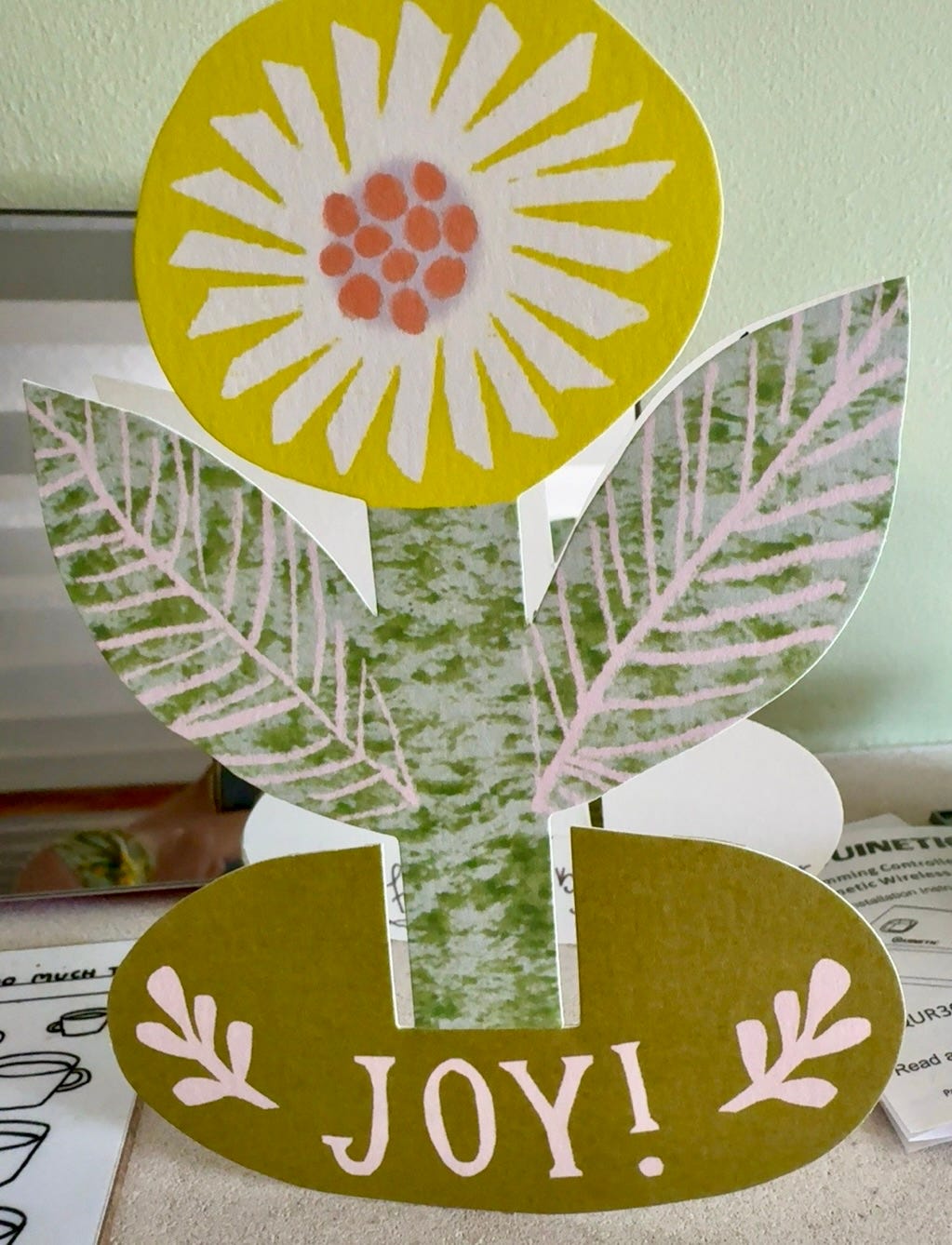
Then Juliet, my oldest friend, gave me this card when she came for a birthday visit. We’ve been friends since we were three. JOY!, it announces, in pink and acid yellow, surrounded by greens, and it happens, absurdly, to contain almost the entire emerging colour palette of the room.
But that’s not why I’m keeping it. I’m keeping it because there is something extraordinary about having someone in your life who knew you before you knew yourself. At this age, I’m increasingly conscious that our oldest friendships aren’t simply relationships; they are repositories, carrying versions of us that no one we meet now can ever know. Juliet’s card has earned its place and reflects her decades-long knowing of me.
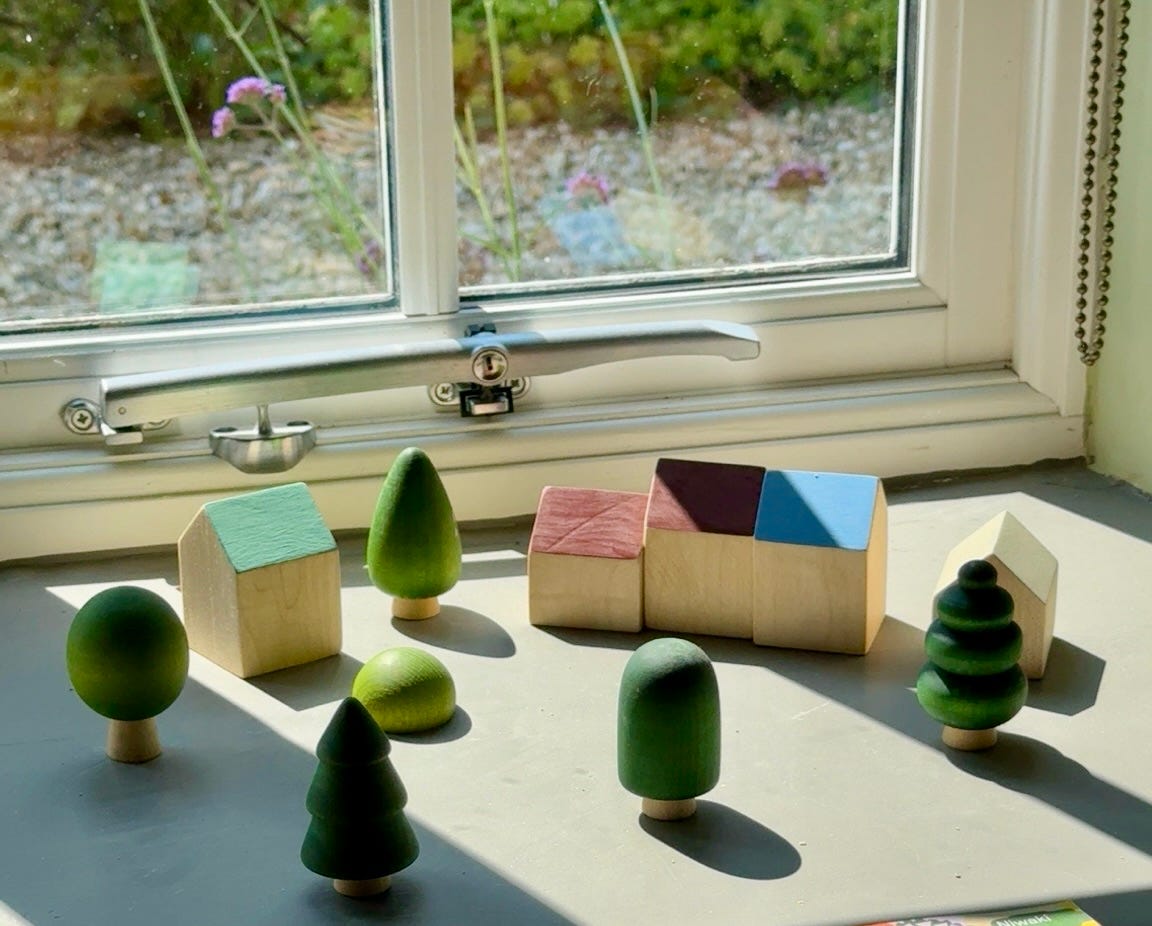
The man found me these little wooden houses at my favourite little shop, Made Found, in Wincanton. They now sit on the windowsill, making tiny coloured shadows in the afternoon sun: a little model of the hope and dreams we’re building together, inside the home we’re building together, in the forefront of the view from my room.
And because apparently even our knick-knacks got the memo, they too are green and dusty pink and smoky blue and natural wood. The palette seems to be composing itself without much help from me.
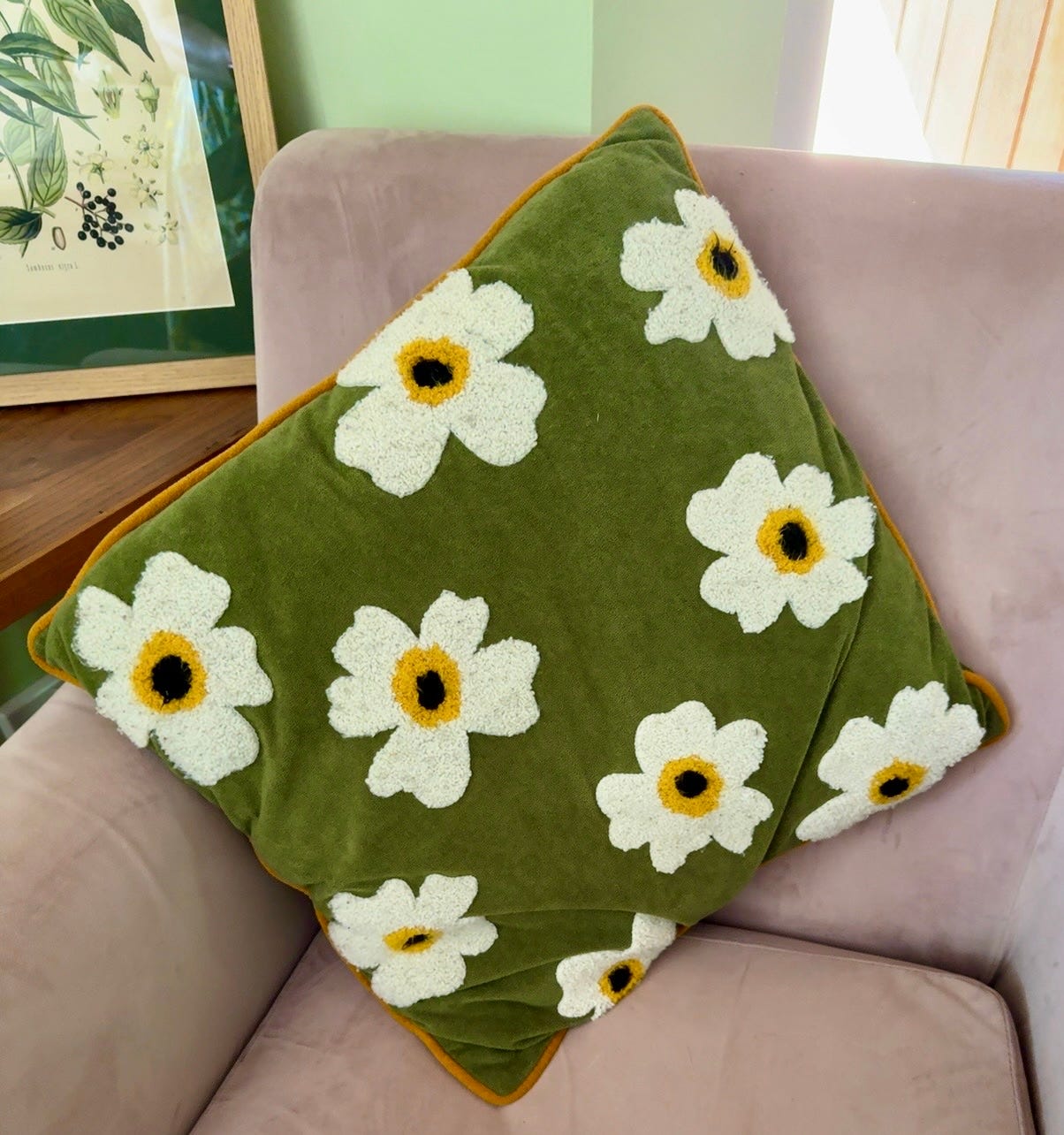
Then there is this cushion: olive green, woolly white daisies, black centres and mustard piping. It cost £2.50 in a charity shop. On sale. It pulls half the room together and makes me smile every time I look at it.
Which is a useful reminder that mindful curation isn’t about buying expensive things, “investment pieces” or even particularly good taste. It’s about resonance. Some things earn their place because they’ve travelled through generations, some because they’ve travelled through friendships, some because somebody you love spotted them and thought of you, and some because they cost £2.50 and are completely fun and fabulous. And make your heart sing.
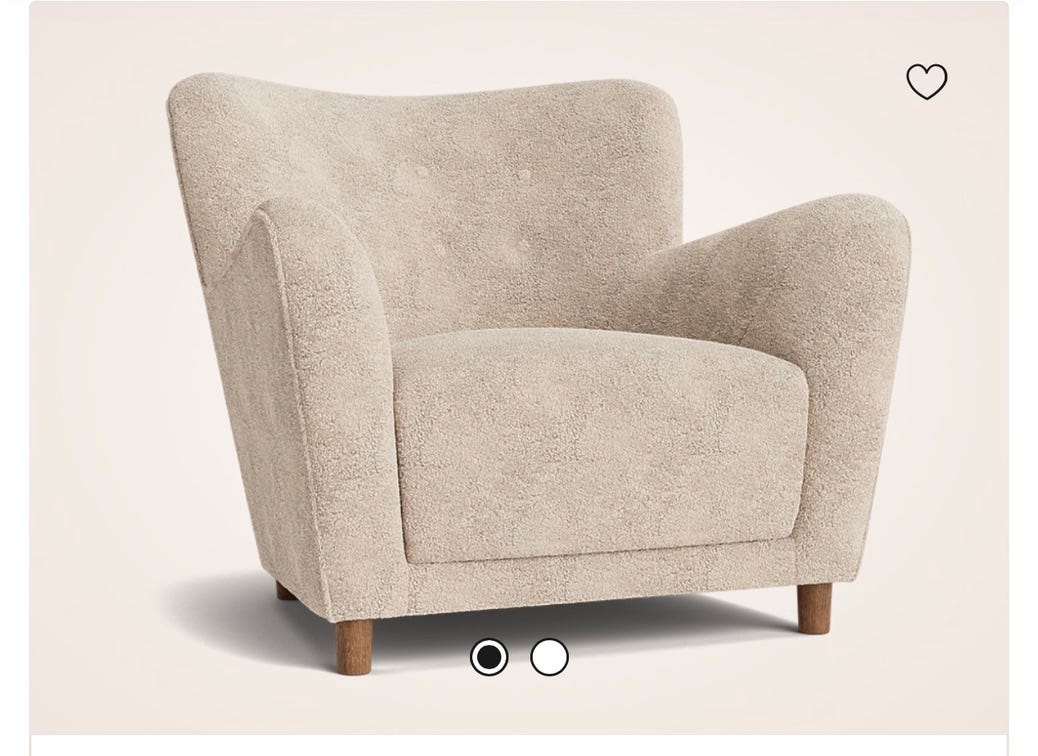
Then there’s the chair. My new friend Lucy Ryan has this Loaf Shearer, and the first time I sat in it at her house I had one of those wonderfully uncomplicated moments of recognition: THIS! I wanted one. Mine is enormous, cream and curly lambswool, with a matching pouffe, and I plan to spend a considerable portion of Late Q3 curled up in it.
But Lucy’s presence in the room feels significant for another reason. We’ve only recently become friends, and this autumn we’re launching a new 60+ group together for NOON. One of the joys of this stage, I’m discovering, is that curation doesn’t mean closing the collection. Juliet has known me since I was three; Lucy has arrived in my 60s. I want both in the weave. The richness is precisely in the mixing: old friends who carry versions of us stretching back decades, and new friends who open doors onto versions of ourselves we haven’t met yet. The same is true of this room — my mother’s painting beside a newly discovered antique, old wood beside a brand-new chair, memories beside possibilities. The things we keep needn’t all come from the past. Some earn their place because they point towards the future.
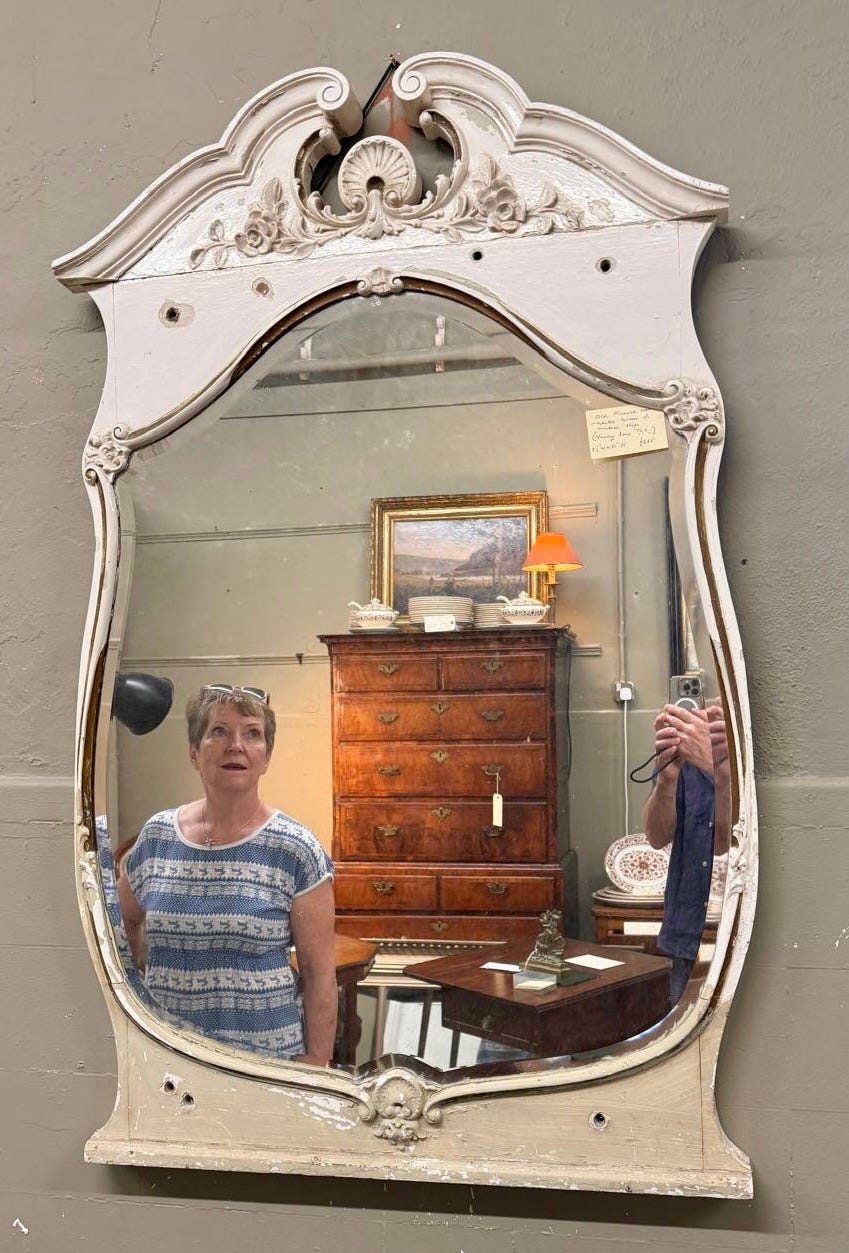
Then there’s the slightly mad old French mirror I found in a small antique shop near Semley. I’ve written about it before. It’s battered and imperfect, its old white finish worn through in places, and much grander than anything I would normally imagine myself buying. AI helped me explore the rococo history behind its exuberant curves and carvings and understand a little more about what I was looking at. The man is fixing it up in his new and much-beloved workshop.
It will hang opposite the window, which means that when I’m sitting in the Shearer I should be able to see the great oak tree outside reflected back at me. I love the thought of an old mirror reflecting a living tree into a new room: past and present, indoors and out, all caught in the same frame.
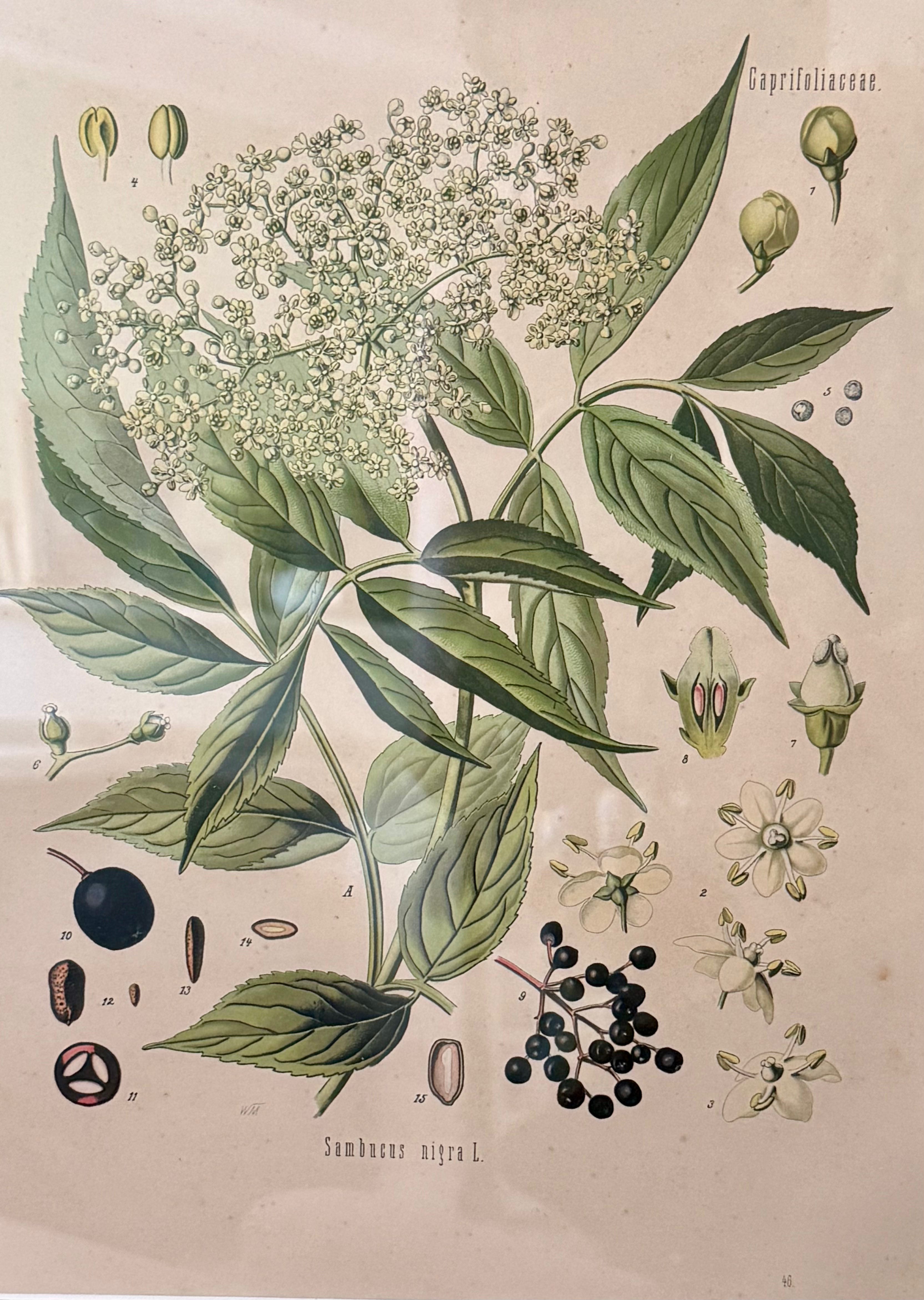
And finally, the elderberry itself. For my birthday, the man thoughtfully gifted me this botanical image of an elderberry (it’s becoming a theme in my life), and only after I’d put everything together did I really look at its colours: sage and olive leaves, creamy flowers, almost-black berries, tiny touches of dusty pink, all held in natural wood.
There was my room. There was also, of course, Elderberries.
I hadn’t planned any of this, which takes me straight back to last week’s weave. We like to think we design our lives, but increasingly I suspect we make thousands of small choices and then, if we’re lucky and live long enough, eventually become able to see the patterns emerging between them. Perhaps the trick in Late Q3 isn’t to start controlling the weave, but to become more conscious of which new threads we choose to introduce.
And then there is the extraordinary new pleasure of being able to see the composition before it exists. I’ve been feeding Sol, my AI accomplice, photographs of the room and its accumulating cast of characters — my mother’s painting, the old French mirror, Lucy’s Shearer chair, the colours of the elderberry print — and asking it to pull them together, move things around and audition carpets beneath them. Suddenly you can see whether something adds a competing voice or brings the whole room to visual serenity.
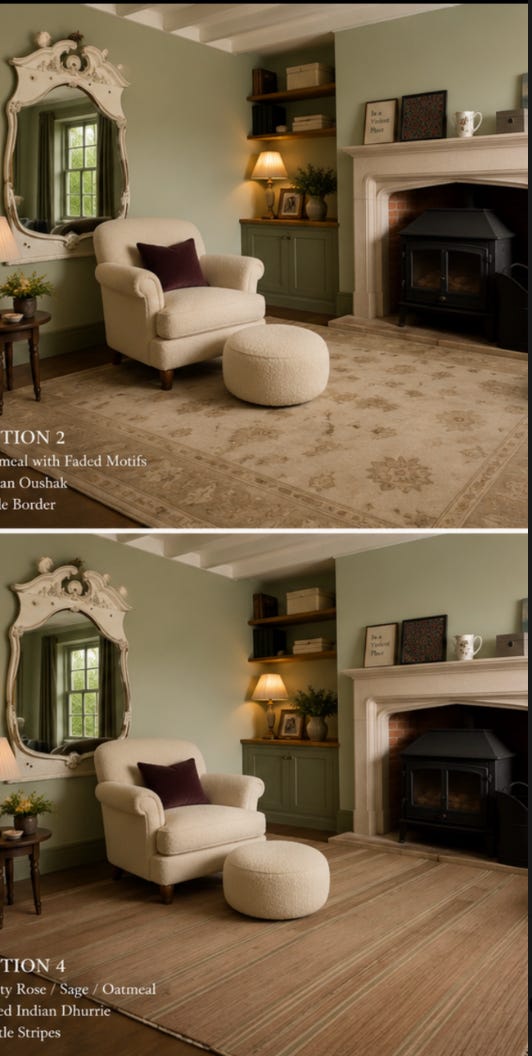
I love this new ability to play with possibilities before committing to them. And perhaps that, too, is a useful metaphor for Late Q3: composing a life isn’t only about what you keep, but how you bring the old and new together, editing and experimenting until the different threads begin to feel like a whole. A little imagination, a lot of curation — and, these days, a little help from AI.
Given all the current angst on Substack about using AI, I realise this may be mildly provocative. But I’m increasingly convinced that one of the jobs of Late Q3 is embracing the future, not demonising it. I don’t want to spend the next decade defending the world I knew against the world that’s coming. I want to stay curious, learn the new tools and use them to make whatever comes next richer. AI isn’t replacing my taste, memories or choices here. It’s helping me play with them, making the composition visible while I’m composing it. Every bit of them.
I’m not interested in decluttering my life. I rather like it over-brimming with wonderful people, lovely things and cool ideas. I want gorgeous glam’kids coming for summer stays, friends new and old around the table, more ideas capable of making a difference, more generosity, beauty, afternoons with the man, work that matters, and time in that wonderfully woolly chair (being delivered next week). What I’m increasingly unwilling to do is fill the gaps with things — or people, projects and obligations — simply because there’s a gap.
Late Q3, I’m discovering as I cross its threshold, isn’t about downsizing at all. It’s about increasing the ratio of meaning to everything else: more house, perhaps, but fewer meaningless things; more ambition, but fewer projects; more generosity and less accumulation. A good composition isn’t necessarily minimalist. It contains what it needs, with enough space around each element for it to matter.
And so I think back to Zoe’s week with us this summer. Perhaps one day she — or another grandchild — will remember the solemn girl hanging in Glamma’s study, play with the little wooden houses on the windowsill, curl up in the wonderful woolly chair or know the old oak first through its reflection in a battered French mirror. That’s how ordinary things become family things: not because they’re valuable, but because they sit quietly in the background while a family lives around them, accruing meaning.
Perhaps that’s the other side of Lynda Gratton’s weave that I hadn’t quite understood last week. Some of the threads we choose in Late Q3 aren’t really for us at all. We’re weaving them into someone else’s beginning.
So, at 65, I’m not particularly interested in disappearing neatly into a decluttered beige sunset. I’m still composing — carefully, selectively and joyfully — with the old and the new, with what I’ve inherited and what I’m still discovering. Perhaps the things we keep aren’t evidence of our reluctance to let go at all. At their best, they’re clues to what we still intend to give, share and pass on.
What are you still adding to your life — very selectively — while the world tells you it’s time to subtract?
Comments
Nothing yet. Say the first thing.
Sign in to join the conversation.