
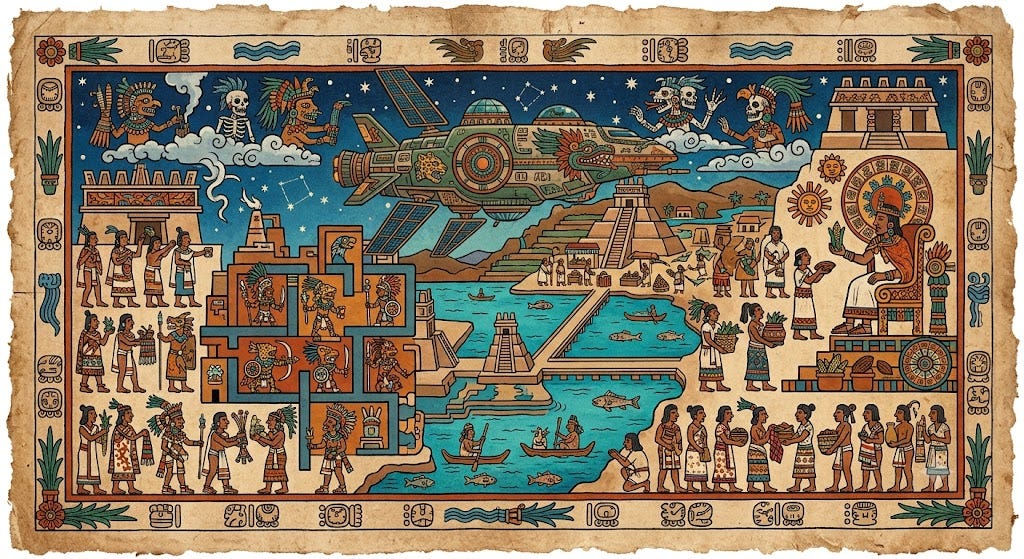
Are empires always bad? What is the connection between empires and postcolonialism? And what does SF tell us about the long history of empire building?
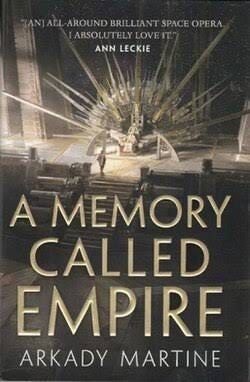
When I wrote my essay about Aztecs in SF (to be found here), somebody messaged me expressing their disappointment that it did not mention Arkady Martine’s recent space opera A Memory Called Empire. I promised I would write about it, so here it is!
Spoilers alert! If you plan on reading Martine’s novel, this essay might spoil whatever surprises you may expect. On the other hand, there are few surprises in the novel’s plot, so you might just as well read on.
Let me start by saying that I liked the novel, despite its glacial pace. It is one of those books that are more fun to discuss than to read. It got the Hugo in 2020, which, despite my gripes, I believe is deserved. It is well-written. Its worldbuilding is incredibly detailed - sometimes, too much so. Its characters, apart from their memorable names, such as Nineteen Adze or Three Seagrass, are not particularly interesting but not completely cliche either. And most importantly, it offers a defamiliarizing view of the stock -in-trade of both SF and postcolonial theory: the Evil Empire.
Empires have gotten a very bad name in SF. Star Wars is an obvious example, but Asimov’s Foundation and Empire (1952) is another early SF text that contributed to the stereotype of the Evil Empire as an all-powerful totalitarian entity crushing dissent and enslaving or oppressing indigenous populations. Interestingly, when Ronald Reagan accurately used this very stereotype to refer to the USSR in his 1983 speech, the left was outraged, even though the definition fit to a t. We shall come back to this later.
In Martine’s novel, the Teixcalaan Empire is modeled on the Aztec Empire that annexed large swaths of Mesoamerica, imposing a brutal regime of tribute in both wealth and human sacrifices on the conquered tribes. However, while the cultural similarities are clear, the novel offers no historical continuity between the Aztecs and Teixcalaan. In SF, the future is almost always positioned in some relation to the present, either part of the same linear history, or an alternative timeline, embedded in the larger multiverse of possibilities. Neither is the case here. Is this an alternative history, in which the Aztec Empire never fell and eventually attained space travel? Is Teixcalaan a deliberate imitation of the Aztecs by another population group, as happens in Michael Bishop’s novel Stolen Faces that I discussed in my last essay? We do not know. And because of that, the novel reads less as an SF and more as an allegory.
There are two kinds of allegorical representation: personification, and historical or figural allegory. The first kind is typical of medieval plays, such as Everyman, in which characters embody abstract qualities of virtue and vice. But it is the second kind that is more relevant today: a narrative which represents something that actually happened in history but in an oblique and disguised way. George Orwell’s Animal Farm is a perfect example: the Bolshevik Revolution retold as a farmyard tale.
A Memory Called Empire tells the story of Mahit Dzmare, the ambassador from a tiny independent orbital station Lsel to the capital of the Teixcalaanli Empire simply called the City. The plot centers on Mahit’s fight to preserve the independence of the station from the annexation by the Empire, while simultaneously being embroiled in the fight for succession to the aging Emperor Six Direction (as in the actual Aztec Empire, the succession in Teixcalaan does not automatically follow the bloodline). At the end, after much complicated intriguing, Lsel succeeds in preserving itself from the conquest by redirecting the Empire’s attention to the alien threat looming on the galactic border where unknown nonhuman enemy is about to invade.
It hardly requires profound knowledge of history to think about Tlaxcalans, Totonacs and other indigenous Mesoamerican tribes that joined Cortes in his conquest of the Aztec capital Tenochtitlan. Without them, he could not have succeeded. Cortes and the Spaniards were as alien to these tribes as they were to the Aztecs, but the tribes’ calculation was simple: better the conqueror you don’t know than the one you know all too well. In Martine’s novel, the unknown aliens play the same role as the conquistadors (the aliens are central to the sequel, The Desolation Called Peace, 2021, which I am not going to discuss today).
But what if the tribes had not joined the Spaniards? What if the Aztec Empire survived? What, in fact, if all the empires whose collapse is celebrated today by every postcolonial seminar in every academic institution in the West had survived? The Roman Empire, the Mongol Empire, the Hapsburg Empire, the Ottoman Empire, the British Empire, what if they all continued existing until today? Would the world be better or worse than it is now?
An empire by definition is a multicultural, multiethnic polity. An empire grows by conquering or annexing other countries, tribes, and populations and by imposing a uniform set of laws and regulations on these areas. They may be economically exploited for the benefit of the metropole but not always. Perhaps the most important aspect of an empire is that it spreads its culture/religion/ideology and imposes it, by force or by the simple weight of its presence, onto the indigenous peoples that it absorbs. Martine describes the imperial dynamics of hard and soft conquest:
And each and every one of those captains has led troops down into a new system, carrying all the poison gifts she can muster: trade agreements and poetry, taxes and the promise of protection. black-muzzled energy weapons and the sweeping architecture of a new governor’s palace…(11).
From Alexander the Great to Osman Gazi (the founder of the Ottoman Empire); from Caesar to Cortes; from Itzcoatl to Sir Francis Drake; from Qin Shi Huang to Queen Victoria; founders and rulers of empires saw themselves as bringing civilization and order into the chaos of barbarism and violence. Were they all wrong?
Let us consider what happens when an empire collapses. The fall of the Roman Empire ushered in the Dark Ages. The fall of the Ottoman Empire was marked by the Armenian genocide and the unrest in the Middle East that continues until today. The withdrawal of the British Empire from India led to the death of almost two million people during the Partition.
Empires may be violent; but the fall of an empire does not guarantee peace. After all, what is the opposite of empire? The nation-state. In the mid-19th century, the rise of nationalism as a dominant political ideology ushered in a period of European unrest which culminated in WW1. And today, while few liberals would defend the idea of empire as a civilizing force, even fewer would defend nationalism, which they erroneously equate with Nazism. This leaves the Western left in a bind. If empires are bad, and nation-states are bad, what is left? As per DSA platform, open borders. Not many takers here, as proven by the last US elections.
The real problem with empires, according to postcolonial theory, however, is not economic exploitation as much as cultural imposition (or “cultural genocide” in the most extreme version). Martine’s book frankly acknowledges the irresistible pull of Teixcalaanli imperial culture, which is described in elaborate details, from its strange naming system, to its stupendous architecture, and its complex and ever-growing stock of poetry and traditional narratives. Mahit is seduced by this culture, torn between her barbarian heritage and her growing love for Teixcalaan. And even though at the end she chooses to return to Lsel, she knows that she may have left the Empire but the Empire will never leave her:
“Nothing the Empire touched would remain hers. Very little was hers already” (447).
Franz Fanon would understand this sentiment. In his book Black Skin, White Masks (1952), he writes about the cultural impact of colonialism, which is not merely economic exploitation but irreducible cultural transformation of the colonial subject:
And yet, Fanon who is often interpreted as the father of postcolonial theory, also has this to say:
In other words, Western culture is here to stay. “Nothing empire touches remains itself” (Martine 421).
You cannot undo the cultural impact of imperial conquest. The Roman law is still the foundation of the legal system in most European countries. Mexico still speaks Spanish and worships the Savior born in the distant land of Judea rather than the native god Huitzilopochtli. The Middle East, which used to be Christian, is still largely Muslim. “Cultural decolonization” and the glorification of “indigeneity” is limited to the academic lounges and the radical fringes of the Western left. Most former colonial subjects cannot return to their ancestors’ ways, and would not if they could.
The intersection of cultural impact and brutal violence is at the heart of imperial history. Good SF (as opposed to ideologically engaged SF) thrives on hard questions, not pat answers. Martine’s novel is not Star Wars because it acknowledges the complexity of imperial conquest and refuses to reduce it to the cartoonish tableau of evil stormtroopers and heroic resisters:
That was the problem. Empire was empire - the part that seduced and the part that clamped down, jaws like a vise, and shook a planet until its neck was broken and it died (392).
Contemporary postcolonial theory misreads Fanon and other early scholars, such as Homi Bhabha, by excising “the part that seduced” and focusing only on “the part that clamped down”. And while oppression may be fought, cultural influence is irreversible. When empires fall, what it left in their wake is hybrid identities, not some pristine Rousseau-inspired “noble savage”, an orientalist delusion if there ever was one.
But there is more. Racism and empire have become synonymous. Self-flagellating Westerners, laser focused on the Transatlantic slave trade, forget that race was irrelevant to most empire builders in history. Romans and Greeks did not care a whit about skin color: their distinction between imperial subjects and barbarians rested exclusively on the acceptance of the Roman law. The Seljuks and the Ottomans, despite the brutality of their Islamic regimes, accepted converts of any ethnicity (though their treatment of black slaves did indicate a racial prejudice). And of course, the USSR, the latest and possibly the worst of the world empires, prided itself on its anti-racism - which may account for the anger of the left when Reagan accurately diagnosed it. In the eyes of his opponents, an anti-racist empire was an impossibility, an oxymoron.
And this is why Martine’s book is so interesting. By modeling her empire on the Aztecs, she short-circuits the usual ideological nexus of empire=racism. The Teixcalaanli are “people of color” - they are described as being very much like the original Aztecs in their physiognomy. Race plays no role in the plot, but the reader, confronted with an “indigenous” galactic empire will has to re-examine their “progressive” assumptions about race, colonialism, and culture. Teixcalaan is both magnificent and dangerous; both seductive and violent; both highly civilized and barbaric.
A sub-plot of the novel deals with the technology that allows the preservation of a person’s memories. If we read A Memory Named Empire as a historical or political allegory of empire-building, we can interpret this technology as a reference to the danger of forgetting the complexity of history and as an invocation of the urgent need to preserve the accurate knowledge of the past. Empires, like wars, are a human universal. Whether they are good or evil depends on what they do. But you cannot erase the past and pretend that decolonization will lead us back to the paradise of cultural purity and authentic “indigeneity”. History does not run backward.
Teixcalaan is not a Star Wars caricature of villainous colonizers. It is a memory of all the empires in the past that have shaped our present and future.
Works Cited
Martine, Arkady. A Memory Called Empire (Tom Doherty, 2019).
No posts
Comments
Nothing yet. Say the first thing.
Sign in to join the conversation.