
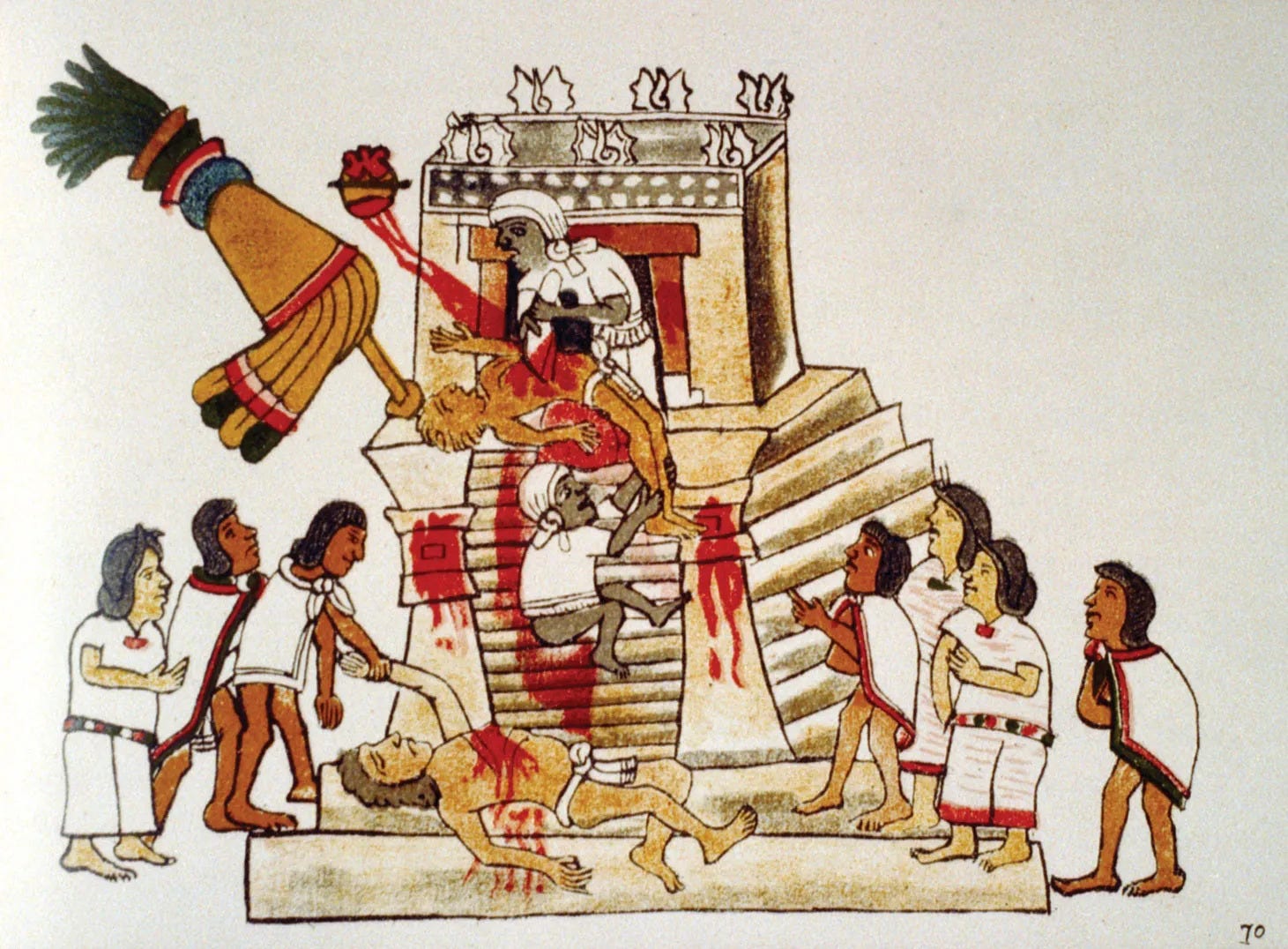
In 1487, about 30 years before Cortes invaded Mexico and destroyed the Aztec Empire, the Great Pyramid was dedicated in the capital city of Tenochtitlan. The ceremony was conducted over 5 days and involved the industrial-scale slaughter of tens of thousands of people. The Aztec records claimed the figure of 80,400; contemporary historians reduce it to between 10,000 and 30,000. But there is no debate as to how it was done:
“A line of prisoners and slaves had been assembled…They were organized into a line that stretched… a considerable distance from the base of the pyramid. One by one, they walked up the steps of the temple. One by one, they came before the priests at the top. One by one, their hearts were removed and offered to Huitzilopochtli” (Myers 176).
The beating heart was removed; the body thrown down; and the blood poured down the sides of the pyramid, eventually covering most of the city, rotting and stinking in the sun.
The Aztecs were not mindless savages. The city of Tenochtitlan was larger than any contemporary city in Europe, built on the lake and boasting impressive architecture, broad avenues, and sophisticated civic infrastructure. The Aztecs ruled a large empire, which they had conquered not long before the slaughter of the Great Pyramid. Like Cortes who put an end to this empire, the Aztecs were newcomers to the region we now called Mexico after them. They used to be a wandering tribe, originating in the semi-mythical island of Aztlan and led to glory by the promise of their god Huitzilopochtli who designated them as his chosen people.
So why did they do it? Why the unfathomable scale of human sacrifice, accompanied by ritual cannibalism? The common answer is: it was their culture. And because the Aztecs happened to be non-Europeans, any criticism of this culture in certain circles is perceived as verboten. For a long time, the conquistadors’ stories of towers built of human skulls and cloaks made of human skin were perceived as an exaggeration or slander. When the racks of skulls called tzompantli were discovered in Mexico City in 2016, confirming the conquistadors’ testimony, anthropologists’ comments centered on the theology of the Aztec religion which regarded human sacrifice as repayment of debt to the gods, before conceding that
“The scale of the rack and tower suggests they held thousands of skulls, testimony to an industry of human sacrifice unlike any other in the world.”1
Obviously, the postcolonial crowd immediately sprang to the defense of the Aztecs with the good old-fashioned “what-about-ism”. The site called Mexicolore responded to accusations of cruelty and barbarism:
The idea of what ‘barbarism’ is really lies in the eye of the beholder. Although Spanish priests thought many Aztec practices to be base and even evil, they preached in the name of an empire (the Holy Roman Empire) that regularly tortured people for the Inquisition!
The obvious answer to that is: so what? If you justify Aztecs’ hecatombs by their theology, what, exactly, is wrong with the Inquisition which was also theologically motivated? In fact, if you take cultural relativism seriously, no cultural practice can be criticized as long as it is rooted in sincere belief. This applies to FGM, slavery, and widow-burning, to name but a few. In fact, it applies to colonialism itself. Since Cortes believed that he was saving the indigenous people’s souls from eternal damnation, why should he not be seen in the same positive, or at least neutral, light as the flaying priests wearing cloaks of human skins?
The reason why so many academics continue to evade the question of moral evil in relation to the Aztecs is the same reason why so many justify the stomach-churning violence of October 7. Both events are seen in the context of settler-colonialism, which, as Adam Kirsch points out, justifies any violence by the indigenous population against the “settlers”, no matter how long ago the initial settlement occurred (7). The irony of this approach is that it cannot be logically squared with cultural relativism, and yet both function in tandem in the academy in the context of postcolonial theory. Ideology subsumes logic and common sense, as it always does.
Of course, cultural relativism is not the only lens through which to see other cultures. Theories of objective morality claim that there is a universal moral code, and that the Great Pyramid slaughter represents a clear instance of its infringement, and therefore can safely be regarded as evil. Religious deontologists argue that the foundation of this code lies in some form of divine mandate; evolutionary psychologists relate universal morality to our evolutionary origin:
An objective basis for morality can be found in an evolutionary account of its origin and development. 2
But this view also runs into a problem when confronted with the Aztecs. Human sacrifices on this scale are clearly dysfunctional for the society that practices them. Cortes’ victory was largely due to the fact that his tiny band of adventurers was joined by the conquered Mesoamerican tribes who took their chances with the unknown white invaders rather than with their cannibal overlords. Aztecs, not Europeans, were the original settler colonialists, and the way they treated their vassals was so outrageous that the rebellion, with or without Spaniards, was inevitable. Clearly other Mesoamericans recognized that there was something wrong with Aztec culture. So, why did not Aztecs themselves?
As always, SF provides us if not with the answers, then at least with the guidelines for asking the right questions. SF constantly deals with alien societies that violate our moral intuitions, as I discussed here. But aliens are, well, alien; evolution may have equipped them with a completely different set of survival tools. But what about human cultures that challenge moral relativism? SF has some illuminating examples to offer as well.
Star Trek has its Prime Directive which is constantly being violated when the crew encounters some particularly egregious example of cultural dysfunction. But Star Trek is a popular mainstream show that has very clear guardrails around uncomfortable or ideologically dissident topics. Literary SF, on the other hand, is much bolder in going where no academic mindful of their tenure prospects has gone before.
So let us consider an Aztec-related SF novel that asks whether cultures, like individuals, can be evil. And an even more “problematic”, to use the meaningless woke parlance, aspect of this novel is that the culture in question, much like indigenous Americans themselves, are victims of colonialism.

In Stolen Faces (1977) by Michael Bishop, the colony planet of Tezcatl is ruled by Glaktik Komm, a vaguely Soviet-style federation. The new kommissar Lucian Yeardance is dispatched to preside over the Tezcatlipoca Reserve where a community of people infected with the incurable leprosy-like disease called muphormosy are locked up in the Long Quarantine. The disease, much like leprosy, causes horrifying deformities: lost digits, missing eyes, noses, faces. The muphormers live on handouts from their supervisors. Unable to fend for themselves, they are supported and ruled by Glaktik Komm. Their religion centers on the worship of babies. When a healthy baby is born to sick parents, he or she is designated as a Teo/Tea, until they begin to exhibit the signs of the disease and are thrown away, to run with children’s wild packs. There is no real family and no social bonds in the Reserve; just anger and savagery.
Lucian feels guilty about the way the muphormers are treated. But digging deeper, he eventually discovers the shocking truth. There is no disease; or rather, the disease had run its course a log time ago. The muphormers are perfectly healthy. There is no need for a quarantine.
So, where do the horrifying injuries come from? You guessed it. The community inflicts them upon itself. In an atrocious blood-letting ceremony, they cut off healthy limbs, gouge out healthy eyes, slash healthy faces. Their culture is the disease.
Why do they do it? Lucian eventually comes to believe that the mutilation ceremony in which the normal babies are turned into disfigured lepers is the only way for the muphormers to achieve transcendence through ritual self-abasement, cruelty, and cannibalism:
Everything that was cut away was saved - fingers, buttock halves, ears, toes, lips, everything… you had to believe these people were deliberately abasing themselves out of a conviction of their own despicability…Everything was terribly methodical - an abattoir whose victims came sedated and smiling to the slaughtermasters…(188)
The Aztecs sacrificed others out of the sense of their own spiritual superiority; the muphormers sacrifice themselves out of the sense of their own spiritual inferiority. The result is the same because it stems from the same perverse need for purification. The muphormers’ culture is explicitly and deliberately modeled on Aztecs; and the novel includes a long and excruciatingly accurate depiction of the human sacrifice ceremony at the Great Pyramid. The Aztecs and the muphormers worship the same bloodthirsty deity: the Flayed God, Xipe Totec.
The novel ends with the Long Quarantine lifted and the muphormers’ society “reformed” by sterilizing all of its children, even though the Glaktik Komm knows perfectly well that the disease is cultural, not biological. The ultimate choice is between the ritual violence of the sick indigenous culture and the bureaucratic violence of its colonial masters. Those Mesoamerican tribes that joined Cortes faced a similar dilemma.
If you ask postcolonial thinkers, they will tell you that colonialism is the original sin of the West, far worse than anything else any other culture has ever been guilty of. Even a superficial glance at the annals of world history shows this to be a bare-faced lie. Slavery, conquest, rape and ethnic cleansing are endemic in many indigenous cultures. So, confronted with the slaughterhouse of the Great Pyramid, the temptation is to minimize, deny, or simply label you a racist for even bringing up the indigenous city literally washed in blood. As Hussein Aboubakr Mansour recently wrote, European colonialism is purged of its historical specificity in order to become the fungible moral currency in the West’s never-ending self-flagellation.
And this is where Bishop’s slender SF novel goes beyond simply reminding us that the Aztecs and other indigenous cultures could be evil. Muphormers, after all, embrace human sacrifice and cannibalism because they have internalized others’ view of themselves as sick, unworthy, in need of expiation and purification. The more you keep telling the West that it is irredeemably corrupt, the more likely it is that it might either succumb to the leprosy of self-loathing or lash out at its detractors. The bloody mask may eventually become the face.
Works Cited
Bishop, Michael. Stolen Faces, Dell, 1977.
Kirsch, Adam. On Settler Colonialism. Norton, 2024.
Myers, Eva. The Aztec Empire. 2026.
https://www.science.org/content/article/feeding-gods-hundreds-skulls-reveal-massive-scale-human-sacrifice-aztec-capital
https://www.sciencedirect.com/science/article/abs/pii/014017509190016J
No posts
Comments
Nothing yet. Say the first thing.
Sign in to join the conversation.