
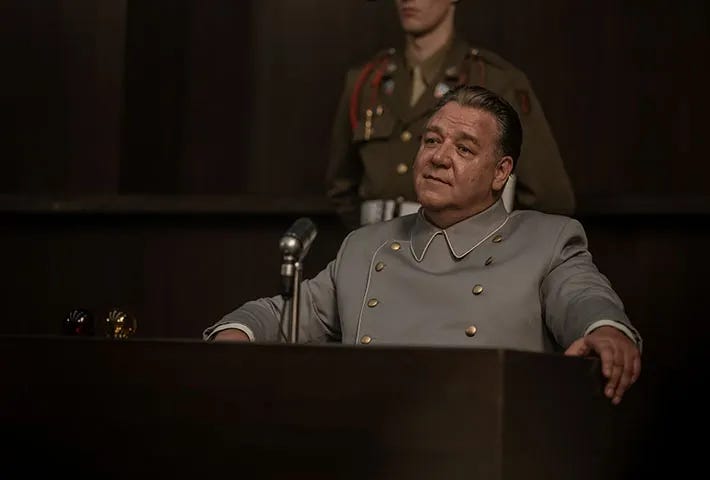
It’s 12:15 in the morning and I’ve just finished watching Nuremberg.
I should probably go to bed. Instead, I’m sitting here thinking about Hermann Göring. More specifically, I’m thinking about one question he asks an American psychiatrist who’s spent months studying him, trying to understand what could possibly make a human being do what he and the Nazis did.
“I wonder if you will remember us as human.”
Yes.
We should.
They were human.
That’s the whole fucking point.
Nuremberg, written and directed by James Vanderbilt and based on Jack El-Hai’s book The Nazi and the Psychiatrist, stars Rami Malek as Douglas Kelley, the American Army psychiatrist sent to evaluate the captured Nazi leadership before the Nuremberg trials, and Russell Crowe as Hermann Göring. Kelley’s job is to determine whether Göring and the other Nazi leaders are mentally fit to stand trial. But he becomes obsessed with a much bigger question.
What makes these men evil?
I know the broad history, obviously. But after the film I started reading, checking what was real and what had been dramatized. The central story is strikingly faithful, even if parts were compressed or changed for the film. Kelley really did evaluate 22 Nazi defendants. He spent hundreds of hours studying them. And he really did come away with a conclusion that should make every one of us profoundly uncomfortable.
They weren’t mad.
There was no special Nazi pathology he could find. No convenient defect that allowed the rest of humanity to put a psychological fence around them and say: There. That’s evil.
Göring was intelligent. Charming. Vain. Friendly. Ambitious. Manipulative. An extraordinary rationaliser.
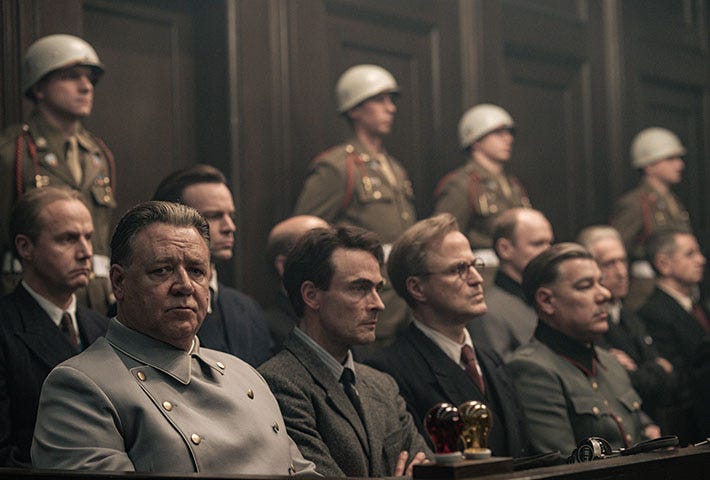
Human qualities.
We call Nazis monsters, and of course I understand why. The word fits the scale of what they did. But I wonder if calling them monsters also comforts us.
Because monsters aren’t us. Monsters are THE OTHER. We don’t know any real monsters. Because monsters live in nightmares and history books.
But human beings?
Human beings live next door. They work with us. They teach at universities. They report the news. They sit across from us at dinner. They support the same football team. They binge watch Netflix shows and have small businesses. They raise children and kiss their partners goodnight and somehow still manage to convince themselves they are decent people while excusing something profoundly indecent like the dehumanization of the other.
That’s monstrous.
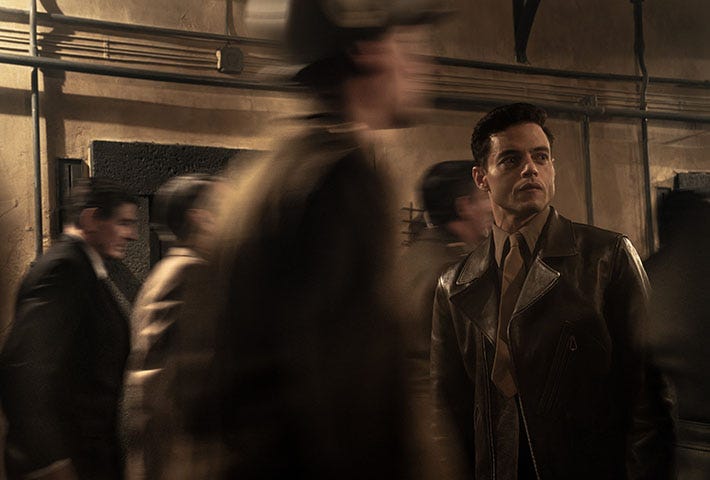
That’s what Kelley discovered. And then, after Nuremberg, he went back to the States tried to warn his own country that what he’d seen wasn’t uniquely German. The personalities, the vanity, the appetite for power, the ability to rationalise cruelty and find a scapegoat, these things could exist anywhere.
Especially the willingness to follow. Especially in America. Then. Right after the war where 6 million innocent Jewish civilians were systematically annihilated and around 85 million people were killed in a brutal world war because only a few people didn’t have the courage to say, “No. Something stinks here. This is wrong. And I’m going to say something and do something about it.” Before it happened.
And here we are today.
Look around.
I’m not saying this is 1933. I’m not saying another Holocaust is unfolding in precisely the same way. History doesn’t work like that, and lazy comparisons make us stupider, not wiser.
But human behaviour has patterns and propaganda has patterns and scapegoating has patterns.
And right now, across America and elsewhere, politicians, commentators and ordinary people are finding enormous audiences by feeding people resentment, conspiracy and someone to blame. Jews. Israel. Usually both.
The popularity of people like Tucker Carlson and Candace Owens and Ye is terrifying. Look at the ease with which ancient ideas about Jewish power, manipulation, money and control are being repackaged, algorithmically distributed and swallowed by millions of people who would be horrified if you called them antisemites. That’s the bit people don’t understand about history. The people inside it rarely think they’re the bad guys.
I read William L. Shirer’s The Rise and Fall of the Third Reich when I was much younger. My grandfather owned it. I remember the physical weight of that book. And it wasn’t the fall that got me.
It was the rise.
The language. The lies. The deceit. The accommodation. The silence.
The incremental nature of it all.
We study history backwards, which makes everyone look very clever. Of course Hitler was evil. Of course the Nazis were lying. Of course someone should have done something. But the people living through it were living forwards. One day at a time and one headline at a time and one lie at a time.
They had choices.
And then there’s Howie Triest.
In the film, Kelley is ready to leave. He’s been dismissed. He’s disillusioned. He’s seen what he’s seen and, essentially, he’s walking away. Triest stops him. Until that moment, Kelley doesn’t even know Triest is Jewish but that’s what Triest tells him. That his parents were murdered by the Nazis.
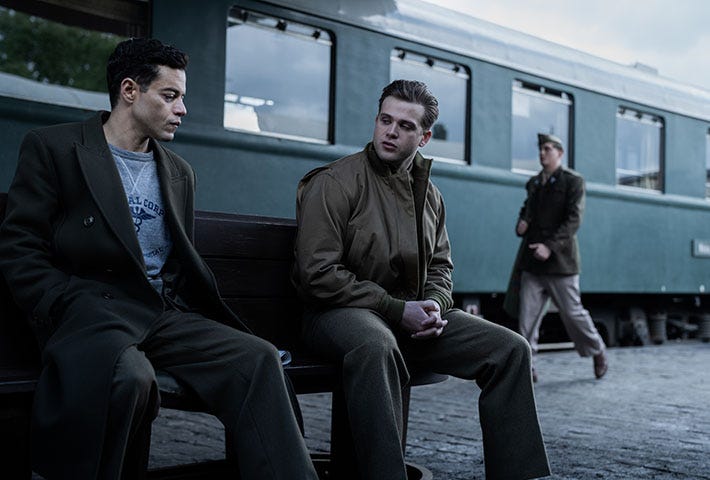
And suddenly this isn’t psychology anymore.
It isn’t a book. It isn’t Kelley’s ambition or his fascination with Göring or some great intellectual question about the nature of evil. It’s Howie’s mother. It’s Howie’s father. It’s personal. Triest challenges Kelley to do something with what he knows. To stop standing outside it, analysing it, and help.
And in the film, at least, Kelley does.
He gives the prosecutors his private notes on Göring. The very material he’d been protecting for his own book and his own ambition. He helps them understand the man they’re facing because Triest has made him understand that there are moments when your career, your vanity and your careful distance from something simply matter less than the greater good.
I don’t know if that exchange happened exactly that way. In fact, the real Kelley returned to America before Göring’s trial.
But as a moment in the film, it absolutely floored me because Triest didn’t win Kelley over with statistics and he didn’t give him a history lesson, either.
He made him feel.
That was it.
He made it personal. And perhaps that’s why that scene has stayed with me so powerfully tonight. People can argue with statistics and debate politics until everyone is exhausted. They can hide behind words like “complicated” and “nuanced” and go home feeling terribly sophisticated.
But tell me about your mother.
Tell me about your father.
Tell me what happened to them.
Now look me in the eye.
That’s harder.
That’s why I make films. It’s why I write. It’s why I speak about Jewish identity, Zionism, antisemitism and the manipulation of language. I’m trying to make people feel - based on absolute facts - what so many of us are desperately trying to get them to see.
This post is public. Share it. Spread the truth.
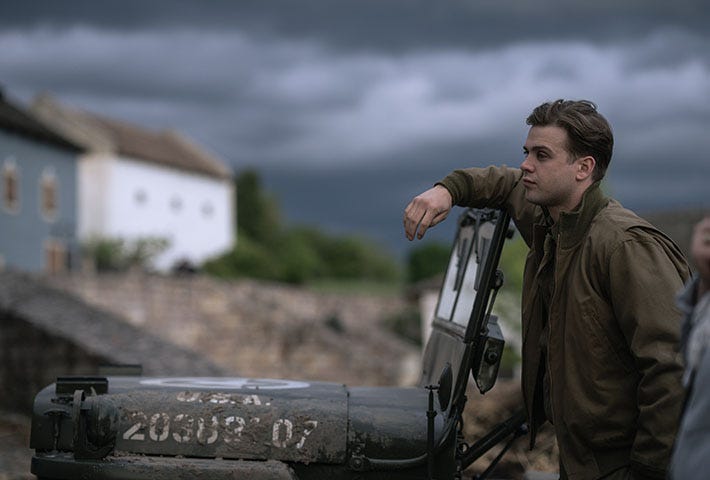
In the film, Howie Triest understood that knowing isn’t enough.
Sometimes you have to make it personal before a human being decides to act. And Jews are scared right now. We’re constantly being told we’re imagining it. Exaggerating. Weaponising history.
But the writing on the wall isn’t on a wall anymore.
It’s in our friendships. Our workplaces. Universities. Newsrooms. Neighborhoods.
Genocide. Colonialism. Apartheid. Racism.
Words repeated as settled fact by people who, in many cases, have never seriously studied Jewish history, Zionism or the history of this conflict. Who don’t know the kind of culture we’re surrounded by. The absolute hatred and lust for violence against us.
And I watch intelligent people repeat the lies. Good people, too. People who believe deeply in justice and people who have kids and do all the things we do.
That’s what frightens me.
Somewhere between that younger version of me reading my grandfather’s book and the older man sitting here at 12:15 in the morning, I keep thinking:
The rise matters.
The bit before everyone agrees who the fucking villains were.
We often talk about what happens when good people do nothing. But doing nothing rarely looks dramatic. It’s not challenging a friend. Sharing something without checking it. Deciding it’s all too complicated. Looking away. Protecting your social comfort because speaking might make dinner awkward.
History is made by people living ordinary lives.
Knowing real history matters because fake history is one of the most powerful tools for creating new hatred. History isn’t simply there to tell us what happened. It’s there to help us recognize human behavior while it’s happening.
“I wonder if you will remember us as human.”
Yes.
They were human.
That’s what we should always remember.
What should terrify us.
And it’s why the rest of us have a responsibility to speak when we see the patterns beginning again. And fight it with everything we’ve got.
-
#imthatjew
Visit imthatjew.com and join the community
No posts
Comments
Nothing yet. Say the first thing.
Sign in to join the conversation.