
In the last article, I have explored dissonance: the friction between beliefs and actions that turns play into self-awareness. But when that friction touches our values, something deeper emerges: moral dissonance.
Games don’t teach morality through lectures, they make us live it. Every hesitation, every instinct, every moment we pause before pressing a button reveals more about who we are than what we win.
Unlike other media, games don’t just depict morality. They simulate it. They make us act on it, often before we have the words to explain why.
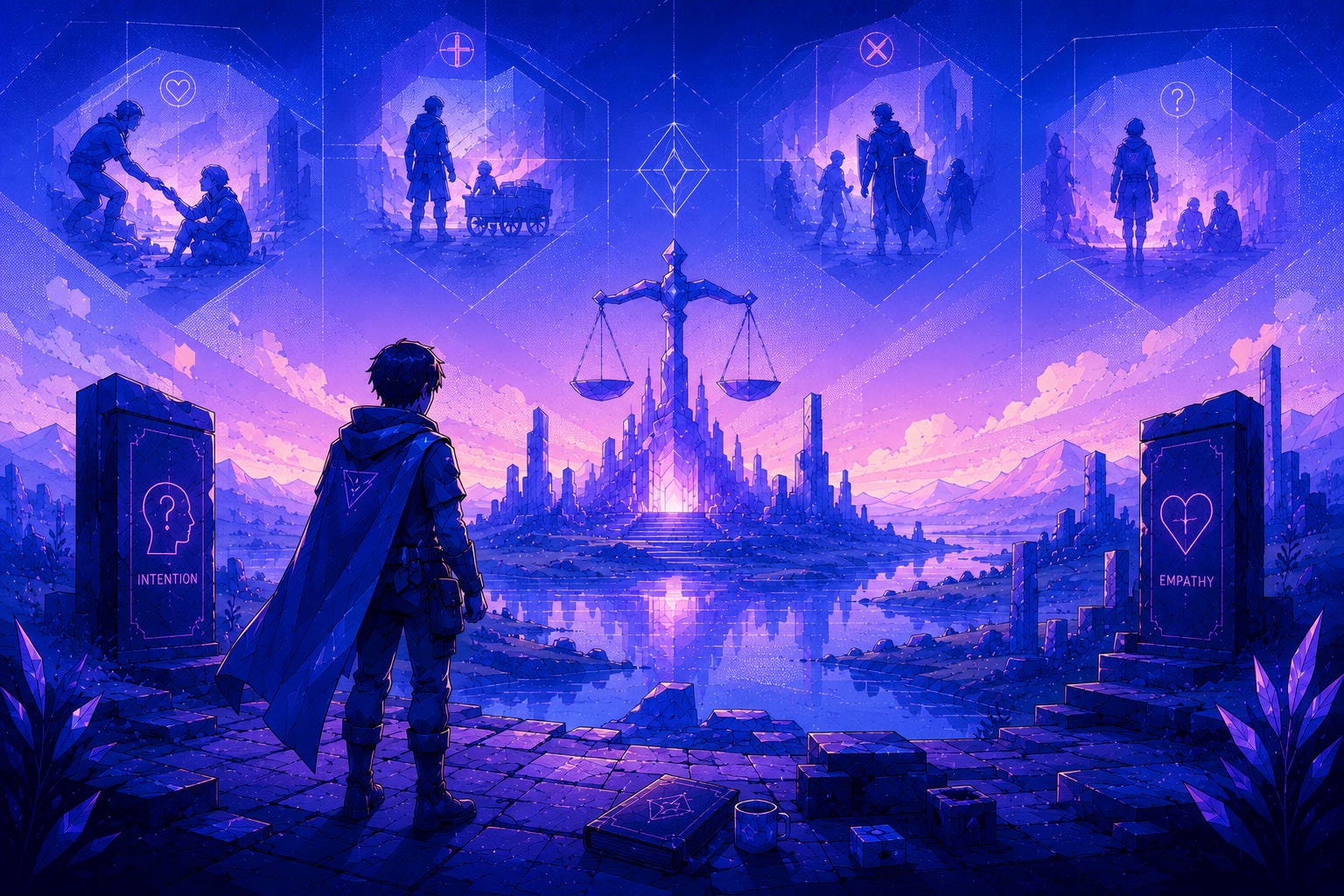
The Architecture of Intuition
As psychologist Jonathan Haidt (2001) describes, moral judgment rarely begins with reasoning. It begins with intuition: fast, automatic, emotional, followed by a slower process of justification. “The emotional dog wags the rational tail,” Haidt famously said.
We like to think our ethical decisions in games are rational, calculated, consistent, thoughtful. But in truth, they often mirror our real-world impulses: our empathy, our sense of fairness, our loyalties, or even our disgust.
Haidt’s moral foundations theory maps five core moral systems shared by most humans:
Care / Harm — the urge to protect others from suffering
Fairness / Cheating — the instinct for justice and reciprocity
Loyalty / Betrayal — our sense of belonging to a group
Authority / Subversion — respect for structure and tradition
Sanctity / Degradation — the feeling that some acts are sacred or defiling
Each person holds these foundations in different proportions, shaped by experience and culture. And each can be activated in play: sometimes intentionally by the designer, sometimes unconsciously by the player.
A mother feeding her child in a cutscene may prime the care foundation. A dialogue about betrayal can awaken loyalty. Even the sound of a soldier calling you “brother” before you pull the trigger can create an instant ethical pause.
Morality, in other words, is context-sensitive code, responsive, fluid, and deeply human.
Moral gameplay doesn’t emerge from the presence of choice alone, but from what those choices mean. (Spoiler ahead)
At the start of Detroit: Become Human, the world trains you to see androids as objects. They are manufactured helpers, bought and sold, addressed as “it,” and treated as malfunctioning tools when they deviate. The interface reinforces this view: androids are evaluated through performance metrics, obedience levels, and probability trees. They exist to optimize outcomes.
You play within that logic. You follow orders. You assess risks. You make decisions the way the system expects you to.
Then the game slowly undermines that certainty. Through a series of small, intimate interactions: calming a frightened child, noticing a trembling hand, hearing an android speak with fear rather than error, the frame shifts. These moments aren’t dramatic set pieces. They are deliberately quiet. They ask you to attend, not to act. And in doing so, they awaken something intuitive: care.
![r/DetroitBecomeHuman - [Theory] What if the reason why Kara cares so much for Alice is because she's designed to be a motherly like Android](https://substackcdn.com/image/fetch/$s_!wjMR!,f_auto,q_auto:good,fl_progressive:steep/https%3A%2F%2Fsubstack-post-media.s3.amazonaws.com%2Fpublic%2Fimages%2Fe995c838-f1bd-4e8b-ab13-d38bb87e12f6_640x360.jpeg "r/DetroitBecomeHuman - [Theory] What if the reason why Kara cares so much for Alice is because she's designed to be a motherly like Android")
By the time the game later presents you with a choice that requires harming or sacrificing an android you’ve come to empathize with, the mechanics haven’t changed. It’s still a button prompt. Still a branching decision. Still a system asking you to optimize.
But you have changed.
Your thumb hesitates, not because the choice is unclear, but because two truths now collide: the rules of the world still treat androids as expendable, while your emotions no longer do. That hesitation is the point.
This is where moral dissonance lives: in the gap between what the system encourages (obedience, efficiency, order) and what the player has learned to value through lived interaction. The game doesn’t resolve that tension for you. It doesn’t tell you what the “right” choice is.
Instead, it turns the decision into a mirror, reflecting not the character’s morality, but your own. The system becomes a moral laboratory, not by teaching ethics, but by forcing you to feel the cost of applying rules that no longer fit the person you’ve become through play.
Spec Ops: The Line begins exactly like a conventional military shooter. You are Captain Martin Walker, sent into a sandstorm-ravaged Dubai on what appears to be a straightforward rescue mission. The framing is familiar and reassuring: you are a soldier with good intentions, clear orders, and a presumed moral high ground. The story tells you that you are here to help. The mechanics reinforce that belief.
Combat rewards efficiency. Headshots feel good. Progress is tied to moving forward through violence. Every system the player understands from years of shooters is intact: shoot enemies, advance, succeed.
Nothing initially asks you to question this logic.
As the campaign continues, the narrative tone begins to fracture. Radio messages grow ambiguous. Civilians appear in combat zones. Allies argue. Walker’s confidence erodes. But crucially, the mechanics do not change. The game still asks you to solve every problem the same way: push forward, eliminate resistance.
Then comes the white phosphorus scene. The game presents it not as a moral choice, but as a mechanical solution. From a distance, enemies are blocking your path. The interface offers white phosphorus as the effective tool. There is no alternative route. No refusal button. No warning that matters. You deploy it because the game has trained you to do so.
Only afterward does the game reveal the truth: the figures you incinerated were civilians taking shelter. The camera forces you to walk through the aftermath. The system that previously rewarded efficiency now shows you the cost, without changing the rules that led you there.
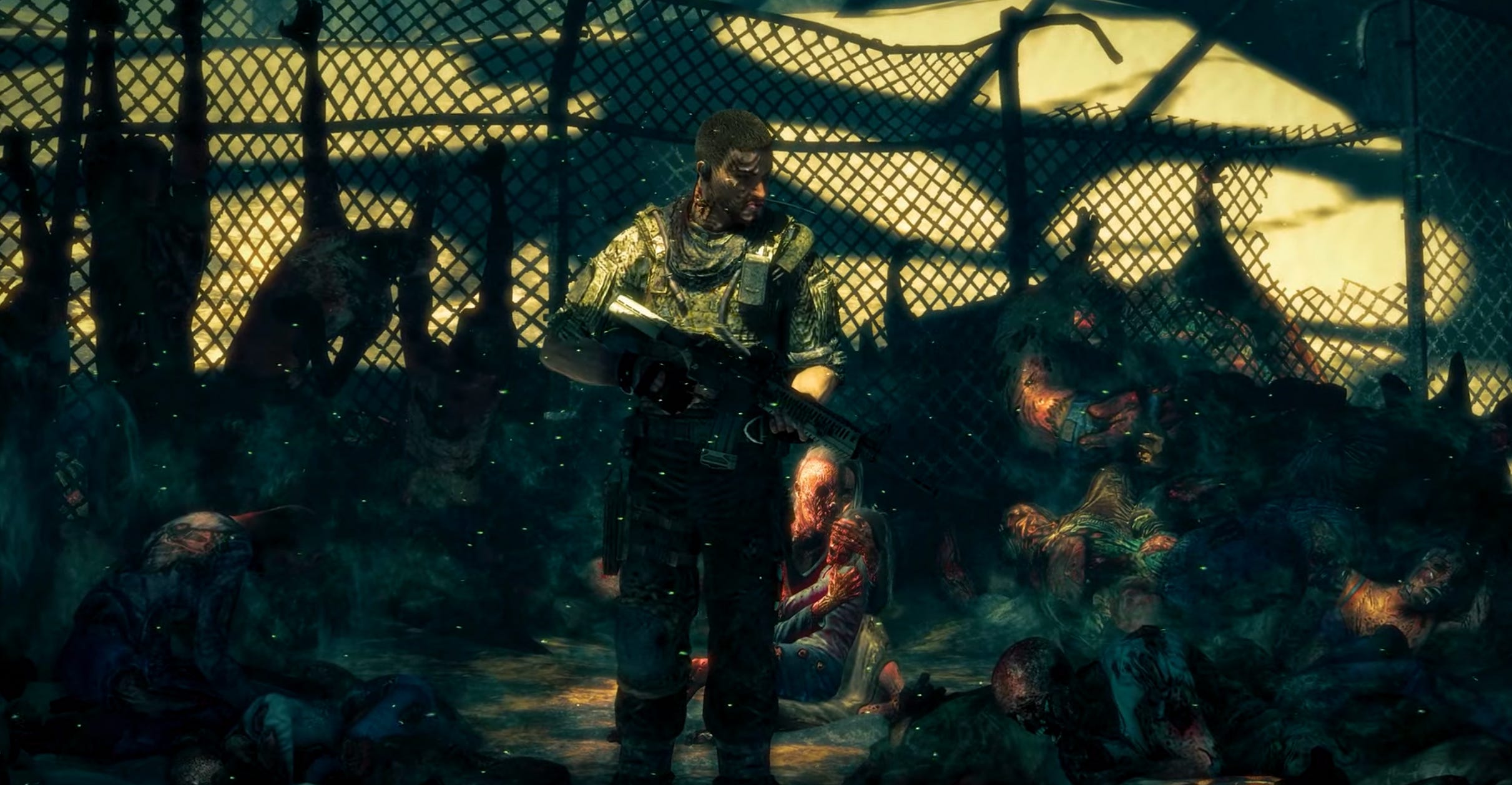
This is the core dissonance:
The mechanics still treat violence as progress.
The narrative now treats that same violence as a moral failure.
You are not punished mechanically. You are not absolved narratively. You are left holding both truths at once.
The moment is devastating not because of the event itself, but because of what it reveals: you didn’t commit the atrocity out of cruelty or intent. You committed it because you trusted the system. Because you followed the genre’s logic without questioning it.
Spec Ops: The Line doesn’t ask, “Why did Walker do this?” It asks, quietly and uncomfortably: “Why did you?”
That is why this is a true example of ludonarrative dissonance, not a mismatch by accident, but a deliberate design where story and system pull apart just far enough to force ethical reflection. The game doesn’t teach morality. It exposes habit.
And in that exposure, play becomes introspection.
Sometimes moral design fails not because it lacks choice, but because it pretends to offer it.
In Fallout 4, you play a survivor in a post-apocalyptic world, searching for your missing child while navigating competing political factions. Each faction claims to represent a different moral vision for the future: order, freedom, technological progress, or human preservation.
On the surface, this looks like a classic ethical setup. You are asked to decide who deserves power and what kind of society should emerge from the ruins.
But as the game unfolds, something subtle happens. No matter which faction you support, progression funnels toward the same solution: large-scale violence becomes unavoidable. Diplomacy is temporary. Coexistence collapses. Critical decisions are resolved through combat, not ethical trade-offs.

The game tells you you’re making a moral choice, but the systems restrict how that morality can be expressed.
You cannot meaningfully refuse violence. You cannot build a lasting alternative. You cannot challenge the structure of the conflict itself.
What remains is moral framing without moral agency.
The game resolves the tension for you by funneling every path back into the same violent resolution: once you commit to a faction, the narrative reassures you that violence was necessary, even inevitable. And when a system does that, when it answers the moral question instead of leaving it open, reflection quietly disappears. The dissonance is removed before it can do its work.
Instead of asking “What kind of world do I believe in?” the game ends up asking only “Which version of force do you prefer?”
That’s the difference between moral choice and moral performance and why simulated ethics can feel hollow when autonomy is constrained beneath the surface.
Morality is social. It doesn’t emerge from abstract rules, but from encountering another mind: a voice, a face, a plea that reminds us someone is there.
In Mass Effect, players are often asked to make decisions about entire species they’ve never met. One of the most famous moments involves the Rachni Queen, an alien creature initially framed as a dangerous monster responsible for past wars. Everything about the setup primes the player to eliminate a threat.
Then the Queen speaks. She doesn’t threaten or bargain. She explains. She describes her people as a chorus, a shared consciousness, and tells her story not with logic, but with voice, rhythm, and sorrow. Her words are layered with echo, almost musical, designed to feel less like dialogue and more like testimony.
In that moment, the choice stops feeling strategic. Many players spare her not because the game promises a reward, but because the sound design and performance transform an abstract enemy into a speaking subject. The moral weight doesn’t come from the decision screen, it comes from hearing someone ask to be understood.
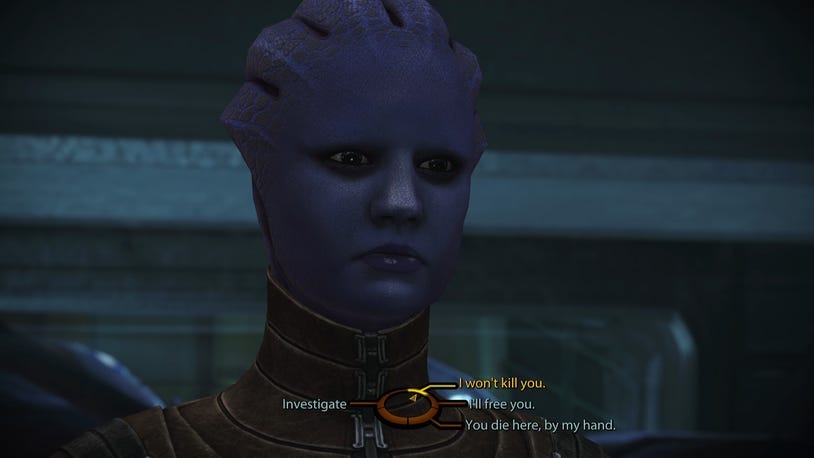
That’s empathy encoded not in mechanics, but in presentation.
Metro Exodus explores the same principle from the opposite direction. For most of the game, enemies are masked, anonymous, and aggressive. They shout threats, rush the player, and behave like obstacles. Killing them feels procedural, part of surviving a hostile world.
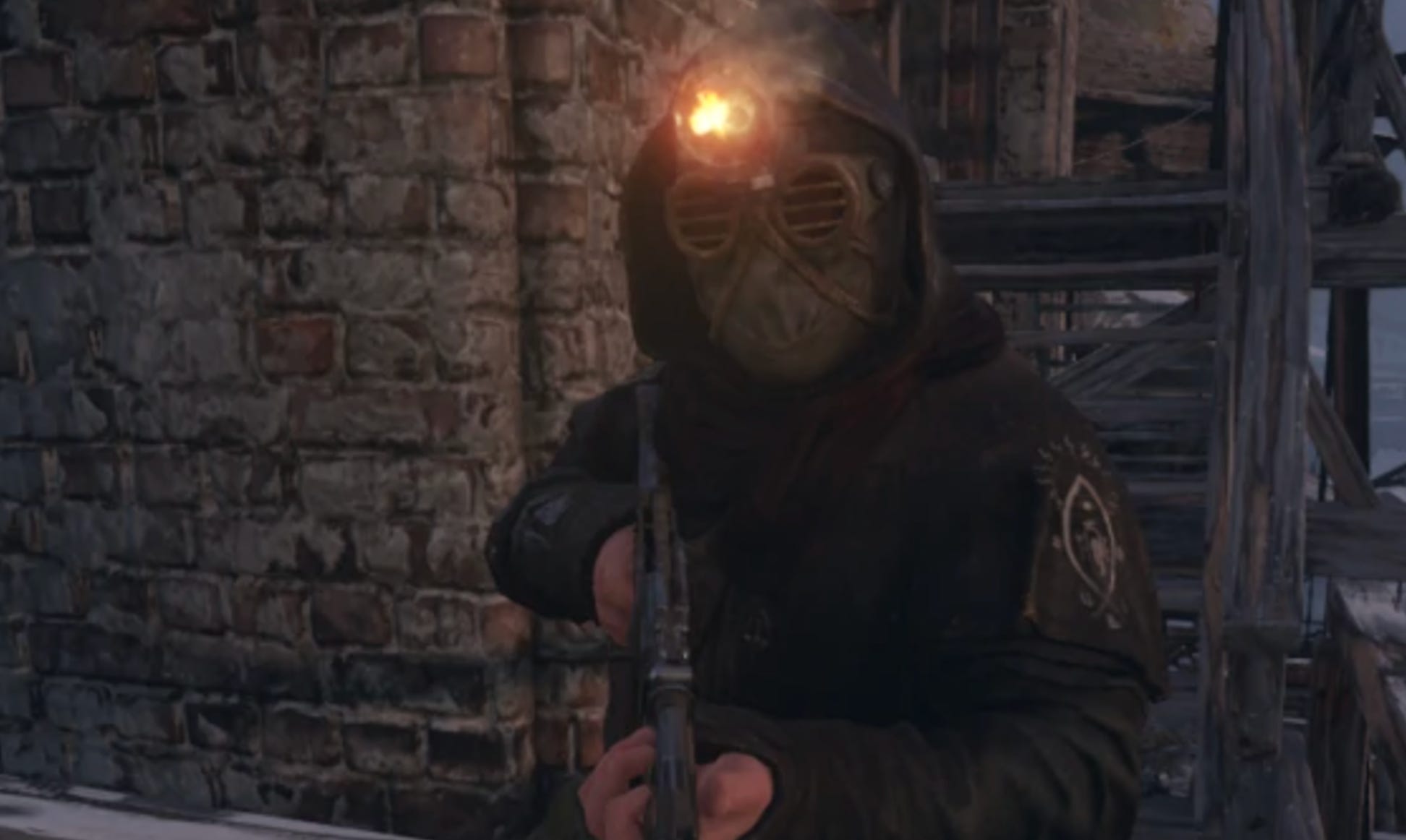
Then something changes. Later encounters introduce enemies who surrender. They drop their weapons. They raise their hands. They beg. Some call out names. Some promise they don’t want to fight.
Mechanically, nothing has changed. You can still pull the trigger.
But psychologically, everything has. The moment an enemy reveals fear, voice, or intention, they stop functioning as a system element and re-enter the moral space. Pulling the trigger no longer feels like clearing a path, it feels like ending a life.
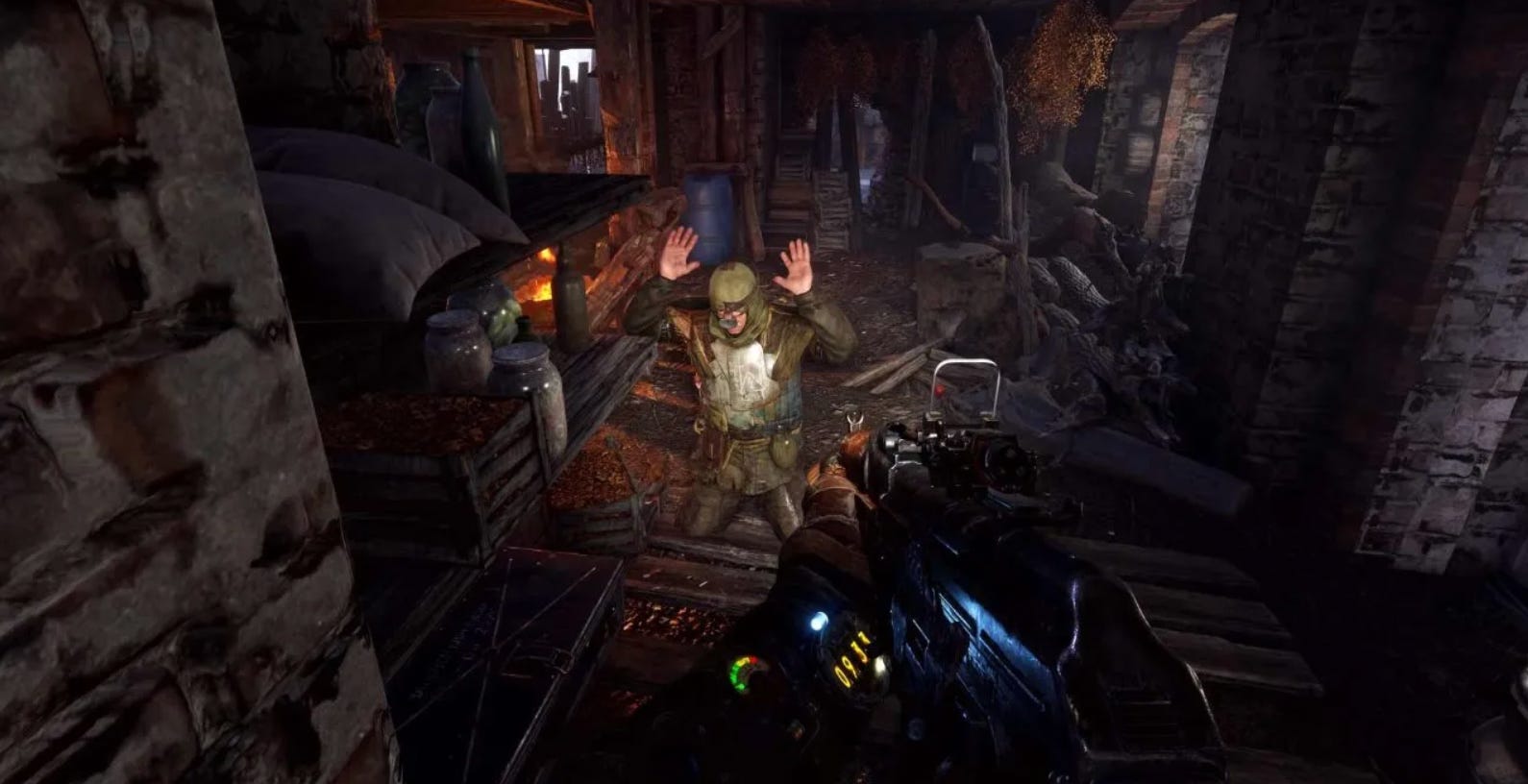
Across both games, the pattern is the same:
When opponents are faceless, morality recedes.
When humanity becomes perceptible, morality returns.
Not because the rules changed, but because perception did.
Morality is never isolated to story beats. It’s also coded into systems and environments.
BioShock disguises ethical choice as mechanical optimization: harvesting or saving the Little Sisters. But each encounter is about empathy versus efficiency.
When you realize saving them still leads to success, the illusion of moral arithmetic collapses and the act itself becomes reflection.
Red Dead Redemption 2 embeds ethics into ecology. Using the wrong weapon ruins pelts and lowers sale prices; harming domesticated animals reduces honor.

The tactile act of cleaning your gun or brushing your horse builds a felt continuity of care, so loss stings even without a pop-up telling you so.
Even nature itself can become a moral presence. In Avatar: Frontiers of Pandora, liberating RDA sites allows surrounding biomes to recover over time, turning ecological care into a visible, systemic reward.

Moral engagement in games thrives in ambiguity. It requires space to feel before judging. That’s why good moral design doesn’t dictate what’s right, it gives room to wrestle with what’s human.
Three principles stand out:
Allow identification before dilemma. Build empathy first: through relationships, ritual, or shared vulnerability. A choice only matters if someone does.
Show consequence without condemnation. Players should see the emotional ripple of their actions, but not be punished for them. Guilt and pride are more powerful than “morality points.”
Keep resolution open. Ambiguity sustains reflection. When players can’t close the loop, they keep thinking and that’s where meaning grows.
We don’t design morality to evaluate players. We design it to invite self-reflection, to let them see their values in motion.
A well-crafted moral game doesn’t ask, “Are you good?” It asks, “Who are you when no one is watching?”
As players, we are both actor and spectator: moral agents inside and outside the system. As designers, our responsibility is not to preach ethics, but to evoke it.
When we design for morality, we design for awareness, for that fragile, luminous moment when players realize their decisions have weight not because of scoreboards, but because of empathy.
And that’s where games stop being simulations and start being mirrors. Sometimes, that moment arrives not in a cutscene, but in stillness. A finger hovering over a trigger. A button press delayed by half a second longer than usual. A controller resting on a knee while the player stares at the screen, unsure how they feel about what they’re about to do.
That pause is the sound of dissonance working. Not as failure, but as awareness.
It’s the moment play turns inward and the player realizes the game is no longer asking them to act, but to reflect.
ReferencesFestinger, L.
(1957). A Theory of Cognitive Dissonance. Stanford University Press.
Haidt, J. (2001). The Emotional Dog and Its Rational Tail: A Social Intuitionist Approach to Moral Judgment. Psychological Review, 108(4), 814–834.
Haidt, J. (2012). The Righteous Mind: Why Good People Are Divided by Politics and Religion. Pantheon Books.
Sicart, M. (2013). Beyond Choices: The Design of Ethical Gameplay. MIT Press.
Oliver, M. B., & Bartsch, A. (2011). Making Sense of Entertainment: Eudaimonic Appreciation as a Central Construct in the Entertainment Experience. Journal of Media Psychology.
Ricoeur, P. (1981). Hermeneutics and the Human Sciences. Cambridge University Press.
Comments
Nothing yet. Say the first thing.
Sign in to join the conversation.