
I’m a libertarian, but crypto highlights that absent regulation, a market with pseudonymity is dominated by pump-and-dumps and criminal hackers. We need some regulation, so the question is about the specifics, not whether it should be more or less. In theory, financial regulation is about protecting the consumer from bad business practices. In practice, it’s a quid pro quo where an industry is given rules governing the products and services it sells, and in return it gets protection from competitors in the form of the fixed costs required to comply with various regulations. When done correctly, it creates a sustainable business model because the business’s investment in compliance focuses it on the long run, which requires repeat customers, which means happy customers.
Last week, the CME sued its regulator, the CFTC, for failing to hold up its end of the deal. On May 29, 2026, the CFTC approved platforms like Kalshi (and related no-action relief for Coinbase) to list cryptocurrency perpetual futures (“perps”) as futures contracts rather than swaps. More recently, Kalshi has sought approval for perps on precious metals (gold, silver, and platinum), and you can see where this is going.
The core legal issue in CME’s lawsuit is that it contends that the perps meet the statutory definition of swaps under the Commodity Exchange Act (CEA, as amended by the Dodd-Frank Act), rather than “contracts of sale of a commodity for future delivery” (futures). This is a good argument for the CME, as without an expiration that enforces convergence between the perp price and the spot price, it is more like a swap than a futures contract. Additionally, funding rates are a characteristic of swaps, not futures. Wikipedia is not authoritative, but it is conventional wisdom, and it currently states that perps are like contracts for difference (CFDs), which are like swaps.
The distinction between swaps and futures is not the CME’s only argument. In the CFTC’s order approving Kalshi’s BTC perp contract for listing as a futures contract on a designated contract market (DCM), the CFTC determined that the contract satisfies DCM Core Principle 3, which requires that a DCM list only those contracts that are not readily susceptible to manipulation. The CFTC’s order states that this is satisfied because
Characteristics of the underlying bitcoin spot market support the effective functioning of the funding rate mechanism employed by the BTCPERP Contract, helping ensure the accuracy of periodic funding payments, promoting convergence, and reducing the contract’s susceptibility to manipulation.
The CFTC then notes that bitcoin’s 24/7 trading enables arbitrageurs to make sure manipulators cannot engage in manipulation. The CME lawsuit mentions that this robustness to manipulation has not been demonstrated.
Convergence depends entirely on the funding-rate mechanism, the purpose of which is to force the contract’s trading price to spot on an ongoing basis. That funding-rate mechanism reflects an economic incentive, and its effectiveness depends on how (at times unpredictable or irrational) market participants choose to respond. The Order does not address whether that incentive can be expected to reliably match the convergence a true future structurally compels, particularly in volatile cryptocurrency markets. —page 29
This is more true than they know. I would add the following.
The perp funding rate mechanism is a farce introduced to convince users that perp prices are not mere Schelling points
The perp premium to spot does not generate arbitrage opportunities
The funding rate can and has been manipulated
Proclaiming that the funding rate ties perp prices to spot in the same way options and futures link to their underlying asset spot price is not true. This is important because when a market is based on a lie, it sets a bad precedent for everyone involved; a little leaven leavens the whole lump.
Perps’ only purpose today is to flummox regulators like the CFTC, who are afraid to make blatantly ignorant arguments about a market they do not understand. Given the existence of stablecoins, futures are a dominant alternative because they are disciplined by true arbitrage. Promoting perps today validates a disingenuous business model and exposes widows and orphans to manipulation.

Ten years ago, it was impossible to short or leverage a long position in bitcoin. All one could do was swap one token for another and generate an unleveraged long position. There were no stablecoins, so the quest was to find a way to trade bitcoin while transacting only in bitcoin. In many futures markets, there is cash settlement, where, at expiry, a contract is marked to the spot price, and longs and shorts then exchange cash equal to the difference between the final settlement price and the price at which they entered the contract. However, without anything like USD to exchange for bitcoin on-chain or at BitMEX, there was no spot market available to implement an arbitrageable expiration price. In addition, because traders could get up to 100x leverage, users were not disciplined, and frequent expiries led to unappreciated closures. In 2016, the unregulated centralized exchange BitMEX offered the first popular perpetual contract, trading bitcoin’s USD price while only transacting in bitcoin, with no expiration.
Instead of a settlement date at which futures and spot prices converge, a perp anchors its price to the spot price via a funding rate mechanism. When the perpetual contract’s price exceeds the spot price, the standard story is that this implies more long than short demand. To equilibrate the market, the long traders pay short traders a fee proportional to this price premium. Thus, as the perp price rises relative to the spot, longs pay a higher funding rate to the shorts, which incentivizes more short positions and fewer long positions. The funding rate at BitMex was credited/debited every 8 hours to every position that is active at that time. The 8-hour window is now a convention for quoting, though today’s funding rate applications are sometimes hourly.
The perp premium is the percentage difference between the perp price and the spot price. The spot price could be from external markets like Coinbase, or for centralized perps, from spot markets on their own exchange:
Perp premium = perpPrice/spotPrice - 1
For example, if you sell a perp that is trading 0.01% above the underlying index, then over every 8 hours you are credited with a funding credit of 0.01%. This perp premium is supposed to tether the perp price to the spot price. At 30k feet, this all seems reasonable. I have not seen anyone dispute its logic except me (see here, here, here, or here). Even Campbell Harvey, a prominent finance professor well-acquainted with traditional futures data and theory, accepts this logic. Crypto is built on protocols of immense complexity that make outside investigation not worth the effort, in that ultimately, no one cares that NFTs do not make any sense, or that Hyperliquid, Base, MakerDao, or Arbitrum are effectively centralized, or that the front-end to Uniswap encourages outsiders to pick off profitable trades and immiserate their long-suffering LPs (who have lost money since day 1).
Perps vaulted BitMEX into prominence, inspiring many imitators. Over time, traders have become comfortable with the product and trust that its perp-premium/funding-rate mechanism works.
The idea that bullish/bearish sentiment drives the perp premium over the spot price is intuitive, but it only holds in a defective market segregated from the world market. Excess retail demand can influence prices only when market participants are constrained. In a complete market with no frictions, if people expect the price to be higher in the future, it is reflected in the spot price, not the basis. In the 1960s, Paul A. Samuelson showed that if most people expect tomorrow’s price to be 101, the equilibrium spot price today should be 101, thereby introducing the law of iterated expectations (assuming interest rates, dividends, etc., are zero). For a liquid market with open entry, the only factors that affect funding rates are interest rates, dividends, storage costs, and the convenience/option value. Thus, to the extent that retail demand drives funding rates, it only highlights a market’s susceptibility to manipulation, which violates the CFTC’s Core Principle 3.
In practice, perp markets operate on a focal point, the current spot (Schelling points, Aumann’s correlated equilibria). On one level, there is nothing wrong with this mechanism. BitMEX introduced it out of a need in the era before wrapping and stablecoins, and they needed a cover story to convince traders that their perp markets were ‘trustless.’ While Schelling points work in practice, it is helpful to convince users that perp prices are disciplined by something more certain. Arbitrage arguments are compelling because they merely require one to trust that traders will tend to maximize their profits, which is something everyone trusts. However, this perp premium mechanism has never operated like a governor on a steam engine; it was just a white lie to get a market off the ground.
Defi perp traders overwhelmingly want to lever long, not short. This makes sense because, conditional on having money on blockchains, one is generally bullish; if you are bearish on ETH, you generally do not have any ETH on the blockchain, and thus were not trading perps. For example, GMX is an on-chain perp market where liquidity providers are the counterparty for any excess retail demand for longs or shorts. Below is a chart of long and short open interest for GMX perps on the Arbitrum blockchain. Green is long; red is short. Virtually all retail crypto traders want long positions.
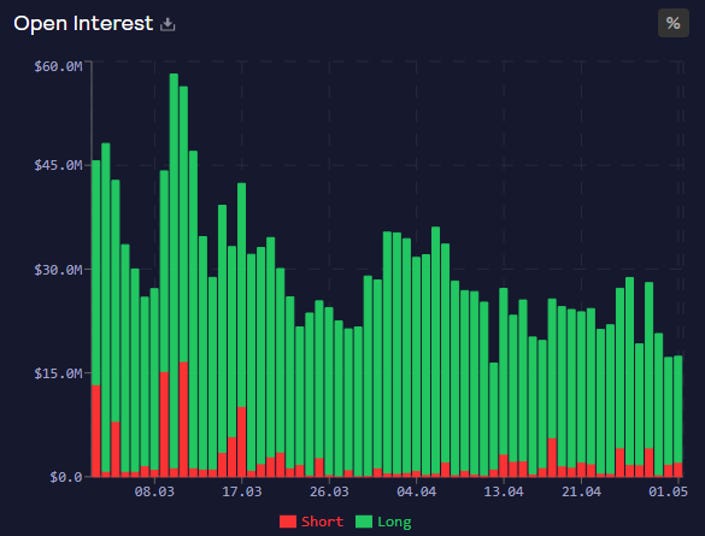
This is the general equilibrium on perp markets. On GMX, those providing liquidity take an offsetting position against net retail demand, passive collective liquidity. For centralized limit order books like BitMEX, unknown market makers are taking the other side of retail demand. In both cases, one needs to incentivize people to take the short side. For many years, the default funding rate of 0.01% every 8 hours—10.95% annualized—was paid by longs to shorts, so that liquidity providers would be short. In the period 2016-2021, when perps exploded in volume and open interest, US interest rates were near zero, making a 10.95% risk-free return highly attractive. This explains how crypto perps could accommodate net retail demand for long positions, but not how these markets tie perp prices to spot prices.
Virtually every introduction of perps mentions that Nobel laureate Robert Shiller invented perps. Shiller had earlier created the well-known Case-Shiller housing price index. As housing is a major asset class in any economy, he thought this index could be used for a futures market. The problem is that, unlike a stock index, there is no way to sell the houses underlying a housing index, because they are too differentiated and their dividends—rents minus depreciation—are uncertain. With ‘delivery’ out of the question in 1992, he proposed a futures market without delivery, i.e., without expiry. These positions would need a way to estimate the housing dividend, and he proposed using an econometric model to estimate monthly housing rents from monthly macroeconomic data. This dividend estimate would then be credited to the longs, and debited to the shorts.
Aside from the lack of a fixed delivery date, Shiller’s market is nothing like a crypto perp. The funding rate was calculated using an exogenous econometric model.
Nothing close to Shiller’s proposal has ever been implemented. A more viable perp market, and a better analog to today’s perp markets, is an earlier paper by Adam K. Gehr based on an actual market. The Chinese Gold and Silver Exchange Society of Hong Kong (CGSES) had a perpetual futures contract in which the daily interest payment was set each day in a separate fixing session after the ordinary spot-price trading. Account margins were credited or debited based on their positions and funding rates. The advantage of this approach is that instead of having several maturities and rolling them over every month, the contract automatically rolled over every day.
Gehr suggested that this approach could be implemented in other markets by adding the funding rate to the spot price for calculating the next day’s margin cash flow. The potential benefit is that compressing all expiries into one market would increase liquidity. The funding mechanism worked like this. If the price of Gold closed at $111.0, and the daily interest rate auction was set at $0.15, the closing ‘futures’ price would be marked at the spot close plus the interest rate, $111.15. Thus, if the long sold at $ 112.00 the next day, the long’s margin account would be worth $0.85, using the prior futures closing price plus the interest rate as the basis. Adding the funding rate to the prior closing price makes it look like the perp premium to spot, but it is just an accounting fiction. Determining the funding rate in a separate market and adding it to the closing price to determine intra-day pnl is quite distinct from using the market futures price premium to spot to determine the funding rate.
I spoke to Gehr on the phone a few years ago, wondering if he was aware of the current crypto perp markets that often referenced his 1988 paper. He said he had interacted with Shiller, and neither could see how crypto perp markets related to their models, though Shiller thought Gehr’s was more relevant (alas, without a Nobel Prize, he’s always the second reference).
The basis in futures markets acts as a funding rate in swap markets. These have been studied for over a century, and show what should be in a futures/spot price premium. Figure 1 below shows the horizontal time axis, with the current futures price moving to its delivery/expiry date, where the black line represents the current spot price. The presumption is that, other things equal, the futures price converges to the spot price, not vice versa.
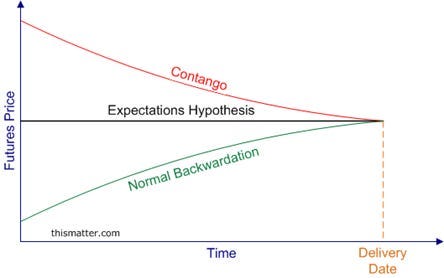
The ‘basis’ is the difference between the futures and spot price. It can be positive or negative. The amortization of this basis can be considered a daily funding rate; in contango, the longs pay the shorts, while in backwardation, the shorts pay the longs. The funding rate is implicit in the basis’s amortization over time: at expiration, the spot price equals the futures price, so the basis is certain to be zero.
There is no basis for swap markets; instead, trades are made in spot markets, and a broker holds the position, applying a daily funding rate. Here, the basis shifts from implicit to explicit.
LongSwapPnLT = Notionalt*[pT / pt - 1 - fundingRate]
Unfortunately, the literature on basis and funding rates is not uniform in its definitions. You can see the basis = ‘futures – spot’ in one book and ‘spot – futures’ in another. Arbitrage ensures that the various costs and benefits of possessing the asset are reflected in the futures basis or the swap funding rate.
As common to arbitrage arguments, the expected return—the risk premium—is absent. To best see this, consider two different riskless investments. As they are riskless, they should have the same return in equilibrium.
Assume you have $1 and want to compare two investments. A Treasury bill generates a simple interest rate return
$1*(1+R$)
Now assume asset A, which generates its ‘own-interest’ rate. Alternatively, you can sell your USD into bitcoin, generate the bitcoin return, and sell the bitcoin futures. This also generates the riskless return.
$1/ST * (1 + Rbtc) * Ft,T
These are both riskless returns, so arbitrage should make them equivalent. With some rearranging, we get
Ft,T / ST = {1 + R$} / {1 + Rbtc}
If we put this in terms of the perp premium, it would be
Ft,T / ST - 1 = {R$ - Rbtc} / {1 + Rbtc}
Or
Futures premium ≈ R$ - Rbtc
This futures premium is paid by the long to the short. For example, if the USD interest rate is 10% and the BTC interest rate is 0%, the long futures price will be at a 10% premium to the spot price. For a trader who was long the futures, if the spot price did not change, the futures holder would lose 10% as the futures price converges to the spot price at expiration, effectively paying a 10% rate on his position.
For currencies with explicit interest rates, this is easy. For other assets, there is no interest rate, but several factors broadly affect their effective interest rate. These include the following.
Dividends: For a stock that pays dividends, its future price will be adjusted to account for the dividend. For example, if a $100 stock pays a $10 dividend before an imminent futures expiry, it is expected to be worth $90 at expiration, so the dividend is subtracted from the current price to determine the forward price. These are irrelevant for crypto, which has no dividends.
Costs of carry: Standard storage costs are like interest rates, subtracted from Rbtc. They include insurance and warehouse costs, as with oil, as well as deterioration, as with agricultural products. A long futures position effectively pays this as the futures price declines over time. These are irrelevant to crypto.
Option value/convenience yield: Inventory for commodities has a floor of zero and a maximum set by the amount of tankers available. For commodities like wheat or oil that have a continuous positive consumption stream, the inventory floor causes price spikes as desperate consumers bid up prices when supply approaches zero. The potential for a spike generates option value for the commodity, which is why backwardation is the general rule for oil prices. However, sometimes the oil tanks become filled, as in the depths of the global recession in April 2009 or during the COVID shutdown in April 2020 when the front-month oil futures price went negative. This is irrelevant to crypto because there are no inventory issues, such as having zero crypto or no way to accommodate more.
Risk premium, aka hedging pressure: If hedgers are net short or long, they must pay speculators to take the other side of the trade to transfer their risk. Keynes famously asserted this was the general case, which he called ‘normal backwardization.’ His example was when farmers sell their anticipated wheat output in the futures market, paying a premium as the long futures price appreciates toward maturity. There are also cases where hedgers are naturally short, such as when airplane manufacturers lock in the cost of their aluminum inputs by buying futures; the shorts are paid as the futures price declines toward the spot price (contango).
The crypto story fits the natural hedging demand story; the only difference is that the underlying perp pressure is from speculators, not hedgers. Retail net demand is overwhelmingly speculative, and for long perp positions, but this has the same effect as the natural excess hedging demand by farmers or manufacturers. However, Keynes’s futures theory applies only to a partial equilibrium setting (as usual for Keynes). Retail pressure alone cannot create a persistent premium for bearing diversifiable risk. A premium must ultimately compensate someone for covariance with aggregate marginal utility or for a market friction that prevents diversification. That is, Keynes’s simple story only works if frictions prevent arbitrage (see Hirshleifer (1990) or Acharya et al. (2013)).[1]
The BTC interest rate can be expanded to include dividend and other carry components, but these are absent in crypto. When Ethereum replaced its proof-of-work blockchain with a proof-of-stake mechanism around 2023, riskless returns in crypto became feasible, with ETH rates of around 3%. Before 2023, risk-free lending rates for BTC and ETH were effectively zero. For the 2016-2021 period, US interest rates were between 0% and 2%. This implies funding rates of -1% to 2% for ETH, nothing like the average funding rate of +10%, with periods of +50% annualized during 2016-23. Given crypto prices are highly procyclical, they have a high beta; a boxed position long ETH and short the ETH perp generates a consistent positive return but is negatively correlated with the market. The fact that one could get paid to put on a position that lowers your portfolio volatility highlights that this can only occur in a segmented market. If such an opportunity existed in traditional finance, it would be quickly eliminated by arbitrage.
The obvious explanation for the positive perp funding rate is the excess retail demand for longs. In crypto, most tradFi institutions that provide liquidity and arbitrage in spot and futures markets are excluded from crypto by regulations. Crypto liquidity providers and arbitrageurs have much more limited capital, so their short crypto positions are not in the context of an overall long market position. These crypto liquidity providers demand a funding premium to take on this position because it increases their risk. This implies that perp markets are segmented and beset by frictions that prevent standard risk premiums and arbitrage mechanisms from working. A corollary is that they are susceptible to manipulation.
Market makers dominate the price setting in all exchanges. If they set the market price 0.01% or 0.05% above the spot price, this implies funding rates of 11% and 55%, respectively. Given a fee of at least 5 basis points and the bid-ask spread, the premiums that generate significant funding premiums are too small for a retail trader to profitably trade.
In standard arbitrage, if you see a price that is too high or low relative to some basket, you can buy the cheap one and sell the expensive one, locking in a guaranteed profit.
An arbitrage trade requires no net investment, has no possibility of loss, and has a positive probability of gain. Such a portfolio can be scaled by any positive constant while preserving these properties. Unbounded profitability is not merely an implication of arbitrage—it is one of the defining characteristics that makes arbitrage inconsistent with market equilibrium. The absence of arbitrage—fair pricing—is the condition that prevents an arbitrageur from scaling up a position without bound.
In perps, the average premium over a 1- or 8-hour period determines the funding rate for that period. Thus, if at the start of a period you sell the instant the premium is 0.05%, and it then falls to 0.00% for the rest of the period, you get no funding-rate revenue to offset your initial perp premium. If the premium has been 0.00% for 7 hours and 59 minutes, and the perp premium rises to 0.05%, if you sell, you get no funding premium. If you put $1 billion into a position to capture the perp funding rate, the second you stop adding to your position, the perp/spot ratio could change so that your position generates no funding revenue. There is no arbitrage.
As a practical matter, the best predictor of the perp premium to spot is a weighted average of the perp premium over the prior day or two, not the current perp premium. This would be fine, similar to how standard swap financing rates influence long and short demand. However, it is misleading to suggest that the perp price is kept at the spot price via arbitrage, and trading based on the ephemeral perp/spot price premium makes no sense.
Regulated markets are subject to presenting an audited tape of their market trades and orders. CME’s co-location facilities are engineered for equalized access (standardized cable lengths and infrastructure, ensuring that no participant receives a structural latency advantage within the matching engine environment). Market Regulation and the CFTC require markets maintain audit trails sufficient to reconstruct trading, detect customer or market abuses, and provide evidence of rule violations.
Perp exchanges post funding rates at various frequencies based on a weighted average of the perp premium. The spot prices they use to benchmark against are parochial indexes they construct themselves, which could be sampled at various intervals under their discretion. A perp price can be calculated in various ways, such as using trade prices, midpoints of the bid-ask spread, or ‘impact prices,’ which reflect the limit order book depth. Any perp premium they generate given these degrees of freedom will have a standard error of at least 0.05%, giving them the freedom to post any funding rate within a 110% band (0.05% —> 55% annualized).
Crypto exchanges are not subject to such auditing, giving them discretion at magnitudes that matter. One should presume that lightly regulated protocols like Hyperliquid and Binance are engaging in all sorts of subtle manipulation because they have the ability and incentive to do so. Anything that cannot be monitored will be gamed.
A conspicuous example of this was provided by a classic crypto protocol, perpetual protocol (aka perp.fi). It was briefly worth over $1B during the 2021-22 bull market. Their innovation was a ‘virtual’ AMM which worked like a standard AMM, but with leverage. While one commenter opined it should be considered for a Nobel Prize, it contained several flaws that led to default. While their perverse funding-rate issue was related to this insolvency, they had other problems. If you build a product on a flawed assumption, the clueless creators probably have other flawed assumptions.
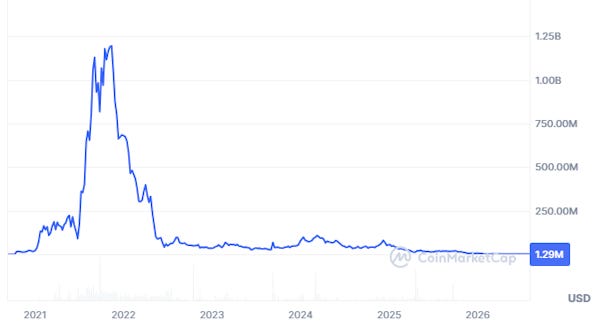
Like most protocols at the time, Perp.fi offered significant rewards to early liquidity providers. This worked well, especially as their token price jumped with their volume and open interest. Unfortunately, the presence of independent LPs, combined with Perp.fi’s naivety, led them to presume they had solved their liquidity problem. Most markets liaise with initial LPs and offer some informal privileges to align their incentives. Perp.fi’s LPs were more opportunistic.
The nature of their virtual AMM implied that the initial LPs who pushed the prices up in the bull market—standard arbitrage—were long. If they sold, they would push the price back to where they bought it, a bizarre bug that the clueless protocol designers thought was a feature. On centralized limit order books, perp LP/MMs/insiders are short, taking the other side of retail demand. In this protocol, the LPs were long, so they rigged the perp price so the longs would receive the funding rate. By setting the vAMM’s price just below the spot price, they gamed the system so that the shorts paid the longs, directly the opposite of what was happening on every other perp exchange in 2021, as crypto was booming and funding rates were well above 20%.
The perp longs were able to create a negative perp premium and a negative funding rate because the market makers/liquidity providers effectively administer this premium. Natural market demand has nothing to do with the average perp/spot price ratio; it is the market makers/liquidity providers who trade frequently who set the price. The price premiums were sufficiently small so that only an insider would care. This highlights the arbitrary nature of the perp premium.
The lack of market discipline in perps is best illustrated by the funding rate on BitMEX’s initial ETH perp. It highlights that retail traders are so eager to get 100:1 leverage that they will not mind being charged an extra 0.1% per day, even if that adds up to 100% over a year. When this was created in 2018, they still only received and paid out in BTC, so they took a notional bitcoin position and paid out the ETH return. They noted this was not a problem, as there is a word for such a product: the quanto.
The fact that there is a word for something does not mean that it is good. Given the BTC notional paying based on the ETH return, this led to a return included a covariance term.
RetETH * (1 + RetBTC) = RetETH + RetETH * RetBTC
The product of RetETH * RetBTC is the covariance between ETH and BTC. Thus, the return on the BitMEX perp is the return on ETH plus its covariance with BTC. BitMEX dominated crypto perp volumes from 2017-2020, yet almost no one mentioned this quirk in one of their most popular products. As with the old bucket shops, most customers are so eager to gamble that they do not care.
Nonetheless, obviously, BitMex insiders knew about this. Looking at their quanto ETH perp return and funding rate data from 8/2018 through 12/2025, you see the covariance term accounted for almost perfectly for the ETH perp’s gross return relative to the ETH return. The total return for their ETH contract was 111% without funding and 62% with funding, which was close to the ETH spot price's rise. The funding rate averaged 49%, and the covariance was 45%.
Annualized Data from BitMEX ETHUSD perp daily funding and return data
August 2018 – December 2025

This all makes rational sense. BitMEX has stated that its market-making desk’s goal is to break even. Given the boatloads of money they were making from their fees, they were not trying to cheat their customers, but to provide them with a way to gain leverage.
The interesting part is that while their quanto perp had an extra 50% annualized in its funding rate, representing the BTC/ETH covariance, no one cared. In 2018, BitMEX CEO Arthur Hayes wrote a blog post about the unusually high ETH funding rate and noted that, due to correlations, ETH was fairly priced. However, he never provided an explicit formula that would be simple enough to follow. The only other post I could find on this peculiarity was a 2020 post on the Deribit website, which featured one of my charts from a June 2019 blog post on the subject (alas, without citation of my post). I interacted with many in online forums, and the average user had no idea that the large funding rate was merely a technical offset for the covariance; they thought it was ‘real.’ If you can add 50% annualized to a funding rate for legitimate reasons and your customers do not complain or ask why, you can add a permanent 10% on average and be pretty certain you’ll get away with it.
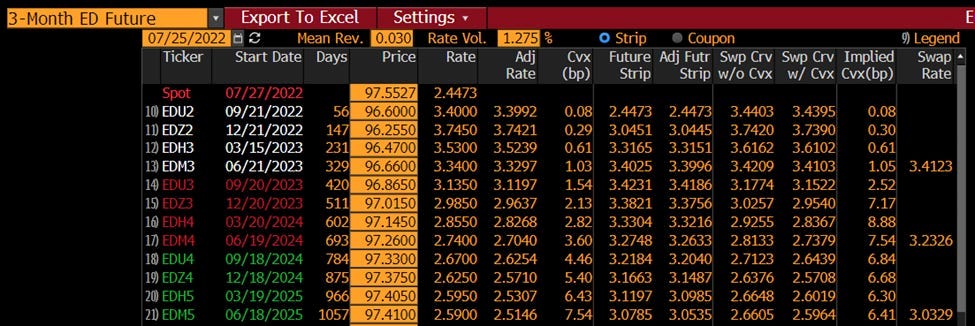
In efficient, open, unmanipulated markets, convexity adjustments are explicit once known. For example, the Bloomberg screen below shows the convexity adjustment needed when comparing Eurodollar futures with a Eurodollar swap. Before this relationship was understood, several large investment banks made actual arbitrage profits by going long futures and short swaps, as the convexity adjustment was not well understood. By 1995, however, a few prominent academic articles highlighted the arbitrage and noted the precise convexity adjustment needed. Ever since, Eurodollar futures and swap traders have built this convexity adjustment into the pricing models they use to compare the two markets, and arbitrage has equilibrated prices accordingly. BitMEX traders had no information panels like this Bloomberg table, just an obscure blog post containing a vague mention that correlations explain the funding rate, and my relatively unknown blog posts.
Bloomberg Eurodollar/Swap Page
BitMEX ETH perp traders were deceived, but fairly so. It was the ultimate victimless crime. There was not a peep from BitMEX traders about their strangely high funding rate. BitMEX insiders applied a funding rate adjustment that compensated for the covariance position ETH perp holders had but were unaware of.
This perp premium farce allows the perp insiders to reap extra returns whenever traders, who are generally long, sit on big profits. This is like when a bettor has won a lot; they have ‘house money,’ so they don’t mind giving a big tip to the dealer or making a frivolous bet. One can see this by looking at the funding rate and the prior 14-day return (see this 2022 paper for further documentation). In traditional financial markets, the primary stylized fact is that price changes are negatively correlated with the basis. Gorton, Hayashi, and Rouwenhorst document that historical spot-price changes, futures momentum, inventories, and the commodity basis are strongly related due to inventory effects. Inventory effects are irrelevant to crypto, but in any case, that correlation runs counter to what we see in perps.
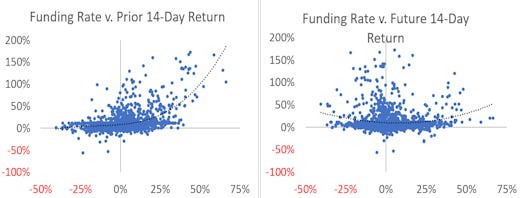
This past return-funding rate pattern has no reason other than a conspiracy. Notably, there is no symmetric funding rate effect on the downside: heads I win, tails we’re even. As the perp traders are getting gouged when they are highly profitable, they do not notice. Among crypto scams, this one is relatively benign.
When prices generate windfall profits to long perp traders, they do not mind 50% annualized funding rates the following day, which amounts to a mere 0.14% daily charge. As market makers are generally short perps, probably hedged with a long cash crypto position, this is a nice way to supplement their standard market-making profits.
When BitMex first proposed perps, there were no stablecoins, and a purely oracle-based price was not trusted. The perp funding rate mechanism provided a comforting story that arbitrage would set prices. Retail crypto traders were so eager to get leverage that they did not mind paying an extra 0.1% per day. With stablecoins, perps can and should be replaced by old-fashioned futures because those markets are disciplined by arbitrage, with spot and futures prices converging at expiry. US regulators should not enable and encourage perps because they have always been a hack and enable manipulation. The only reason to persist with perps over futures is the naïve belief that these markets are some great innovation, like the bitcoin consensus mechanism itself, and to confuse regulators.
Perp funding rates have fallen considerably since the early days, but they have never been held accountable for their prior gouging (charging well over 5% APY more than the US interest rate to go long). There is no sign of remorse. Trusting perp markets would be reckless, as it signals ignorance and duplicity. Why tolerate perps when a simple outright futures contract can eliminate it?
[1] “Keynes’s normal-backwardation mechanism requires an imperfectly elastic supply of speculative capital: with costless, complete-market participation, producer hedging pressure does not itself determine the futures risk premium (Hirshleifer 1990, 411, 422–423).”
No posts
Comments
Nothing yet. Say the first thing.
Sign in to join the conversation.