
So I wrote this a year and a half ago. We were, of course, in the midst of winter respiratory illness season.
Sadly, the beat goes on. Spring, summer, winter or fall, the system is inadequate.
Enormous new hospitals are everywhere. Urgent care centers and free-standing ERs are all about. Cancer centers spring up, imaging centers for CT and MRI are all about.
And yet, the sickest of the sick are simply left behind. And boarded in ERs awaiting admission in hospitals that are already full to overflowing.
Our patients are miserable. When they are stuck in the ER, sick, vomiting, feverish, in pain, it’s easy for them to feel angry and hopeless.
Likewise when they’re mentally ill, holding for admission in another town and feeling more and more depressed and suicidal in four bare walls and paper scrubs. I don’t want my patients to be uncomfortable or hopeless.
Now, I know that everybody is doing their best with what they have. But we need to do better for two particular reasons. And I don’t mean this on the level of the folks at the bedside, but at the level of the system and the administrations across the land. (Administrators who would never allow their own loved ones to languish for days in an ER.)
Which brings me to the second reason. I don’t want my colleagues, our physicians, nurses, PAs, NPs and assorted staff to feel hopeless and ignored.
People are leaving emergency medicine jobs. Every day they struggle to do what’s right and feel as if they’re banging their heads on the wall. They have inadequate staffing and inadequate rooms and leave home emotionally distraught.
This isn’t a ‘my hospital’ problem. This is a national problem. Heck, it’s an international problem. Canada, at least, is facing the same and I suspect it’s likely the same in the UK. (Any comments from experience are welcome.)
I am usually very encouraging about young physicians going into my specialty. But these days, for the first time in my career, I’m starting to wonder. It isn’t the ‘swoop in and save the day’ specialty emergency medicine once was. It’s becoming the ‘go back into the mud and slog around trying your best day after day’ specialty.
And I hate, hate, hate to say that.
So here’s my post, and it remains relevant today.
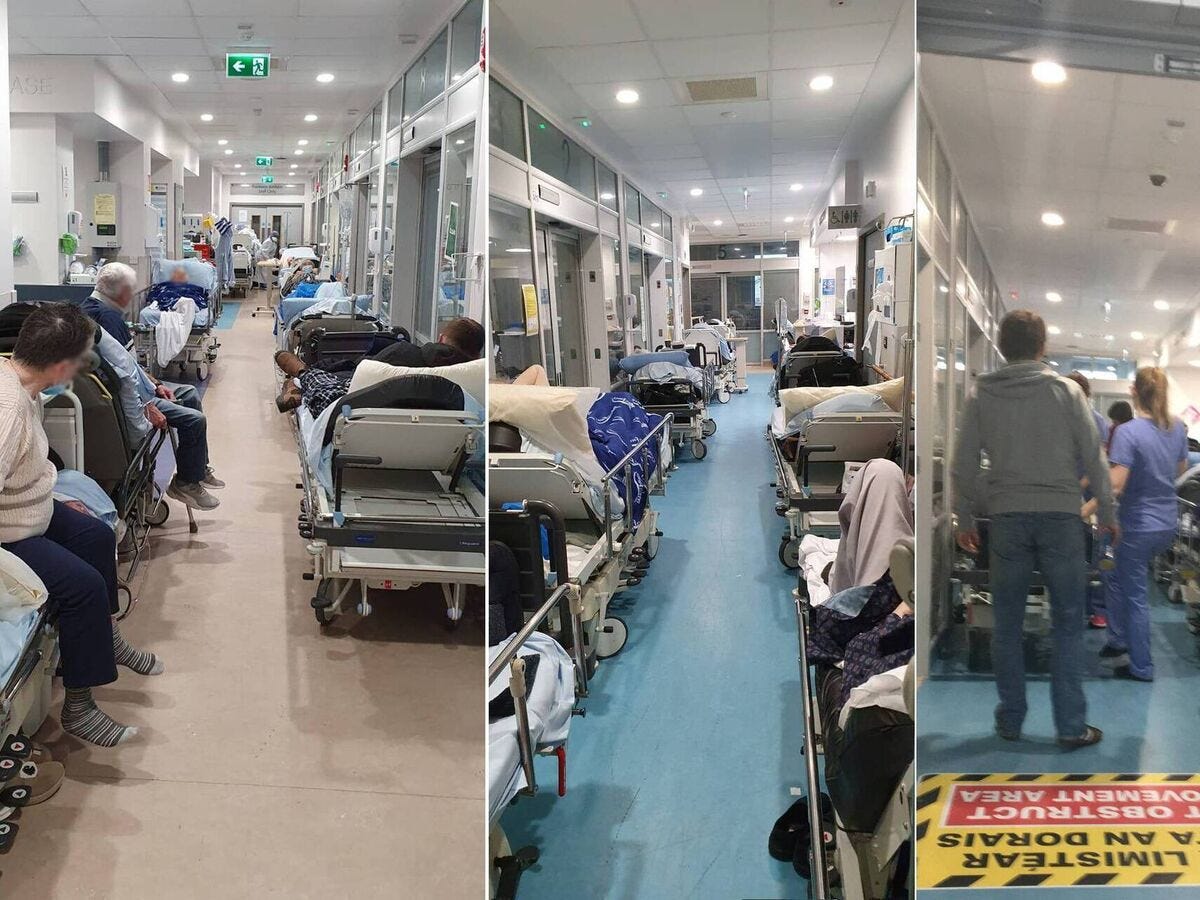
Last night when I came to work most of the beds in our 31 bed emergency department were full. There were about twenty patients either in the waiting room proper or in the chairs that serve as “rooms” behind the triage area.
Much of the problem was the fact that we were boarding patients who were waiting on inpatient beds, psychiatric admissions to transfer to higher levels of care elsewhere. By 2 am, I was the sole physician, along with a nurse practitioner, responsible for a department with about twenty patients, ten of whom were holds, along with 17 in the waiting room.
Now, there are places busier than that and there are always physicians seeing sicker patients somewhere else. Still, our acuity was high, including a critical patient who was intubated, receiving blood, vasopressors, sedation and antibiotics. The stack of EKGs performed on patients with chest pain grew thicker through the night. And all I could think as I looked at our tracking board was “this is just dangerous.”
Boarding is a problem across the country. It’s one of those frustrating, multifactorial issues that make modern emergency departments so miserable for professionals and patients alike. Research suggests that boarding is dangerous. The issue has long been on the radar of the Joint Commission. https://pubmed.ncbi.nlm.nih.gov/29570120/. In fact, JCAHO has suggested that ED boarding should be managed by boarding patients in hallway beds on the inpatient units. This of course is seldom met with enthusiasm by hospital management or nursing. The attitude was nicely summed up when I was trying to press for this earlier in my career, and the nursing supervisor said it was not going to happen. “Dr. Leap, when patients leave the ER, they expect to go to a better place.” That was a pretty honest assessment. It can be bad in the ER and it’s just expected. Deal with it.
But it isn’t just inconvenience for patients or difficult working conditions for staff. There’s a real human cost of boarding as boarded patients appear to have higher mortalities. So our patients wait longer and are less comfortable. They and their families are endlessly frustrated by the limited care they receive in the ER, it’s loud and frightening and to put the icing on the cake, they have an increased chance of dying. That seems like an issue we need to address.
So why is there so much boarding? The classic answer is that we have a nursing shortage which manifests as a bed shortage, so hospitals have no place to put patients. In addition, we have a shortage of nursing home and rehab beds and a surplus of people who need them. Therefore, patients who could be discharged aren’t. Also, hospitals keep beds open for post-surgery care. Which makes sense I suppose, as surgeries reimburse well. I think all of those are true. But I think there are other reasons.
For one thing, there are transfers. In a time when we’re all afraid of litigation, things that might be admitted to community hospitals are not, as physicians don’t feel comfortable stepping outside defined boundaries. These patients are typically transferred from the ER to other locales. Small to medium sized hospitals also have to send people out due to limited specialty resources, insufficient ICU beds, inadequate quantities of blood products or any number of reasons.
The crisis of mental illness and addiction also fills our beds. Psychiatric and shospitalizations are often difficult to obtain and the criteria for admission to them can be complex. It may have to do with insurance status, degree of aggression, medical co-morbidities or a patient’s prior history of being problematic (that is, ‘burned bridges’).
Patients brought or sent to the ER for nursing home placement also take up beds, and also can be in the emergency department for quite literally days to weeks. While necessary, the beds they take up are not available for acute care; they simply turn high speed, high tech departments into warehouses as the old and infirm await their own transfers to new living conditions.
Transfers can take anywhere from hours to weeks to accomplish as we wait for beds to open at the equally stressed referral centers. Then, once accepted, it can be an issue of transport. Ambulances and helicopters are not infinite resources. Patients may board simply because there’s literally no physical way to get them transferred elsewhere. A family member once asked, at a rural hospital, “what do you mean there aren’t any ambulances?” “I mean, ma’am, we just don’t have one available. Not until morning at least.” It’s a shocking thing to say and to hear.
Of course, the consequences of the boarding crisis go beyond frustration or even poor outcomes among those boarded. The chaos of a crowded emergency department, where staff are watching both new patients and boarded patients, can cause other downstream effects. It is exhausting, it is overstimulating and extremely anxiety inducing. Subject a professional to enough of this and they will absolutely find another job when they can.
Not only so, the attention and physical space required by the boarded patient causes the new patients to wait longer and longer in the waiting room. Privacy cannot be protected very well in chairs lined up in hallways, or fast-track rooms separated by curtains. (Two factor verification of log-ins aside…)
It’s difficult to do a thorough exam, it’s difficult to obtain labs or X-rays or to give any therapies with insufficient nursing staff in triage areas, or managing hallway patients. So, long-term boarded patients can, through no fault of their own, cause poorer care to the new and potentially very sick patients just beyond the entry way. It used to be sort of axiomatic that is someone signed left before being seen, they just weren’t sick. However that’s untrue. Very sick patients leave out of discomfort and exhaustion. No doubt, some of them die as well. But they aren’t included directly in the mortality increase caused by boarding.
The nurses and physicians, medics and techs, NPs and PAs I know don’t mind hard work. And they don’t mind sick patients. What they mind is being daily overwhelmed and having fewer resources and less space in which to do their jobs.
One of the great frustrations we have in emergency medicine is that we feel abandoned by administrations, both locally and at large. At the end of the day, new solutions are rarely offered and when five PM rolls around, the evening and night staff swim upstream as people continue to check in and need treatment, admission or transfer.
It seems that the very least our leaders could do would be to take seriously the issue of boarding. To use the parlance of recent years, the boarded, and those unable to be seen due to lack of beds, are all customers.
And we want happy customers, don’t we?
No posts
Comments
Nothing yet. Say the first thing.
Sign in to join the conversation.