
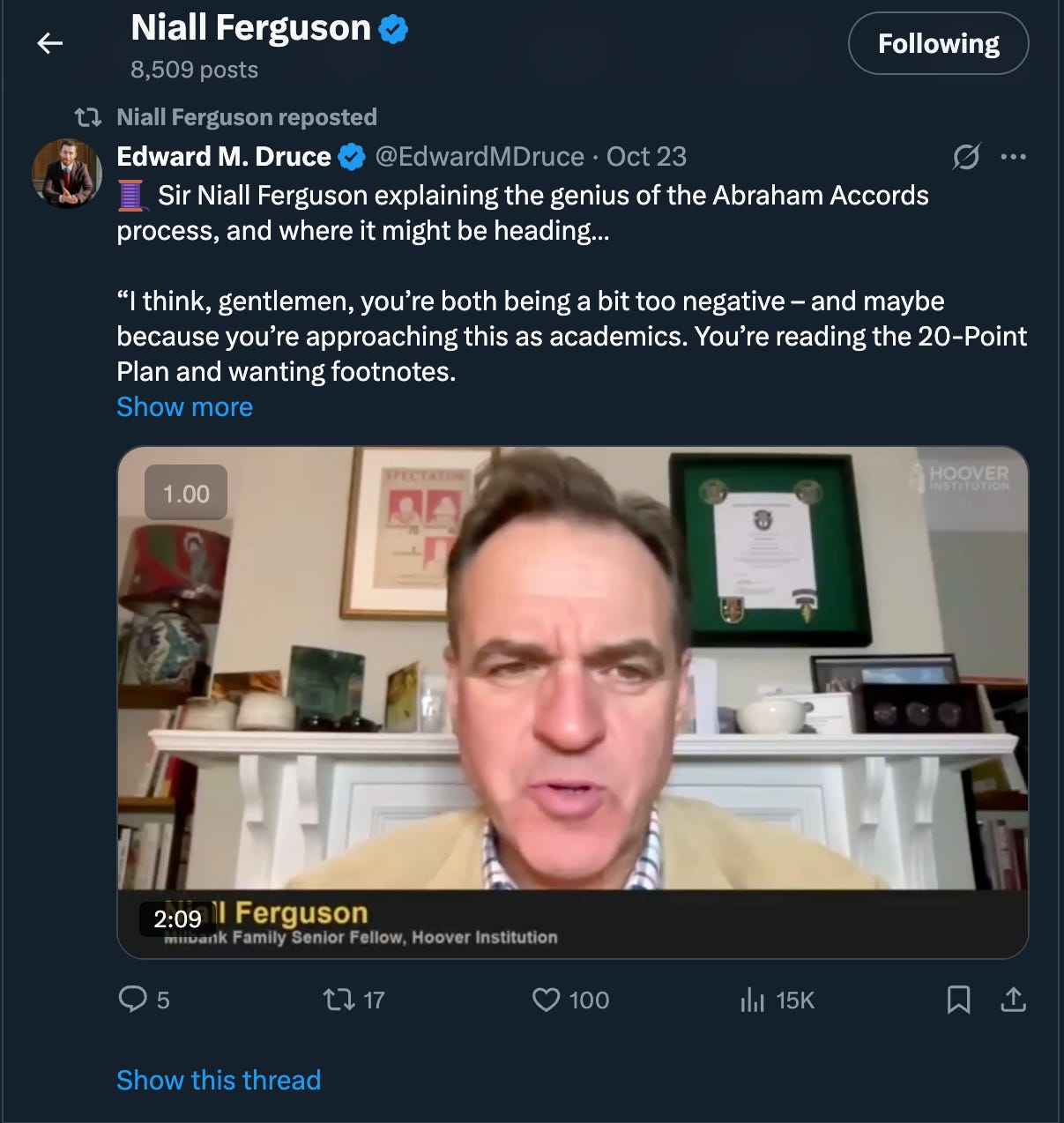
“I think, gentlemen, you’re both being a bit too negative – and maybe because you’re approaching this as academics. You’re reading the 20-Point Plan and wanting footnotes. But, of course, the architects of this plan are not academics. They’re real estate guys. They’re the ‘deal guys’, as Jared Kushner calls himself and Steve Witkoff. And the key here is to look behind the 20-Point Plan... and ask yourself: have the constellations of force changed in a way that is significant? I think they have. First of all, I think this plan extricates PM Netanyahu from a real cul-de-sac that he got into… His military option had boiled down to ‘occupy the whole of Gaza’, something that has been tried before without success. I think it’s important to recognize President Trump’s ability to put pressure on Netanyahu in a way President Biden just wasn’t able to do. More importantly, the US team were able to get the Qataris, in particular, to lean on Hamas to sign the agreement. And getting the hostages out is a major breakthrough. It’s not a trivial thing. It’s really the whole point. Because now the hostages are out, then there’s a very stark choice: Hamas can either cooperate with the terms of this agreement, or face destruction. And what have they got now? They don’t have any hostages – though they may have the corpses of the hostages they murdered. So I think it does change the situation quite profoundly.”
This quotation (and more that follows) is a transcript of Sir Niall Ferguson explaining (on last week’s Stanford GoodFellows podcast) the genius of the Abraham Accords process, and where it might be heading. It’s the best commentary I’ve read/listened to on the forces at play, by far.
Part two, which I might post highlights of tomorrow, gives a play-by-play of how negotiating leverage was created in the past month, among all Middle Eastern partners. Examining the levers that were used to pull this off is fascinating.
What does the name “Abraham Accords” actually mean?
From the first Abraham Accords treaty, normalizing relations between the UAE and Israel, in 2020 – beautifully put:
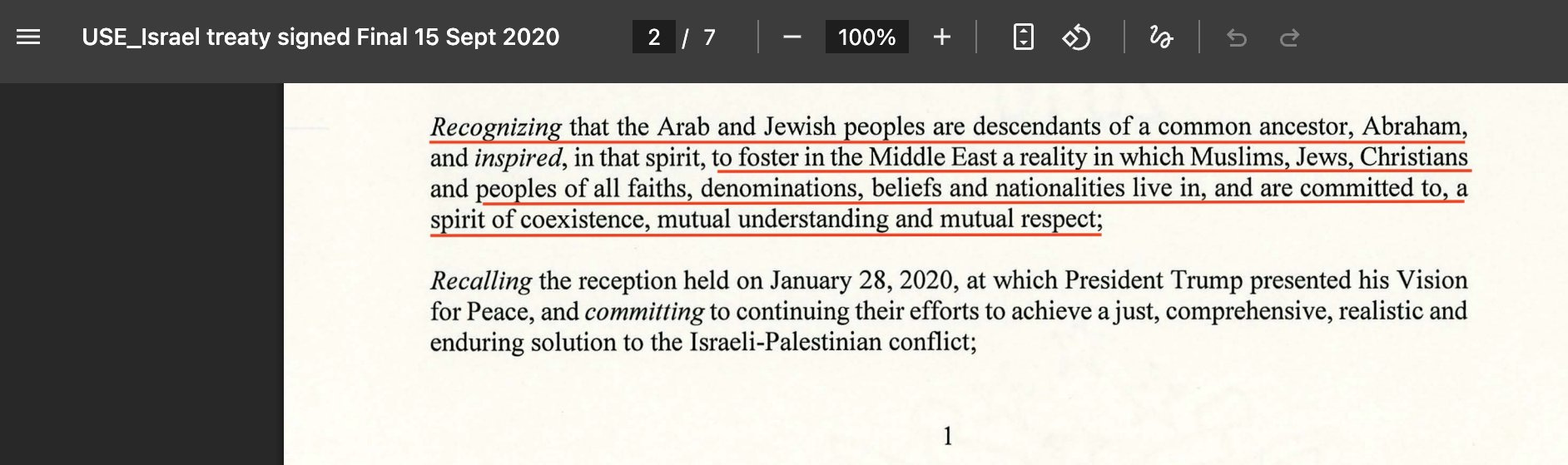
“Recognizing that the Arab and Jewish peoples are descendants of a common ancestor, Abraham, and inspired, in that spirit, to foster in the Middle East a reality in which Muslims, Jews, Christians and peoples of all faiths, denominations, beliefs and nationalities live in, and are committed to, a spirit of coexistence, mutual understanding and mutual respect.”
Back to Sir Niall:
“When Jared Kushner first became involved in the Middle East in the first term of the Trump administration, I remember discussing it with him… His plan was the economic revival of the region, taking advantage of the economic interests that united Israelis and Gulf Arabs. Gulf Arabs need to diversify away from hydrocarbons; the Israelis have technology as well as democracy going for them. That insight, when it was first proposed, was scorned by all the experts on the Middle East. I remember the sneering articles in The New York Times. I was one of the few people who said, ‘You know what, this actually sounds like not a bad idea.’ And I think we are seeing here the revival of that project that produced the Abraham Accords in the first Trump term, and gets the Gulf Arabs and Israelis into a better relationship with one another, and makes the Palestinians less central to the grand problem of peace in the Middle East. I think this is a really major breakthrough… It’s about getting the Abraham Accords process back on track. It’s a huge success for the real estate guys, and I think we should take our academic hats off to them.”
(I did write in March 2025, the morning Steve Witkoff’s interview with Tucker Carlson dropped:
Interesting Steve can’t recall the names of the four disputed Ukrainian regions. But this only proves the wisdom of Jean Monnet’s principle: In negotiation, you have to go for the “essence of the problem”. Details are not important, if you understand, and can align, high-level incentives. A real-estate developer is better suited to deal-making than an academic. This should not surprise people.
Steve is meeting with Putin’s special envoy, Kirill Dmitriv, today in Miami – so let’s hope further momentum of this kind can be created with Russia.)
Continuing on the Middle East:
“There’s a lot still to think about in the Middle East… I think the key thing was to stop Gaza being the focal point of all debate. Particularly because of the effect it was having in isolating Israel diplomatically. And that’s why it was so important to get something done in Gaza; to get the hostages out, and now I think Hamas is in a weak position. What happens if Hamas completely defies the terms of the agreement? …I think if they flout things that they’ve signed up to, they’re not going to get a lot of sympathy in Doha or anywhere else. And as President Trump said on social media, if Hamas doesn’t stick to the deal, then they can be destroyed. I don’t rule that scenario out.”
“What’s exciting to me about the vision that Jared Kushner had in the first Trump administration is that it’s not just something that a bunch of development economists at the State Department or the World Bank came up with. It’s an actionable business plan. And in the interregnum, when Joe Biden was nominally President, what was Kushner doing? Well, with Affinity Partners, he was building an investment fund – raising money from the Qataris and the Saudis, and investing that money in things like Israeli defense companies. Although that gets criticised, not least in The New York Times, because having left government you’re supposed to just kick your heels minding nobody’s business, in reality I think what has happened is that Kushner’s fund has deepened his ties in the region and shown that the Abraham Accords are a business plan, as well as a diplomatic solution to the problem.”
“I think the idea that you can get Saudis to invest in Israeli companies is really quite profound. It helps to be a historian here. In 1973… Israel was very isolated. It was a coalition of Arab states that went to war [against Israel]. Israel really only had the United States to turn to at that time. Moreover, that war escalated into a major economic shock that affected the whole world, because of the oil embargo imposed by the Arab OPEC states. We’re in a completely transformed world now, where the Arab states are in fact recognizing Israel one-by-one through the Abraham Accords, and then through private channels investing in Israel… When you compare Israel’s situation over 50 years, you can see how much better it is. There really has been a significant improvement in Israel’s position economically, militarily, and strategically. These are the achievements that sometimes get lost in the daily debates.”
“I’m an optimist that Israel will continue to be a place that generates innovation and attracts capital. And if that capital starts to flow from the Gulf, because the Gulf states realize that they can’t base their future on extracting hydrocarbons, then that seems to be the economic underpinning of the Abraham Accords process that Jared Kushner originally envisioned. Now, I mention him one more time because I think he has not received anything like the recognition he deserves. On the contrary, I think he has been the recipient of some of the nastiest press that I can think of being directed against a public individual in the last 10 years. But if you read his book Breaking History [my review of it here], which is really very good, I think it gives an account of where the Abraham Accords came from as a project, and all the different people who played a part in making it happen. It’s this capacity to get people – particularly in Saudi Arabia, the Emirates, now more recently in Qatar – to realize: there is a path forward. That the path to peace lies through economic interaction with Israel is the real genius here. And I do think it represents a paradigm shift. We used to think solutions in the Middle East would come from diplomats, or academics, coming up with elaborate plans, and then development funds being brought in. To think about this as something that the private sector can drive – I think is really, really new. Despite all the criticisms that are directed routinely at President Trump, he has been able to achieve what eluded Joe Biden. And I think would entirely have eluded Kamala Harris if she’d become President.”
*
If you enjoyed this, please share the X thread version (with video) here:
https://x.com/EdwardMDruce/status/1981327785269325934
I also very much appreciated this from Niall’s colleagues at Stanford/Hoover, on the same podcast:
John Cochrane: “Trump has really scored some pretty amazing foreign policy successes, and yes, it turns out that if you know how to negotiate with the unions and the zoning board in New York, you’re pretty well-placed to negotiate with the Arabs and Hamas; better than the professors of the Kennedy School.”
Russell Berman: “Whether that paradigm shift in the Middle East has international implications: is the world going to be doing business by doing business differently going forward? What sort of professional is going to be operating in the negotiations of the future? Will it be the Harvard Kennedy School? Or will it be the Harvard Business School? Will it be conceptual idealists? Or will it be hard-nosed businessmen?”
Extremely good question.
*
My summer 2023 review of Jared’s book – following recommendation by Dominic Cummings – with highlights of the best deal-making lessons; precisely how Jared began this process:
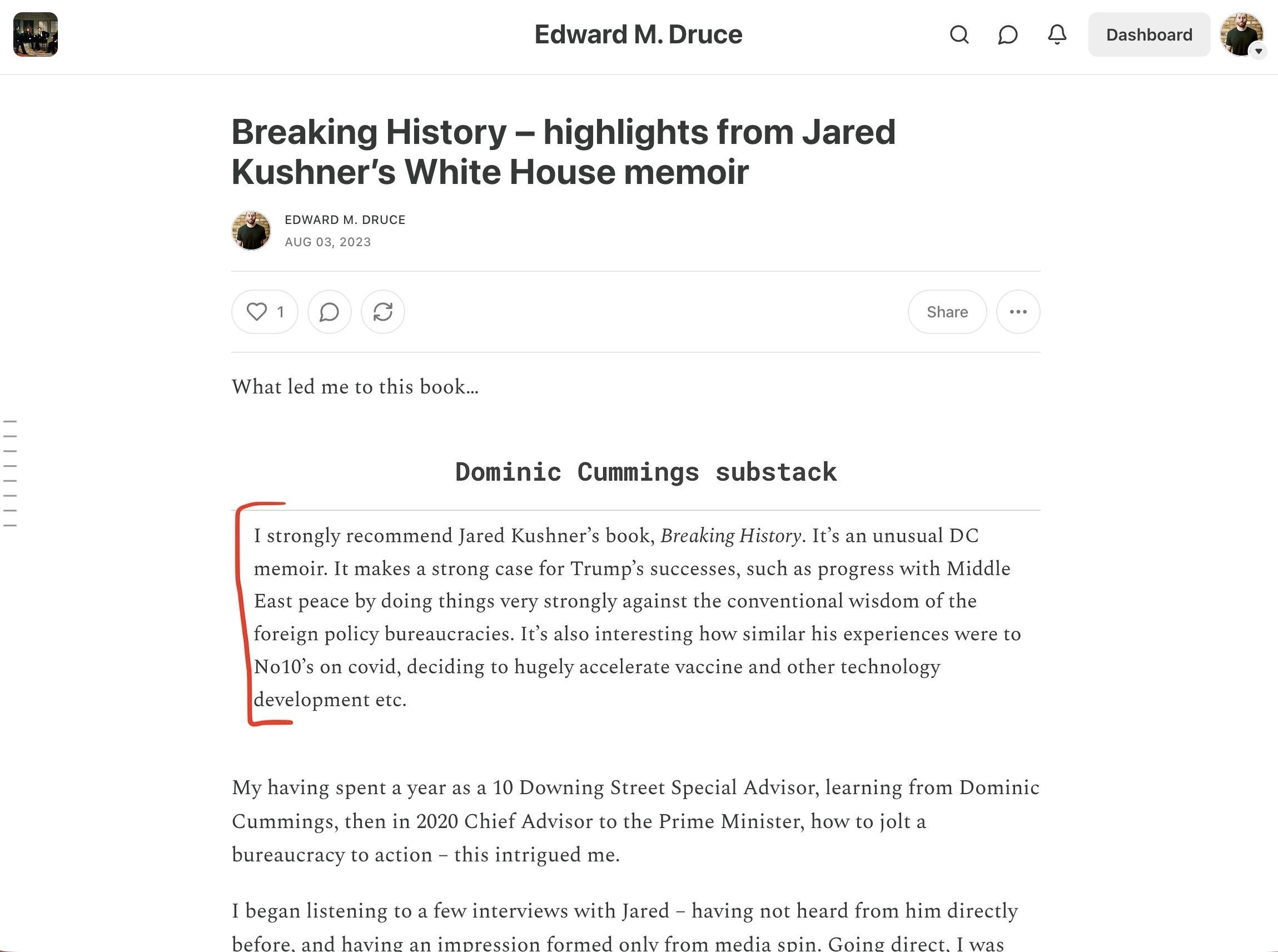
Dominic Cummings: “I strongly recommend Jared Kushner’s Breaking History… It makes a strong case for… doing things very strongly against the conventional wisdom of the foreign policy bureaucracies.”
Link here to my summary of the book.
PS. Skirmishes following a ceasefire are normal.
In 1953: “Eisenhower said that the [Korean] armistice was not the culmination, but the beginning of peace in Korea. The president noted that there was much more work to be done.”
Eisenhower: “Throughout the coming months, during the period of prisoner screening and exchange, and during the possibly longer period of the political conference... we and our United Nation allies must be vigilant against a possibility of untoward developments, and as we do we shall fervently strive to ensure that this armistice will, in fact, bring free peoples one step nearer to their goal of a world at peace.”
“It was also a very imperfect ceasefire with lots of skirmishes and such.” [Now enduring 72 years and counting.]
Skirmishes are to be expected. No surprise when they happen.
No posts
Comments
Nothing yet. Say the first thing.
Sign in to join the conversation.